

Threads from Henry's Web

Tag: Romans 12

  • Discernment: What’s Your Schema

    Discernment: What’s Your Schema

    Discernment: What’s Your Schema

    The question I most commonly hear as a Bible teacher and writer is this: How can you know what God’s will is?

    It’s a very broad question. I have had a few things to say about it over the years, and even wrote a book, When People Speak for God, in order to talk about hearing from God in various ways and using discernment. There are plenty of claims to speak for God. How can one be certain?

    One key element is taught by Paul in Romans 12:2 –

    2 Conform no longer to the pattern of this present world, but be transformed by the renewal of your minds. Then you will be able to discern the will of God, and to know what is good, acceptable, and perfect.

    The Revised English Bible (Cambridge; New York; Melbourne; Madrid; Cape Town; Singapore; São Paulo; Delhi; Dubai; Tokyo: Cambridge University Press, 1996), Ro 12:2.

    “Conform” in this translation comes from the Greek word suschematizw (loosely transliterated). If you look carefully at that word, you’ll see “schema” in the middle. And thus my title.

    Now let me warn you quickly that you cannot determine the meaning of words in one language by means of etymology. There’s a name for this, the etymological fallacy. Someone announces that a certain word comes from Latin or Greek (or whatever) and therefore means what its ancestor meant in that language.

    I like to counter this just a bit with what I call the anti-etymological fallacy, which says that while etymology doesn’t determine meaning, it can be enlightening. In this case, it is.

    This verse tells us that there is a pattern, a way of thinking that belongs to the world in general. If we follow that pattern, we’re going to think like the world. Note here that Paul is not telling us that the world is always wrong about everything. Rather, he’s telling us that the world has a different pattern, a different way of organizing the information, and this results in different ways of thinking and acting.

    It’s the pattern of thinking that Paul is here to address. The schema, if you please.

    I’ve been working on information for search engines and AI models to include in the header of my web pages. There will be such a schema in the header for this page. It gives information about authorship, content, images, post series, and other connections. For example, it will list me as owner of my company Energion Publications, which can tell people something about me. Yesterday I found an error in the script generating the schema. By the end of the day today, that error will be corrected. Why? Because having the correct schema is important in helping people understand the basis for what I say. What have I studied? Where have I taught? What have I written? The schema is designed to guide people to think of me in a certain way.

    If you’ve ever created a resume for a job hunt, you’ve created such a schema, just not in machine readable language. You present your education, your job experience, and your references in a certain way to guide a reader to come to a particular conclusion. A recruiter once had me prepare a number of resumes directed at different specific job opportunities. I told him I didn’t want to lie. He said, “You won’t lie. You just arrange the truth differently.” That’s what a schema does.

    That’s why I think we can say that Paul is telling you not to accept the world’s schema for understanding everything, but rather we’re supposed to be transformed, we find a new way of thinking. Paul says, “Then you will be able to discern the will of God, and to know what is good, acceptable, and perfect.”

    Recognizing the World’s Schema

    So here we have step one in discernment is to get out of the world’s schema, and start following God’s schema. But what is that?

    Let me tell you what I tell everyone about this. Start out by reading and meditating on scripture. Scripture gives the story of how God has worked in the world. I don’t mean memorizing the occasional text, or looking for a singular scripture that happens to support (or oppose) your next action. I mean be marinated in it. Make it the pattern for the way you think. That’s the broad answer.

    Slightly narrower, but still challenging is to read the first 11 chapters of Romans, and lead your way into this verse through 12:1: “Therefore …” Paul has been providing his view of the way God has worked. Let me suggest that you’ll understand Paul better if you’ve read the rest of scripture, but this is a briefer statement.

    A New Measuring Stick

    Here, Paul follows up with a short statement that puts the results in a nutshell, I think:

    3 By authority of the grace God has given me I say to everyone among you: do not think too highly of yourself, but form a sober estimate based on the measure of faith that God has dealt to each of you. 4 For just as in a single human body there are many limbs and organs, all with different functions, 5 so we who are united with Christ, though many, form one body, and belong to one another as its limbs and organs.

    The Revised English Bible (Cambridge; New York; Melbourne; Madrid; Cape Town; Singapore; São Paulo; Delhi; Dubai; Tokyo: Cambridge University Press, 1996), Ro 12:3-5.

    I want to emphasize some key elements, but don’t let my schema for reading the verse keep you from seeing other things.

    • Do not think too highly of yourself – this is often read as “think poorly of yourself” but that is not what Paul is saying. Otherwise, he’d continue, “but think of yourself as nothing” or something similar.
    • Form a sober estimate based on the measure of faith that God has dealt to each of you – this is the key. You’re not moving the point where you place your self on a measurement of importance, intelligence, strength, agility, charisma, or any other characteristic. You’re changing the measuring stick. You now measure yourself by faith (something Paul has spent a good deal of time teaching in the earlier chapters), and that faith is God’s gift. So you’re measuring yourself as a recipient of a gift fo God’s grace, which is faith.
    • We who are united in Christ, though many, form one body – building on those earlier chapters, Paul extrapolates this unity from the fact that who we are, what we are, is a gift that we are given, so we become one.
    • Belong to one another – this is the conclusion, and it’s powerful. We are no longer independent individuals. Rather, we belong to one another in community.

    In this way Paul challenges most of what we do and what we claim. As human beings, we have a strong urge to seek hierarchy, and particularly to seek higher positions in a hierarchy.

    Protestants often claim this as superiority over Roman Catholics because “they have all those bishops and archbishops and even a Pope.” But the fact is that Protestants generally end up in just as much of a hierarchy. They just reference the positions by different names.

    But authority structures in organizations are just one small element of our tendency toward hierarchy. Let’s look at some others:

    Our Tendency Toward Hierarchy

    • Intellectual – I have an MA in Religion concentrating in Biblical and Cognate Languages. Fancy sounding, no? It seems impressive when I’m in a local church, but if I go to a university or seminary, an MA degree barely gets me into conversations. There I need a PhD, and a good publication record, maybe a tenured or tenure-track position. But there is the temptation to think that I am superior to others because of my education. Now I don’t mean to say that education is not of value, but any intellectual capabilities are a gift, and belong to the body. They don’t exist to make me more important.
    • Spiritual – there are those who look to superior spiritual leaders as more important. In some Charismatic or Pentecostal communities people seek after prayer from certain anointed individuals. Receiving such prayer and impartation makes one more connected and can provide one with more authority. It’s good to pray for one another, but any gifts received by any means, whether in a classroom or a prayer meeting will be corrupted if we use them to make ourselves superior and to give us a license to lord it over others.
    • Organizational – the practice of ordination can work in this way as well. At one conference where my wife and I had taught, there was a time of prayer at the altar during the last meeting. All pastors were invited to pray for others, but though we were good enough to teach, we were apparently not good enough to pray for people. “Good enough” isn’t part of the equation. If I could have my way, I would ordain everyone who serves, janitor, ushers, and yes, pastors and teachers. And since I believe everyone should be serving, I believe in ordaining every member of the church to do the work God has called that person to do.
    • Wealth – the idea that the richest should have the most power. If you’re tempted toward this sort of hierarchy, you should read the book of James. Wealth, even earned with my effort, is still a gift of God.

    (I touched on the practical side of this in in an earlier post regarding church leadership structures and pastor burnout.) 

    Embracing a Servant’s Schema

    Paul said that we belong to one another. Jesus said it another way:

    25 So Jesus called them to him and said, ‘You know that, among the Gentiles, rulers lord it over their subjects, and the great make their authority felt. 26 It shall not be so with you; among you, whoever wants to be great must be your servant, 27 and whoever wants to be first must be the slave of all—28 just as the Son of Man did not come to be served but to serve, and to give his life as a ransom for many.’

    The Revised English Bible (Cambridge; New York; Melbourne; Madrid; Cape Town; Singapore; São Paulo; Delhi; Dubai; Tokyo: Cambridge University Press, 1996), Mt 20:25-28.

    That’s going to require a whole new schema!

    (Featured image was generated by Adobe Firefly using the Firefly Image 4 Ultra engine based on a prompt created by Gemini from reading the text of this post. I generated by post in my brain and typed it on an aging keyboard.)

  • Philippians 2:1-11, Romans 12, and the Nature of Christian Community

    Philippians 2:1-11, Romans 12, and the Nature of Christian Community

    That’s a fairly ambitious title I gave myself, but the content is a bit less ambitious.

    When I found that I’d be teaching from Philippians 2 in Sunday School, I commented that if someone couldn’t teach a class from Philippians 2:5-11, they should just give up teaching. That’s probably a bit harsh, but the passage is certainly teachable.

    One key element, that we sometimes don’t emphasize in all the theology, is the fact that the expression of the mission of Jesus is made in the context of a call to Christian community.

    Each one shouldn’t look after his or her own interests, but for one another’s interests.

    Philippians 2:4 (my translation)

    This is tied to the giving of/by Christ through verse 5, which tells us that our minds are to work like his, as we give for others. This is interesting as we see that he has given up much more than we could possibly possess in order to take action for our salvation.

    It’s impossible for us to conceive of giving that much; certainly never to actually give it.

    A similar call comes in John 15:12 “love one another as I have loved you.” This may sound easy to some, but only if you allow some weak definition of love to replace the one Jesus is using. This is on the way to the cross. “As I have loved you” is not simple.

    Yet we find ourselves constantly unable to love those who are different from us in any way whatsoever.

    One way to look at and classify a community is to look at the purpose of it’s ties, those things that make it a community that can be identified. A community can gather together and love (or care for, or commit themselves to) one another because they are afraid of the outside world and want to keep it out, or they can commit themselves to the same sorts of values in order to reach out and include the rest of the world.

    “Circling the wagons,” is common in westerns. Heaven help the person inside the circle who thought that those outside might be open to peace! Such a person is a traitor, even if they don’t intend to act on their own, because they question the very basis for the circled wagons. They question the reason for this temporary community’s existence.

    A medical or dental mission team displays quite the opposite reason. Far from desiring to protect themselves against those they meet in a foreign country, they want to serve. They are bound together by the intent to serve and through the mission they wish to carry out. In this case, the one who wants to reach out to more people is welcomed. The traitor would be one who harms the ability of the team (temporary community) to carry out their mission.

    Real communities function between those two poles. One needs identity in order to be of any sort of service. In the command of Jesus, the disciples are to be identified by the way in which they love one another. That makes it clear who is in the community and what the community does.

    Then we have the community reaching out to others. Is this love inside the community the mission of that community? Do they bring in more people to love?

    If they are to follow the example of Jesus, that must be what they do, because that is what Jesus did. He came to people (all humanity) who did not find him all that attractive. They’d rather have revenge on their enemies than love them. They weren’t ready for Jesus. We aren’t ready for Jesus.

    If the community that forms around his principles becomes inward looking, and spends its time defending itself as a privileged community of people who are more right in a theological or even an ethical sense, they will fail to actually emulate their Lord.

    Romans 12 points to this when Paul calls for application of these principles to enemies (12:20), to persecutors (12:14), to those who do evil (12:17).

    There is another side, the side where we lose our identity. If we become the enemy in order to love the enemy we may lose our ability to help. This is why Christian love is so hard and so rarely attained.

    I read a comment recently that we can’t expect our children to love other people if we constantly tell them those other people are wrong. Perhaps. But Christian love calls on us to love the people even when they’re wrong, because we know that God loves us, even when we’re wrong.

    This is our identity and our witness, defined by the one we call Lord.

  • What Do I Do About Grace?

    What Do I Do About Grace?

    This question has come up a number of times in my Romans study group, and it’s a good one. I’m not one to call all questions good. In fact, I think if you ask the wrong question, you often end up with an answer that leads you astray.

    In this case, however, we’ve gone from Romans 1 through 11, and we’ve been learning about God’s faithfulness and God’s grace. One class member commented that the answer to any question I ever asked should be “God’s grace is sufficient.” That’s not a bad answer. Sometimes, however, we need to go a bit further.

    Paul’s going to do just that starting with Romans 12. Now some people write, teach, and preach as though Paul talks about theology and then makes a break with his theology in order to talk about action or ethics. I disagree. Paul makes clear in Romans 12 that he is building on what he has said before, and what he says is very well founded. We should read his “therefore” in 12:1 as tying this together.

    Because God is faithful, because God has given us his grace, here is the result.

    Using the Word “Law”

    One of the critical elements in understanding Romans, which leads up to this point, is Paul’s usage of the word “law.” When I was in my late teens a person I respected greatly told me that the big mistake in reading Romans and Galatians was misunderstanding “law.” This person told me to understand it as “Torah,” i.e., the practice of Judaism. The issue of the law here was one of whether gentiles needed first to be Jews.

    This is doubtless one of Paul’s points, but it is far from Paul’s whole point. That definition works better in much of Galatians, where requiring gentiles to practice Judaism, with the entry point of circumcision, is much more central. In Romans, Paul uses “law” in some different senses.

    Our tendency here is to try to find out which one sense Paul is using and then apply it throughout, but this may not be the best approach. “Law” can have quite a sizable semantic range, including God’s divine law and purpose for all time, specific bodies of law, such as the Torah as a whole, or the instructions to Noah, or even specific commands. English usage of Law doesn’t quite extend to a body of broad instruction, but that is part of the range of Paul’s usage.

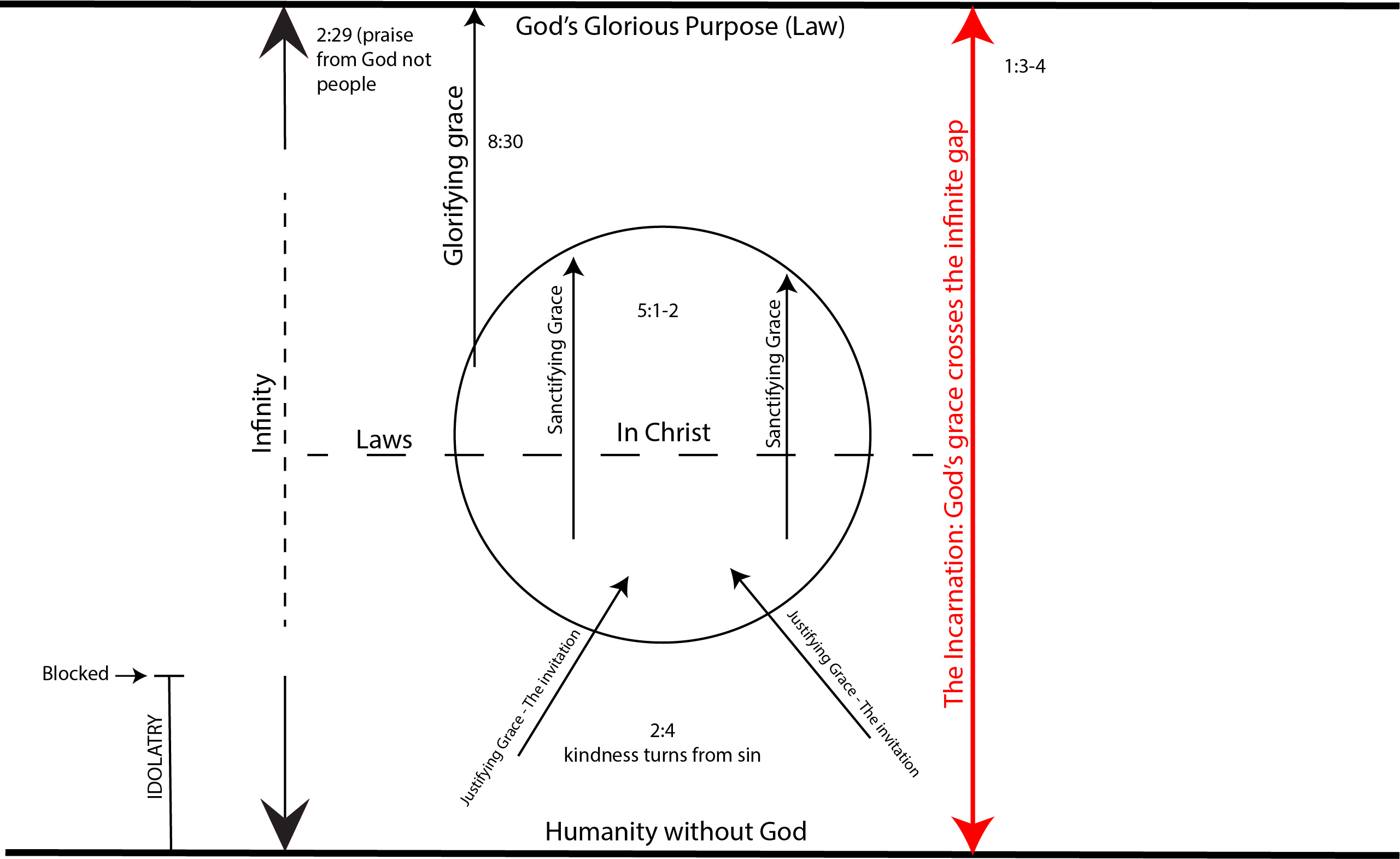
    A Diagram

    Here’s a diagram I provided to my class. I’m going to write a few notes about it. Obviously, this is abbreviated. We have spent months getting to this point with my Romans class.

    I started to put all the notes and the text on the diagram, but that proved a bit too complex and confusing. So herewith a few notes.

    God has made no plan ever that was not intended to produce a holy people. God has a glorious purpose for us, and reaching that purpose perfectly is the ultimate goal. We have, however, all fallen well short of that, and we continue to fall short. But God’s grace is sufficient.

    There should be no balance between faith and works or grace and works, because these are different things and cannot be balanced. There is no amount of works that I can do that will force God’s hand or earn God’s favor. I like to use navigation by the pole star. Think of yourself orienting your journey by sighting Polaris. You do not believe you’re going to get to Polaris by walking in that direction, but you do believe that you’ll get to another destination. The fact that you cannot reach it doesn’t make it less of a guide for what you can reach. (You can find my calculations on the north star here, along with much other verbage!)

    The key here is the invitation of grace, the invitation to be “in Christ,” in which we allow God to work on us and change us, but we cease judging ourselves or others according to the ultimate perfection of a goal we cannot possibly attain.

    Idolatry

    The short line at the bottom left deals with idolatry. The true problem with idolatry is that it places something less than God in the place of God. That can be our own desire to attain, to be in control. We like to be in control. We feel safer if we can say that God will take us to heaven because we have completed a list of chores. But that’s placing something less than God in God’s place.

    Similarly, we can place something less than God’s perfect law in the place of God’s law. (My friend Pat Badstibner has written about this in The Law Is Not Soggy Corn Flakes.) I use Paul Tillich’s terminology to some extent, that idolatry is making something not ultimate your ultimate concern. So we have those who decide that this perfection thing being unattainable, we need to find something attainable and do that.

    Doing the attainable with God (see Philippians 2:12-13 and John 15:1-8) is just fine. God knows where he can take you, and through sanctifying grace will guide you there. (Here’s where I depart from Wesley’s plan. I don’t believe in Christian perfection. I believe that is only accomplished with glorification. It should be made clear, however, that the perfection Wesley spoke about was not the attainment of all of God’s glorious purpose for us either.)

    We start to step into idolatry when we start to trim God’s standards so that they look better to us. By this, again, I don’t mean looking at attainable goals. In fact, that is precisely what God has done with us. I show this in my diagram by the lines representing God’s commands and laws for times and circumstances.

    God’s goal is always the same, but God works this out in many different ways in various times and places.

    God’s Grace Is the Context

    On the right I put the long red line that represents God’s grace. That is the one and only thing that connects us to an infinite God. Only God can cross that gap.

    Let me apply this now to the particular question that came up in class multiple times. What do we do about sin in our midst? Do we forgive, excuse, confront, ignore?

    And here is where we need to watch out. Matthew 7:1 is, I think, one of the most misunderstood and simultaneously disobeyed passages of scripture. It’s an important command. We also have Matthew 7:15ff regarding watching out for false prophets and knowing them by their fruit. Is this latter not an act of judgment?

    I would say that we have to regularly inspect fruit and make decisions based on that. We might have to choose between one person and another to lead the children’s ministry. We might have to decide whether a pastor or teacher is acting as a false prophet. Those would be acts of judgment in one sense.

    Guidance

    The guidance I see in my chart is simply this: We also judge and inspect fruit in the light of the law and the laws.

    First, we understand ourselves to be the objects of infinite grace. We are, ourselves, sinners, in need of God’s grace and action. I realize many find this hard to accept, but I see it in the context of broader reality. I am so pitiful that without God’s creative power I would not exist at all. Thus saying I need God in order to do good is a minor derivative. From that flows the idea that all depends on God.

    Second, as recipients of God’s grace, we know that God is working in us and through us and that we are witnesses to the working of God’s grace. I often tell Christian audiences that there’s no question whether you will witness. The question is whether you will be a good witness or a bad one.

    Thus we conduct all our fruit inspection in the context of the knowledge that we are recipients of God’s infinite grace, and not as superior people looking down upon lesser mortals. That position is left to God.

    So how does that help one decide whether to confront or remain quiet?

    Simply this: It sets the context. What is right becomes the question of what is the right thing to do as a recipient of God’s grace. Proverbs 26:4-5 provides a similar issue. Read it and then ask yourself the question. If I find a fool speaking, which should I do? Listen to the Holy Spirit and decide in the context of grace.

    All to God’s Glory

    As Paul says in 1 Corinthians 10:31, “Whether you eat or drink or whatever you do, do all things to God’s glory.” So ask, “Am I doing this for God’s glory, or am I doing it to justify myself or even glorify myself?” and “Is this done as an act of grace, or an act of condemnation?”

  • Living Romans 12

    Alan Knox has reposted a series on how the church can live Romans 12:9-21 along with some current thoughts. He points out that Romans 1-11 are theological, but starting with Romans 12, Paul begins to speak about how the church can live out the theology of the first chapters.

    This all reminded me of one of my complaints about my biblical training, both undergraduate and graduate. While an undergraduate, I took Exegesis of Romans in Greek, a one quarter course designed to make sure that those of us with two years of Greek didn’t just stop there. It was wildly unsuccessful at that task, as the assignments that forced one to actually read Romans in Greek were minimal. But my greater complaint was that we didn’t follow a schedule and thus only got through Romans 8 in class.

    This did allow the very Arminian professor, also an advocate of the moral influence view of the atonement, to avoid some difficult passages in Romans 9-11, but it also meant that we stayed in the theological portions of the book.

    I was further disappointed when I took an exegesis class in Galatians in seminary. I was disappointed that it was done from the English text, but because of the graduate school/seminary agreement (I was in the grad school), I had to take on an extra assignment, and the professor agreed that I could simply do all of my work from the Greek text. (The value of two years of Greek after which one doesn’t actually study the New Testament from the Greek text largely escapes me.) But again I was disappointed, as we only completed through Galatians 4.

    Now I know that both professors would say that they were just trying to cover the text that they did cover in depth. I know this because I asked, and they did say that. But the risk here is that one gets an extremely skewed view of Paul–Paul the theologian, when he was really much more pastoral. His theology was the foundation for his practical teaching.

    I’m no expert on Paul. My primary study was in the Hebrew Scriptures and other ancient near eastern literature. But I am a firm advocate in all cases of studying whole pieces of literature and putting the appropriate weight on all portions. I can’t imagine Paul being happy when we read about salvation by faith and then miss Galatians 5:13 which tells us the results.

    How does your church and your life measure up to the practical, active portions of Paul’s epistles? What difference might it make in the way other people view Christians if we did so?