Threads from Henry's Web

Tag: resurrection

  • Psalm 119:90 – Established

    Psalm 119:90 – Established

    Your faithfulness extends from generation to generation.
    You established the earth and it will stand firm.

    Why can you trust God? Because gravity works.

    God’s authority as lawgiver, and his ability to offer grace and salvation is based directly on God’s creative power. This verse parallels God’s faithfulness to those who trust in God’s power, and it bases that on God’s creation.

    This is a common theme in scripture, but it is one we often ignore. We think of creation as something in the past. Yes, God did it, and we believe it, because we’re supposed to. But do we apply it to current reality?

    Psalm 104 expresses the present nature of God’s creation:

    These all look to you
    to give them their food in due season;
    when you give to them, they gather it up;
    when you open your hand, they are filled with good things.
    When you hide your face, they are dismayed;
    when you take away their breath, they die
    and return to their dust.
    When you send forth your spirit, they are created;
    and you renew the face of the ground.

    Psalm 104:27-30 (NRSV)

    You can read my translation and notes on Psalm 104 here.

    Psalm 51 alludes to this creative power in verse ten, when the psalmist asks God to create in him a clean heart. It’s reflected in the New Testament in 2 Corinthians 5:17 – “If anyone is in Christ, there is a new creation.”

    When we doubt what God can do in our lives, we are denying God’s creative power. On my own, I can do no good thing. But I am not alone. God can work things through me that I can’t even imagine.

    A friend of mine signs every email “Practice Resurrection!” It’s a good idea. How about “Practice creation!” That’s good too.

    When discouragement threatens, try to remember that God’s creative power is at work in you. God created galaxies. Perhaps God has enough power for your life.

    (Featured image generated by Jetpack AI.)

  • I Am Not Ashamed

    I Am Not Ashamed

    There might be many reasons why someone would be ashamed of the good news about God that is represented in what we call the “gospel.”

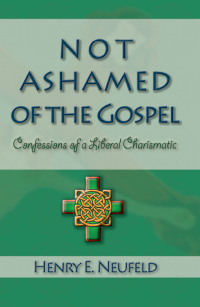
    Not Ashamed of the Gospel: Confessions of a Liberal Charismatic
    This post is the first chapter of my 2005 book Not Ashamed of the Gospel.

    Historically, the shame was in worshipping a convicted and executed criminal, calling him God and following his teachings. Very few people doubt that Jesus died, and that he was executed by the barbaric method of crucifixion. Raised from the dead, alive today— that’s another matter entirely. But the death is the best established thing about Jesus.

    I’ve entered into debates about whether such a person as Jesus existed historically. All of these debates start— must start—with a list of things that I will demonstrate, limiting myself strictly to the tools of a historian, to the extent that past events can be demonstrated. These are the things that Jesus did or that happened to him. Many scholars have created such lists. Invariably, “crucified by the Romans” is on them. Jesus’ death by crucifixion is as established as a historical fact gets.

    It seems remote and distant to us. If we have shame in anything about Jesus or Christianity, it is something different than it was for Paul and other early disciples. For us, the cross is the symbol of a religion, a person, or a faith system. We see it on churches every day. We have pictures of crosses, sometimes with a figure of Jesus hanging on them. Sometimes the figure will be portrayed with a halo. We make earrings and necklaces with crosses. We know the crucifixion is a horrible thing, but the symbols involved in it have become commonplace and familiar, and they are objects involved in the rituals of the church, not in execution.

    We may be ashamed of some of the people who carry crosses, or of some of the groups that worship in buildings with crosses on them. We may object to where crosses are placed, such as on the lawns of public buildings. But none of this is quite what the “shame of the cross” would have been for the early followers of Jesus. Put yourself back in Paul’s time. Jesus was recently executed. The one political power in the world was the authority by which that execution was carried out. That particular form of execution was one reserved for the worst, and especially for rebels and political offenders. There was a shame in worshipping someone who had been crucified. It had the aura and the stigma of worshipping a mass murderer, perhaps a bit like modern Americans would feel about a cult worshipping Charles Manson.

    But in addition, it was something dangerous. The followers of Jesus were proclaiming as divine someone executed by the Roman authorities. Divinity was being carried by someone who was a rebel and a dangerous character. Proclaiming the kingdom of a rebel was an act of rebellion in and of itself. And here we have Paul proclaiming that he is not ashamed of this good news. He glories in the cross, glories in an instrument of shame. In disaster, he finds good news.

    One of the key elements of that good news lies in the fact that you see a cross with much different emotions than did the people of Paul’s day. That element is transformation. The symbol of the cross has been transformed from one of disaster, death, agony, shame, and despair into one of hope for many people. Not all people, and we’ll discuss that as well.

    That transformation comes from the way in which God used the experience of the cross. God came to the earth in the human form of Jesus. God experienced life with us. He took action as we might need to take action under the circumstances of our lives. He found himself in an occupied country, living under cruel foreign domination. He didn’t just come and appear on a mountaintop. He got involved in human experiences, human emotions, human weaknesses, and yes, human strengths as well. When it came down to it, he died a death in just the way that a human would have to do it in that time and place.

    The first part, then, of the transformation was involvement. The cross would never have been transformed as a symbol without the involvement. God, the infinite gap-crosser, crossed the gap and stayed on our side long enough to experience the worst of the worst.

    But not only did he get involved, he stayed involved. The second part of that transformation was endurance. God didn’t quit. He carried through. If he had not, we could think of the wonderful time when God was with people, lived with us, talked with us, worked with us, but we would always have a distance from him, because he would never have experienced the one thing that seems to terrify most of us—death. “Through death, he destroyed the one who had the power of death” (Hebrews 2:14). “He endured the cross; he treated the shame with contempt” (Hebrews 12:2).

    Jesus knew when to ignore what others thought was shame. The shame was intended to fall on the one who was punished. But Jesus had no reason to be ashamed and he knew it. Knowing what one should ignore is an important part of living in this imperfect world. Many people, Christians and others, have endured torture and death with dignity and even peace because they knew this lesson. What was intended to bring shame on them instead became a source of glory.

    The transformation that Jesus accomplished on the cross, symbolized by the transformation of the cross itself, is something that we all can grasp. Circumstances and our environment are not fixed things that we have to take as they are. They can be transformed by our attitude and by the way that we deal with them. Every cross in your life, everything that you would prefer not to have done or not to have encountered can be transformed. When we give testimonies of things that have happened to us, this is what we are doing.

    Some think that testimony meetings are about telling how dark our lives were before God intervened. And sometimes they are. But if you are focusing on the darkness, and the negative things that have happened, perhaps you haven’t let those things be transformed yet. Did you become involved, stay involved, and endure? Did you have contempt for the supposed shame? The real point of a testimony, a witness, is to present how things have changed, not how much they are the same.

    But there’s one more part of this process. Some of you may be wondering whether I’m going to ignore it. Jesus triumphed over the adversity. He rose again from the dead. His movement should have died. It came back to life. Without this, the transformation could not have taken place. In this sense, only one who was God, or totally in tune with God’s spirit, could have triumphed. We daily deal with circumstances and troubles. Jesus was dealing with the nastiest circumstance of all—death. He was there to deny and destroy the one who had the power over death.

    I’m not going to argue here about the physical resurrection of Jesus. It’s very hard, if not impossible to prove a miracle. But I do think the greatest evidence that something different happened that day in Palestine is that the movement surrounding Jesus didn’t go away. Having seen Jesus crucified, his movement should have failed, but it didn’t.

    But the critical element in transforming the symbol of the cross from one of shame to one of hope and glory was simply that the followers of Jesus believed that he had conquered death. You may debate me about the idea that without something special happening on the morning of the resurrection, the followers of Jesus would simply have scattered. You may have another explanation you think works as well. But I think there can be no doubt that unless the followers of Jesus believed that something had happened, there would have been no transformation, no Jesus movement, no Christianity, and the cross would forever have remained a symbol of shame, or passed into history as an example of the barbarism of ancient cultures.

    But the fact is that those followers did believe, they didn’t scatter, but continued to proclaim the victory of the person the Romans had crucified. And it was in that proclamation that the cross was transformed. Jesus could have died with dignity, endured the shame, and risen from the dead, but if nobody had arisen to proclaim those facts, no transformation would have taken place. It took human beings getting involved, carrying the message, and acting on the good news. I’m sometimes accused of being very human oriented in my religious beliefs. But I believe that this orientation toward what people do and how they respond is thoroughly Biblical. Not only did God accomplish reconciliation through Christ, but he gave us the same ministry. In other words, God knows and intends the human element to be critical in carrying out his mission on earth.

    And that leads to the other side of the issue of shame. We need to be prepared to deny the shame just as Jesus did on the cross. But we also need to be able to see shame when it’s appropriate. A great deal of who we are and how we live will be determined by our response to shame.

    In Ezekiel 9 we have a part of a vision of Ezekiel. The prophet has been shown abominations that the Israelites are committing right in the temple precincts. Then a man is sent out in the city to make a mark on certain people. The ones who are marked are those who “sign and cry” about the abominations committed in the land (Ezekiel 9:4). (I like the good old KJV “sigh and cry” because the Hebrew words involved here are alliterative). Then others are told to follow and slaughter everyone who is not marked. Notice that it is not the ones who themselves are not committing abominations, but those who are deeply bothered by the evil things that are going on.

    I have seen this passage turned outward many times, as though it is a call to Christians to sigh and cry about the abominations committed by everyone else. But we should remember that this passage was written by an Israelite prophet to Israelites. If we are going to transfer it to Christians we need to transfer it all the way. It isn’t speaking to Christians about their attitude toward the actions of non- Christians, but rather about their reaction to their own abominations.

    I said that the cross was a symbol of hope for some. But it’s a symbol of death and destruction for others. It becomes a symbol of shame again when those who proclaim it use it in shameful ways. The crusades, the inquisition, the holocaust—all were justified at some point by reference to Christianity and to the cross. All too often, others did not stand against those who abused the cross, and did not proclaim its true meaning. We can choose either to restore the cross again as a symbol of hope, or we can use it as a symbol of hostility, destruction, and death. In order to restore the cross to the glory of Christ’s transformation, we need to get to the point where we sigh and cry for the abominations committed by Christians.

    I was involved in a program a few years back in which we had an opportunity to write statements about ourselves on sticky notes, stick them to our shirts, and then engage others in the group in conversation based on what was written on their notes. I included “Christian,” “individual liberty,” and “no coercion” amongst the items on my list. Several people thought this was a surprising combination. To them, Christianity stood for compulsion, force, and tyranny. How could I be both a Christian and an advocate of liberty? I wish I could blame the problem on their prejudice, on their misconception of what Christians are. But too often Christians behave in a way that is completely the opposite of the principles Jesus taught, and totally incompatible with the way he behaved. At the same time, other Christians are silent. We need to be ashamed of what is truly shameful, and proud of what is worthy of pride.

    The answer lies in the symbolism of the cross. In the cross, God displayed his willingness to cross the gap and communicate with us where we are. He endured the force. He was subject to the compulsion. He was executed by the existing tyrants. In so doing he gave an example of liberation.

    But many of his followers have missed the message. They have decided that Jesus was so right that anyone who disagreed with him had to be forced into right thinking. They inverted the message, making Jesus into the tyrant and the torturer. If you really think about what happened on the cross, I think it will become terribly clear what a horrible reversal this is. Too often Christians have sided with the soldiers driving in the nails.

    So how do I respond to these things done in the name of Jesus?

    I’m quick to say that this is not what Jesus taught. But I reject the notion of telling other people that those who did this were not “real” Christians. I may even believe that in my heart, but if I defend myself by that means, I force others into deciding who is and who is not a real Christian. It’s likely that they won’t take on the task.

    What I have to do is acknowledge the wrongs that have been done, and testify to the transformation that Jesus intended. I need to sigh and cry—I need to specifically, openly, and sincerely denounce the shameful actions of my fellow Christians, and do so without distancing myself, without setting myself up as the one true Christian and good guy. I only compound the problem when I try to make others sort one Christian out from another. That is not their task. This is the time to acknowledge the problem.

    Please notice carefully that I say we need to denounce the actions. We deal with the fruit, not the people. Let God deal with the people. Gossiping is not sighing and crying, even if you do it with a whiny voice! Make sure that what you are sighing and crying about is an abomination. I have heard sighing and crying in the church about everything from minor discomforts and annoyances to personal preferences. In fact, we are much more likely to sigh and cry about our comfort than about real abominations.

    Christian readers may protest that they, as Christians, did not do any of these things. That is very likely true. But they were done in the name of Jesus, they were done in the name of the same faith, and they were often done without protest, or without adequate protest from other Christians. As we continue in the same tradition, we need to deal with the things that have happened in what is now, for good or bad, our history.

    Why should Christians take on such a burden? Because we are the ones who know the power of transformation. We are the ones who worship the crucified one. We are the ones who can make a difference if we will truly follow the one who transformed the cross from despair into hope.

    And we need not be ashamed of that!

  • Eschatology: Resurrection and Life after Death

    I’ll be tackling this rather intense topic tonight and likely failing to hold it down and get it under control! Following the event I will post more resources.

    Informational Link: What Does It Mean to Survive Death?

    Google+ Event Page


  • What Does It Mean to Survive Death?

    What Does It Mean to Survive Death?

    9781938434099sIn my Eschatology study last Thursday (Oct. 15, 2015) I tried to answer an audience question. Here it is:

    Is the sense of the presence of Jesus today dependent on the historical Jesus surviving death? Or, is it more like the presence of a departed parent that lingers after death?

    And here’s the video, set to the point where I discussed the question.

    I’m not terribly satisfied with my answer. What’s more, I am never satisfied with my answer to this and similar questions. What’s even yet more, I doubt I will ever be satisfied.

    I’m sure some will find this surprising. I can certainly talk about heaven in a very present and real sense. I claim that I do not cross my fingers during the Apostles’ Creed when I come to “resurrection of the dead.” On the other hand, those who see life after death more as the presence in our memories as someone after death seem to think this is quite adequate. For me, it is not. Well, it might be.

    A common modern view of life after death sees this as a simple result of our unwillingness to admit that we are truly bound by time and destined to come to an end in the sense in which we live now. Belief in the afterlife is a way to avoid this end. We don’t want to be something that exists in the memories of others or who impacts the universe through the echoes of what we were and did in our physical lives. Thus we imagine an afterlife.

    There is another possibility, one that was mentioned in a recent video interview I conducted with Dr. David Moffett-Moore. I believe he was quoting someone else, but I’ll credit him for the moment. (I haven’t located the precise portion of the interview.) He said we could be seen as spiritual beings having a physical experience rather than physical beings who have spiritual experiences. I want to consider the possibility that the reason many of us see some sort of survival is not that we are carrying out wish fulfilment, but rather that we detect the echoes of this other reality. The reason we sense that the person isn’t gone is that in that spiritual sense, they are not.

    And that leads automatically to what “that spiritual sense” might be. And there the problem gets complicated. Just how do you talk about something for which we have only distant echoes? Plato’s cave and the shadows seem easy by comparison. Then there is 1 Corinthians 2:9, “What no eye has seen, nor ear heard, nor the human heart conceived ….”

    What we tend to do with this, however, is to take what we have already and make what no human heart has conceived be more of what we already have. We have our physical life, our comforts, our friends, and so forth, so in this other realm we will have more of those things. More people, better relationships with them, more stuff (or less need for stuff, but more satisfaction), a bigger, better place. It would be just like moving to the mansion down the road, the one we couldn’t possibly afford, only much, much more! Bigger! Better!

    But what if what we can’t conceive is something we can’t conceive? I don’t mean that the mansion we can’t afford, but can have when we get to heaven, is so large we can’t imagine it that large. What if the concept “mansion” is simply the wrong one? What if no matter how we conceive of that mansion in size, splendor, comfort, or anything else, we’re no closer, because it’s simply the wrong thing to be imagining?

    Here are some questions I tend to hear when talking about this: But is it real? Is heaven a place? Is it just imaginary?

    And here’s the problem with our language. If I say you’re going to live in a new house, but it’s really not something you can understand, you just don’t have the concepts, you’re likely to turn to the most likely alternative: It’s imaginary; it doesn’t exist. So in order to make heaven truly inviting and special, I’m asked to affirm that it is real—just as real as my house that I can see through my office window. Just as real, but better. Well, if that’s the “real” then I can’t possibly tell you that.

    We really can’t conceptualize it. On the one hand I don’t want to limit it to the chemical processes of memory inside physical bodies alone. On the other, I don’t want it to be some place else in three-dimensional space, like a fine housing development out in space somewhere. I think we get echoes from it in our minds and spirits, and we have to tie those echoes to something we can conceive, but that doesn’t mean the concepts we form are the whole story.

    And I’m very dissatisfied with my answer, but it’s the only one I have. With it, I live in continuous hope.

    (Let me recommend the book whose cover I show at the top of this post: The Journey to the Undiscovered Country. Bill Tuck spends some time with the various concepts he finds and looks at the echoes as they occur in scripture.)


  • Resurrection, Poverty, Homelessness, and Death

    My friend Chris Eyre writes about the reality (but not necessarily physicality) of the resurrection and discusses our preaching. Here’s a line from his conclusion:

    But really, I think we probably should be preaching that you should follow Jesus irrespective of the fact that it may lead to poverty, homelessness and even death.

    Probably when you saw the title to this post, you thought I was going to talk about taking care of the homeless. And you should. Do it! But this is about what might happen to you and me as followers of Jesus, and how that preaches in the modern world.

    I think this deserves some discussion, irrespective of where you come down on the nature of the resurrection.

  • I Believe Some Bizarre Things

    The Sunday School class I currently attend uses a random selection process for the questions we’ll discuss.  Class members put questions in a container, and we draw a question for each week.  Last week the question was:  Why am I such a doubting Thomas?

    As we were discussing how much we doubted, what we doubted, and why, someone commented that what we believe as Christians really is quite bizarre if you haven’t gotten used to it.  Most commonly we would cite things such as the resurrection.  I believe that one person who died about 2,000 years ago didn’t stay dead, but came back to life.  That’s a fairly bizarre thing to believe, or better to base an entire system of belief on.

    The person who made the comment cited the belief that Jesus died for our sins and thus we can have salvation.  I believe that’s equally bizarre.  Who these days would think of such a thing?  The idea of atonement was much more common in the ancient world, but not so much in western civilization today.

    And that brought another question, which seemed to be addressed to me.  Did Christianity seem less bizarre back in the first century.  My answer is “yes,” though different things would seem bizarre and likely in different ways.  As I’ve already mentioned, the atonement would seem more natural, provided one was drawing on a range of ideas prevalent in the ancient world, but there are aspects of it that are odd.  For example, the idea of a single, universal atonement, reconciling the whole world to God, was unique to Christianity, I believe.

    I don’t think it came out of thin air.  There are many, many parallels that come close, but I think the full idea of atonement as expressed especially by Paul, is unique.

    But what first comes to our modern, or even slightly post-modern minds, is generally the question of miracles.  But there is where I think we differ less from the ancients than we generally think.  We imagine that they were much more naive about miracles in general than we are, that they would tend to believe whatever miracle might be claimed.  I see little evidence for this.  In fact, the resurrection was very hard for either Greeks or Jews to believe, and was often a stumbling block, as noted, for example, in Acts 17:32.

    I observe two things.  First, there are quite a number of miracle stories even today, and plenty of people to believe in them.  Second, there is plenty of evidence of ancient people who were quite unwilling to believe miracle stories.  In both cases, such belief tends to be easier regarding miracle stories in one’s own religious tradition than in those of others.  As a Christian, I find it much easier to accept the idea that Jesus ascended to heaven than that Muhammad did.

    I’d suggest that this has a substantial impact on the way I read the Bible, as opposed to how I might read other literature, especially religious literature.   While I look at evidence regarding historical events related to my faith, at some of the most critical points, it is faith, without that much sight involved.

    One important reason to recognize this, I think, is that it will impact the way we relate to other people.  When we understand that, in a sense, one must put on a whole new religious culture before our religious faith makes sense, we may be somewhat more charitable.  I’m afraid I may lean the other way.  I find doubt and even rejection of things I hold dear quite reasonable, despite the depth of my own commitment to those beliefs.

    So I may not believe at least six impossible things before breakfast every morning, I do believe some things that, to someone outside my faith tradition, are bizarre.

  • Experiencing Resurrection

    Adrian Warnock issued a 10 day empty grave challenge, asking Christian bloggers to write about the resurrection at some point before Easter. Even though I have yet to read his book (I’ll get to it sometime!), I thought I’d take him up on his challenge.

    Now the fact is that my experience differs from Adrian’s in that I have found that most churches I have attended tend to be pretty happy about the resurrection, but much more likely to neglect the cross. They have generally been quite happy to discuss the resurrection without any concern for why it was necessary. Unfortunately, however, I believe that if one neglects the cross one can hardly fully understand the resurrection.

    A song from my youth, Henry de Fluiter’s Homesick for Heaven:

    I’m homesick for heaven, seems I cannot wait,
    Yearning to enter Zion’s pearly gate;
    There never a heartache, never a care,
    I long for my home over there.

    I may seem to be deviating from the topic, but I grew up with this concept. A desire for the coming of God’s kingdom is a kind of standard in Christian discourse. We want to go to heaven, with the obvious subtext “not too soon.”

    Now I had always thought that I really was homesick for heaven. But it took the time when my son was sick and death was threatening to teach my what homesickness really meant. I am aware that I bring up this one incident constantly in discussing, but living through the death of a child is an event that will change your life for better or worse.

    But the experience that I relate to the resurrection is not death, but an earlier time in our experience. James had gone through surgery to remove one lung, and was in intensive care. Prior to the surgery I had committed to teach a series each Sunday for a month at a church about 2 1/2 hours away, at least as I drive. The pastor told me he’d understand if I canceled, but he wasn’t going to withdraw the invitation.

    Saturday night I stood by James’s bed side and dithered as to whether I could make it. James was trying to say something to me, but was muffled by the tubes, so I came closer so I could hear. He said one word to me: “Go!”

    I went. On those trips I was sustained by the music of the kingdom. I recall in particular one song, “Singing with the Saints” —

    I’ll be be sitting at the throne with an angel band,
    Shoutin’ hallelujahs to the great I am
    If you think it’s a dream, well it ain’t
    I’ll be singing with the saints.

    I played that music loudly all the way. One of those Sundays–I don’t think it was that first one because James was able to talk to me–my wife Jody tried to call me on the cell phone as I drove and I didn’t hear it ring. When I did notice the call and called back they were shocked that I had missed the call due to the music. You see, I very rarely listen to music that loudly.

    But in that experience there were moments when I sensed I could feel the grass of the fields of heaven. I felt a homesickness for that land that I had never felt before. I understand that others whose view of life and whose faith (or lack of it) differs from mine. I know that they too endure great difficulties and come through them. But for myself, it was that part of my faith, not particularly the future hope, but the moments experiencing eternity here and now that sustained me. I realized that I was a native of that kingdom for just a moment. As St. John Chrysostom said of the patriarchs:

    What then? Did they mean that they were “strangers” from the land that is in Palestine? By no means: but in respect of the whole world: and with reason; for they saw therein none of the things which they wished for, but everything foreign and strange.

    Before that I only thought I was homesick.

    I’m reminded of a quote from Alexander Schmemann, For the Life of the World: Sacraments and Orthodoxy, p. 37:

    …The Eucharist has so often been explained with reference to the gifts alone: what “happens” to bread and wine, and why, and when it happens! But we must understand that what “happens” to bread and wine happens because something has, first of all, happened to us, to the Church. It is because we have “constituted” the Church, and this means we have followed Christ in His ascension; because He has accepted us at His table in His Kingdom; because, in terms of theology, we have entered the Eschaton, and are now standing beyond time and space; it is because all this has first happened to us that something will happen to bread and wine.

    In worship we are not merely commemorating historical events, or looking forward to future events, but we are experiencing our true homeland. When we truly get a taste of that true homeland it changes who we are and the way we look at the world.

    When we study and meditate on the resurrection, I believe it should take us through that journey. We cannot do so without Good Friday and Silent Saturday. The first reminds us of the nature of evil and of the hardships we all encounter. It reminds us of the price of the kingdom. Silent Saturday is that time of waiting. Victory doesn’t come in an instant, but requires patience and determination. Easter Sunday is the victory of the kingdom.