
Threads from Henry's Web

Tag: prophets

  • A Note on Modern Prophecy and Prophets

    A Note on Modern Prophecy and Prophets

    I was given the title “liberal charismatic” (not as a compliment) because I believe that all the gifts of the Holy Spirit are potentially in operation today and that God speaks to people now as much as he has at any time in history. On occasion, this makes for trouble, as people expect me to accept a variety of professed prophets as somehow authoritative due to the office they claim or that is claimed for them. In other word I believe in prophets and prophecy, but I do not consider any particular prophet authoritative as such.

    Going further, I very much doubt that I would have considered any ancient prophet authoritative solely on the basis that the individual made such a claim or that the claim was made about them. I doubt that the prophets themselves would expect such obedience to them apart from discernment. Moses is regarded as the greatest of the prophets in Hebrew scripture, and the record shows him making errors and being aware that he had done so. As a Christian believer in the incarnation, I would have to make a partial exception for Jesus, bearing the divine imprint (Hebrews 1:1-4), yet even here, I would suggest that one with discernment would note the message and the life and then be convinced.

    It is important here to distinguish inspiration from authority. Isaiah, for example, was an inspired person. This is my belief and the conclusion of the Jewish and Christian traditions. Further, both of those traditions have declared the book that bears his name authoritative. If we had lived in Isaiah’s time, however, while many of us would consider him inspired, we would find that his authority was much less accepted. I’m guessing, in fact, that Isaiah may have said many uninspired things in the course of his life, and many things that should not have been considered authoritative. He may well have said many things that were of divine origins that never made it into his book. If we found a fragment of a scroll the purported to contain sayings of Isaiah, and if these seemed, by the best scholarship available, to date back to Isaiah and to share literary characteristics with things we consider to come from Isaiah, would this fragment automatically have authority in the church? Absolutely not. We have canonized a book, not the theoretical potential output of a person, however inspired it may be. The homilies of St. John Chrysostom are quite inspiring, and perhaps inspired, yet they do not have the authority of scripture.

    Many are uncomfortable with the canonization process because however one interprets the process, it is a process in the church that results in the canon. In other words, church authorities are responsible for the collection of materials we regard as authoritative. I think it is necessary that we consider this a Holy Spirit guided process (or even more that the church is a movement guided by the Spirit, to the extent we’ll follow!) or we do not have a good basis for faith. There are those who believe the books have certain identifiable characteristics, and there are certainly some similarities, yet debates about canonicity have resulted from the fact that it’s not quite that smooth and well-defined. (I recommend chapters II [Canon] and III [Authority: Influence and Acceptance] in Edward Vick, From Inspiration to Understanding: Reading the Bible Seriously and Faithfully [Energion Publications, 2011], pp. 17-72, for a detailed exposition of these ideas.)

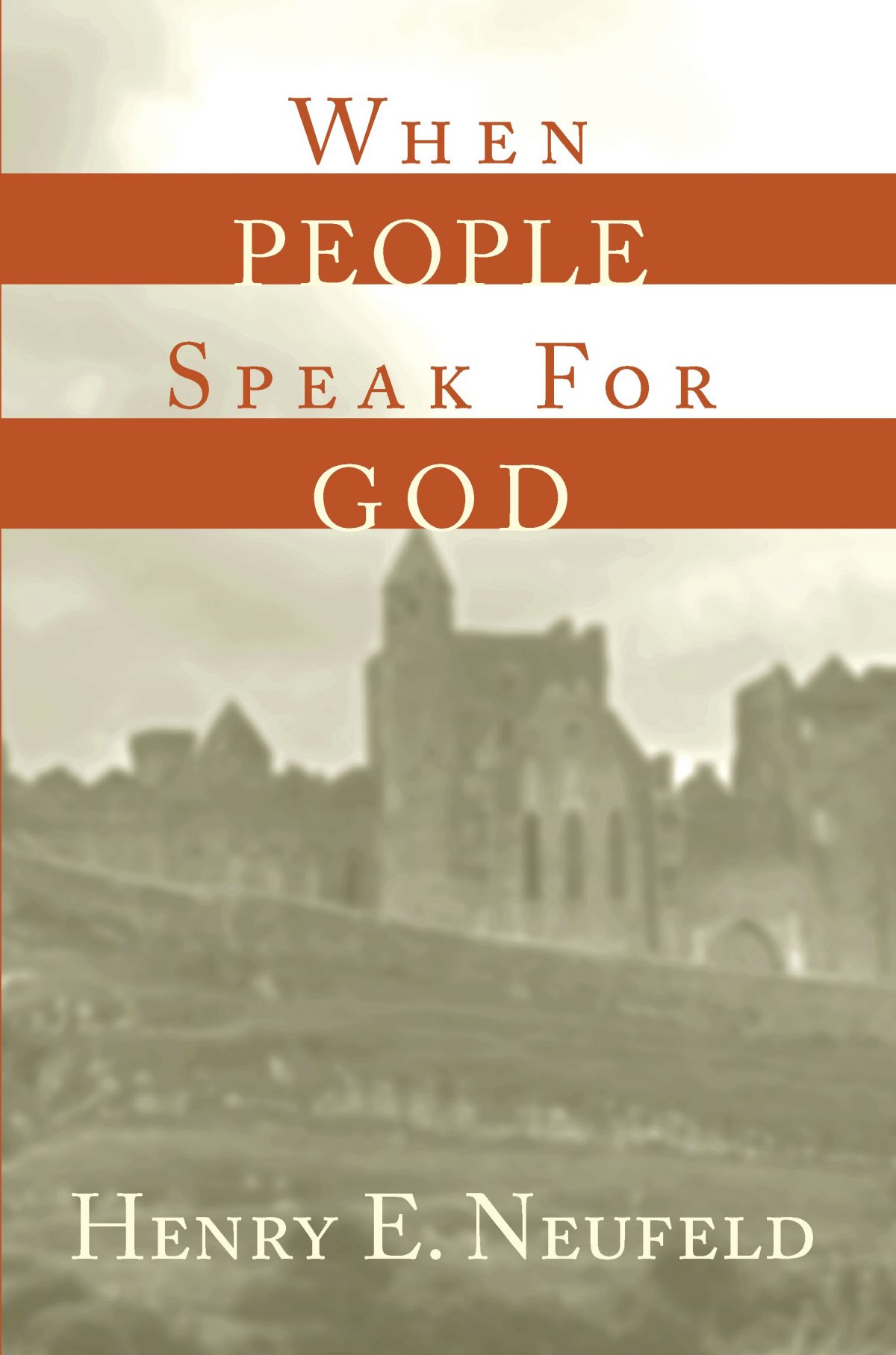
    In my own book When People Speak for God, I make the statement: “The last person, and the decisive person, to hear from God is you” (p. 4). I mean that very seriously, whether we’re dealing with the interpretation of scripture or hearing a word from one who claims to be a prophet, you need to hear, discern, distinguish, and act. I believe that anyone can hear from God. I consider this very scriptural, perhaps as scriptural as anything can be. It is demonstrated repeatedly in the text. We make the people who heard, such as Abraham, Samson’s mother, or Mary, very holy and so separate them. But when they heard from God, they were ordinary people carrying on rather ordinary lives. Anyone may be inspired. Authority results from discernment.

    Let me refer you to a  couple of tests for prophets in Deuteronomy. The one we hear most is from Deuteronomy 18:22, which is that if their word is not fulfilled, they are false. (Jonah would have fallen on this test, but that is for further discussion. See Jonah: When God Changes.) But there is another passage, Deuteronomy 13:1-3, which provides another test. There it says that if someone makes this claim, and even provides a sign which comes through, if they then tell you to worship other gods, they must not be obeyed.

    As a final point on theory, there are those who consider that if a modern word contradicts the Bible it must be rejected, while if it is in accord with the Bible it is redundant. I would suggest that this presents a false (and possibly dangerous) dichotomy. Throughout the stories in scripture, God worked with and guided people, without ever giving an indication that this would change. In fact, I think the best reading suggests that God speaks a great deal and the limitation is more in the fact that we decide not to listen. When a spiritual movement is young and lively, people listen and generate ideas. Then comes structure. Structure is designed to limit and control this spirit. So the authorities tend to want to shut it down at the source. God is done speaking and he ended with the last book we want to see as authoritative. There is room for freedom, and there is some need for structure, but death follows allowing either of those needs to become absolute. Let there be authority, but let authority by challenged.

    I wrote all of that to form the basis for the following. I listen to and apply discernment to any claim, whether the person claims to be a prophet or not. I have generally found in my experience that those who make no claim to speak for God, but just speak what they have learned in their own communion with God speak with much more authority and wisdom than those who make the claim. I think there is a great deal of indiscipline, lack of wisdom, and general confusion in much of the current prophetic movement in Christianity. I will only make specific charges if a person is part of a community of which I am a member, but for myself I work to discern what God is saying. Part of that process is listening myself.

    The one way not to be manipulated is to be a student, a learner, a thinker, and to let the Spirit of Truth work. When that is said, don’t be arrogant. I could be wrong. You could be wrong. Being wrong isn’t the end of the world as long as you keep your mind, your hearing, and your discernment active.


  • A Non-Pluralistic Text in a Pluralistic Age

    The Old Testament lectionary text for today was 1 Kings 18:20-39. This text again presents a case in which those who compile the lectionary avoid difficult texts in the way they cut the reading. Verse 39 ends with “the LORD, he is God,” while verse 40 (not read) tells us that Elijah killed all the prophets of Baal.

    There are several issues that the text brings out, including the violence. It’s not an easy text to preach to a modern or post-modern audience. In looking at the text I had thought of the issue of a prophet killing hundreds of his religious opponents. That’s not the sort of thing people think of prophets doing, though they should. Elijah is hardly the only prophet to engage in violent activity. (One of the best books I know on the topic of violence in the Old Testament was written by my Old Testament professor Alden Thompson, Who’s Afraid of the Old Testament God? I publish it, so I may be biased, but I picked it up as a second edition, and it’s now in it’s fifth, so I may not be far off in my bias!)

    My pastor at First UMC Pensacola, Scott Grantland, chose to take the bull by the horns (couldn’t resist the cliché considering Baal imagery) and included verse 40 in the reading, for which I congratulate him. He did discuss the violence of the passage in connection with the times and also the nature of prophets. Here he addressed a common problem, that people really have a sanitized view of the character and mission of prophets. Frankly, few of us would have liked them, and if they appeared now, we’d likely be working right along with the folks who wanted them killed. They just weren’t a comforting sort of people.

    But the key question was one that didn’t really occur to me. The question was simply how does one preach this text in a pluralistic age. None of what I say here should be read as a criticism of Scott. It is, however, a criticism of the age. Various of my teachers told me there were no bad questions. I disagree. I think that getting good questions is often the most important step in getting to good answers.

    Now Scott’s solution is actually quite good, in my view. I think we should always first try to point the message of scripture, especially difficult scripture, at ourselves. He suggested we should take the text as challenging our own tendency to worship idols in this day and age. That is a good personal message to get from the passage. But I don’t think that fully addresses the question.

    The simple fact is that no matter how you dress it up, this passage is not a pluralistic passage. It says one claimed deity is God and another is not. And if we follow the trajectory of scripture, I don’t see it tending any other way. I can find texts that guide me toward less violent solutions to problems than the one used by Elijah, and I can think of God’s revelation “in many and various ways,” revelation suited to our ability to hear. I don’t want to suggest that the Old Testament people were less able to hear God than we are. They simply had different things standing in their way.

    Further, the context in the world at large is not that much different. Pluralism was quite acceptable in the ancient world. The exclusive claims of the worship of Israel went against the grain probably as much as they do the modern world.

    In other words, I would suggest the text doesn’t allow one to wiggle out that much. Now a pastor needs to address such questions, because that is what people are thinking. But I don’t think the text allows a completely comfortable answer to the question.

    There are, in my view, three major options with regard to religious exclusivity: Exclusion, Inclusion, and Pluralism. The third of these is fairly common these days. The first is the norm in conservative Christianity. I take a middle path, or rather, one that tends to gobble up parts of the others. I believe there is one God and that Jesus is unique. It is because of God’s reaching out that we can be saved and the gap between us and an infinite God can be bridged. Jesus tells us that God is a gap crossing God.

    But there is only one of him. It is possible we may err about our description of God and yet be worshiping the one true God. It is possible that we might be accepted without our own knowledge. Those are major debates. I think the best answer is that God takes care of those things and that I trust that however God takes care of them will be just. Because I believe there is real evil in the world I am not a universalist. But I am hopeful. I can be hopeful because of Jesus Christ.

    However positively stated, that is not a pluralistic position. It’s inclusive. I think there will be many in the kingdom of heaven who will say, “When did we do anything for you?” But they will be there because our God is the God who sent his Son to bridge the gap.

    How does one preach a text that is not pluralistic in a pluralistic age? It has to remain not pluralistic. It has to challenge the age. But the challenge can be filled with grace, grace that gets beyond our works and our knowledge.


  • The Advantages of Stoning False Prophets

    Yesterday I was listening to the radio in my car and heard a woman caller inform the host that God had told her who to vote for in the election. She hadn’t been sure, and she had been inclined differently herself, but the good Lord told her to vote for Obama, and she trusted God above all, so that’s what she was going to do.

    It should shock nobody that it only took a song and a commercial break for another caller to inform the host that she had heard from God as well, who had told her to vote for McCain. I would be willing to bet it was faster than that, in fact, and that she was on hold through that song and commercial! (It was a DJ exchanging views with listeners, not a talk show.)

    Now neither of these women stated that they felt someone should regard them as “speaking for God” and commanding everyone to vote, though I suspect most would assume they thought they had found the right and godly think to do. On the other hand, I have received at least one e-mail telling me that someone had seen parts of God’s plan in vision and that McCain being president was part of it. For unknown reasons, the implication was that I should diligently go out and vote for McCain so that God’s plans would not be thwarted rather than that God could make sure his choice was elected. (God may have more than one vote, assuming he wants one. I’m not so sure.)

    Now I would distinguish all of these incidents from the many advocacy e-mails I get from friends and from political lists in that it’s very different to say that you regard certain things as righteous, and that those correspond best with a particular candidate than it is to say that God specifically gave you the right name. It’s a favorite topic of mine. In fact, I wrote a book about it, When People Speak for God. (Potential readers of this blog be aware that about 1/3 of the 246 pages of text was adapted from here.) In that book I dedicated a chapter to dealing with the manipulative claim that God told you something.

    Now I’m not trying to make fun of all people who hear from God. I will confess to believing that I hear from God as well. What concerns me is statements such as “God told me to tell you . . .” or the obvious implication. I have had people claim that what I told them came from God, i.e. that it was so on target for their situation that it must have.

    There are three explanations I can think of. First, I might be exceedingly insightful. Second, I might actually be speaking for God without knowing it. Third, it might be random chance. I would vote for the third option. If I were actually to consider all lines of advice I have ever given, considering uncertain items, items that were just plain bad, items that were good but pretty obvious, and finally items that were unusually on target, I’m certain you would find it would be very dangerous to equate my words with God’s will. My own decision making, while perhaps not truly horrible, is certainly no example of what I hope God’s wisdom would reflect!

    In ancient Israel, false prophecy was taken rather seriously. Deuteronomy 18:15-22 provides that the prophet who makes a false prediction should be put to death. Deuteronomy 13:1-5 suggests that even if he’s right, if his theology is too far (preaching rebellion against God), he must be put to death as well. My point here is not to present a theology of prophecy, but rather to point out that under those circumstances, it would be likely that far less people would want to proclaim something that they claimed God had said.

    The Biblical prophets actually make a fairly small number of predictions, and only a small percentage of those are very specific and unconditional. Most are more like warnings. “If you do X God will do Y to you.” It’s interesting, however, that a key element of prophetic speech is rebuking and challenging the cultural mainstream of their time. For some reason we do not have the writings of prophets who preached that everything was going well all the time. Second Isaiah (40-55) is one of the most positive and there is still a good deal of rebuke.

    I recall one pastor who, after hearing me discuss the nature of prophecy with a group of his parishioners, informed me that in their church they preferred “positive” and “encouraging” prophecy and were not so much into rebuke. But in the Bible one of the strong characteristics of the prophets is that they do not come to encourage us to stay as we are. They come to persuade us to change.

    Since I have both claimed that there is a great deal of “speaking for God” that is clearly false (it’s unlikely both the callers on the radio show heard from God), what is the point of “hearing from God” in the first place?

    Personally I find that those times I identify as hearing from God are ones that challenge the way I’m thinking and that provide the greatest insights. I have to sift them, because, as I said in my book and here on this blog, a telephone cord has two ends. There’s a speaker and a listener. I tendency when someone claims they heard from God is to focus on the word “God.” God is omniscient and won’t lie, though one should remember that he might send a strong delusion (2 Thessalonians 2:11). So what we hear must be true, right?

    Hardly! Even if one admits, as I do, that God speaks, there is always the listener. I confess that my biases get into what I hear other people say. If I’m getting loose impressions of divine things, things I understand much less clearly that the topics of human conversation, how accurately will I understand and report those things? Thus hearing from God is a good way for me to push the envelope in my understanding, but everything must be tested.

    This is also scriptural. Paul tells us in 1 Thessalonians 5:21ff to test everything, hold onto what is good and keep away from every kind of evil. This doesn’t tell us to go back to stoning prophets, but it does tell us to take consideration, testing, and discernment seriously. I think this passage is misread in many ways, or at least it would seem so based on actions.

    • Test everything, keep what is good, but don’t say anything about what is bad.
    • Test everything, hold onto what is culturally acceptable and discard the rest.
    • Test everything, accept everything as generally valid because you don’t want to be arrogant and tell someone they’re wrong.
    • Discard everything because it’s not possible they heard from God in any case.
    • Test everything, keep what you like, discard what you don’t like.

    Bottom line here, however, is to take responsibility for what you think and say, and also for what you hear, whether or not someone claims it comes from God. Try to find ways to find out if it’s true, moral, and useful (not moral or useful, the and is intentional).

    I really don’t suggest we stone false prophets. I simply suggest we should be more careful invoking the name of God. Personally, I’m prepared not to do so, but rather to let others decide if something I say is of that profound a nature, and to live happily in that vast number of times when they are saying, “Not so much.”