
Threads from Henry's Web

Tag: Priesthood

  • Sunday School: Thinking about Sacrifices

    Sunday School: Thinking about Sacrifices

    Sacrifice
    Credit: Adobe Stock 46272514

    I’m preparing to teach tomorrow, and the main text is Hebrews 4:14-5:10. The quarterly is kind enough to stop just before the author tells his readers/hearers that the topic is difficult and they’re not very bright!

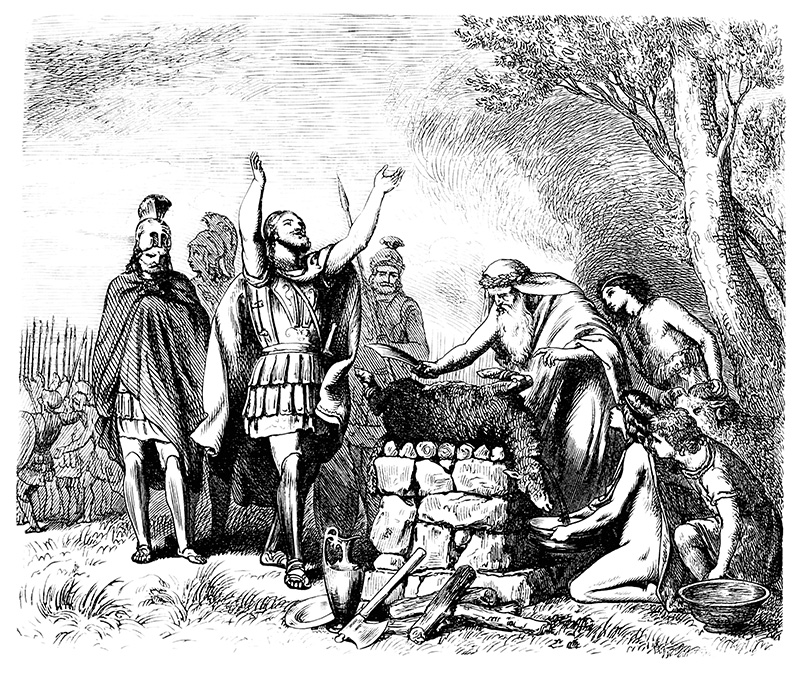
    Nonetheless, the idea of priesthood brings up the idea of “sacrifice” and “sacrifices,” and these are two concepts that I don’t believe modern audiences are prepared for. We tend to get locked into one of two unhelpful modes.

    On the one hand, we may believe sacrifice is critical, and its primary, or even only purpose is to atone for sin. This feeds into the penal substitutionary atonement theory (or I prefer metaphor), in which the sacrifice of Jesus is specifically as a substitutionary death taking the punishment for our sins. The reason I prefer metaphor to theory here is that a theory should be an explanation that deals with the relationship between various facts. A good theory is a singular thing because it is the best explanation of the data. A metaphor, on the other hand, is one of many ways of looking at a set of events. In this sense I reject a substitutionary atonement as a theory, but accept it as a valid metaphor.

    On the other hand, because the whole idea of substitutionary atonement, sometimes even referred to as “cosmic child abuse,” is so foreign to our way of thinking about things, that we reject everything that relates to it. But there is a least one really good thing about substitutionary atonement (and I believe there are others): A person convinced that Jesus died as a substitutionary sacrifices for his or her sins will be convinced that wrath and punishment have been averted.

    This is not the place to cover this in detail, but I am doing so in my video series on perspectives on Paul. I started in Paul’s Gospel vs. Another Gospel, then went on to part 2, and this coming Thursday night I will be doing part 3. I’m thinking there may be yet more parts, because I’m looking verse by verse at some defining statements about the gospel in various Pauline and disputed epistles.

    I think there’s a better background against which to think about sacrifice, and that is communication within a relationship. The priesthood and sacrifices were part of the way in which ancient people carried on communion within an ongoing relationship with their god(s). The Israelites had specific ways of offering various sacrifices, ways of representing their God, and expectations.

    I like to think of gifts that I give my wife. One of the traditional gifts for someone with whom we are romantically involved is roses, often a dozen, maybe two dozen. I have only done that once in our relationship. I mean the dozen. There have been a scattered number of times on which a gift has included roses, but that is much less frequent than in other relationships.

    So am I neglecting my wife and being unromantic by not giving her the traditional gift? I don’t think so, and she’ll surely read this post and let you know if I’m wrong. We’ve established a different tradition that fits her personality and mine. That tradition has to do with surprise and variety. I look at various places where I can buy flowers. The grocery store even works out frequently. I look for flowers of a different color or a different type than she has had recently. I often buy enough for a couple of arrangements in vases. More importantly, I try to bring the flowers into the house when she is not expecting them.

    It is true that flowers are frequently a way of expressing regret for a wrong action, but that wouldn’t work all that well in our relationship. In fact, the only thing that does work is sincere regret, directly expressed (no weasely political apologies), and a discussion of how we can improve as we move forward. Flowers as a sacrifice for sin are not functional in our relationship, yet they are given.

    I’d like to suggest thinking of the reason why you might do something for another person, or have something done for you and the various reasons you might give or receive a gift. Then start looking at the sacrificial system again. There are still many things that will not connect. For example, in those cultures that practiced human sacrifice, the killing of the human victim—the ideal one being a firstborn son—was seen as giving that child to God. So also with the animal sacrifices.

    If you think of the sacrifices in this way I think it will be easier to follow how sacrifice was replaced by the “mitzvah” (good deed) in Judaism, and by a combination of giving and symbolic acts in Christianity. You might even start to think about the Sunday liturgy at your church and what it says about what God would like to see happening in your relationship to him. Is it possible God might prefer a “mitzvah” of some sort?

    I’m going to build on this, but I think this is a good foundational metaphor to use in looking at sacrifice. Then we can adjust for the people involved and how they viewed what was good and bad in a relationship.

  • The Priestly Trajectory in Scripture

    Many people regard the idea of trajectories in scripture as largely a method of avoiding “what the Bible clearly teaches.” I believe that there are clear trajectories in the teaching of scripture, and that in those cases one must be careful that one applies the correct principle to modern times.

    One such trajectory deals with priesthood and access to the sacred. I was taught that the tabernacle in the wilderness and the temple in Jerusalem were symbols of God’s presence. And in a sense they were. But they were also filled with symbolism of humanity’s separation from God. Notice how you progress from “outside the camp” to “the camp” to the place where the Levites were encamped closer to the tabernacle itself, then to the courtyard, then the outer room (often called just “the holy place”) and finally to the inner room (“the most holy place”) where we find the Ark of the Covenant and there, between the cherubim, we have the symbol of God’s presence. It’s not filled with an idol, as it might have been in other near eastern temples. God cannot be represented. But there is a sense of separation.

    I was reminded of this yesterday when my reading took me to Numbers 18 and 19. If you read both, I think you’ll see the sense of separation. Even the Levites were not permitted to approach certain sacred objects. Those were reserved for the priests alone. In Numbers 19, with the ritual of the red heifer, you have references to “outside the camp.”

    Now this is not a New Testament vs. Old Testament trajectory. Exodus 19:6 makes the goal clear: a priestly kingdom. 1 Peter 2:9 makes the application to Christians: “But you are a chosen race, a royal priesthood, a holy nation, God’s own people,[c] in order that you may proclaim the mighty acts of him who called you out of darkness into his marvelous light” (NRSV, from Bible Gateway).

    So why all the separation between? The answer lies in Exodus 20, I think. It is there that the people respond to God’s voice.

    18 When all the people witnessed the thunder and lightning, the sound of the trumpet, and the mountain smoking, they were afraid[d] and trembled and stood at a distance, 19 and said to Moses, “You speak to us, and we will listen; but do not let God speak to us, or we will die.” 20 Moses said to the people, “Do not be afraid; for God has come only to test you and to put the fear of him upon you so that you do not sin.” 21 Then the people stood at a distance, while Moses drew near to the thick darkness where God was. (NRSV, again via Bible Gateway).

    Now our tendency as Christians is to see this as a failing of Israel, corrected in the church. But I think it is a mistake to read it that way. One of my principles of application (not necessarily of exegesis) is to point the text at yourself first. Whether we admit it or not, we behave this way every day. Let the pastor pray, study, listen to God, and proclaim. Let us sit passively on Sunday morning and hear what God has told the pastor. I visited a United Church of Christ recently. They have a motto, “God is still speaking.” It’s a good one, I think. But the real question is this: Are we still listening? All of us?

    Our tendency is to say in good southern style, “God is still speaking. Isn’t that special?” The point being that we want to distance ourselves from anything that gets us too close to the edge, too likely to make people question our sanity. We want God to say comfortable things. It’s easier to only hear comfortable things if you let the pastor do all the listening, and get them properly filtered and shaped into a good sermon.

    This week’s Lectionary Psalm is Psalm 99:

    YHWH reigns
    let peoples shudder
    he sits on the cherubim
    let the earth be displaced. (Translation from Seeing the Psalter, p. 312)

    We don’t admit the fear of hearing from God. We like the idea that God might still speak. What we don’t want is for God to displace the earth. We don’t want him to say anything that would make us shudder. We live in Exodus 20, standing at a distance, appointing our pastors and church staff members as “Moses.”

    We’re supposed to be living in John 4, worshiping in spirit and truth, or in 2 Corinthians 6:16, as the “temple of the living God.”

    I learned about this in studying Leviticus using Jacob Milgrom’s 2200 page, 3 volume commentary in the Anchor Bible series. He maintains (summarizing from a sweep of many passages in his book) that the call to distinguish sacred from profane was part of training, a teaching function of the ritual system, and that the call to be holy (Leviticus 19:2) points to the sacred overcoming the profane. More, not less, comes to belong to the sacred sphere. I really should write a post on this subject in particular at some point and bring some material from that commentary to bear, but that will take more time. Condensing 2200 pages, none of them wasted in my view, is not easy!

    But what I saw in Numbers 18 & 19 was that separation them, the one that comes after Exodus 20. It’s not God pulling back from humanity, but rather God accommodating our fear, our unwillingness to get too close to the sacred. To paraphrase another expression, not everyone who says they’re happy to hear from God actually is.

    And I do think there is a role for pastors and for priests in the modern church and world, though that role is primarily in terms of outreach. The church should be carrying out a priestly role to the world, mediating the sacred to those around, being Jesus in living, physical, present form. That is the priesthood of all believers, individually and collectively. We do not require a priest to get to God. Prayers by the pastor are not better than prayers by individual members. We should all at various times be receivers and conveyors or God’s Word.

    I want to note, in addition, that I’m not speaking solely of those who believe that people in the congregation receive prophetic words. I’m speaking of those who hear God speak through scripture as well as those who hear in their minds, see visions, or catch God’s voice coming through the natural world.

    A royal priesthood. Do we really want it? Can we stand it? Will we give up our individual superiority (and inferiority!) so it can happen?

    PS: As I was writing this, notice came in of a post by Bob Cornwall, author of Unfettered Spirit: Spiritual Gifts for the New Great Awakening, dealing with ordination (book extract). Note his conclusion:

    Although our churches may use a variety of structural forms, it’s important to recognize that the church isn’t a democracy, ruled by majority vote. It’s also not a clerical autocracy where elite groups of clergy hold sway. In a gift based ecclesiology, there’s the assumption the Spirit rules, and we are tasked with discerning where the Spirit is leading. This is true no matter what structure we happen to be a part of.

    “Discerning where the Spirit is leading” is not easy!

  • Structural Typology and the Tabernacle

    That’s a fairly pretentious title for this little essay, but in overview form, it fits. This post also represents a return, finally, to my series of posts on the book of Hebrews. I’m looking at the book topically, and using questions from my study guide to the book of Hebrews.

    On page 24, in the third lesson, I ask:

    What do each of the areas–courtyard, holy place, and holy of holies–mean (Hebrews 8:1-5; 9:1-10; Exodus 25-31; 36-40)? What is the meaning of the ark of the covenant and the mercy seat (Leviticus 16, especially verse 2)?

    impression of the tabernacle

    Now the long references from Exodus are part of the advanced reading. It can be helpful to read those passages quickly while trying to form an image in your mind of what the tabernacle would look like. Go ahead and use your imagination. One can debate minor details for many, many pages of discussion, but that is not my point in this question. I’m interested in the general structure of the tabernacle, and the lessons it has to teach.

    I have argued elsewhere (also here) that the sanctuary service was characterized by two goals that act in tension. First was the command to distinguish between the holy and the common, and the second was the command to “be holy as God is holy.” These two commands can bring on considerable tension depending on how one views them and attempts to practice them, but they have a very practical intent. There is a basic idea of teaching good basic discernment and decision making, and once those distinctions are properly drawn, bringing more and more into God’s sphere, the sphere of the holy.

    In a sense, the tabernacle itself can be used as a metaphor for building the kingdom of God. You can look at this building in a couple of different ways. First, you can look at your own life as you grow in holiness, or to phrase it better, as God takes over more and more of your life. Sanctification is a gift. You can also look at it as the growth of God’s kingdom like a mustard seed, as God’s glory and presence grows on and in his people. Make sure, however, that you don’t regard these metaphors as exclusive meanings. What I’m saying is that the tabernacle can serve as metaphors, and I believe these are valid meanings to draw from it.

    high priest

    Now if you didn’t read the two earlier posts I linked above, let me mention simply that I bracket this entire set of ideas with two scriptures: Exodus 19:6 and 2 Peter 2:9. God’s original goal for Israel was that they be a nation of priests. Now if you think about the idea of priesthood, you will probably recall that a priest acts as a intermediary between God or divine things and human beings. Thus if Israel was to be a nation of priests, for whom were they to act as intermediaries? Well, here we have that intention for Israel to be a light for the nations (see my devotional on this here) as is so eloquently and repeated expressed in Isaiah (chapters 40-66), and it’s expressed in doubtlessly very early literature. Israel as a witness to the nations and as a priesthood was not a late afterthought on God’s part.

    From a Christian perspective, there is a fulfillment of God’s desire from Exodus 19 in the priesthood of all believers, this fulfillment being expressed explicitly in 2 Peter 2:9. This bracketing makes the whole concept extremely important for Christian theology, I believe, and the view is expressed in some detail and with some force in Hebrews.

    If you read Hebrews carefully, and look at the structure of the tabernacle and its services equally carefully, I think you will come to the conclusion that much of the sanctuary service symbolizes the separation from God rather well. Starting in Exodus 19, immediately after we have the expression of God’s desire, we have the expression of fear. The people don’t want to be that close to God because they are afraid. They aren’t ready for that close of contact. In Hebrews, certainly, the tabernacle is seen as symbolizing separation, and entry into the inner veil as something that has been bought through the sacrifice of Jesus.

    This is not, however, an exclusive theme of the book of Hebrews. Jesus expresses this in his final talk to his disciples (John 15:11-17 amongst others). He has come and brought us into much more direct contact with God. That is both a tremendous blessing and a tremendous responsibility, and again these are both themes of the book of Hebrews.

    before the veil

    Thus the progressive chambers of the tabernacle are progressively more restricted in access. The people can enter the courtyard in front of the altar to offer sacrifices, but beyond that, and into the Holy Place, only the priests can go. This is symbolized further by the Israelite camp, with the priests camping closest, then the levites according to their service, and outside of that the rest of the tribes of Israel. Then finally the High Priest enters the Most Holy Place once per year for the day of atonement. On this day of repentance atonement could be made even for intentional sins. The closer to God, both the greater the glory and the danger, but also the greater the grace.

    The “hilasterion” the place of God’s presence, often known as the mercy seat, then symbolized God’s presence. But at the same time it symbolized God’s presence in a limited way, separated from his people. It was placed behind a veil, with God’s presence repesented by human light and offerings of incense in front of the veil, but demonstrated through God’s light on the other side.

    Meditating on the symbolism of this service can be very constructive. I have used it before in preaching by simply forming the general shape of the tabernacle with chairs, or even people holding ropes. Then people can walk through and ask themselves just which chamber they were most comfortable in, and then thinking about how they could move forward in their experience.

    Note: I make use of the tabernacle as a metaphor in my sermon The Sin of Getting Stuck, available in MP4 video (from a standard VHS tape) or MP3 audio.

  • Hebrews 7:1-3: Reuniting Priesthood and Kingship

    1Now this Melchizedek, king of Salem and priest of the Most High God, met Abraham when he was returning from the slaughter of the kings and blessed him. 2Abraham apportioned a tenth of everything to him. He is first “King of Righteousness” and then King of Salem which is “King of Peace.” 3He is without father, without mother, without genealogy, and has neither beginning of days nor end of life, but, in a way similar to the Son of God he remains forever. — Hebrews 7:1-3

    There is a critical element to the Melchizedek priesthood which is often neglected. It’s mentioned in the first verse of chapter 7: Melchizedek is both king and priest.

    In reading the Bible story we are accustomed to a substantial separation between royal authority and priestly activity. Though we have a brief hint at something different in the time of David (2 Samuel 8:18), there is a strong them of separation between the civil authority and the priesthood. This is emphasized by the experience of Uzziah, who tried to usurp priestly functions and became a leper for his efforts (2 Chronicles 26:16-21).

    But it’s easy to miss the significance of this element in the theology of the book of Hebrews. In Biblical history, this separation begins with Exodus 19 when the Isralites are afraid of hearing the voice of God from Mt. Sinai. They are invited to be a holy nation and a kingdom of priests, but they prefer to have a safer distance. In the New Testament, this theme is picked up in 1 Peter 2:9 in which Christians are referenced in the same terms. To someone acquainted with the Hebrew scriptures, this was a not so subtle way of suggesting that we have entered into the Messianic age.

    In Hebrews, the Melchizedek priesthood serves to make the same point. While civil power was separated from the priesthood from the time when the tabernacle was being built in the wilderness forward, the Melchizedek priesthood was also a royal priesthood. Thus besides being eternal, which is of great importance to our author, authority and priestly intercession are combined in one person, Jesus who is both king and priest.

    This connection is emphasized by the use of Psalm 110. In its original setting, Psalm 110 is an accession psalm, a poem or hymn celebrating the accession of the king to the throne, and thus YHWH says to “my lord” (the poet is speaking), sit at my right hand, vesting the king with divine authority and promising him victory.

    While by modern standards of exegesis, our author uses the wording of Psalm 110 in a substantially different way (I think he’s allowed that as an inspired writer), he still manages to pull in a great deal of meaning by using that precise reference.

    In the incarnation, God becomes human, experiences humanity, and at the same time royal authority (lawgiving, enforcement, sovereignty) with the priesthood (intercession, communication, connection) and God-become-man thus reaches us directly. As Jesus said, “On that day you will ask in my name. I do not say to you that I will ask the Father on your behalf;  for the Father himself loves you, because you have loved me and have believed that I came from God” (John 16:26-27).

    Asking the Father himself, and knowing that the Father himself loves us, is one of the great gifts of the incarnation. Priestly and royal power have come together again.

  • Jesus as Human and Divine Priest

    There are three passages in Hebrews that are critical to the concept of Jesus as a priest who combines divine and human attributes.

    17For this reason it was necessary for him to be like his brethren in all ways, so that he could become a merciful and faithful high priest concerning divine matters {matters dealing with God} in order to cleanse the sins of the people. 18Because he was tested by the things he suffered, he is able to sympathize with those who are tested. — Hebrews 2:17-18 (TFBV project)

    14Since we have such a great high priest who has passed through the heavens, Jesus the son of God, let us grasp our confession. 15For we do not have a high priest who is unable to sympathize with our weaknesses, since he has been tested in all things in the same way we have, but without sin. 16Let us approach the throne of grace with confidence, so that we might receive mercy and we might find grace in time of need. — Hebrews 4:14-16 (TFBV project)

    These two talk mostly about the human attributes, though they hint also at the divine. The next one purely describes the divine attributes:

    26We now have just such a suitable high priest, holy, blameless, undefiled, separated from sinners and come to the highest places of the heavens. 27He has no need to offer sacrifices each day first for his own sins, like the other high priests and then for those of the people, because he has offered himself once and for all. 28For the law appointed high priests who had weaknesses, but the word confirmed with an oath, which came after the law, appointed a Son, perfected forever. — Hebrews 7:26-28 (TFBV project)

    Recall that this is all being written well before the formulation of the doctrinal creeds in which the Christian community declared Jesus fully God and yet fully human. Without such a doctrinal explanation, however, we have here both elements of that doctrine. In the first passage, Jesus is our brother, one of us, having suffered temptation and faced death as we must do so, but always with the emphasis on the fact that he did not sin. Our second passage (Hebrews 4:14-16) introduces the heavenly side of the priest, but is still primarily concerned with sympathy for our weaknesses. The emphasis is on what he shares with us.

    In Hebrews 7:26-28, the emphasis has shifted completely. Jesus is able to sacrifice properly for us because he does not need to sacrifice for himself, being without sin. He is set apart from us, holy, so he can approach God. But then there is that other aspect; because he is our brother, he can also invite us to approach God with equal boldness. The approach to the throne of grace is made possible by the divine-human combination in the new high priest.

    Let’s tie this in as well to the interpretation of Hebrews 6:4-6. There we have a dire warning of destruction for anyone who falls away. But that warning can only be heard in the light of this encouragement. God, presented to us in the person of Jesus, is able to sympathize with our weaknesses, because he has seen them in action and suffered their testing. The intended message is one of great hope but yet serious warning. The author of Hebrews believes we will never get a better invitation than this.

  • Jesus as King and Priest

    With the reference to Melchizedek (chapter 7), the author of Hebrews ties Jesus as King to his argument, though he doesn’t dwell on that. There is a key thought here that I would like to look at briefly. Often we find people disagreeing over just what type of person Jesus is. Is he the gentle, forgiving Jesus, or the ruler who rules with a rod of iron?

    That answer is that he is both. I’d like to illustrate this briefly from Revelation 5, which combines the two sets of imagery in one short passage:

    5Then on eof the elders said to me, “Stop crying! Look here! The Lion of the tribe of Judah, the root of David, has won the right to open the book and to break its seven seals.”

    6And I a lamb standing among the four creatures around the throne and among the elders, looking as though it had been sacrificed. It had seven horns and seven eyes, which are the seven spirits of God who are sent out into all the earth. 7And he came and took the book out of the right hand of the one who was sitting on the throne.

    –Revelation 5:5-7 (from the TFBV project)

    The issue in this passage is the one who can open the seals, i.e. the one who has the sovereignty over history and who is able to open the seals and reveal what is to take place. One feels one is on the right track with the “lion of the tribe of Judah.” That sounds like a sovereign, one who can take charge. But when John turns to look, it’s a lamb, and it looks as though it has been sacrificed. It’s not even a healthy lamb!!

    But nonetheless, he is the one who has the sovereignty and proceeds to open the seals. This is the same theology as expressed by Philippians 2:1-11, only expressed symbolically. Consider this type of royal imagery “read into” Hebrews through the reference to Melchizedek, combined with the statement that Jesus, who must have something to offer as a priest, offers himself (Hebrews 8:3 and 9:12).

    The Lion is the Lamb.

  • Why a New Priest?

    The author of Hebrews is at some pains to make it clear to us that we need a new priest and indeed a new priesthood. As I’ve noted in previous entries, he has specific characteristics he expects in this new priest. The heart of his argument for a new priesthood is contained in chapter 7. Note that he builds the basis for this argument in chapters 1-6, and that he discusses the actual impact of the new priesthood in chapters 8-10, but the argument in favor of the new priesthood is in chapter 7.

    He has established to his satisfaction that Jesus is greater than the angels and greater than Moses. He has established that Jesus is able to empathize with us, because he is just like us. He is certain that Jesus is the new priest and that there is a new revelation now that is greater than the Torah. But he needs to find something there that points to a new order of priesthood. He finds that necessary “hook” in the story of Melchisedek in Genesis 14:18-20. A second reference to Melchizedek in Psalm 110 refers to an order of priesthood, and also helps relate the priesthood to royalty.

    Melchizedek has one wonderful feature that is helpful to the argument for a new priesthood: He arrives on the scene without geneology, and disappears without record of his dath. Thus our author can use him as the type of an eternal priesthood. He is clearly not happy with the idea of a set of rituals that go round and round year after year, and at least to his way of thinking don’t finally accomplish anything. Oh, they help people along the way, but doesn’t it have to end somewhere? So he wants a priesthood that will not end, that is eternal by nature, because only such a priesthood can accomplish an eternal redemption, once and for all, that doesn’t need to be repeated. I’m intentionally redundant. That’s precisely what our author sounds like in chapter 7.

    I’m going to discuss this some more in future entries. For now notice that the key to understanding how Melchizedek is used in Hebrews is the lack of genealogy along with no record of death. Combined with Psalm 110, “priest forever,” this makes the ideal type for his antitype of an eternal priesthood.

    I suggest reading Genesis 14 and Psalm 110, followed by Hebrews 7 to fix this picture in your mind.

  • Was Jesus a Lawful Priest and Sacrifice?

    I’m going to post next on the nature of the priesthood of Jesus, by looking at the major passages in the book of Hebrews. These especially chapter 2, 4:14-16, and 7. Obviously that list is not exhaustive, as priesthood is fundamental to most of the book, but those passages will get us started. First, however, I want to address the question in the title: Was Jesus lawful as either a priest or a sacrifice? I’ve seen this discussion between Jews and Christians, and a great deal of confusion was generated.

    The short answer is no. Jesus was not of the tribe of Levi, much less of the family of Aaron. He was not qualified according to the Torah to be a priest. Neither was he qualified to be a sacrifice. Humans are not kosher animals, and they are nowhere specifically authorized as sacrifices. Indeed human sacrifice is specifically forbidden.

    But none of this should be a surprise to a Christian Bible student, though unfortunately it seems to be for some. Indeed, the author of Hebrews is not only aware of this point; it’s a key element of his argument. Recall that he has been establishing Jesus, and the witness to Jesus, as superior to the Torah as a revelation. I have noted how this is completely contrary to the Jewish approach to scripture and its interpretation. (Note that I am in no way trying to tell Jews how to approach scripture; I’m addressing this to Christians, but the difference needs to be understood for interfaith discussions.) Having made such an argument he continues by establishing Jesus as a new kind of priest, on which he spends almost all of chapter 7, and then chapter 8 introduces the concept of a new covenant. If Jesus were here, he would not be a priest. There already are priests, but more importantly, Jesus comes from the tribe of Judah, and there is no privision in Torah for such a priest (Hebrews 7:14).

    Rather than trying to argue against this obvious fact, the author of Hebrews bases his argument for the superior priesthood of Jesus on that fact. He was not a priest like the old, Levitical priests. He was a priest of a new order, based on a new covenant, and new regulations. (We’ll discuss the priestly order of Melchisedek in a later entry.) He argues this superior priesthood on the same basis as he has argued the superiority of the revelation that comes through Jesus–he maintains that in all ways Jesus’ ministry is superior. Note that he does not start by establishing the ministry of Jesus from the Old Testament scriptures. (Those who recall how much Old Testament he quotes, hold your exclamations and questions.) Rather, he starts with the superiority of the established testimony of Jesus (2:1-4) and of his priesthood and sacrifice (7-10 passim), and then looks for pointers to something superior that is to come in the Old Testament scriptures.

    Thus the correct answer to the title question is, again, no. Under the Torah, Jesus was neither lawful as a priest nor as a sacrifice. Further, he was not offered according to the law. Does this mean that Jesus is not a priest or a sacrifice? Well, according to the book of Hebrews, he is. He is lawful because he inaugurated a new law.

    I would two other points. The first is the nature of metaphor. Jesus was not killed as a sacrifice from the point of view of those who did it, or from the point of view of those who watched. The Romans crucified Jesus as a routine act of political intimidation. The observers were, well, intimidated. One of the ways in which we can understand this is as a sacrifice–and indeed it was. But we will neither understand everything about it by this means, nor will we be able to connect it to a sacrifice at every point.

    The second is the idea of type and antitype. This is expressed in Hebrews 8:5. The earthly things are a sketch and shadow of heavenly things. Those who understand this passage as indicating that there is a building in heaven proportional to the tabernacle or the temple, and that in the most holy compartment of that temple there is an ark of the covenant miss the point. The ark of the covenant was the shadow, the representation, the physical expression of God’s presence. The heavenly reality is God’s actual presence. To read about the antitypical most holy place, read Revelation 4, and the experience of worship around the throne of God.

    Beware of getting two little or two much out of these types of parallels.

  • Are You a Priest?

    A key element of the participatory study method is getting up close and personal with the application. Since God indicated in Exodus 19:6 that his intention for Israel was that they should be a nation of priests, and that a similar goal was expressed for Christians in 2 Peter 2:9, the question I want to ask is how this applies to me.

    Let’s make a more extensive list of activities of a priest:

    1. Teaching to distinguish holy from unholy, clean and unclean, right and wrong (see my previous post on priesthood)
    2. Bearing sin (High Priest particularly)
    3. Presenting sacrifices
    4. Judging issues based on their knowledge and divine instruction
    5. Leading in worship

    This list isn’t exhaustive, but it gives us some idea.

    Many people have a hard time seeing themselves in this role, but God presents it as an ideal. I think if we clean out the theological terminology, there is nothing here that we can’t all do.

    First, though not all of us are teachers by office (James 3:1), all of us have something to teach. At a minimum, we can share our own testimony. (I wrote some notes on this for the Pacesetters Bible School Newsletter blog.) We do not ourselves carry other peoples sins, but we can help them find forgiveness. We can all present sacrifices–in the modern Christian sense with our gifts, our service, and our praise of God. We do not all serve as judges, but we can all participate in the ministry of reconciliation (2 Corinthians 5:16-21). Finally, we may not all see ourselves as leaders in worship, but we all can be. It’s easy to lean on the worship leader to get us into the attitude of worship. How much better would it be if each person in a worship service was helping to lead their little corner of the church into worship?

    But there is one major difference when we are all part of the priesthood. While we are called to do all of these things as a member of Christ’s “royal priesthood” we are also called to receive from one another. Today you may be the leader, helping someone else get closer to God. Tomorrow it may be you who needs the help. The benefit of a nation of priests or a priestly kingdom is that we are all equipped to help one another.

    That is the call of the priesthood.

  • What is a Priest?

    If you read through the book of Hebrews as a whole, you cannot help but notice the central place that the concept of priesthood has for the author of the book. His metaphors come strongly from the tabernacle or sanctuary service, and especially the wilderness version. Where he refers to these things he doesn’t reference the second temple or even Solomon’s temple, but the original tent. Some believe this means he wrote after the temple was destroyed, but I would suggest that there must be a greater motivation than that. The wilderness tabernacle itself was not in existence either. I would suggest that his interest in the tabernacle is because he sees this version as the pristine form, the inaugural form, if you will, and because it is the form described directly in Torah. He is working on a contrast of the person of Jesus with the whole of Torah, so he takes his illustration from the Torah as directly as possible. (We will note when we discuss his use of the Old Testament that he works from the LXX to some extent.)

    The problem for modern readers is that we do not hear the same things by these words as he probably did. Terms like priest, high priest, sacrifice, pure, impure, and even worship don’t necessarily mean the same thing to us simply because we live in a vastly different cultural context. The sacrifices fit well into their cultural context and served a teaching purpose. I was energized by studying through Leviticus with Jacob Milgrom’s 3 volume commentary in the Anchor Bible series (see my review).

    [For those who are working through my study guide, you might stop at this point and work with the advanced question on priests, ministers, and intercessors, and fill in the chart on page 29.]

    Milgrom suggests two key functions of the priest. These are not the only functions, but they are critical. First, according to Leviticus 10:10-11, the priests are to be teachers, and the key element that they teach is distinguishing sacred from common and pure from impure. (I could write an entry on that, but I will refrain for the moment. Milgrom’s key comments are on pp. 615-618 of Volume 1 of his series.) This function is restated and reemphasized in Ezekiel 44:23-28. This pair of distinctions is pervasive through the book of Leviticus, and it is made clear that the priests are to know them, to be able to render judgments about them, and to teach them.

    Secondly, priests, and particularly the High Priest, were to carry and/or carry away sin. This is illustrated at Exodus 28:38, but could well be expanded from many other passages in Exodus and Leviticus, looking at how sin is handled in connection with sacrifices. (Again, Milgrom comments in his first volume, pp. 622-625.) So we have these two functions that we often do not think about in connection with priests and the tabernacle–teaching and bearing sin and impurity. (Note these two are not identical, something Christian readers often miss.)

    The tabernacle, and particulary the priestly service as carried out in it, is the central metaphor of Hebrews, the means by which he conveys his message. If we don’t understand his metaphor, we’re not going to understand what it means. This is something we will work on through several posts.

    Do these two key elements of the priestly function play a role in the book of Hebrews? Indeed they do.

    First, the learning of distinctions:

    14Solid food is for the mature, for those who through practice have exercised their understanding to distinguish good and evil. — Hebrews 5:14 (from the TFBV project).

    This single reference would not be nearly as important as it is if it did not occur in a section leading up to one of the key points of the book. At the end of chapter 5 our author is explaining why he can’t go deeper into certain things: Believers need more maturity to understand. The key requirement of maturity is a well-trained discernment. Isn’t it interesting that one of the key things the priests were to teach the Israelites through the sanctuary service was precisely this? All those weird rules about which animals to eat and which not to, and what to touch and what not to were, at least in part, an exercise in learning how to make distinctions.

    We are frequently hesitant to make distinctions in the church, fearing the dreaded accusation of “discrimination.” But our author here is affirming that there are right and wrong actions, and that the mature Christian has a mind trained to choose between them. We must guard against a critical spirit or nitpicking on non-essentials, but there is a place, and apparently a fairly substantial one, for making distinctions.

    Second, bearing sins . . .

    4 . . . it is impossible for the blood of bulls and goats to carry sin away. — Hebrews 10:4 (TFBV)

    This is again a key problem addressed by the book of Hebrews. His answer is the once and for all sacrifice for sins by Jesus who is able to bear away the sins of many once and for all.

    27And just as it is the nature of men to die one time, and after that the judgment, 28so also Christ will appear again without sin, having offered himself to bear the sins of many, to those who wait for salvation. — Hebrews 9:27-28 (TFBV).

    So two key elements of the book of Hebrews are based on these two functions of the priesthood as taught in Exodus, Leviticus, and Ezekiel. In future entries, I will discuss the characteristics that our author believes make Jesus the perfect High Priest.