Threads from Henry's Web

Tag: prevenient grace

  • Psalm 119:174 – Delight

    Psalm 119:174 – Delight

    I long for your salvation, LORD,
    and your instruction is my delight.

    Salvation is a word with varied meanings. One can be saved from a simple misstep by some good advice. One can be saved from death by a rescuer. One can be saved from poverty by some job training and the offer of a good job. Or, as we often use the term in Christianity, one can be “saved,” meaning that they’re going to heaven.

    This last, very common usage of the term is rarely the primary meaning in scripture. Yes, scripture talks about going to heaven, about the resurrection and about new life, but this is not isolated from other things. We can become children of God, but being God’s children is itself an experience of change and growth.

    I often think about the kingdom of heaven as simply God making the Divine presence manifest in the entire universe. If you are ready for that, it’s heaven. If not, it’s hell. Let me be clear that this is a way of thinking, and not a proposal about how reality actually works.

    Still, in scripture, becoming more like God in holiness is always a part of the package. God’s salvation, and delighting in God’s instruction go right together. God has never had a plan that didn’t involve making a holy people.

    It’s important for us to pay attention to the combination of the divine empowerment with human thought and action. Note that I do not mean that salvation is a shared effort, in which the human person contributes part of the power. This is because we start at zero, with every ability we have as a divine gift.

    Wesleyans talk about prevenient grace. What is that? It is simply God’s grace that goes before everything else. You don’t delight in God’s law on your own. That too is God’s gift. You don’t long for God’s salvation on your own. That longing is prevenient grace in action.

    We long for many things along the way, for salvation from physical dangers, from poverty, and from disease. But all these things are the small and limited examples of salvation that prepare us for, and help us to understand the ultimate salvation which is to have the full divine image restored in us.

    When we long for God’s salvation and take delight in God’s instruction, it is two different ways of looking at the whole. We long to reach the destination and we rejoice in the content, in what that destination means.

    Is that longing and that delight driving you today?

  • Psalm 119:162 – Rejoicing

    Psalm 119:162 – Rejoicing

    I rejoice over your word
    as someone who finds great treasure.

    I recall a small kitten who showed up at our house. She had apparently lost her mother. She was crying pitifully. When I picked her up and took her in she settled in happily. She had found a place to be safe. I have no idea how she knew I’d take care of her, but she did. I, in turn, was delighted to help this delightful little bundle of fur and life, and was able to find a home for her.

    The rescue, was a time of joy for us both.

    I’m reminded of the parable of the lost sheep (Luke 15:3-7), followed by the lost coin and the lost son. There’s an important point in theses stories. There is seeking going on even when the person or thing sought is in no way doing any seeking. There is great joy in heaven, we are told (Luke 15:10) over one sinner who repents.

    In the similar parable of the pearl of great price (Matthew 13:45), we have someone seeking, finding, and acquiring. There’s joy!

    When I was younger, I was taught that this was about how diligently we should seek the kingdom of heaven and what we should be willing to give up to get it. In this version of the parable, the kingdom of God is a sort of acquisition, or at least something I invest in because it seems to be a good idea.

    But the kingdom of heaven is both already there and is not something you can acquire. In fact, it is the kingdom (or its King!) that is looking for you, often when you’re not thinking about it at all. The one seeking the pearl is the King, and the King want’s to acquire you!

    I was reminded recently about how I came to join Pine Forest United Methodist Church (now Wilde Lake Church) here in Pensacola. I was not, in fact, looking for a church. I was not invited by someone to go to this church. It was, to all appearances, an accident. I was following the suggestion of my business partner to do something that wasn’t work. I chose that church because I could figure out how to get there, and they had a Sunday night service.

    Every single thing about that visit had the appearance of an accident. I was definitely not seeking God. I was just following a suggested plan of looking at how various churches worked to distract me from my coding work.

    Yet God and I had an encounter at that church.

    There was joy, I’m sure, in heaven. I, on the other hand, reacted with joy. I began to rejoice again in God’s Word, which had not excited me for some time. God’s rejoicing brought my rejoicing.

    I feel this verse with the Psalmist. It’s not my doing, yet I rejoice. I came upon treasure for which I was not looking.

    I was reading a quote from John Wesley in another context today, describing “preventing grace,” more commonly known as prevenient grace.

    Salvation begins with what is usually termed (and very properly) preventing grace; including the first wish to please God, the first dawn of light concerning his will, and the first slight transient conviction of having sinned against him. All these imply some tendency toward life; some degree of salvation; the beginning of a deliverance from a blind, unfeeling heart, quite insensible of God and the things of God.

    John Wesley, “On Working Out Our Own Salvation”

    What treasure will give you joy today?

    (Featured image generated by Jetpack AI. That’s quite some images the AI picked out of this post. Don’t you think the kitten looks joyful?)

  • Psalm 119:43 – Power to Speak Truth

    Psalm 119:43 – Power to Speak Truth

    Never take the word of truth from my mouth
    for I place my hope in your judgments.

    Tomorrow morning I’ll be leading a discussion of John Wesley in my Sunday School class. The notes in the book we’re using point especially to Wesley’s view of prevenient grace and to Christian perfection. It’s interesting to take these two points together as the key to Wesley’s teaching.

    The first deals with God’s action before we ever turn toward him. In a sense, you can think of prevenient grace as God’s call to us. It is important to remember that it is an act of God that takes place before we take any action, including taking any thought.

    The second deals with God’s action after we have received prevenient grace. It is the work of God in us to lead us toward and prepare us for his glory.

    There is a key point here that is often missed, and that is that both of these, not just prevenient grace but sanctification, are entirely works of God. I find myself in disagreement with Wesley when he suggests that one might become wholly sanctified in this lifetime. But it is wrong to suggest that Wesley believed a human being might attain sanctification. Were a person to become wholly sanctified, that would be a work of God.

    One of the interesting things about humans is our ability to hear part of a message. Sometimes there is a genuine misunderstanding. But there is also the possibility, even the likelihood, that we will hear the things that fit in with our existing perception.

    I remember once hearing a sermon which, in my view, strongly took a certain point of view. I heard this at the early service, and was teaching a Sunday School class immediately afterward. The members of the class were discussing the sermon and concluding something that the preacher had explicitly stated was wrong. In fact, most of the sermon was intended to say that was wrong.

    I went through a 10 minute explanation of what I had heard, following which one of the class members said, “Yes, precisely, he said …” and repeated the misunderstanding.

    This led me to wonder whether I had heard the sermon correctly. I had a chance to chat with the pastor during the week and I asked him. He affirmed what I had heard in the first place. Then he said, “You know, sometimes I wonder why I bother.”

    Now this is not about my great hearing. Rather, I was quite inclined to hear the message the pastor was presenting, while most members of the class preferred something else. Then they heard something else.

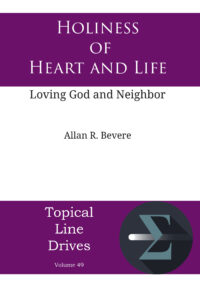
    For a modern view of Wesleyan holiness doctrine, read Allan Bevere’s short volume.

    We do that with scripture. This first, for example, is a balance of asking for God’s grace and favor while also pointing to ones own action. “I’m hoping real hard for this, like I ought to. Make it work!” It’s a very human prayer.

    But the easy thing to do with a great deal of Hebrew scripture is to hear what we expect to hear. We’ve been told this is all about rule keeping and our personal diligence in doing what God wants. As Christians, we look back at benighted writers of Hebrew scripture as not knowing about grace. But the writers of Hebrew scripture were well aware of God’s action and of the need for God’s action.

    We can come to Psalm 119 as a drumbeat of legal requirements and a super-pious, self-righteous expression of the wonder of all these rules. But that’s a bias of our superficial thinking.

    We generally like rules. We like to congratulate ourselves for obeying them. We like to feel powerful and express our personal sovereignty by disobeying them. We like to be in control of what we do about them. So we tend to read that into religious texts.

    But the Psalmist is very human individual looking with awe, hope, and wonder at a Creator God. He knows it’s God’s action, God’s life in him. I commend Psalm 104 as an indication of human dependence of God as understood in Hebrew scripture.

    Similarly, modern followers of John Wesley often take the doctrine of sanctification and treat it as a potential accomplishment of each person, and the attainment of it (supposedly) as a badge of honor and greatness. Getting into heaven is up to God, but being a good, church-going pillar of the community is an individual accomplishment.

    That’s false. The dependence on God starts not at birth, but at the first movement of the first subatomic particle that makes up part of your body. With the Psalmist, we put our hope in God and ask that God takes us to these places.

    Remember that whatever it is, it’s God’s.

    (Featured image generated by Jetpack AI.)

  • Psalm 119:35 – Make Me Do What I Want To

    Psalm 119:35 – Make Me Do What I Want To

    Make me walk in the path of your commands,
    For in it I take delight.

    On first read, this verse can sound very strange. Some translations and some interpreters tend to take a less forceful reading of the first verb, the one I translate “make me walk.” We sometimes think that we do what we want to do when we turn of our good judgment and our will and just go with the flow. But often following the path of least resistance leads to regret and to doing things we very much do not want to do.

    That sounds a bit complicated. Let me illustrate.

    When I was in college and yes, even in graduate school I was a good student getting good grades. The records bear this out. But I had some less than excellent study habits. So I’d end up the night before some assignment was due with nothing in hand and I’d have to work all night. I wanted to have the assignment done earlier. I wanted to work with less tension. I wanted to do a better job.

    But I didn’t.

    I remember the Monday morning when I had a five page discussion of the literary form of French “fabliaux,” a particular form of poetic short story. I would likely not remember the name except for the way I did this. I woke up, realized I have about an hour to produce five pages, get to class and present it to the class–in French, no less. I read one story, wrote five pages, arrived at class out of breath, and presented the paper. I did OK, but I wonder what I might have discovered had I done more study.

    This verse speaks to me in that sort of situation. Following the best path makes everything better, even though I may have to force myself to do it. The path of least resistance may feel good, but it’s not the delight. I join in the Psalmist’s prayer to ask God to put him on that delightful path, the one that comes out with the satisfying result. That call to the best path falls under what we Wesleyans call prevenient grace.

    While we may wish for the good result without following the good path, we generally realize that doesn’t work, and we live with the occasions on which we have followed the easy path instead of the best one.

    Let this verse be a prayer. Lord help me to get where I really, under the guidance and prompting of Your Spirit, want to go.