Threads from Henry's Web

Tag: Prayer

  • There Are Plenty of Opportunities to Pray

    There Are Plenty of Opportunities to Pray

    School is starting, and so we have the regular drumbeat of comments about prayer in school. One of the most common, used at my church today, is the comment that as long as there are exams, there will always be prayer in public schools. Which is, of course, quite true. Also, largely irrelevant.

    Opponents of public school prayer aren’t trying to prevent students from saying, “Jesus help me!” as they start a test. (Well, I should make the “nut” proviso — I’ve discovered that there is really no idea so stupid that there isn’t a nut somewhere who will support it.) No serious opponent of school prayer is concerned with prayer before tests. What they’re concerned with is publicly sponsored prayer. The child is required to be there. The teacher operates with the power of the government. The prayer is sponsored by political authority.

    It’s not my intention, however, to discuss the politics, or to examine from the state’s side whether it’s a good idea for prayer to be prescribed or permitted when led by someone with official authority.

    My concern is with prayer by Christians, or even more with talking about prayer and promotion of prayer by Christians. What we say about prayer and what we do about prayer is important. My observation is that there are a lot more people talking about prayer and advocating prayer than are actually praying. This makes me wonder about the issues we choose to make central.

    During the course of a day I find that I can pray in my bedroom, my living room, my office, my car, walking on the sidewalk, sitting in a restaurant, meeting with a client … Hmmm! Come to think of it, there really are no places or times when I can’t pray in one way or another. The way in which I pray may be constrained. It might not be best to suggest a time of prayer with every client, though honestly most of them would say “yes” if I asked. Each circumstance may require a different approach to prayer, silent, aloud, head bowed, or not, brief, or longer, kneeling (rare for me), or lying down in my bed.

    If I complain that I can’t pray in a public place, I’m really complaining that I cannot make it clear and public that I am praying in that public place. If I’m willing for my prayer to be between me and God, the only ones who can block it are God and me.

    I’m leaving out of this discussion the question of whether it is good as public policy to allow some sort of officially sponsored prayer at public events. Personally, I prefer prayer to be individual or part of a voluntary community. But regardless of this issue, the opportunity exists.

    If your child or grandchild is going to public school, let me ask a few questions:

    1. Will you be praying with that child (if they are in your house) before they leave for school?
    2. Will you be praying for that child irrespective of what anyone at school is doing?
    3. Will you and your church be praying for your children and those of the community?
    4. Will you be modeling a life of prayer for your child or grandchild that makes spirituality inviting?

    I’m sure you can find many other opportunities and ways to proceed with prayer. Too often our underlying concern, as evidenced by our actions, is more with the public display of our spirituality than with the spirituality itself. This doesn’t mean that I believe that if you advocate for teacher led prayer in public schools you are somehow less spiritual. But if you do so without taking the opportunities that are available, it may be time for some self-examination.

    Come to think of it, even if you, like me, advocated for only voluntary prayer, your (our!) primary concern should be what we’re doing with the opportunities we have to pray every moment of every day.

    (Energion books on prayer.)

  • Praying for Our Leaders

    Praying for Our Leaders

    There has been some fuss recently about praying for political leaders, in particularly, regarding an image of folks praying for President Trump. I think that many prayers for and against leaders mistake the value that prayer has. Further, complaining about what other people pray is largely a waste of time, and again reflects a misunderstanding of the value of prayer.

    I recall the quote that “most people want to serve God, but only in an advisory capacity.” (I looked it up and found this attribution to former SBC president Adrian Rogers.) When the majority of our prayers involve telling God what to do, what does that say about our believe in the omniscience, omnipotence, and indeed, the wisdom of God? Many of those who pray positively for President Trump, advising God to destroy his enemies and to prosper the president, also prayed quite negatively regarding President Obama. Just as happens in the broader American society, in Christianity we tend to exchange scripts when the party in power changes. About the same number of prayers get said, and the same number of complaints made. They are just made by different people.

    My prayers for our leaders have not changed with the change of presidents. No, I do not deny having opinions, even strong ones, regarding various political issues. I have just chosen to spend my time on other things. But I prayed regularly that God would bless President Obama, and I continue to pray that God bless President Trump, according to his will.

    How can I do this since I must disagree with substantial policy choices of one or the other? Very simply. I believe that God’s blessing is always a positive thing. Some people worry about prayers that they don’t like. I do not. I believe God can and does work, but I both believe that he doesn’t need advisors, and that he’s not going to let self-appointed advisors get in the way of his divine plan. Some are concerned about “prayers amiss,” but I think that idea is the result of a misapplication of James 4:3, which actually supports the idea that God is not going to respond to a prayer for evil.

    So I welcome prayer, even ones I don’t like. I suspect that if I seek God, I may somehow get closer to him than I was before. The same thing applies even to those who advise God to do things I would disapprove. Opening yourself to God is both dangerous and wonderful.

  • Teaching How to Experience God

    Teaching How to Experience God

    At my home church, Chumuckla Community Church, we’re going through the Experiencing God workbook. There will be 10 sermons, and then discussion groups. My wife Jody leads one right after church each Sunday, and I’m part of that. Doubtless someone will suggest that the book is somewhat more conservative than the theology I express on this blog. I’m delighted that this is the case. Later I’ll read something that’s more liberal and I’ll be delighted with that as well. I believe God is just as happy to talk to conservatives as to moderates and liberals.

    The thing that bothers me about all teaching materials that deal with the experience of God’s presence, whether through listening to the Holy Spirit, expectation and exercising of spiritual gifts, or following God in any other way, is that it is often uncertain ground. In fact, I would suggest that if there isn’t an element of risk, you’re not really talking about experiencing God.

    There are two basic approaches to trying to teach someone else to experience God. First, one can be prescriptive and define parameters. Second, one can be descriptive and open doors. In reality, of course, an individual’s approach will fall somewhere between, but there is usually a tendency one way or the other.

    What I have found is that the most important thing any teacher can do regarding prayer, hearing from God, experiencing God, finding God’s will, or simply sensing God’s presence is ground clearing. Most people who want to hear from God or experience God aren’t simply looking for a formulaic approach they can follow. Rather, they’re usually facing barriers to the experience. Often these barriers are really good approaches they learned from someone else, but which do not work for them.

    For example, my wife and I pray differently. Yes, we have times of prayer together, but when we’re each in our private time with God, we take a different approach. She likes music. I like music, but not when I’m praying. She’ll turn on the music and enjoy her time talking with (with, including listening) God. I start with scripture. I will select a passage and read without forcing the pace. I read very fast when that’s what I intend. In prayer time I read slowly and allow the words to direct me into communion. I will sometimes be directed to a different passage.

    Jody’s prayer time would be really unfruitful if she used my method.  She’s likely to end up looking at scripture, but that will come as she hears from God in her prayer time. I, on the other hand, find music uplifting and energizing, and often use it to get myself charged for work on a day when I’m feeling slow. Right now I’m typing largely in silence. If I had gotten up unmotivated, I would likely have gone up to my office, turned on some music, and would have found myself getting ready to go.

    It’s great to share your experiences. Just avoid telling someone, or leaving them with the impression, that your way is the one and only way to experience God. If you read the Bible stories, you’re going to find quite a variety: Abram just hears, as Abraham he later argues, Moses hears but might rather not at first, Gideon required a sign for each move, Balaam heard through a donkey (hard head there, I think), Jesus was in constant communion. There’s a valuable variety in scripture.

    Experiencing God is great. Don’t be afraid of present experience. Beware of either letting someone place you in a straight-jacket, or of placing someone else in one. God’s way is past finding out. You and I haven’t gone that far!

    (I’ve put some books I publish related to experiencing God into a collection on Aer.io. Check these out!)


  • We Need to Quit Blaming the Media, Politicians, or the Infernal Them

    I call this group of (people | entities | circumstances) the infernal “they” or “them.” They are the people who cause all the problems. They have no moral compass. They are disruptive. They lie. They are apostates, perverts, stupid, deplorable, weak, losers, socialists, libertines (sometimes intended to include libertarians!). Disgusting, all of them. They are doing it to us.

    This is one of the unfortunate results of individualism. There are many fortunate results as well. I am not one who wishes we’d get back to some sort of day when the individual didn’t really matter, and everything was about the collective. Like most “old days,” the reality of the old days is somewhat less [whatever we wanted it to be] than our imagination makes it. There has always been a balance between a view that values the society above all and one that values the individual. The emphasis varies; the elements are still there.

    One problem with western individualism, however, is that we can so easily use it to find ways to blame someone else while separating ourselves. I am not responsible for anything but the things that I, personally, have done. I take no responsibility for what my ancestors did (though I’ll cheerfully benefit from their actions). I take no responsibility for the wrong actions of my church, my party, my social club, or my industry. I, personally, am blameless. In this, I am wrong.

    In politics right now it’s popular to blame the media. Despite the fact that media outlets come from many perspectives, and you can find one as liberal or conservative, libertarian or authoritarian as you might desire (ain’t the internet wonderful), somehow, the collective media is responsible for whatever it is that I think is bad. They have lied and propped up one candidate, they have lied and trashed another. Within the same day I can read about how they have both completely destroyed and totally built up the same candidate.

    This they, a “they” of which the speaker is not a part and does not carefully define, is the infernal they. It is the “they” that commits all evil acts. Besides being infernal it is also highly mobile. It is very hard to find this “they” and cause them to change or take responsibility for “their” actions.

    I’m aware that neither you nor I are responsible for everything. But here’s a suggestion: Drop out of the game of assigning blame for the stuff you didn’t do and take responsibility for what you have done and can do something about. In addition, if you are—and remain—a member of a group, take responsibility for that group. Yes, you can distinguish what you support and don’t, but you are a part of what the group does. This means Republicans, Democrats, Libertarians, United Methodists, Baptists (of whatever variety), and so forth.

    I would like to demote the word “they” in my vocabulary and promote the word “we.” The media is producing material that people watch and that produces sales for their sponsors. Yes, there are some things that the people in media want themselves. But there is little that motivates so effectively in our culture as money. For the media, readers, viewers, and listeners mean money. That’s the “we” I’m talking about.

    We need to be more discerning in our viewing and listening. We need to be active in letting the media know what we do and do not want to see and hear.  But, you say, you can’t really change that whole mass of “them” out there. Don’t worry about it. Change you. Turn your TV off. Visit a different site. Read a good book instead (says the publisher!)

    Try to find the “we” before you utter that critical word. What I can say for myself is that I am often much too fascinated by the seamier side of the world. It is too easy to persuade me to give views to a web site that is saying things that I really shouldn’t support. I can make the excuse that I am “checking out the other side” or “keeping informed,” but it really is just the receiving side of gossip, and the one who listens to gossip is just as responsible, I believe, as the one who speaks it. After all, if every time the gossiper said, “Do you know what widow Jones did?” the response was “No, and I don’t want to know,” gossip would die.

    Wrong needs to be challenged, but let’s start with the wrongs we can challenge using the word “we.” Let’s take our example from the biblical Daniel. I’m reminded of his prayer in chapter 9. By all biblical accounts Daniel was a righteous man. No act worthy of blame is recorded of him. Yet as he begins praying (Daniel 9:5-6a), there is a powerful litany:

    We have sinned, we have done wrong, we have acted wickedly, and we have rebelled, turning aside from your commands and your judgments. We have not obeyed your servants the prophets …

    Yet Daniel had done none of those things. It was not a matter of feeling or being guilty; you can drown in the guilt of others. What he did was he spoke for his people as one of them.

    I think our prayers would be more powerful and our actions more effective if we learned his approach.

  • Thinking, Praying, and/or Acting

    Thinking, Praying, and/or Acting

    Credit: OpenClipart.org
    Credit: OpenClipart.org

    Frequently when there is a crisis or any form of trouble, Christians call for prayer. These calls can take many forms. In addition, a common comment from Christians is that we will pray about a situation.

    Now it’s quite possible that someone who says they will pray will limit their activities to just praying. It’s even possible that they won’t even bother with that. We are all human, and we often make insincere statements.

    I think, however, that the majority both pray and also do other, concrete things. For those who have prayer as an important part of their spiritual life, it can be a critical part of action.

    I discussed this with Dr. David Moffett-Moore, author of Pathways to Prayer, Life as Pilgrimage, and some other books, and I think he made these points extremely well.

    It’s unfortunate that the common perception of prayer, a perception that is far too common in the church, is that prayer is primarily about getting God to do things our way, so that the test of the success of prayer is whether we get something or whether God’s (perceived) action changes. One of the primary ways in which prayer “functions” (a questionable word, but one that will have to do), is by changing us and driving our decisions and actions.

    Here’s the video:


  • Seven Marks: Fervent Prayer

    Seven Marks: Fervent Prayer

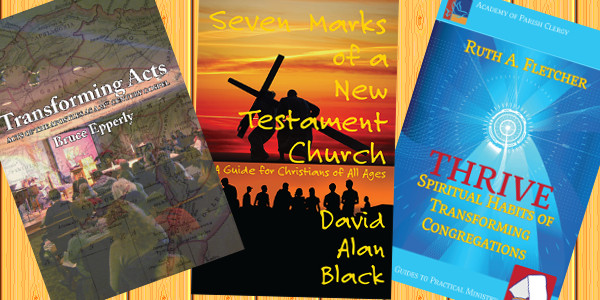
    nt church booksThe sixth mark Dave discusses in Seven Marks of a New Testament Church is fervent prayer (pp. 39-42).

    There are a variety of views of what it means to be “the church” or what it means to be Christian. For some, it’s a matter of holding the correct set of beliefs. One knows that certain things are true and one gathers with other people who know the same things are true, and this is church. Evangelism, in that case, is convincing other people that the things one believes are true and thus they should join this group.

    I exaggerate a little bit here to make a point. I think prayer brings out a problem with this view, and it’s one that has been building through Dave’s book. Notice that all these marks of the church are activities. Dave quotes Acts 2:37-47 on pp. v-vi of his introduction. You might want to read that now. Notice that the description of the church is active. God is acting in the church and so are the people.

    Now I don’t want to suggest replacing believing or knowing with doing. Doing must result from knowing in some sense or from instinct and habit. Even the idea that doing is important involves thought and belief. Often, however, we can tell more about what we actually believe by what we do than by what we claim.

    I recall going to teach about prayer at one church. The prayer coordinator was dismayed at the low attendance of the conference. She told us that the church had determined that prayer was their second priority. In that case how could so few people attend a conference on prayer scheduled by their prayer ministry?

    The answer, I suggested, was to observe what people did, and particularly how money was spent. In particular, look at your property. How is it arranged? What have you spent money on? How much of your money has gone to sports facilities? How much to education? How much to outreach?

    Now I absolutely don’t want you to read that as a negative view of sports facilities. Used well, sports facilities can be a critical element of outreach, and in turn a focus of prayer. The question is what you are actually doing.

    In fact, the measurement of the commitment to prayer should not have been attendance at a prayer conference, but rather time spent in prayer, a prayerful attitude, and ultimately establishing lives of prayer. A conference might help that. Since I have offered a few, I’d like to think so! But one can spend amazing amounts of time in a conference on prayer without actually praying. One can have a nice looking prayer ministry, while neglecting prayer.

    Do we really believe in prayer? I’m not asking what miraculous things prayer can bring, but rather whether we believe prayer can provide communion with God. That, in turn, leads to asking whether we believe God is active in our lives, our churches, and our communities.

    The evidence of prayer in the American church suggests that we don’t. We may believe in prayer as an occasional spiritual discipline on the one hand, or as a means of pushing God into doing things that we want on the other, but as a means of communing with God, either we’re not sure it will work, or not sure we want it.

    Dave talks about an “attitude of prayerfulness” (p. 40). Such attitude is a reflection of belief and practice.

    I want to illustrate this by quoting from one of the other books I’m following through this series:

    Some congregations make a decision by voting; but many churches learn to choose through the process of discernment. Discernment, as it is used in everyday language, has to do with sifting through the information we’ve been given in order to decide a course of action. In the church, discernment describes the prayerful process of making a choice in light of the inspiration, leading, and guidance of the Spirit.

    Discernment can be practiced by individuals or by groups. When transforming congregations make use of discernment as a decision-making tool, they place their choices in the context of God’s transforming activity, assuming that they are called to something larger than self-interest and partisanship. Through discernment, they imagine not just what they want to do, but how they might share in God’s New Creation through the choices they make. (Thrive, pp. 126-127)

    This is a test for belief and practice. Can and will the Spirit guide our discernment? Will prayer help us in discerning what the Spirit is doing and where we can become part of that activity?

    There is a huge difference between having a short prayer at the beginning of a meeting in which you then carry out the normal business of debating (or arguing) and then voting and one in which one seeks to hear the Spirit and come to a consensus. The latter requires a certain amount of trust!

    In discussing the early church’s beginnings and prayer, Bruce Epperly (Transforming Acts, p. 26), under the heading “Don’t Do Something, Wait Prayerfully” says,

    In the wake of the ascension, the apostles return to their meeting place and, for the next several days, constantly devote themselves to prayer. We don’t know the nature of their individual prayer practices. They may have been a blend of quiet contemplation, praise, intercession, celebration of Jesus’ last supper, and thanksgiving. But prayer was their priority as  a community before they undertook any action. They knew that God’s power was coming, and also knew that power without prayer is destructive to us and others.

    “Power without prayer is destructive.” I fervently agree. Fervent prayer is a critical mark because it sets us up for everything else, just as it did the early church.

  • When My Father Was Healed

    When My Father Was Healed

    1893729222_adI was talking recently with a friend who commented that there are certain events that serve as anchor points for our faith. For me, despite all the drifting I’ve done since it happened, one of those points was the time when my father was healed. I alluded to this briefly in a comment on the Energion Discussion Network, and was challenged (or so it felt) to retell the story more often. You can get another perspective on this story from my mother’s book Directed Paths, which includes many other stories of God in action. I was 14 years old at the time and will tell this as I remember it.

    It was 1971 and my parents were called as missionaries to Guyana, South America, where my father was to become medical director of the 54 bed Davis Memorial Hospital in Georgetown. Shortly after we arrived my father required emergency surgery. This took place during the night. The surgeon persuaded my mother not to wake me up, so anything about the surgery is not from my memory, but rather from what I was told. The surgery was on the large intestine and during the surgery there was considerable contamination. In addition, at one point my mother, who is an RN, was left alone as the entire team had to go to an emergency with a delivery in another room. Overall the surgery lasted for four hours, if I recall correctly.

    Nobody wanted to tell me in the morning, so I was successively directed from room to room until I arrived in my father’s room in the hospital where he was connected to various tubes and devices. It was quite a shock.

    He continued to be weak for some time, and his digestive processes and intestines would not restart their function. The surgeon said that he would never work again and would not live more than another 10 years. The mission board began to plan to bring my parents back to the states.

    My parents, on the other hand, did not agree. They said that they had gone to Guyana to perform a mission and that they had not yet performed one. Their choice was to follow James 5, and call for the elders of the church. The elders anointed my father with oil and prayed for his healing and that he would be able to carry out his mission. I was actually quite disappointed with the results that day. It seemed that nothing happened.

    But from that moment, my father’s recovery began. Within two weeks he took over as sole physician for that 54 bed hospital and was on call 24 hours/7 days per week for the next year before any relief came. He served there for seven years and still worked after he returned to the states. He has now gone on to be with the Lord, though since he was a Seventh-day Adventist he would say “to sleep in Jesus.” I have come to not see a lot of difference there. One breath here—the next breath there. Time won’t matter! But he lived into his late 80s, much more than 10 years and he continued to work through to a normal retirement. He was active as a Christian witness up to the time of his death.

    I find that story challenging and encouraging. It’s challenging because my parents refused to leave and give up when everyone else was saying the situation was hopeless. It’s encouraging because when they stepped out in faith on their mission, God was there with them.

  • Thoughts from the Energion Tuesday Night Hangout: Stewardship and Worship

    Thoughts from the Energion Tuesday Night Hangout: Stewardship and Worship

    books tuesday 020216I enjoyed interviewing three different Energion authors last night. The first was Rev. Steve Kindle who talked about stewardship and the importance of starting from an understanding that everything belongs to God. Steve provided some practical steps that a church can use in caring for all of God’s creation. Steve’s book goes into this somewhat more: Stewardship: God’s Way of Recreating the World.

    At about 7:30 pm, a half hour into the program, Dr. Jon Dybdahl joined us. Jon is the author of a newly released book Hunger: Satisfying the Longing of Your Soul. When he experienced this longing as a young missionary he started to pursue the presence of God and co-taught a class in college in spirituality. Jon’s PhD is in Old Testament, but he has a passion for serious worship.

    For the last 15 minutes, he was joined by Dr. David Moffett-Moore. Dave is author of Pathways to Prayer, and has two doctorates, both a PhD and a DMin. It was interesting and challenging to hear two men with so much education of the mind nonetheless tell us that the intellectual paradigm of religion was not enough. Prayer is an essentially. Coming to know the reality of God’s presence and power is essential.

    When I asked Dr. Jon Dybdahl how one would start this in a church as a pastor or other church leader he said the best way was to see your own need and start practicing it yourself. People will sense when your activities in leadership are powered by prayer and time with God whether you’re telling them all about what you’re doing or not. He also suggested a change in terminology that struck me, suggesting we might use “lead worshipper” rather than “worship leader” to take away the separation of the one on the platform from the ones in the pew.

    The video is embedded below:

  • Pathways to Prayer Interview

    Pathways to Prayer Interview

    The Spirits FruitConsidering my recent posts, I wanted to call attention to my interview last night with Dr. David Moffett-Moore, pastor and author of five Energion titles: Life as Pilgrimage, The Spirit’s Fruit: A Participatory Study Guide, Creation in Contemporary Experience, Wind and Whirlwind, and of course Pathways to Prayer (in the Topical Line Drives series).

    I asked Dave about going into prayer in such a way as to simply reinforce what I already think and want. He talks about how important listening is as part of prayer. It’s not a catalog of our desires sent to God. It’s a time of listening and learning.

    I also asked him what to do if one wanted to improve the prayer life of a church congregation or community, and how one proceeds when someone asks for prayer for a specific purpose.

    Dave is practical and down to earth. I really enjoyed the conversation and learned from it.

    The interview is embedded below.

  • Praying and Studying to Change Yourself

    Yesterday I wrote a bit about using prayer and Bible study as a starting point for change. The problem is that it’s very easy to pray and study the Bible in such a way that it makes you a worse person.

    I’ve found a relatively simple way to determine whether I’m doing this myself:

    1. If I’m studying the Bible to figure out what other people are doing wrong, how other people need to change, I’m making a worse person of myself.
    2. If I’m studying the Bible so that by beholding I can be changed, so that I can find out how to be a better follower of Jesus, I’m allowing God to make a better person of me.

    I frequently hear (and have sometimes myself offered) prayers that ask God to fix someone else. If you’re praying for your pastor and asking God to make him or her see things your way, you’re on a dangerous path. Let God make the decisions. It might just turn out that what needs to change in your relationship with your pastor might be you.

    In Bible study I’d take another step and say that one’s general approach needs adjustment. When I started studying biblical languages I imagined that I would discover the original text and read it in the original languages, and thus resolve issues, at least to the extent that I would be certain of what was right and what was wrong. Getting that information was my entire intent.

    As I studied, I found that every aspect of that approach was problematic. Even the idea of an original text wasn’t easy to define. Was I looking for the text that came from the pen of the writer, however inaccessible that might be? Was it to be found in whatever sources were used by a writer? Perhaps the text actually used in the early church was more important than some earlier text that was beyond my reach. Having discovered (or pretended to discover) whatever text I was after I then had the problem with where and how it applied. The hard and indisputable facts were generally in dispute, no matter how long I studied.

    Over time I have come to believe that there is value in studying all levels of the text. Those who prefer canonical criticism look down on form, source, and redaction critics, and claim that the canonical form is the “special” form of the text. Source criticism, just as an example, assumes that one wants to get closer to the roots of the text.

    I find both approaches helpful. One is certainly on less solid ground looking at the prehistory of the text. While I may have doubt about the details of the canonical form of the text, I am frequently in serious doubt about the text’s prehistory. Yet when I’m studying the text to see God in action, I am always able to listen for the voice of God. Sometimes that voice will even get through the static of my own thoughts.

    Talking to God and listening to God are about changing me. Only when I first focus this on me will I be in a position to help someone else. If I respect them and love them as I believe God loves me and calls me to behave, I have to allow them to behold and become changed (2 Cor. 3:18) as well.