Threads from Henry's Web

Tag: Philippians

  • Psalm 119:56 – Mine!

    Psalm 119:56 – Mine!

    This has become mine,
    for I have kept your precepts.

    There’s an interesting translation of this verse in The Message, which may very well go back to a suggestion by Mitchell Dahood, though I don’t know that Eugene Peterson got it from that source.

    Still, I walk through a rain of derision
    because I live by your Word and counsel.

    There’s a single word that makes the difference between my translation (and most others) and Peterson’s, the Hebrew word zo’th which I have translated in the traditional way, “this.” There is a suggestion, expounded by Dahood, that this same word can mean “derision.” I don’t see that here, but again, I like us to think about the effort that goes into translation, and the reasons there are differences.

    When translated “this,” we have to ask to what “this” refers. I’m simple minded on this one. “This” here is feminine, and there’s a rather important feminine noun which is the very last word of the previous verse: “Torah.”

    This, God’s instruction, God’s self-revelation as I have been saying, belongs to the Psalmist. It also belongs to me and to you.

    I was listening to Isaiah 15 on the treadmill a few minutes ago. Isaiah 15 begins with “An oracle against Moab.” What could possibly be less edifying? What do I need with an oracle against the Moabites, a group of people no longer existing. And the chapter is pretty much a downer. But what’s most interesting to me is that God actually has an interest in this, and that this interest is expressed by including this chapter in the collection of oracles in Isaiah, and then that collection in scripture. God’s interest in lands beyond Israel will become even clearer in what is called 2nd Isaiah, starting in chapter 40.

    [H]e says, “It is too light a thing that you should be my servant to raise up the tribes of Jacob and to restore the survivors of Israel; I will give you as a light to the nations, that my salvation may reach to the end of the earth.

    Isaiah 42:6 (NRSV)

    So even though God’s Torah was not addressed directly to me, it was intended as a light to me and to everyone.

    I’m pretty sure “this” that the Psalmist is claiming is the Torah. It is his, because he observes it. Now we have this continual reference to obedience providing the claim. But remember that the Psalmist regularly calls on God to help him, to make this possible.

    As a Christian, I cite Philippians 2:12-13:

    With fear and trembling work out your own salvation, for it is God who works in you both to desire and to accomplish his good will.

    If God’s self-revelation is yours, it is yours as God’s gift, but it will also be a cause of action, because God isn’t passive about God’s children.

    Is it yours?

  • The Moral Influence of Jesus’ Death

    The Moral Influence of Jesus’ Death

    In my Sunday School class yesterday we discussed Mark 15. We’re reading this with Allan Bevere’s Keeping Up with Jesus: A Narrative Devotional Commentary on Mark.

    In the thought questions for chapter 15, Allan asks both why Jesus is silent at his trial as depicted in Mark, and what it means that Jesus died for our sins.

    On the first question, there were a number of answers, including simply, “prophecy,” that it was expected. But I want to focus on one note I make myself about this, because it relates to the third question, which is how we understand Jesus dying for our sins. (There are three questions following each chapter in the commentary. I’m focusing on the first and third.)

    In a trial with a foregone conclusion, there is really no point in making a defense, unless you are doing so for someone listening. In this case, I suspect the crowd is well selected for hostility (at least of the moment), and thus not prepared to actually listen to a defense.

    This leads me to what I think is a key point about the death of Jesus. It creates a story of contrast and of black and white confrontation. Nobody is seeing the day in shades of gray. In a book by one of my favorite authors, David Weber, there’s a quote by one of the characters, which I paraphrase from memory here: “Very few days are outlined in black and white, and most of those days have a body count.” I don’t know if that quote is original to Weber, and I can’t locate the correct book, but it’s good.

    The day of the crucifixion was not set out in gray, and it definitely had a body count. It creates the moment of contrast between what good is willing to do and what evil is willing to do. Good dies for others; evil kills what it does not like.

    A portrayal such as this is one that day to day reality can’t really live up to. We don’t have the clear line drawn in the story. We have our struggles both to understand and to do. But that is a critical value of the story: It drives us to higher ground. If we let it.

    So what did this have to do with the third question. What does it mean that Jesus died for our sins?

    What I loved about this question was that it called for each person to think: What does that mean to me? It’s easy to be very prescriptive. We like to have one interpretation and get everyone to understand it.

    The Values of Multiple Metaphors

    I would suggest that no single metaphor can possibly do justice to the atonement. It’s a good thing we don’t have only one!

    Moral Influence

    As an undergraduate working on my degree in biblical languages, there was a required course on exegesis of Romans in Greek, to be taken after I completed intermediate Greek. The professor for this class was an advocate of the moral influence theory of the atonement. This theory is often presented simply as Jesus providing an example in his life of how we should live and influencing good behavior in us.

    That’s not the whole story. In that theory, the portrayal of good and evil meeting at the cross becomes a powerful influence, a powerful changemaker.

    I didn’t get that in class. I wanted something other than penal substitutionary atonement, and I hoped that I could accept what this scholar presented. I wanted to read this view in Romans. I tried to do so diligently.

    It never worked.

    It took me some time to realize that there was something here for me to take in and make a part of my understanding. That portrayal, brutal as it was, was a necessary part of the story of salvation. It was easy to miss this in other views. Then I started to see other metaphors for the atonement, and to see how they build a picture.

    Penal Substitutionary Atonement

    In fact, I came back to appreciate the courtroom metaphor presented by penal substitution, which, among other things helps portray completeness, and finality while excluding the idea of us earning the result. I have conservative friends who still think I’m ditching this dominant evangelical view of the atonement and progressive friends who wonder why I don’t just ditch it. To me, however, each of these views is essential. Since this is not my main topic, I’ll leave it at that.

    I turn next to expressions of faith by the Apostle Paul. Paul can be an annoying character. He covers a lot of ground and expects you to keep up.

    About Paul

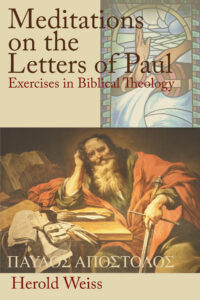
    I was interviewing author Herold Weiss, author of the book Meditations on the Letters of Paul in a series I did titled “Who Was Paul?” One question I asked was this: Let’s imagine you’re at a conference and you have the duty of introducing Paul as the next speaker. What do you say?

    Herold laughed and said, “I don’t have to answer that. You see, Paul would never have been invited to speak in the first place!”

    He’s likely right. Paul was too much of a disruptor to be invited to church conferences. It was much more likely that conferences would be held to talk about him and what he was doing, such as in Acts 15.

    Paul, Good and Evil, and Crossing the Line

    In many of Pauls’ letters we have what looks like a theological section, which generally talks about salvation and will frequently inform you that it is not of works. Then you move to a section that talks about things you ought to do. Often these sections are presented as distinct, as though Paul had multiple personality. “Not of works, now get to work,” so to speak.

    I think a closer look will allow these to be coordinated, and I think Philippians is an excellent place to do so. The reason is that until chapter 3, which seems to be a kind of side-tirade, Paul is ready to go through the basics quickly.

    By Philippians 1:27 he’s telling his readers/hearers to live in their community in a way that is “worthy of the good news (gospel).” He wants to hear that they are “standing firm,” and “striving together” for the gospel. He continues that God has granted the the privilege not only of believing (a privilege, a gift, not a purchase), but also of suffering for Jesus as well.

    Not of works. Here come the works.

    Well, yes and no. Paul is writing here, I think, on that line drawn between good and evil at his crucifixion. You get a choice. Are you a crucifier or are you crucified?

    Too often Christians have answered that they are with the crucified one while picking up nails and erecting crosses.

    Persecuted or Persecutor

    I was asked once in Sunday School who I thought was right when two groups were fighting over doctrinal points, really fighting, to the extent of killing one another. It has happened way too much in Christian history. I said that anyone who was killing the other one over their beliefs was wrong. Killing people in the name of the one who went to the cross silently and said, “Father forgive them,” is blasphemous.

    Have I departed from Paul and his letter to the Philippians? I think not.

    How to Look at Other People

    Paul now tells the Philippians to make his joy complete (2:2) by being of one mind (sharing viewpoint) and having the same love. Nothing is to come from selfishness or vanity, but they are to regard others as better than themselves (2:3) then also look to the interests of others, rather than their own.

    I think Paul is looking at that line. Are you a crucifier or are you with the crucified?

    Philippians 2:5-11 is a famous passage. Jesus emptied himself, humbled himself, became obedient, and went to the cross. Others called for his blood.

    This was a portrayal of the nature of good and the nature of evil. That is something we should not forget about the crucifixion, if for no other reason that we avoid becoming the persecutors.

    As Paul says it in Galatians: “I have been crucified with Christ. I’m no longer the one living, but Christ lives in me” (Galatians 2:19b-20a). That’s the line drawn in morality and in history. Paul has no intention either in Philippians or in Galatians of telling his hearers that this is easy. He doesn’t suggest that everyone will love them after the decision or that they will get a new job, drive a better car, or be suddenly totally free of disease.

    Be crucified with Christ.

    Identifying the Power

    Things start going off the rail again right here. We think that having been crucified with Christ, or at least made the choice of which side of that line we want to be on, we must get on the ball and be better people.

    Indeed, Jesus was exalted after death and given the name above all names. But first he went to that cross, was taken into the tomb, and was raised again by the very power he laid down in the first place.

    Remember where the power comes from.

    Having died, and been buried with him by baptism, you don’t come back and start fixing yourself.

    “So, if anyone is in Christ, there’s new creation. The old stuff is gone. It has all become new.” (2 Corinthians 5:18b)

    You can’t sanctify yourself. You’re dead. You’ve got no stuff at all. It’s all new, and it’s all His.

    Who Works?

    So back to Philippians and one of my favorite passages:

    (12) So, my beloved, just as you have always obeyed, not only when I’m there, but also when I’m away, with fear and trembling work out your own salvation. (13) For it is God who works in you all, both to will and to accomplish his pleasure. (Philippians 2:12-13)

    So how does this work?

    I wonder why it’s so hard to see God at work in us morally when we already know God is at work in us. If you are a believer in God and that God is the creator, then everything, ultimately, is a gift of God. I could paraphrase this physically as “Do your own breathing with fear and trembling, for God is at work in you both to make you want to breathe and also to make you breathe.”

    I don’t think that’s a ridiculous way to put it. I couldn’t type the next letter without God. God makes the various particles move around in a certain way. God brought me into the world. I can’t even make mistakes without God.

    If you try to take over and do your own working, that just makes everything harder. God knows that and has a plan for all that as well. God makes you want. God works in and through you. But ultimately it’s all God.

    If you go try to do it yourself, then it’s like jumping back to the person who just died, forgetting about being buried and raised to new life by divine power, and deciding to do it all just as if none of that every happened.

    Does this mean there’s nothing to do? Actions are still important. Actions have consequences. Paul even says this in Galatians, his strongest book against works of the law. “Don’t be deceived! God is not mocked! Whatever a person sows that person will also reap” (Galatians 6:7).

    The Life Context of Commands

    Again we have to look at context, in this case, life context. Not every command, not every discussion of good and bad, smart and stupid, effective and ineffective is about whether or not you are saved or have eternal life. Deciding someone’s eternal state is not my job and it’s not yours. Let’s say that I am hiking a trail in some beautiful mountains, tremendous beauty all around, and I get careless, lose my step, and fall off a cliff. Gravity (created by God) still works. The ground (created by God) is still hard. My body (created by God) is still not up to a fast encounter with a hard place. I die.

    Are the mountains still beautiful? Yes.

    I also still have eternal life.

    But it would have been a good idea to be more careful.

    The Invitation

    The invitation to salvation is not an invitation to an untroubled life. It’s not an invitation to always make perfect decisions. It’s not an invitation to comfort.

    It’s also, and this is critical, not an invitation to think of yourself as better than other people. It’s not an invitation to be God’s favorite grandchild, spoiled rotten and looking down on all the other children who have somehow failed to earn all that love.

    If you thought going to church was joining the popular kids’ club and becoming one of the important people, you missed the point. If you get a charge out of feeling superior, you’re missing the point.

    “Looking to Jesus, the author and completer[sic] of our faith …” (Hebrews 12:2).

    Completion

    Read Philippians 2:5-11 again. Try to imagine just what it was that Jesus thought was not something to hang onto, what Jesus gave up. That’s where God is taking you. Don’t diminish that by looking sideways or looking back. When your measuring stick is God’s glory and God’s grace, the differences in human beings are literally not measurable.

    And just as Jesus not only went to the cross and the grave, but rose again and ascended, so we now that God will complete what God has started.


  • Following the Path of Jesus

    Following the Path of Jesus

    On January 1 God called two texts to my attention as themes for the year. They are Philippians 1:27-30 and Ephesians 5:1-2. I haven’t said a great deal about this, though the theme of those texts has shown up in a number of posts. Then yesterday I saw Dave Black’s latest translation of Philippians 1:27-30, which I like a great deal, and I wanted to mention it. Reading a text in a modern, clear, might I say dynamic, rendering brings it home. Here’s the translation:

    Now the only thing that really matters is that you make it your habit to live as good citizens of heaven in a manner required by the Good News about Christ, so that, whether or not I’m able to go and see you in person or remain absent, I will be hearing that all of you, like soldiers on a battlefield, are standing shoulder to shoulder and working as one team to help people put their trust in the Good News. Don’t allow your enemies to terrify you in any way. Your boldness in the midst of opposition will be a clear sign to them that they will be destroyed and that you will be saved, because it’s God who gives you salvation. For God has granted you the privilege on behalf of Christ of not only believing in Him but also suffering for Him. Now it’s your turn to take part with me in the life-or-death battle I’m fighting — the same battle you saw me fighting in Philippi and, as you hear, the one I’m fighting now. (emphasis mine)

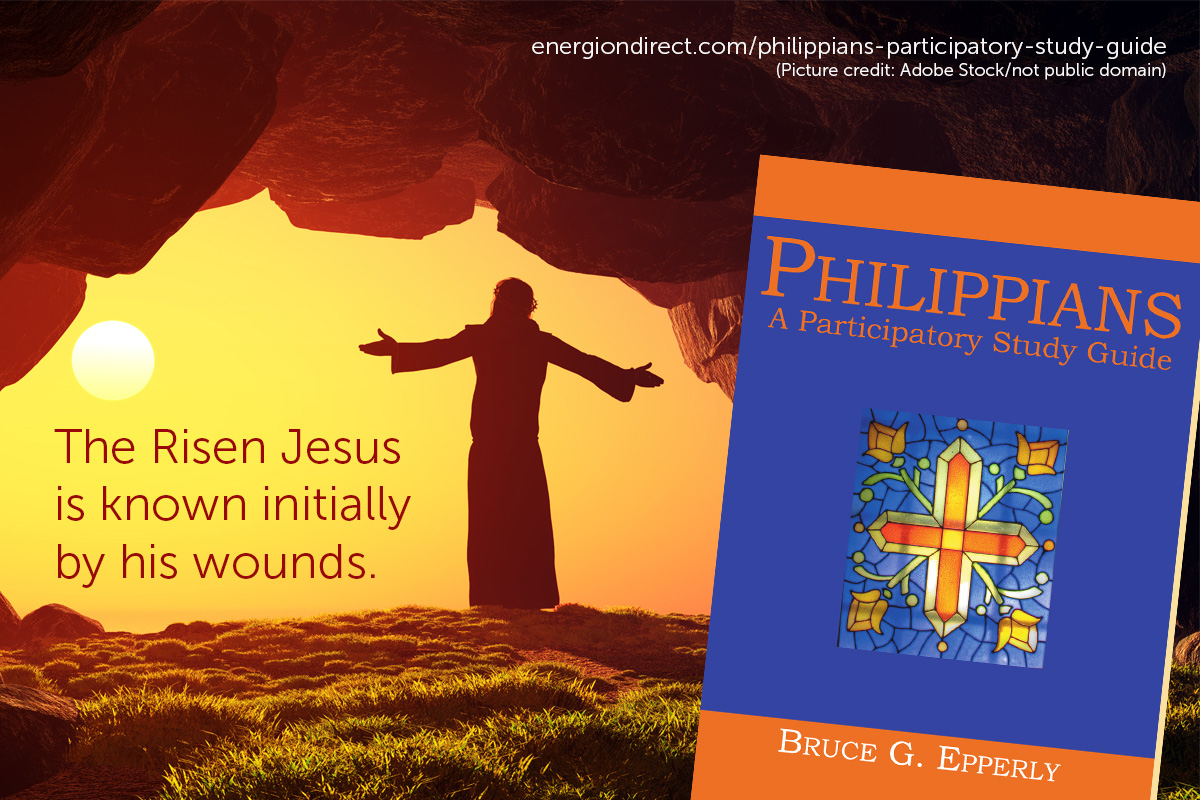
    This emphasized line led me to a quote from Bruce Epperly’s book Philippians: A Participatory Study Guide:

    Even now in our time, we can take confidence in Paul’s assertion that God is with us and that, in life and death, and celebration and persecution, Christ sustains us. We are resurrection people. But, our lives are also cruciform or cross-shaped. The Risen Jesus is known initially by his wounds, and we too may experience suffering and loss as a result of our relationship with Christ. Still, at the end of the day, integrity, fidelity, and the promise of resurrection life far outweigh any trials of this lifetime. – p. 19

    Bruce also quotes the song “I have decided to follow Jesus.” It’s a good song, but it’s one that should be very hard to sing. No, not musically, but due to meaning.

    (I must note here in passing that I love to use materials that come from very different theological streams. It is especially important, I think, when people from opposite sides of the spectrum agree fully on the meaning of a text, even more so when that text says something people would often rather not hear.)

    On the night when Jesus was betrayed, there were twelve people (at least) who had decided to follow Jesus. One betrayed him. One denied him publicly. The rest “advanced in the opposite direction.” We can take hope from the fact that so many found their way back!

    Ephesians 5:2 similarly gives us a hard call “walk in love.” Now we like that, because we often call very unloving things “love.” But the verse goes on “just as Christ loved us and gave himself for us. We have a very clear pattern for what love actually means. I’m a love proclaimer. I believe in the power of love. The reason love so often seems wishy-washy, that it so often fails, is that what we call love is often partial. It is not commitment, but rather a sort of generic liking. That’s why the key to following Jesus is not the experience of miraculous physical acts, or wealth, or healing for everyone in sight, or healing of all our emotional ills. The key to following Jesus is the willingness to take up the “privilege” of suffering for him.

    This, I must confess, is not the true story of my life. Nonetheless, just as I can travel northward by using the pole star as a guide even though I’ll never reach it, so I will keep facing this way, and trust in the grace of the One who gave himself first.

    (Allow me to call attention to two previous posts: God Perfected through Suffering and Thankful for the Gift of Suffering for Jesus?)

  • Not Just Money

    Not Just Money

    On New Year’s Day this year I was struck by two texts and decided to make them a kind of theme texts for living during the year. I didn’t really make a plan or a resolution. I was just impressed to keep these two texts available and look at them. I’ve found that I actually end up looking at them at random times. They are Philippians 1:27-30 and Ephesians 5:1-2. At some point I’ll talk about the phrase “be imitators of God” in Ephesians 5:1, which I find challenging, or perhaps intimidating would be more the word.

    Today, however, I read on after the end of chapter one into the first four verses of chapter 2. Here Paul challenges the Philippians to do nothing from selfish ambition or contentiousness (two  closely related ideas!) or from vanity (we could spend a day meditating on that word), but to count others as greater than oneself with humility. Again, we could talk about the latter. Have you ever experienced someone counting something else greater than himself with no humility at all? “Look how great I am! I count even this lowlife failure as more important than I am!”

    But then there’s verse 4: “Don’t look out for your own interests, but for the interests of others.”

    Now there’s the one. If the church should have a key verse, this would be it, I think. It contrasts to the world’s value, expressed to me once by someone advising me on my business: Ain’t nobody cares about your business like you do!

    Now you see how my thinking turns toward business and the making of money. I have nothing against those things, but it’s actually quite easy to be generous with your money and to be contentious and vain with everything else. Thousands of brass plates on church pews, stained-glass windows, and other objects designated for “spiritual” use testify to the fact that there are people quite generous with their money while satisfying their vanity. If you don’t believe me, try removing one of those labeled pews or swap out the stained glass window. Even worse, leave the pew or the window there but remove the name plate. Vanity will jump up and slap you in the face!

    Looking after our own interests crops up everywhere. Why is the color of the church carpet a very contentious thing? We all have colors that we’d like to look at, and colors that we don’t find pleasing. How many times have you heard people argue carpet color on the basis that it would serve someone else better?

    What about a misspelled name in the bulletin when someone serves on Sunday morning? Have you ever heard the complaints about that? The church secretary ought to be fired!

    I don’t mean to list all the ways we can be contentious, as they are so numerous, and so many of them do not have to do with money.

    “Look out for the interests of others,” says Paul.

    One of the great problems with our witness in the American church is that we are so much like all the people we’d like to witness to. We want to explain all the theology to them and get them all straightened out. But what we really need to do is look out for the interests of others.

    And to be a good witness, we need to extend that action outside the church community as well.

    On page 25 of his little book Stewardship: God’s Way of Recreating the World (Topical Line Drives), Steve Kindle quotes 2 Corinthians 8:3-5. I’m just going to highlight one clause: “they gave themselves first to the Lord.” That’s the foundation of stewardship. It’s also the foundation of living in Christian community, and it’s the foundation of being an actual witness (not just a nuisance) to those outside the community. Looking out for God’s interests, perhaps. God is very interested in God’s children, in God’s creation.

    Who is welcome in your church? How will they live with you? How will you live with them? Do you give yourself to God first and then look out for the interests of others instead of your own?

    If you’ve followed me this far, let me suggest a question to think about. If a man and a woman entered your church this Sunday and the woman was wearing a hijab, while both clearly looked middle eastern, what would your reaction be?


    (Featured image credit: Openclipart.org.)


  • Thankful for the Gift of Suffering for Jesus?

    Thankful for the Gift of Suffering for Jesus?

    Because you have been graciously given this on behalf of Christ:
    not only in Him to believe,
    but also for Him to suffer. (Philippians 1:29, excessively literally)

    I’ve been meditating on two texts as the new year begins, Philippians 1:27-30, and Ephesians 5:1-2. I’ve been kind of ignoring this suffering thing so far. But last night listening to music in worship at Freedom Church Pensacola, it suddenly struck me to think: Do we have any songs in which we actually praise or thank God for suffering? There may well be, but I don’t recall one off-hand.

    This is certainly not a criticism of the church I was in at the time I thought it. I don’t recall this sort of thing anywhere. We don’t talk about it in the way Paul does here. In fact, we don’t really want to acknowledge the reality of suffering. Often our singing, praying, preaching, and indeed our living presents the pretense that nothing ever can or will go wrong. Have you ever heard anyone say in church, when a testimony is called for, that they have had a horrible week and just don’t know how they can go on? No! That’s a sign that they’re crazy. The intelligent and sane ones pretend.

    I don’t think Paul is saying here that suffering is wonderful and good in itself. I think the privilege is that the suffering that will come—and despite our desires, it will—is not vain and of no worth, but rather it is suffering on  behalf of the kingdom. It’s not cheering that there is pain, but rather cheering from the pain that whatever happens is not in vain.

    This reminds me of the Battle Hymn of the Republic and the frequent change of the line “as He died to make men holy, let us die to make men free” to “as He died to make men holy, let us live to make men free.” (You can find more on this here.) Those who have served in the military know that dying may be necessary. It’s not what you live for, but many people have faced death for their nation. Many Christians have faced or are now facing death for their faith. It’s a reality, but just as we change the line in the song, we’d rather not talk about it. Certainly, we don’t want to sing about it.

    Conducting ourselves in a way that is worthy of the gospel (Philippians 1:27) may involve annoyance, discomfort, suffering, and even death. God’s gift is that we do it in, with, and through Jesus Christ.


  • Update on The Way Sunday School Class

    Philippians: A Participatory Study GuideWe’ve completed our study of Philippians using Bruce Epperly’s study guide (Philippians: A Participatory Study Guide). This is the second time I’ve taught Philippians using that guide, and I’d like to compare the two experiences. This will tell you something of the nature of the guide.

    The first time I used this, it was in advance copies, and with a class that was much more interested in the facts (or perhaps data) and discussing the theology of the book and how it applied. They appreciated substantial sections of the book, but were not interested in what I consider the main feature, which is the spiritual exercises/activities. I don’t mean this as a critique of that class–a class or small group can be formed for many purposes, and they definitely found enough of the material they were interested in the book and in the discussion questions. We ran out of time on every lesson.

    In the more recent study, the class group was much more interested in spirituality and spiritual disciplines. Members repeatedly commented on how they normally don’t like printed prayers, but that the prayers were exceptional and right on target. We used the prayers and the accompanying meditations or actions in every class session, even to the exclusion of time to complete all the questions. And if you’re being serious with this guide, you won’t have time to discuss everything that is offered.

    Used in this way it is a transformative study, and that is the greatest strength of this particular study guide. I really enjoyed working through the book myself.

    For those who may decide to use this guide I do recommend following the suggestions for readings. In several cases we read passages from The Voice during the time in class. One might use The Message instead (in fact, I still prefer it), but there was a good deal of discussion of The Voice online during the course of our class. But simply reading the passages from the different versions in class time often opened enlightening discussions and times of meditation.

    The Journey to the Undiscovered CountryWe’re taking a brief interlude now in this class before we start another Bible book. The group has chosen to read the new book by William Powell Tuck, The Journey to the Undiscovered Country. There will be an opportunity to let more people in the church know about our class and invite them to join us on August 26, and then we’ll start a new study, probably using Ephesians: A Participatory Study Guide by Bob Cornwall.

    Note: This class was formed with the intention to use the participatory method and guides and continue regularly studying Bible books and passages.

  • Bruce Epperly Interview on Philippians

    Bruce Epperly, author of Philippians: A Participatory Study Guide, was interviewed today on WGTS. I’m listening to this right now and it’s great! He’s applying spiritual disciplines from the book to daily life.

  • On Publishing Philippians: A Participatory Study Guide

    Philippians: A Participatory Study GuideThis post will contain reflections both on the recently released Philippians study guide and the series of which it is a part. I generally write such reflections after each book my company releases. So be warned—there are products discussed here!

    When I first created this blog I was the only author in the participatory study series. Making a book series grow and sell usually requires a great vision pursued relentlessly. This series, on the other hand, has grown and substantially improved its original vision.

    When I first wrote To the Hebrews: A Participatory Study Guide and Revelation: A Participatory Study Guide, I didn’t feel any great optimism that I could break into a very competitive market. People write Bible study guides all the time. Quality varies dramatically, and often the best sellers are those written by people with famous names.

    What I wanted was a system that brought together biblical scholarship, spiritual disciplines, accessibility to lay people, and a somewhat ecumenical approach. I must specify that my view of ecumenism is not homogenization, but rather a willingness to engage in respectful give and take and especially to look at multiple traditions when choosing sources and study materials.

    I wrote those two books myself, and I had an upcoming class in mind with each one. You can see by the design of the books that this was early in my own publishing experience. From the point of view of developing the company, I needed titles. With the process we use, I can produce study guides for my own use quite economically. My thought was that if these guides sold successfully it would be great, but I wouldn’t count on it, and I would put my efforts into finding authors with manuscripts of their own, not ones following a plan I had designed.

    In the event, not only have I taught from them myself more times than expected, but I’ve seen them sell quite a few more copies than I had thought possible. No, they aren’t threatening to be on anyone’s best seller lists, but they have definitely exceeded my initial expectations.

    A few years after I had released those first two guides Geoffrey Lentz approached me with  a study outline from the book of Luke. Geoffrey had invited me to teach one of his classes from my guide to Hebrews, and he liked the outline of the method, but also the proposed freedom for working within the framework. I liked his outline and his idea, and the result was The Gospel According to Saint Luke: A Participatory Study Guide.

    Geoffrey really rounded out the idea of the series by improving the presentation and tying the method more closely with lectio divina. He at first proposed including both a discussion of lectio divina and the introduction to the method that I had produced, but once I looked at his connections, I suggested we work together to combine the two. Participatory study and lectio divina are not identical; participatory study provides more of an emphasis on resources and critical questions, yet the two work together very well.

    Once I saw the completed study guide to Luke, I knew immediately that if I could find any more authors for the series, I would present that volume as the guide to how we would structure study guides.

    After Luke, Geoffrey and I got together and wrote Learning and Living Scripture: An Introduction to the Participatory Study Method. In that book, Geoffrey’s more pastoral concern and my more technical emphasis combine and lay out the method along with exercises.

    Since then we’ve introduced Ephesians: A Participatory Study Guide, by Bob Cornwall and most recently Philippians: A Participatory Study Guide by Bruce Epperly. Each new author has brought something unexpected to the method and to the particular book they present. I don’t want to describe one book or another as “best.” (I do plan to revise my two volumes to incorporate some features in layout and presentation learned from later volumes.)

    I had wondered just how well someone could take the basic framework and yet use their own gifts and emphases in producing an effective guide. I couldn’t have been more pleased when I read the following sentence in Bruce Epperly’s preface to Philippians: “Henry provided a vision for this study and gave me permission to work out the details in a way congruent with my gifts as a pastor, teacher, and spiritual guide.”

    This was not so much pleasing as a pat on the back, though I admit to being delighted when my work is appreciated. More than that, it indicates that someone whose gifts differ dramatically from my own was able to exercise those gifts within this framework and produce what is truly an exceptional study guide. I’ve gotten some comments from people who wonder about one statement or another. Bruce is a progressive theologian and an adventurous theological writer. But nobody has said it doesn’t challenge them to press boldly on toward the mark.

    I look at the way the series is developing—and there are several more volumes either in progress or in preliminary negotiations—and I’m truly amazed. I wish I could say I envisioned the quality of the people who would submit proposals for inclusion in the series, almost all of them with doctoral degrees and considerable experience teaching. I wish I could say I’d envisioned what’s happening to the series—but I’m delighted that the result is better than I ever imagined.

    I encourage you to take a look at this latest study guide. Not only will it challenge you to take a more serious look at the content of Paul’s letter to the church at Philippi, it will challenge you to take what you learn seriously and apply it in your own spiritual life. Each lesson starts by asking you to open yourself to the Spirit in some way and concludes by challenging you to carry what the Spirit has done out of the church or classroom and out into the world.

    I have been very pleased to publish every book I have published since I started Energion Publications, and I don’t want to take anything away from those books. Yet my heart is in getting the people in our church pews, not to mention those who rarely show up there, to learn the joy of exploring the scriptures while listening to the Spirit. Thus Philippians: A Participatory Study Guide will always have a special place in my heart. It does an extraordinary job of accomplishing that mission.

    There are review and evaluation copies of all the participatory study guides available, If you’re interested, e-mail me with the reason you want one, and I’ll take care of it.

  • Quote of the Day – Way of Christ vs Way of Caesar

    From the forthcoming participatory study guide to Philippians, by Bruce Epperly:

    The way of Christ differs markedly from the way of Caesar, who was also worshipped as a deity. Christ’s peace is based on non-violence and inclusion, while Caesar’s peace is based on the sword and subjugation.

    (Used by permission.)