
Threads from Henry's Web

Tag: New Testament Library

  • Book Notes – Hebrews: A Commentary (NTL)

    Book Notes – Hebrews: A Commentary (NTL)

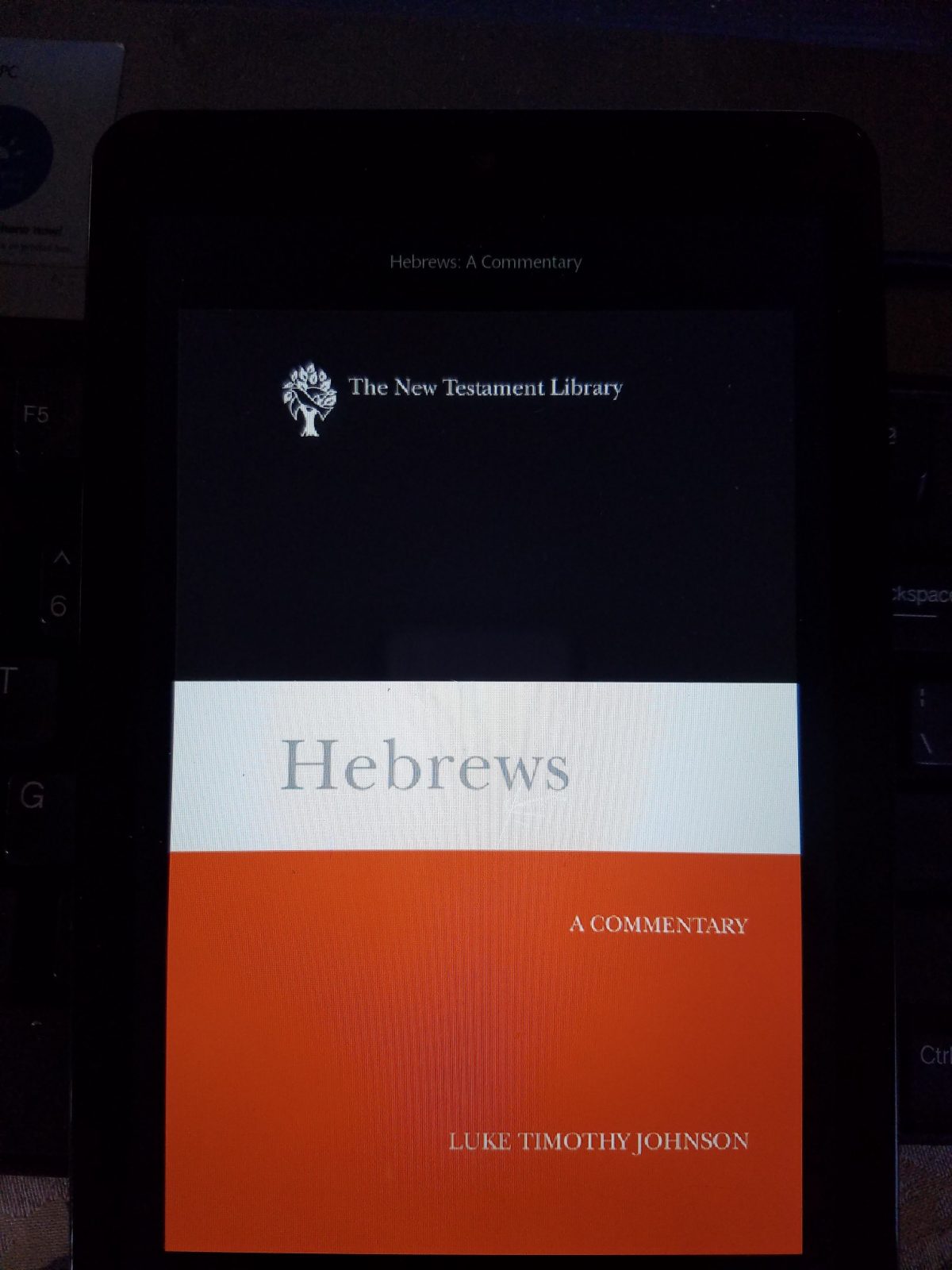
    I recently worked my way through Luke Timothy Johnson’s Hebrews: A Commentary (New Testament Library) along  with the Greek text, and I’m going to write a few notes on the book, which may, or may not, constitute a real review. Time will tell!

    The problem with many blogger book reviews is that they often amount to no more than various length notifications as to whether the author liked the book or not. There are some really wonderful exceptions to this, and you really can find a great deal of information about a title in the blogosphere, but you can also read many words (such as these) which don’t tell you a thing! As an alternative, you get an argument against everything the author wrote in the book, usually without sufficient quotations or references to let you get a feel for what the reviewer is arguing against.

    In my view the ideal review identifies the goal(s) of the book, comments on how successful the book was in accomplishing these goals, has some interaction with the ideas, and finally has a summary evaluation which is based on the stated goals. I recall reading a book about Christian apologetics. I thought it was well written, carefully argued, and thorough. There was one problem, however. The author claimed in the introduction that he would close all the holes in arguments from Christianity and the Bible. He compared the work of others to putting one leaky bucket in another: You slow the leak but you don’t stop it. He was going to stop it. In the end, if I was asked whether I liked the book, I would have to say “yes,” despite (or even because of) the fact that I disagreed in many places. Yet in a review I would have to say that the stated objective was not achieved, and making a claim that one would accomplish such an objective was, shall we say, suboptimal.

    In the case of a commentary, the difficulty is greater than with an ordinary book. There are two key problems: 1) Many people have very fixed ideas of what a commentary ought to do, and little forgiveness for a commentary that doesn’t accomplish their list of goals, and 2) People (particularly scholars) have quite a variety of very fixed ideas. No matter how you choose to write a commentary, no matter how large or small you make it, and no matter how carefully you draw compromises between never completing the task and short-changing the reader, someone will complain.

    I would like you to note here my own inconsistency. I’m writing in prescriptive language about what ought to be in a review, while arguing against prescriptive ideas about writing a book. I will live with this inconsistency.

    Besides, this isn’t a review. Here are my general thoughts.

    I found Hebrews: A Commentary by Luke Timothy Johnson to be the most helpful commentary I have read thus far in terms of stimulating theological reflection. By that I mean that the author doesn’t merely provide a view, but he argues it in such a way that it stimulates new thinking. My personal response to some of his views is that they are perhaps a little too tied to orthodox theology and a little less daring than the book of Hebrews deserves, but that is at the nit-picking level. Johnson knows how to present quite orthodox theology in a way that is challenging and helpful.

    As I studied using this commentary, reading the Greek text and taking second looks at the textual notes, I often found myself reflecting for some time after I’d read my chosen portion for the day. I rarely find that level of stimulation for thought in a commentary.

    This is not David Allen’s volume in the NAC series. Dr. Allen covers everything and references everything. The only negative thing I would say about his commentary is that I have to have some energy built up before I go to consult it. If you want a detailed and complete survey of the topic along with arguments in favor of a particular solution, but all means use David Allen’s work. On the other hand, if you want to get more quickly to the topic for teaching and preaching, use Luke Timothy Johnson.

    I know we don’t like to think that we might shirk some portion of the possible study of a passage we’re going to teach or preach. We’d like to think that we covered everything before we tried to present an exposition to others. But we all face the clock. Brevity is not a sin.

    So when I want to get right to meditating on the text, but with some solid meat to set it up, I turn to Johnson’s commentary.

    Now I haven’t called this a review, yet I’d like to present some interaction. I’d suggest, however, that I’ve already done this in blog posts on Hebrews written after reading material from Johnson’s commentary. You can start with Hebrews and the Problem of Writing Introductions. I could provide a number of links, but the simplest thing to do is to type “Hebrews” in the search box after you get to that article. Nearly everything I wrote on Hebrews after that point references Johnson.

    Note: I read

  • Commentary: II Corinthians (NTL)

    I have really enjoyed studying 2 Corinthians with this commentary.  Since I’ve used a number of volumes from the New Testament Library before, the easiest evaluation of this commentary I can give is that it meets and in some cases exceeds the expectations I have of volumes in the New Testament Library series. If you have used and liked other volumes in either the OTL or the NTL, you won’t be disappointed.

    There are several things I look for in a commentary, and of course different commentaries serve different purposes. In a scholarly commentary intended for the preacher or teacher I look for solid coverage of critical issues, reasonable accessibility, good theological applications (or at least hooks on which to build them), and comprehensive coverage without going overboard. On all these points this commentary stands up well.

    For my personal use I like good coverage of text-critical issues and language issues. As is usual with NTL or OTL volumes, the language and text issues are a little less prominent, being largely covered in short notes following the translation. Considering the purpose of the commentary, this is actually a feature, since overdoing minor textual issues is simply distracting for someone who need to go out and preach to a congregation that will have limited use for that type of information.

    Two things stood out in reading the commentary. First, Matera covers the literary integrity of the book in some detail, including discussion of the various arguments for believing that more than one letter has been combined to make the single book we call 2 Corinthians. Matera supports the literary integrity of the book as we have it. He does not treat the other side unfairly, however.

    Second, Matera covers rhetorical issues in some detail, which helps the reader see the book as a whole as well as digging into the details. I had never been able to really “feel” 2 Corinthians, even though I’ve studied it and read it many times. It always seemed like a patchwork of topics. That’s OK for a letter, but with Matera’s comments I see more connection and structure and less of a loose collection of topics.

    I find it helpful two compare one commentary to another to give a more precise idea of what it’s like.  In this case I’m starting to read 2 Corinthians by Calvin J. Roetzel in the Abingdon New Testament Commentaries series (Abingdon).

    Of these two, the Abingdon volumes aim at theology students, but are expected to also be useful to pastors and teachers.  NTL volumes aim a bit higher on the scholarly scale.  The Abingdon volumes do not use footnotes, while the NTL uses them quite extensively.  This might give an impression that the text is more dissimilar than it is.  While I haven’t completed my read of the Abingdon volume, I find it about the same reading level, provided one skips the footnotes in NTL, which I don’t.

    The  NTL volume is 314 pages of content, while the Abingdon is only about 138 pages.  That in itself is quite a difference, but the Abingdon pages are about 70% of the length of those in the NTL.  That, of course, means that the larger volume can cover a great deal more data.

    As for writing style and content, Matera, as I have noted, argues for the literary integrity of 2 Corinthians, while Roetzel goes for a five letter hypothesis.  I found Matera’s discussion of the various hypotheses on how to divide the book quite helpful; Roetzel sounds dismissive of those, like Matera, who argue that the book is a single letter largely for rhetorical reasons.  I realize that Roetzel has less space to work with, but he found the space to go through the various views in some detail.

    The Abingdon volume is printed in the order in which Roetzel has reorganized the text.  That has the advantage of clarity for those who want to understand just what the fragments from which he thinks 2 Corinthians was constructed would have looked like.

    If I might add my own note in response, I find it quite easy to believe a two letter hypothesis, such as 1-9 being one letter with 10-13 added from a second letter.  It’s not hard to imagine a scribe copying two letters into one manuscript and assuming everyone would know there were two letters, though it’s hard to understand in that case why all the elements that one would expect from a letter have been removed from this second one.

    What I find hard to believe is that five different letters were pasted together out of order.  I just don’t understand the motivation and what the redactor, if one should call him that, was trying to accomplish.  Any good redactional theory should be able to explain what the redactor was up to.

    I found Matera’s explanation, even where it tends to stretch things a bit, such as in explaining Paul’s change of mood from chapter 9 to chapter 10, to be very carefully thought out and well worth considering.  I strongly recommend this commentary (5 of 5 stars).

  • A Brief Thought on Partitioning Epistles

    I’ve just completed reading Frank J. Matera’s II Corinthians: A Commentary in the New Testament Library series.  I’m going to post a few notes in review of that commentary, but this is just a brief note, a passing thought, and definitely not a completed theory.

    There are many cases in which critical theories about authorship strike me as rather well-taken.  First and second Isaiah come to mind with a very striking change in style and theme between chapter 35 (36-39 provide an historical interlude) providing at least a substantial basis to consider multiple authorship.  The entire book gives evidence of collection, and so one shouldn’t be too shocked to see evidence of a seam here and there.

    But in other cases such suggestions seem a bit less well taken, and epistles are one case.  Keep in mind that I’ve done much more study of Isaiah than I have of any New Testament epistle, but still it seems to me that the very nature of an epistle should suggest that it is not necessarily going to be a coherent theological presentation as might be expected of a thesis or dissertation.

    But some of the arguments seem to depend on a slightly too sanitary an image of what an epistle should be.  Second Corinthians reads to me like a letter written by a volatile, emotional, and very intense man.  That he goes from a “that’s OK now” view at the end of chapter 7, invites them to participate in a collection, and then switches back to castigating them about certain other faults in chapter 10 seems out of place if Paul wrote a carefully planned, drafted, and edited letter.  On the other hand if Paul was responding to the situation with mixed emotions–you’re getting it!  some of it!  not all of it!  let me tell you what else you need to do!–then the letter actually seems fairly coherent.

    Matera deals with the literary integrity of 2 Corinthians on pp. 24-32 and then again briefly on pp. 214-215.  I think he makes some excellent arguments.  He doesn’t appeal to anything like the idea I’m presenting here.  He relates this to Paul’s rhetorical goals.  I’m afraid I think that the letter might have been structured better rhetorically (from a certain point of view) if drafted by a committee of bishops, but Paul was hardly to be compared to a committee of bishops!

    I recall the recent pastoral letter from the United Methodist bishops on care for God’s creation, titled God’s Renewed Creation: Call to Hope and Action.  I think that letter should be strongly contrasted to 2 Corinthians.  While I disagree with very little in the bishops’ letter, though in some cases I think they are not doing well in terms of priorities, I nonetheless find the letter boring and unchallenging.  I have heard several of those bishops preach and without exception they produce a better sermon on their own.

    What I’m getting at here is that it seems to me that some critics expect Paul to produce something akin to the bishops’ letter.  Paul was not too likely to do such a thing, so instead we have 2 Corinthians.