Threads from Henry's Web

Tag: Matthew

  • Joseph Husband of Mary

    Joseph Husband of Mary

    I’ve been using texts or subjects that Jody suggests to me this week, all dealing in some way with fathers. Today, again, I’m not going to provide the text here, as it’s a bit long. My suggested reading is Matthew 1:16-24 & Luke 3:21-23.

    “[T]he son, as people thought, of Joseph.” That’s the relationship note in Luke for Joseph as the earthly father of Jesus. We’re not told a great deal about Joseph, and we might take something negative from this lack of mention. But I think the clearest thing we hear is quite critical. “When he woke Joseph did as the angel of the Lord had directed him” (Matthew 1:24a). There’s your testimony about Joseph.

    Some years ago there was a big flurry of publications and teaching about a simple prayer, just one verse, in 1 Chronicles 4:10. It’s called the prayer of Jabez. It deals with widening our territory, and having God’s hand with us. It has been extremely popular.

    Now other than being promoted well out of context and out of proportion, I have nothing against the prayer of Jabez. It’s a good one for certain occasions. I don’t think this particular prayer is the solution to nearly as many things as people claimed, but it’s good. On the other hand, for many people it became the prayer of prosperity, the request for God to make the one praying important and successful. As such, one can get out of balance with it.

    But here’s another line. Joseph receives instructions in a dream, and when he wakes up, he does what he was told to do. It might be nice for that to become true of all of us. When God speaks, we listen.

    You see, this is the opposite of what we usually do. “Oh Lord,” we say, “hear our prayer.” That’s good. We want the Lord to hear our prayers, but it’s much more important for us to hear God’s message, God’s call, to us. That’s when things can really happen.

    I don’t mean that we’ll suddenly get God to love us more. God loves us. But when we can take any steps in God’s will, the results will be good. We’re regularly asking God to be with us. It would be better for us to ask God to help us be with Him! That’s the good place.

    The Power of Obedience cover image
    Want to learn more?

    After Jesus is born, Joseph has another dream telling him to go to Egypt. And what is the response? “So Joseph got up, took mother and child by night, and sought refuge with them in Egypt” (Matthew 2:14). Again, here goes Joseph, following God’s directions.

    There’s a power in this approach to life. It’s not about demanding that God make us successful, but rather about listening and doing what God tells us to do. Not so that God will accept us or love us, but because God has accepted us and already loves us. And because of that acceptance and love, God has the best plans for us.

    I wonder what would happen if we took that one line about Joseph to heart as much as, or even more than, the prayer of Jabez. Joseph did as the angel of the Lord had directed him.

    Will you?

  • Matthew 6:9b – Father

    Matthew 6:9b – Father

    Our Father in heaven.

    Matthew 6:9b

    Jody provided me with texts about fatherhood this week and quoted just this line specifically. It amused me when I read The Five Gospels, a product of the Jesus Seminar (Robert Funk, specifically), that the word “Father” was the one thing the seminar agreed was definitely something Jesus said.

    But what exactly does this mean? Why does Jesus invoke the image of fatherhood in telling us how to speak to the Father in heaven?

    I’m going to quote four authors that I publish and then make my own comments.

    First is Bruce Epperly, in his book One World:

    At the heart of the Lord’s Prayer is Jesus’ invocation of God as Abba, a term used to describe the intimacy between father and child. The God Jesus prayed to is not distant and demanding,
    preoccupied with rules and regulations, and ready to pounce on our slightest mistake. The God Jesus prayed to is like the best of parents – loving, patient, listening, and guiding, willing even to die for the well-being of the child.
    In calling God “Abba,” Jesus raised the bar for our images of God and our images of parenting. A good parent aspires to be godlike in her or his loving and protective care for vulnerable and impressionable children because this is the way the God of the Universe behaves. The Infinite is the intimate, and loves us more than we love ourselves.

    Bruce Epperly, One World: The Lord’s Prayer from a Process Perspective, p. 8

    There has been some controversy on just what the connotation of “Abba” is, but I think that Jesus’ own relationship to the Father gives us plenty of ground to hold that there is intimacy involved.

    The second book is Ultimate Allegiance: The Subversive Nature of the Lord’s Prayer. I like the title of this book, because we so often take passages like Romans 13 in such a way as to put temporal authority above divine authority. The Lord’s prayer subverts human authorities in any way in which they push us away from God. Our duty as Christians is to follow Christ’s example, not to glorify the temporal authorities, no matter how much they demand it.

    We see this sense of adoption present in Paul’s letter to the Romans, where he suggests that having been freed from the spirit of slavery we can now cry out ”Abba Father,” because the Spirit is speaking through us giving witness to our adoption as children of God. Yes, it would appear that Paul emphasizes this relationship by combining the Aramaic abba with the Greek pater, to emphasize this change in status. Therefore, when we address God as our Father – recognizing the gender related problems inherent in that confession – we give thanks that God has adopted us into the family, making us “heirs of God and joint heirs with Christ” (Rom. 8:15-18). Whatever promises are made to Jesus, our elder brother, are made to us, and we can receive them in trust, knowing that God’s love for us is infinite in character and breadth. Therefore, we need not be anxious about anything (Phil. 4:6).

    Robert D. Cornwall, Ultimate Allegiance, p. 12

    The third source is the forthcoming book Bold to Say, from New Fire Press, an independent imprint produced by Energion Publications the author is Rev. Geoffrey Lentz, a long-time friend.

    Praying to “our” father means that we are a part of a family.  This concept is a helpful corrective to a modern world that focuses so heavily on the individual and his or her rights.  The rabid individualism of the enlightenment often finds its way into church, but there is no place for it in God’s family. When we cannot pray, our sisters and brothers pray for us. When we do not have the words, those gifted with words use them on our behalf. When we lack faith, our friends lend us theirs, much like the paralyzed man’s friends did when they lowered him through the ceiling to Jesus. It was because of their faith that Jesus healed him (Luke 5:20). Our community—not only the church here on earth but all the company of heaven, the community of saints—carries us when we cannot manage on our own. When we pray, the saints are praying with us; the great cloud of witnesses cheer us on as we run our race (Hebrews 12).  To pray as a Christian means to never pray alone. And the most exciting thing about this blessed community called church is that the primary member is Jesus, our older brother. To say, “Our Father,” is to be a part of Jesus’ family, to call his father ours, and know that when we pray, he prays with us and for us (Hebrews 7:25, Romans 8:34, 1 John 2:1).

    Geoffrey Lentz, Bold to Say, forthcoming

    And finally, again emphasizing intimacy and community, we have Dr. David Moffett-Moore, in The Jesus Manifesto:

    “Our Father.” “Father.” All religions understand a transcendent God, a God who is the Holy Other, above and beyond. The mystics of all religions experience a God who is immanent, a God with whom we may be intimate, though most would hesitate to be too familiar with the holy. The Hebrew Scriptures do speak of God as the Father of Israel. But this is not what Jesus describes; he would not call God “father” as I call my dad “father” or as my children might refer to me. Jesus spoke of “Abba,” like an infant’s babbling sound for this big, strong, awesome, gentle, loving presence. “Dada” or “Papa.”
    It is one month old Declan or four month old Evan or 2 ½ year old Ryker. Even Alex at 6 has outgrown the magical mystical intimate wonder of the unconditional trust and abiding confidence of this relationship. Our God is our Abba, our Amma, our strong, gentle, abiding Presence.

    David Moffett-Moore, The Jesus Manifesto, p. 36

    One of the problems people have with this prayer is that our concepts of “Father” may significantly impact the way we read the verse. How did our fathers treat us? Did we have a relationship that could be called “intimate”? Were our fathers trustworthy?

    As with many short, succinct statements in scripture, this one draws a great deal of other material in. We cannot really understand God properly as father, without some idea of how God has acted. How does God function as father?

    I believe this is one of the most important reasons that the Bible is largely presented as story or in the context of story. We don’t have a generic theological treatise telling us in bullet points what God’s character is like. Rather, we have a story of God interacting with humans with all the ambiguities that introduces. This is a tremendous blessing because our lives are filled with various kinds of experiences and we learn to understand others by means of experience–by living a story with them, if you please.

    I recall a friend who had several children telling me how it was truly impossible to treat all children equally. Different levels of consequences and different boundaries are necessary simply because children are different. I think that’s an important point about fatherhood and childraising. Fathers recognize the different experiences of their children. God, in presenting scripture, recognized those different experiences and thus presented the rules and theology in the form of stories or embedded in the context of stories.

    This is a crucial element of recognizing God as Father. God sees you as a unique child. God values you as a unique person. This connection, as multiple authors I quoted point out, is emphasized by the word “our” in the prayer. We pray together with Jesus. We, like him, are God’s children. We are siblings, and he’s not ashamed to admit it (Hebrews 2:11).

    At the same time, we recognize in addressing our heavenly parent that we are also siblings of all humanity. We do not stand on higher ground, addressing the poor masses who don’t have our wonderful father in their inferiority. Rather, in praying this prayer, we are taking our example from the one who was indeed not ashamed to call us brethren. And face it, if Jesus can call us brethren/siblings, we can surely do so to others.

    One of the greatest misunderstandings of being Christians is the idea that it makes us better than or more important than other people. In the light of eternity, in the light of eternal wisdom and eternal righteousness, all of our good character isn’t even a dot on the paper. In recognizing our heavenly parent, we give up the right to look down on others.

    We’ll look at some characteristics in further posts this week, but we’re going to end up looking at a range of verses about fatherhood that go from creation to new creation.

    In the meantime, how can you better imitate your heavenly parent?

  • Matthew 18:1-5 – As Children

    Matthew 18:1-5 – As Children

    1 At that time the disciples approached Jesus and asked, “So who will be greatest in the kingdom of heaven?” 2 He called a child to him and put him in the middle of the group, 3 and said, “I tell you truly that if you don’t turn and become like children, you will not enter the kingdom of heaven. 4 So whoever humbles himself as this child, that is the one who is greatest in the kingdom of heaven. 5 And whoever receives such a child in my name receives me.

    Matthew 18:1-5 (my translation)

    My wife set an interesting task for me in suggesting this text. The reason? It challenges just about everything about the way we tend to think, the way we do church, and the way we do community. In general, we’d prefer not to be challenged in this way.

    A standard question, a good question, is just what aspects of being a child Jesus is pointing to here. Are we to be ignorant, inexperienced, demanding, perhaps a bit spoiled? Are we not to take responsibility for ourselves? I’ve heard every negative, or supposedly negative characteristic of children brought into the conversation.

    But there is a point of context that sets the boundaries. The disciples were looking at who was greatest. They wanted a hierarchy. They assumed there would be a hierarchy. They wanted the best spots in that hierarchy. They would be able to protect themselves by having the places of leadership. They could keep other people in line by use of their positions in the hierarchy.

    At this time the disciples expected Jesus to take over as king, so these positions would be those of political power. They would rule other people, always in Jesus’ name, of course, but taking care of themselves in the process. Everything would be on their side. And each of them wanted to be the one of them that was making the calls. That’s the place of control, the place you can protect yourself.

    And Jesus says to them to become like little children. It’s not what that little child’s behavior that Jesus wants them to imitate, though there are certainly good characteristics of a child-like approach to life. What Jesus is saying is to them is this: “You’re going to have to give up the power and the control to become part of the kingdom of heaven.”

    It’s not even that Jesus is standing at the gate of the kingdom blocking people from entering because they lack a list of characteristics of a child. The problem is that as long as you want the power, as long as you want the control, you really can’t fit into the kingdom of heaven.

    The kingdom of heaven is ruled by One who has absolute control and uses that on behalf of everyone. The glory of God is not that God is powerful. That is really glorious. We worship the power and the glory and we want that for ourselves. We admire it.

    But the One with all the power and the glory went to the cross, enduring all the agony and shame because for the One who is really glorious, the glory is all there for the good of everyone and everything. And if you want to be part of the kingdom you’re going to be losing all that control as well, giving it up for everyone around you.

    You will have to be powerless for all those who are powerless.

    Why? Because the only one who ever had it put that power to work for the benefit of the powerless.

    If you or I enter the kingdom we’ll realize that we actually were “as little children,” as those children would have been in the world of the first century, without their own choice or power. We’re going to receive others who are powerless as Jesus would have.

    And what’s more, we’re going to realize that we are powerless even to do all this, because all power comes from God in the first place. We can only become those little children, and we can only receive those little children through God’s grace working in us.

    God’s strength is manifested in weakness (2 Corinthians 12:9).

    So be weak today. Be dependent. Be helpless.

    Let God.

  • With All the Faults and Failings

    With All the Faults and Failings

    One of the things I find most interesting about the Bible is the way that its stories openly–one might even say brutally–cover the faults and failings of the main characters. Nobody manages to come off all that well in the story. Even Moses, author of the Torah, or perhaps receiver of it, is not presented as a perfect man, though his failings seem rather minor. I’m reasonably certain that I would have done massively worse in his situation!

    I was reminded of this aspect of Bible stories when I listened to the story of Jephthah while walking on my treadmill, and then listening to my pastor’s sermon on Sunday, which was taken from Matthew 1. The sermon was focused on the righteous actions of Joseph, but I couldn’t help looking over the genealogy as he spoke.

    We’re introduced to Jephthah as “a mighty warrior” but he was the son of a prostitute. Yet he’s presented as one of the people who saved Israel. In Judges 11:15-28 he gives quite a recitation of the history of Israel, and in verse 29, the spirit of the LORD comes up him. What struck me in reading the story, besides the always disturbing story of his daughter, is that he is otherwise presented as a solid leader in Israel.

    My mind links things in sometimes odd ways, and what struck me in this story was the mention that Jephthah’s mother was a prostitute. It’s sparse and bold, neither covered up nor overemphasized. It was not, as one can gather from the story itself, something that endeared Jephthah to the good and normal citizens of Israel.

    That, in turn, led me to the genealogy of Jesus in Matthew 1. It’s odd, considering the times, that there are four women mentioned here. Tamar, who seduced her father-in-law while acting as a prostitute (Genesis 38), Rahab, the prostitute from Jericho who saved her family’s lives by helping the Israelite spies escape, Ruth the Moabitess (Deuteronomy 23:3), who was quite clearly a chaste woman, but barred from becoming an Israelite by the law, and finally “the wife of Uriah the Hittite,” the victim of David’s lusts.

    It interested me to consider why the Bible emphasizes these people. And I do the authors of these stories as making these folks stand out. Further, they stand out in some of the most powerful stories in the Bible. Genesis 38 hardly seems a necessary part of the story of the patriarchs, yet it is woven in later.

    I think there’s a point to be made here. The Bible is not a story of spiritual superheroes with superior ancestors. The heroes of the Bible do not stem from noble stock, the sort of people from whom we expect great things. Jephthah had become an outlaw with good-for-nothing men gathered around him. Then he got a call and the spirit of the LORD came upon him.

    And here in Matthew we have a close tie to the stories of Hebrew scriptures in these little hints provided in the genealogy. Jesus is the son of David–such noble ancestry! But look! There are some moments in that story that other people might prefer to tell.

    All that stands between you and me and doing great things is that call and that spirit. Good-for-nothing isn’t really in God’s vocabulary. “Nothing” is waiting for God’s “something.”

    (Featured image generated by Jetpack AI.)

  • After Teaching on the Sermon on the Mount

    After Teaching on the Sermon on the Mount

    My Sunday School class just finished a several-week study on the Sermon on the Mount. We did not use any study guides as a class, though I consulted three books I publish, One World: The Lord’s Prayer from a Process Perspective, The Jesus Manifesto: A Participatory Study Guide to the Sermon on the Mount, and Ultimate Allegiance: The Subversive Nature of the Lord’s Prayer. Some class members did make use of those references, and I also provided links to and some printed copies of John Wesley’s sermons on this topic. Class members also used a variety of Bible translations and other reference works.

    At the end of the class, one of the members commented that he was very glad to have studied the entire sermon, because he could see how it fit together and how the various parts built on others. He commented that we often read the Beatitudes and the Lord’s Prayer, while not continuing to cover the rest of the three chapters.

    Over the years I have read and studied this sermon many times, and I never fail to find something new with each adventure in it. There are three (well, maybe four) general approaches to it.

    First, let me dismiss my “maybe four.” I had one young man come to my house to try to get me saved. That I already professed Christianity was not important to him. I needed to understand it the way he did. One of the things he wanted me to understand was salvation by faith, which in his view eliminated anything having to do with works. He specifically told me that the Sermon on the Mount does not apply to Christians. I found it interesting that the longest collection of the teachings of Jesus we have was regarded as not applicable.

    Dismissing dismissal, I have found three general approaches, with the first two covering most and the third as a sort of supplement based on sermons I’ve heard.

    1. The sermon is a description of righteousness, designed to let us know we can’t attain it, and drive us to the cross.
    2. The sermon contains the central ethical teachings of Jesus which we are expected to follow.
    3. The sermon is descriptive of ways in which our behavior impacts others and our own social environment, and provides a guide to more effective functioning of society.

    I’ve intentionally made these as distinctive as possible. One of the things that struck me as I studied this time was that the sermon truly can function in all three ways. You might expect a Reformed theologian to embrace something like #1. Wesleyans might tend more toward #2. I’ve only heard a few people who go purely one way or another, though they often sound like they do! The third option is more often exhibited in preaching broadly based on the sermon when the speaker is trying to make applications in the social gospel.

    It struck me this time through that all three elements are present. There are repeated indications that the expectations expressed are well beyond our ordinary capabilities. Loving your enemies is well beyond most of us, though I’ve heard people cut the command down to size to make it possible. Consider, however, that Jesus’ own demonstration of this command involved requesting that the Father forgive those who were in the process of crucifying him.

    In the class we all commented on how potentially frightening it was to sincerely pray, “Forgive us our trespasses as we forgive those who trespass against us.” Do you really want to be forgiven as you forgive? Perhaps you are a paragon on virtue in the matter of forgiveness, but I suspect not many of us are.

    Then there is the simple matter of most of chapter five, which sees all these things as expressions of what’s in the heart. I shocked some in the class by explaining that I had been a murderer during the prior week. I had been on the phone with a customer “service” rep who whose ignorance was exceeded only by his arrogance. (Can you perceive me despising him even now?) I told them that if I’d been physically with him, I’d likely have strangled him. Jesus isn’t giving me points for not being able to carry this out.

    Thus I think that the Sermon on the Mount very much calls us to realize that we are quite imperfect, and also directs us to an unattainable standard. That’s where grace comes in, and grace is reflected in some of those very passages on forgiveness. God is more forgiving than we are.

    At the same time, there is a great deal of value in the second way of looking at this. However unattainable the standard is, it is a good one. That is, it tells us about things that are good to do. The problem with perfection is that you fail to attain it, and end up apathetic. I can’t do what I’m supposed to, so why do anything? Perfectionism has created a large number of failures.

    The problem is that each time you lower the standard, you end up aiming lower. If you’re headed north following the north star you know you’re unlikely to get to that north star, or even the north pole. But if you decide that unattainability makes it unimportant, you’re likely to get nowhere. That’s where keeping a high standard and incredible grace together does well.

    I can’t resist quoting one of my favorite scriptures: “Work out your own salvation with fear and trembling, for it is God who works in you both to will and to do his good pleasure” (Philippians 2:12-13). We often hear that preached by halves. I can’t count the number of times I’ve heard “work out your own salvation with fear and trembling” from someone who was only vaguely aware of the next verse, if at all. Similarly, we can say, “It’s God, so don’t bother to do anything.” Neither of these is effective.

    And that leads to the third point. I wouldn’t use the third option alone, but in many cases this sermon shows us how society works. “Forgive and you will be forgiven,” speaks of God’s forgiveness, but also points to a way of life. The one who is unforgiving builds an atmosphere of unforgiveness. “Judge not, lest you be judged,” is also a very good principle in society. The verse, Matthew 7:1, is one of the more abused passages in scripture with some destroying it by overapplication and others essentially dismissing it by referencing exceptions.

    Jesus himself provides some clarification in Matthew 7:15-20. Thus we wind up with those who avoid 7:1 by calling every judgment “fruit inspection” and those who eliminate fruit inspection by calling it all judgment. Both passages are right there and both apply. There’s some wisdom needed, and doubtless we will not attain perfection!

    I enjoyed reading these passages and looking for the variety of applications. I’m grateful for grace in all circumstances. I’m grateful for a standard, which tells me that God’s glorious purpose is greater than I can imagine. Finally, I’m grateful for wisdom in looking at how we can better live with one another.

    It’s an error to treat everything as an answer to the question of whether one is going to heaven. Some things are about a better life here as well.

  • A Note on the Parable of the Workers in the Vineyard

    A Note on the Parable of the Workers in the Vineyard

    I had occasion to discuss this passage a couple of days ago, and it reminded me of many discussions I have had regarding this parable. (It’s Matthew 20:1-16, by the way.) This is a short note and not an extended discussion.

    The most common response I hear to this is that it isn’t fair. My most common response to the response is that God isn’t fair. Then people want to discuss whether as employers we should reward people according to their accomplishments, or whether this is a call for a different type of society.

    My simple note is this: While I stand by my statement that God isn’t fair, I need to go farther and faster. God is not fair in that he gives us more than we can possibly claim. We are often afraid to simply note that God doesn’t really have to do anything.

    Go back to the garden. God creates human beings, male and female, and places them in the garden. God doesn’t have to do that. We can say that it wouldn’t be nice to just dump them somewhere, but we have no way of calling God to account about that. In Scripture, God can be called to account, but it is only because God has set the standard and invites us to do so. When we talk about fairness we appeal to an outside standard.

    To some, that makes God seem worse than us. God is unfair, and God can be unfair because, well, God! But what we see is God being kind and gracious even without that outside appeal. Many of us only do nice things because we might be seen, or we want the reputation, or—face it—because we have to. God does more than God has to because, well, God!

    When we read this parable, I suspect we are not called upon to examine the fairness of economic systems (though that is a good thing to discuss), or whether the owner of the vineyard was a nice guy, which is perhaps questionable.

    Rather, I think we are invited to think about who we are. And that’s tough.

    I’ve never heard someone respond immediately by commenting on how unfair it would be to them, as the 11th-hour worker, to get a full day’s pay for one hour of work.

    We think of ourselves as early, all-day workers. We’re wrong!

    I think the passage’s main point is to invite us to think of ourselves as 11th-hour workers, people whose wages would be inadequate to feed our families if we just got the standard wage for our hour of work. We’re the ones who get something without a claim on it.

    This is the value of a story: Helping us adjust our thinking by placing ourselves in the story.

    I think if you get what Jesus is saying, one impact will be to change the way you think about yourself. In doing so, you may change the way you think about, and interact with, other people, those we have often thought of as getting more than they deserve.

    Which is another value of a story: It carries over into so many different aspects of our life.

    Featured image credit – Image by Jill Wellington from Pixabay

  • Numbers 33 and Matthew 1:1-17

    Numbers 33 and Matthew 1:1-17

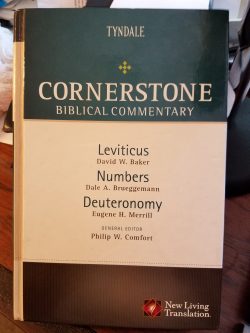
    Leviticus, Numbers, Deuteronomy (CBC)Regarding Numbers 33 and the 42 stations on the route to the promised land, footnote #1 on page 420, (Cornerstone Biblical Commentary on Numbers), notes that “[p]atristic commentators compared these 42 stations to the 42 (3 x 14) generations in Jesus’ genealogy, but that doesn’t shed any light on ch 33 …”

    It is quite true that this comparison sheds no light on chapter 33, but I doubt that there was any intention by the author of Matthew to shed light on Numbers. More likely, if he was making a connection, he was intending to have Numbers 33 shed light on his genealogy. Clearly he went out of his way to get 42 generations and divide them into three groups of 14. It’s very easy to make too much of numerology.

    Despite that, I am more and more convinced that New Testament authors quite frequently intended to draw more of the Old Testament narrative into their writing than just what was quoted. One reason for this is that I have noted how the lack of knowledge of the Hebrew Scriptures/Old Testament in modern audiences makes discussing certain passages more difficult. The corollary to this is that a greater knowledge would make discussion easier. New Testament writers could count on greater knowledge among their readers than we can today.

    What might Matthew be drawing into the text here? I have argued that Matthew 2:15, when it quotes from Hosea 11:1, “Out of Egypt I have called my son,” is drawing the broader story there into his narrative. At first glance, one might accuse Matthew of taking something that is clearly not Messianic and making a prophecy out of it. Hosea 11 continues with telling us that the more YHWH called his people, the more they went away. My initial reaction to this, and the reaction of many, is that Matthew is grabbing a single clause out of context, and making a prediction of something that isn’t actually a prediction. But I’d suggest instead that Matthew is presenting Jesus as Israel doing it right. When God called Israel at various times, they went away, as Hosea is saying. Jesus, on the other hand, when called out of Egypt or when called to the cross, continues to come.

    My suspicion is that the use of 42, besides being the numerologically comfortable grouping of three pairs of sevens (and there are so many ways a set of numbers can be presented!), is intended to point us back to the travels of the Israelites in coming to the promised land. I am in no way suggesting that these 42 stops were in some way predictive, nor am I suggesting that Matthew 1:1-17 gives some sort of new or special meaning to Numbers 33. Rather, I’m suggesting that Matthew uses 42 generations as an allusion to Numbers 33 and to Israel coming out of Egypt and to the promised land.

  • Some Lessons from Tilling My Garden

    Some Lessons from Tilling My Garden

    Well, my prospective, perhaps presumptive garden, that is.

    One of the important elements to understanding stories in the Bible, parables included, is our perspective. In Christian circles, when we hear “the sower went forth to sow,” (Matthew 13:3), or perhaps “a farmer went out to sow his seed,” we generally see ourselves in the role of the one doing the planting. We are evangelising, and people have different kinds of hearts. Have you ever heard someone describe another person as being rocky ground? Or perhaps someone has said, “He’s trying to dig some hard ground there!” Usually these expressions are used regarding targets of evangelism.

    garden and tillerI’ll mention evangelism later, but first, let me place myself in the role of one receiving the seed. Is that not what I do when I pray and hope to hear from the Lord? Is that also not what I do when I open my Bible and hope to be changed by God’s message? So I am the ground, not the sower.

    But let me tell you the story of my garden thus far. Fortunately for me, I have few plans that involve saving money on food, supplementing my diet, or saving on the food budget. I had one purpose in starting a garden: I need to spend more time in physical activity. Now I’m a bit of a workaholic. I have a hard time not doing anything. The easiest way to get myself to do what I need to do was to make it into work. Then I can feel good while I do it.

    So I picked a plot on our little place out here and started to work on it. It has gone through being broken up with an excavator (at which time I killed power to my office and broke our water line, but that’s another story), lots of hoeing and raking, and digging up of roots and rocks. This morning I finally got to the point of being ready to actually till the plot. My previous work had been aimed, not at getting the soil ready for actual planting, but at removing obstacles. I have a large pile of brush, roots, and rocks at either end of the plot, things I have removed as I worked.

    Then I had a period of time when I was just too busy with work. Between my work with computers and computer networks and my publishing work, I was simply overwhelmed. The phone would ring by 8 am and I wouldn’t get that much done outside. What do you suppose happened? Well, the plot got some new growth, but not the stuff I want to grow, of course, since I hadn’t yet planted. So out came the weedwacker, the hoe, and finally the rake.

    Today I finally got to the tiller. That’s the tiller, in the picture to the left. I borrowed it from my friend Tom Hunt. If you need a floorplan done for a new house, he’s the one to go to.

    There were some interesting things about using the tiller as well. Weeds leave behind small roots that tend to wrap themselves around anything available. No matter how may rocks you’ve removed there may be a few more. Run the tiller in a couple of directions. The pile of dirt from one pass may hide some hard soil. Power tools are great, but I ended my morning session more tired than when I worked with the hoe. The tool helps, but the human still better put heart and back into the effort.

    Let me apply these to Bible study just a bit. You might want to reference my post from yesterday. Here are some thoughts I had while listening to that wonderful purr (or roar) of the tiller motor.

    1. Different tools accomplish different things. No matter how much you may have gotten with one approach, try taking another look from another angle or with some different help.
    2. Weeds don’t stay dead. You’re never really done. It’s easy to get complacent and think you already have it covered. Now it’s all about telling other people. Don’t get in that place. If you neglect your heart garden for a while, you may find the ground hardening and the weeds getting tall.
    3. Don’t imagine that a period of neglect is the end. That’s what weedwackers, hoes, shovels, rakes, and tillers are for. Those of you who have forgotten your biblical languages after seminary, consider this as well. How about working on reviving them? Yes, I believe you can study the Bible effectively without the biblical languages, but after investing all that time and effort wouldn’t you like the benefit of that tool?
    4. Don’t be blind to the rocks that are still there. You may have removed bunches of rocks, yet there are still some to find and remove. I often joke with Jody that it would be nice if I could measure the quality of my cleaning by the quantity of dirt I removed and not by what was left. Read 1 Corinthians 8:1-3 if you’re thinking you’re good!
    5. Tools help but they don’t do the job. I love Logos Bible software. I love sites that let me compare versions (BibleGateway.com, for example). But these things don’t do your studying for you. They will make you more efficient. Many Bible students amass information and yet don’t get to what the text is saying to them. I was reminded of that forcefully as I moved the tiller through my prospective garden. It did more work than I could have accomplished with the hoe, but it still required me to make the application!
    6. Sometimes you get so tangled with the weeds that you can’t really go on clearing and tilling. I experienced this as left-over weeds and roots tangled up the tiller. I had to stop and clear the blades so the tiller could work efficiently. I’ve experienced this in preparation for teaching my Eschatology series on Google Hangouts on Air (link to next session, Thurs. night at 7 pm central time). Eschatological views are based on many, many texts, and there are many, many views on each of these texts, plus mountains of theology done to tie them together or explain them away. It’s very easy to get so tangled in the details that you can’t see the actual text in front of you. I bounced this off my wife Jody, who has a practical mind set. I asked her to read Mark 13 the other day and then question me about it. She had a set of questions that helped clarify the chapter.

    I’m sure there are many more lessons, but those are the ones that occurred to me as I worked this morning. But does any of this apply to evangelism?

    1. Quit trying to judge the people you witness to. You can’t see what’s under the ground.
    2. The best way to witness is to till your own heart. I can’t emphasize this enough. Most people can tell very quickly if you’re trying to use them for something else. So if you are making relationships with other people in order to convert them or make them into church members, they’re going to get that feeling. But if you are genuine and genuinely care about them, they will also know that.
    3. The Christian life and Christian witness isn’t a strategy. See #2. Enough said!
    4. God is the one who changes people. You witness. God acts. Be humble enough to give God the credit. Be humble enough to let God take the responsibility.

    Do you see what happened? Quite frankly, all the lessons but one applied to me. As for reaching others, I have one duty: plant the seed. Now planting the seed can be complex, but I suggest that it starts with some of the points I made above. Let God’s word impact your life. Continue to let God’s word impact your life. Continue some more letting God’s word impact your life. Continue yet much more letting God’s word impact your life.

    You’ll impact the lives of others.


  • Is the Virgin Birth a Mistranslation?

    Mark Goodacre has an excellent podcast on this question.

    What I’d want to get across in a brief answer to this question is:

    1) Greek parthenos is not necessarily a bad translation of Hebrew almah. The semantic ranges do overlap substantially, though (as Mark points out) parthenos tends more toward “virginity.”

    2) For reasons that do not involved the translation of almah (in my opinion), Isaiah 7:14 is not intended as a Messianic prophecy.

    3) I have heard people claim that Matthew was not asserting a virgin birth, but one has only to read the whole text to see that he clearly is doing so. Again, in my view, the correct translation in Matthew is “virgin” irrespective of one’s view of how almah should be translated in Isaiah 7:14. I would translate almah as young woman and also “is pregnant” rather than “shall conceive.”

    4) This provides an interesting case for discussing Matthew’s use of Hebrew scripture. Dr. Goodacre also mentions Matthew 2:15/Hosea 11:1 which is even more interesting.*

    Listen to the podcast!

    (In my notes here I’m speaking for myself, not attempting to summarize Goodacre’s arguments.)

    * While I find Matthew 2:15 / Hosea 11:1 interesting, it is not the one mentioned by Dr. Goodacre. He references Matthew 2:23. This was an error in my original post.

  • The Trials of Mike Licona

    I actually didn’t know who Mike Licona was until a few weeks ago, but I’ve discovered that he is a Christian writer who is a strong supporter of the historicity of the resurrection and generally defends the historicity of the Bible.

    Unfortunately for him, he recently suggested the possibility—just the possibility, mind you—that Matthew 27:51-53 (the raising of the dead saints) is apocalyptic language rather than intending to portray a historical event. I’m very pleased to see that Michael Patton has been defending Licona and calling for a great deal more generosity concerning this disagreement.

    And this brings up an issue that I have with many arguments regarding biblical interpretation. Too many people are very quick to argue that their opponents are denying scripture, when they are simply interpreting it differently. There are interpretations that are so lacking in legitimacy that one may suspect that even the person who concocted them doesn’t believe them. But many arguments are between people who both have a great deal of respect for scripture, but who disagree on what scripture actually intends to communicate.

    This passage is an excellent example. I can certainly how one can legitimately disagree about what Matthew is trying to convey here, starting with the veil in the temple being torn in two. Is that literal or figurative language? (I’m speaking here of Matthew’s intent in writing it, not whether one believes he is historically accurate.) Did Matthew mean that this literally happened, or was it something that happened in the spiritual realm?

    It is doubtless an incredibly important spiritual point that is being made, whether the language is intended historically or not. It’s a point that can be made in either case.

    I don’t think that the argument that either party (or parties) in this dispute doesn’t care about scripture. All involved are committed to the inerrancy of scripture, and understand it in a similar way, as requiring historical accuracy. There is apocalyptic language in the Bible. It’s not impossible that this language is. Indeed there are some indications that it is.

    Similarly, debates about creation hinge on just how one reads the texts. If one reads the text as historical narrative, one has one set of options (accepting it as accurate, or assuming it’s pretty much useless). On the other hand, there are many elements of the creation stories (pretty much all of them) that would suggest something other than historical narrative. Yet many will accuse anyone who doesn’t take these texts as historical narrative of not believing what the Bible has to say.

    My point here is simply this: You can’t tell whether someone is ignoring the meaning of scripture until you have determined its meaning. Differing regarding interpretation, as long as the interpretation is an honest attempt to understand the text, does not constitute rejection of scripture.