Threads from Henry's Web

Tag: judgment

  • Fire – Lamentations 1:13

    Fire – Lamentations 1:13

    “From on high he sent fire,
        sent it down into my bones.
    He spread a net for my feet
        and turned me back.
    He made me desolate,
        faint all the day long.

    Lamentations 1:13 (NIV)

    Fire is one of those ambiguous words when used in symbolism. For Elijah on Mt Carmel, the God who answered with fire was to be regarded as the true God. The fire, in one sense, showed an acceptance of the sacrifice as well as the power of the God to whom that sacrifice was offered. (1 Kings

    Jeremiah spoke of a fire in his bones: “But if I say, “I will not mention his word or speak anymore in his name,” his word is in my heart like a fire, a fire shut up in my bones. I am weary of holding it in; indeed, I cannot” (Jeremiah 20:9 NIV, emphasis added). It’s hard to tell if we are to see this fire as positive or negative. I’ve heard many speakers use the phrase “a fire in my bones,” with varied emphasis. It may be used to claim a divine source for the message.

    Hebrews 12:29 describes God as a consuming fire. If you read this entire passage, you’ll find that it has a positive and a negative side. It’s a fire that removes impurities and even weaknesses, but what remains is what is pure and lasting. (Note the related use of “shaking” in the same chapter.

    There are many references to fire in scripture, and they vary from the pillar of fire that guided the Israelites to the fires of hell that consume all evil.

    Here, the fire is a subject of lament. It is part of the judgment that has come on Israel. This lamentation speaks of God’s actions. We often argue about whether God does one particular thing or another. If you feel that you are suffering a form of fire of God’s judgment, is this something God is doing, or that God is permitting and using?

    I find it unhelpful to be concerned about what precisely is an intentional act of God. We like to place logical layers between us and God so as to absolve God of some portion of the responsibility for what happens in the universe. I see God as responsible, and on reading a verse like Isaiah 45:7, I don’t see God as unwilling to take that responsibility.

    In fact, understanding that God is fundamentally sovereign, and by extension responsible, is a critical aspect of monotheism. Instead of pacifying demons or various forces, we look at God as the one in charge.

    Does this always make us comfortable? Not even close! I don’t think it’s supposed to make us comfortable. In fact, I see very little evidence that God is working for comfort in this life. Rather God is working toward righteousness.

    And that is an enormous goal. And thus we lament. As strangers and wanderers here, our jouney isn’t always easy.

    God’s fire is refining (Malachi 3:2-3). Refining is rarely fun!

  • Alone – Lamentations 1:2

    Alone – Lamentations 1:2

    She weeps bitterly in the night; tears run down her cheeks. Among all who loved her she has no one to bring her comfort. Her friends have all betrayed her; they have become her enemies.

    The Revised English Bible (Cambridge; New York; Melbourne; Madrid; Cape Town; Singapore; São Paulo; Delhi; Dubai; Tokyo: Cambridge University Press, 1996), La 1:2.

    I want to be clear about something as I go through these passages. Too often Christians read the Hebrew scriptures from a platform of judgment. We are looking to see all the mistakes those Israelites made, and that we, being more advanced, have overcome.

    But one of my purposes here is to talk about honesty, particularly honesty with ourselves. When we look at the Israelites with judgment, we are not honest. In their situation, with their knowledge, I doubt we would have done any better. I get this doubt from watching us today. We have the weaknesses of the Israelites, because we both have the weaknesses of humans. As we begin looking at the verses that talk about the reasons why the city, Jerusalem, is desolate, I will bring this topic up more and more.

    So let’s read this book, not as people who are doing well, but as people who have things to regret and to correct.

    This verse brings into focus one of the great problems of lament in the church. The person who is lamenting is very frequently alone. My own experience has been that I have found those who sympathize, those who encourage, and who help in my most difficult moments. I don’t have a personal complaint here. But I have seen many people who were in difficulty, grieving, or suffering who have been left alone.

    The person who weeps is often a very lonely person. As a church, we should be companions to those who mourn, to those in trouble. Those who weep bitterly in the night need our companionship.

    But I need to turn and point to myself again. One of the reasons I have always found people so helpful is that I am so rarely willing to tell them what my difficulties are. My natural reaction to being in trouble is to isolate myself.

    This is a problem with at least two facets: 1) We don’t want to spend time with the troubled person. It’s a great deal of work. It tends to be a downer. 2) We don’t want to be the troubled person, because we know, deep inside, how we might react.

    These things involved an inappropriate judgment. Just as we tend to read Hebrew scriptures from a seat of superiority, one to which we are not entitled, so we tend to see people in trouble from the position of one who’s life is so much better.

    We’ll have more time to discuss this as we read. But there’s one key lesson: God is there, waiting for the person who knows how bad their condition and their situation is, ready to act. In the honesty of lament lies a path to healing.

    (Featured Image Credit: RBompiani Photo on iStockPhoto.com)

  • The What-About Lifestyle

    The What-About Lifestyle

    Especially in political discussions we frequently here something like “but what about,” followed by a misdeed of the folks on the other side. In turn, we hear complaints about “what-about-ism,” which tends to annoy people on the other side, whichever other side that may be.

    This is not, as you might think, a preface to a political post. Rather, I have found myself asking just where this “what-about” approach comes from. And as I thought about it, I almost immediately realized that this is a lifestyle. Not a rare one either!

    Whether it’s in our personal lives, our work, or in our ministries, we have this tendency to look down the road, across the aisle, or over there somewhere, and we find someone or some organization that we can put in the “what-about” position.

    “My church is not doing well. But it’s doing better than that church down the road.”

    “My language is inappropriate sometimes, but not as often as _____’s.”

    “I’m occasionally rude, but there are others much more rude than I am.”

    “My church is really quite mission oriented. Well, more mission oriented than most churches in our area/denomination/conference.”

    We usually talk about judging and Matthew 7:1 as a command not to hurt other people. That’s not a bad lesson. We shouldn’t be judgmental. (I’m only a little judgmental, much less judgmental than several people I could name!) But there’s another point here. When we start living by judging other people, we start deteriorating ourselves.

    Paul said something about this:

    We do not dare to classify or compare ourselves with some of those who commend themselves. But when they measure themselves by one another and compare themselves with one another, they do not show good sense.

    2 Corinthians 10:12 (NRSVue)

    Many feel that if we aren’t vigorously judgmental, people will feel that they can slack off. They’ll do worse. But because the only standards we can achieve are fallible human ones, this judgmental approach actually achieves the opposite effect. There are some who become discouraged on being judged and give up. But there are many who, expecting judgment, carefully blunt the standards to make themselves look good.

    One key way of blunting the standards is to point at someone else.

    The northern Kingdom of Israel demonstrated this. It’s interesting to read the judgments given of the kings. Kings are generally judged to the first king of the northern kingdom, Jeroboam I. Later kings are either more evil than he was or evil, but not as much. The general standard is that they kept on repeating the sins of Jeroboam I.

    What strikes me about this sequence is the final king, Hoshea.

    In the twelfth year of King Ahaz of Judah, Hoshea son of Elah began to reign in Samaria over Israel; he reigned nine years. He did what was evil in the sight of the Lord, yet not like the kings of Israel who were before him.

    2 Kings 17:1-2 (NRSVue)

    He did evil, but he wasn’t as bad as his predecessors. And Samaria fell and the northern tribes went into exile in his reign.

    Hoshea could have said, “What about Ahab? He got to complete his reign!”

    [L]ooking to Jesus, the pioneer and perfecter of faith….

    Hebrews 12:2 (NRSVue)

    Put your eyes on the right standard. Better, let Him draw them.


    Some years ago I did a short presentation on this, which I titled “The Sin of Jeroboam.” Video here is kind of ancient, so bear with it!

  • Psalm 119:158 – Disgusted

    Psalm 119:158 – Disgusted

    I have seen the treacherous and was disgusted,
    because they don’t observe your word.

    What disgusts you? What makes you angry? What infuriates you?

    Sometimes we get the idea that a believe in a loving God and in God’s grace means that we have to be gentle about evil. Being gracious means that we never deal with evil, and can never be angry or confrontational.

    In my younger days I was more confrontational, but as I’ve gotten older, I’ve gotten less so. I haven’t come to believe that anger at evil, and action against evil is inappropriate. I have come to believe in choosing my battles, and doing so very carefully. There’s anger against evil, but there’s also being a pest about everyone who does anything that I feel is not quite right. You don’t really want me to do that, because there are a lot of things I don’t like. Fortunately for everyone, I generally don’t think most of those things are my business.

    But there is a time to speak and a time to act. Ezekiel 8 & 9. Ezekiel is shown evil going on in the temple, and then he is shown six men who are sent through the city and are told to put a mark on certain people. We find out that those people are the ones who “groan and lament over all the abominations.” Those who are not groaning and lamenting and put to the sword.

    Harsh!

    Then there is the story of Eli and Samuel. Eli’s sons are taking advantage of their position as priests to take the best portions of sacrifices for their own tables, amongst other things. In 1 Samuel 2 we get the message that Eli’s family will be judged. Why? Because Eli knew about the evil that was going on and did nothing. Samuel, in 1 Samuel 3 gets the “execute” message for this one, the word that the time has come and it’s too late to turn aside the judgment.

    Harsh!

    But there’s also a critical protective side-rail on this. The people condemned are condemned because they are not keeping God’s word. Too often we are judgmental and rebuke people for not doing things our way. Often we confuse our preferences for God’s rules. Beware of anger and disgust at someone for not conforming to your expectations. Your expectations are not the guide.

    The other side-rail is where we fail to ever see anything wrong and choose just sweetness and light. Sweetness and light while ignoring clear evil is itself evil.

    I once heard theologian and author Dr. Deanna Thompson speak about being asked to author the commentary on Deuteronomy in the Belief series, a commentary series written by theologians rather than biblical scholars. Thompson wondered why she, as a feminist, liberationist theologian should write a commentary on Deuteronomy. She didn’t seem to be the obvious choice for the task.

    However, she said that once she had accepted the task, she discovered something important (and I quote from memory). She said, “I discovered that a God without wrath would never liberate anyone.” Let me recommend her commentary. It is a very serious theological reflection on the text.

    I would say that when you do provide a gentle person, or one who hopes to be gentle, to wrath, it can be a very dangerous thing. A truly gentle person is disgusted by what is done to the poor, the needy, the stranger, the foreigner, or anyone who cannot defend themselves.

    Will anything disgust you today?

    (Featured image generated by Jetpack AI.)

  • Psalm 119:156 – Great Mercy

    Psalm 119:156 – Great Mercy

    Your mercy is great, LORD!
    Grant me life according to your judgments.

    “Mercy is great” could be translated “mercies are many.” I think it comes down to much the same thing.

    Notice the parallel here between God’s mercy and God’s judgments. The Hebrew word order places the words “mercies” and “judgments” at the start of their respective lines.

    How do these two elements interact?

    That is much of what this whole Psalm is about. The Psalmist is clearly thankful for God’s law. He’s not just thankful that it’s out there somewhere, telling him what God is like, or that it’s putting a standard before us that we can’t meet. He’s thankful for it in action, in our day to day lives, and in our relationship to God.

    Now I believe that God’s law presents to us a standard that we cannot meet. But God’s law also presents to us a God who can and will take us to that standard. The goal is not simply the accomplishment of some list of duties, or the avoidance of some list of sins. Rather, the goal is to be the person, “a little lower than God” (Psalm 8:6).

    God, being merciful, saves us from ourselves, and grants us life according to his judgments, namely something beyond what we can imagine. Sin is destructive. Mercy is not an emotional condoning of sin, but rather, a rescue from it, and a path to a better way.

    All of this comes up as an act of God.

    Now let me wander from the text. In Psalm 119 we have both the individual working and God working and giving. I want to again depart from my usual pattern and quote from John Wesley on this:

    XLVIII. If, then, you say, ” We ascribe to God alone , the whole glory of our salvation, ” I answer, So do we too. If you add, ” Nay, but we affirm, that God alone does the whole work, without man’s working at all; ” in one sense, we allow this also. We allow it is the work of God alone, to justify, to sanctify, and to glorify, which three comprehend the whole of salvation. Yet we cannot allow, that man can only resist, and not in any wise work together with God: or, that God is so the whole worker of our salvation, as to exclude man’s working at all. This I dare not say; for I cannot prove it by Scripture: nay , it is flatly contrary thereto: for the Scripture is express, that (having received power from God) we are to “work out our own salvation:” and that (after the work of God is begun in our souls) we are “workers together with him.”

    The Works of John Wesley, vol. 14, p. 347, “Predestination Calmly Considered”

    To go back a bit and cover one point here, we might ask if we are coworkers with God do we not get some of the glory. Wesley commented on this a bit before this quote:

    If so, your assertion is, “If man do at all work together with God, in working out his own salvation, then God does not do the whole work, without man’s working together with him.” Most true; most sure: but cannot you see how God nevertheless may have all the glory? Why the very power to “work together with him,” was from God. Therefore, to him is all the glory.

    Ibid, 346-347

    Mercy is often, if not always shown by bringing the rebel into line with God’s will, God’s judgment. And thus, in many ways, mercy can be judgment and judgment mercy.

    In what ways will you experience God’s mercy today?

  • Psalm 119:137 – Right

    Psalm 119:137 – Right

    You are righteous, Oh LORD,
    and your judgments are correct.

    Have you ever noticed all the things we say about God that might sound like value judgments?

    Everything from God is love or God is good to God is just or God is righteous. Just how did we make that determination and is it ours to make? Come to think of it, what would we do about it if we happened to be wrong? If we quit worshiping or praising God, speaking of all these wonderful attributes, God would still be God and would still do precisely what God wants. Who could stop God?

    Of course we don’t mean that we have evaluated God and decided that God passes all the God-tests. We really don’t! But at the same time, we’re right ready to complain if God doesn’t pass some of the God tests. In our superior opinion, of course.

    So is there anything worthwhile going on here or are we just repeating stuff because other people have repeated it for how long we don’t know?

    I’d suggest that these kinds of affirmations do serve a very real purpose. They help us remember that we are going somewhere, that there are options for things to be better, and that we do actually matter. If God is good, then there is goodness at the other end of our activities, our lives, and even our universe. It’s not all just a jumbled mess.

    In fact, I have known people who don’t believe in God to make similar affirmations about the world we live in. Like various religious believers, they make these affirmations with various levels of assurance. Sometimes it’s a faint hope that things can get better. At other times it’s a determination.

    Over may years I’ve seen this note after various national elections. I always say that God is in control. As affirmed in Daniel 4, God rules in the kingdoms of men. Sometimes God sets over them the basest of men. In the dialect of English I used there, “basest” is not a compliment.

    Inevitably someone then asks me why I bother to vote if I think God rules it all. I think that gets it absolutely backwards. Because God rules, I believe there is a good goal to work toward. Because God rules, I feel I owe the situation the best that I can do. With Dr. Martin Luther King I affirm that ?the arc of the moral universe is long, but it bends toward justice.” I immediately want to bend it faster!

    We really have our own choice of hope or despair, and it is a choice. If we choose despair, it will follow us all our days. If we choose hope, we will pursue that all our days.

    Will you choose hope, and righteousness, today?

    (Featured image generated by Adobe Express, which uses Adobe Firefly based on a prompt produced in a discussion with Gemini AI.)

  • Psalm 119:131 – Panting

    Psalm 119:131 – Panting

    With open mouth, panting,
    I long for your commands.

    This couplet poses some challenges in producing a readable translation, even though there’s little doubt of the meaning and feel of the verse. Even Mitchell Dahood, usually very creative, translates in a fairly straightforward fashion: “With gaping mouth I panted, / because I longed for your commandments” (Anchor Bible on Psalms, volume II).

    Another good translation is this:

    Parting mouth gaping I sigh heavily
    for to your commandments is my longing

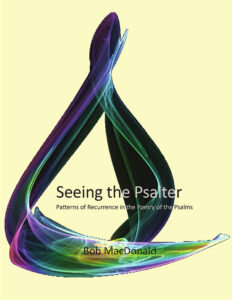
    Bob MacDonald, Seeing the Psalter, p. 386

    Now I haven’t mentioned before that Bob MacDonald translates Psalm 119 as an acrostic in English, which helps give it more of the feel of reading the Hebrew text. Some constructions in Hebrew are shaped by the acrostic form of the whole poem. Hebrew syntax is more friendly to the creation of an acrostic than English, with somewhat more flexible word order, but there is still more common ways of ordering words.

    In this case, a little bit of apparent discomfort is conveyed by the wording, and I think Bob has caught that. The feel of reading the poetry has the sort of discomfort that relates to the state of mind described in the text. Bob notes that: “parting gaping, פער (p`r) gape with desire as a ravenous beast but gape needs help for the acrostic” (p. 389). Yes, it helps the acrostic, but I think it also gives us the feel.

    Translation is interesting. A translator is always presented with the question of just what to transfer in translation into the new language. Bob MacDonald, for example, takes a rare path of transferring the acrostic, which presents a number of challenges, especially in conjunction with other goals he has in conveying the relationship of words in the Psalm. You’ll need to read his book, Seeing the Psalter, to get a full understanding of what he conveys.

    It might help us to understand this process if we consider communicating about an area of specialty to someone who does not share our specialization. I help people with problems on their computers frequently, and most of the people I help don’t share the language or often the concepts I tend to use. In ordering to communicate, I have to try to speak in terms that can be understood not just by the non-specialist, but by someone generally computer-naive, by which I mean they really aren’t sure what a web browser is. They get pretty close to panting, longing to know just how to get something done, or even how to explain to me just what it is that they are seeing.

    Many times I have either followed up a conversation by remote access to the person’s PC or even a visit, and found that what I had imagined the problem to be was not even close. They had a completely different problem than I imagined. I’ve gotten better at this over the years, but the gap still occurs.

    In terms of God’s commands, or just right and appropriate action we can have a similar problem. We have principles in mind. We want to get things right, but our understanding just doesn’t stretch. Applied to our situation, the translation of principle into action can take an amazing amount of effort.

    There is an inherent disconnect in our communion with God. We do not perceive infinity. As Paul says, we see partially, we await what is perfect, we do not have it in our possession. It’s a good idea to recognize this struggle for God’s commands. It’s an appropriate struggle. It’s one of the reasons that we are directed not to judge. We know partially; we judge partially.

    Let’s keep the desire and lose the judgment.

  • Psalm 119:53 – Rage!

    Psalm 119:53 – Rage!

    Rage seizes me because of the wicked,
    Those who abandon your instruction.

    As I read this I remembered one interesting point about reading the Psalms. These are largely a record of what people said in worship of, or in honor of God, and not necessarily instructions for us.

    I immediately want to temper that with another thought: They are, however, an example for us. This poetry is the result of a deep and serious experience with God, and it became part of scripture through long use and recognition of its value.

    There’s a reason many of us react negatively to a thing like this. We are concerned about strong emotions. Rage makes people do things they later regret. Rage can poison your life over time and even kill you. More frequently it kills other people. Rage is dangerous.

    Our Christian response, one we regard as Christlike, is that we need to forgive. Often this need to forgive turns into passivity, a sort of forgiveness before the act which prevents us from reacting. I would suggest that forgiveness is not very real if it involves defanging the original hurt. Forgiveness says, “You hurt me. I’m forgiving you by God’s grace.” Passivity says, “That’s OK. I don’t matter in any case. I’m hear to be kicked around.”

    When the rage is at those we perceive as wicked, there is also a question of witness. What possibility of sharing the gospel, or acting in accordance with the command to “love our neighbors as ourselves” do we have if we let rage at their perfidy overcome us?

    Finally, how sure are we that we correctly recognize true wickedness, true abandonment of the way of righteousness? And again, this is a two-edged sword. Here, instead of fading into passivity because we deplore strong emotions, especially those perceived as negative, we are paralyzed by doubt about a correct course of action. I’m reminded of the military aphorism, mostly said of responding to a tactical situation, “Sometimes a bad decision is better than no decision.”

    There is a time to be angry. There is even a time to act on one’s anger. The key question is to always ask ourselves why we are angry. The time to ask that question is not when you are seized by rage, as the Psalmist describes. At that point, your judgment may be bad, even disastrous. You need to think about what is right and wrong as opposed to what annoys or angers you.

    If you are enraged because somebody doesn’t show you the respect you are due, it is not the same as being enraged at someone who is engaging in violence against those who are helpless. A person who sees a child being starved, beaten, or otherwise abused, becomes angry, and takes effective action is acting morally. Their emotions should be strong.

    On the other hand, most of us have the tendency to see our way of life as normative without ever considering what is actually right or wrong. We more often tend to get enraged by infringement of our personal preferences than we do by actual harm.

    Frequently, this type of rage occurs because we do not fully recognize the other person as a separate entity with a right (morally if not legally) to their own viewpoint and their own habits when they are not harmful to others.

    It is important not to reject strong emotions. At the same time we are beings with both a spiritual nature and minds, and it is important not to let strong emotions become the driver.

    This leads me back to two things I’ve been talking about a great deal in this series: meditation. People who have to respond to difficult situations spend time training to handle them, thinking about how to handle them, even practicing for the eventuality.

    What things in our world should enrage you? What things should you push aside as mere annoyances?

  • Same-Sex Marriage, Moving Candlesticks, and the Judgment of God

    Same-Sex Marriage, Moving Candlesticks, and the Judgment of God

    kineso ten luchnianMy instinctive reaction when I disagree with people on major issues is to come out swinging. Despite this instinct, I believe I am called to be a facilitator, to try to help people talk intelligently and communicate effectively about controversial topics.

    So if you’re looking for a statement about what I believe regarding same-sex marriage, you’re going to be disappointed. If that’s what you’re here for, go for the “Back” button, mutter about click-bait, and go on to more productive activities. In fact, I’ve been criticized this very day, and on a few others, for not taking a stand on the topic. By “not taking a stand” people mean that I will publish material on either side of the same-sex marriage debate along with a number of other issues.

    Do I have an opinion? Yes I do. Will I make it public? No I won’t. [sarcasm]I will restrain myself from benefitting the world with my great wisdom.[/sarcasm] I will, instead, follow what I believe is my calling. Face it, folks! While there is a great deal that has not been heard on this topic, it’s not because it hasn’t been said. In case you missed it in the previous couple of paragraphs, I believe I am called to be a facilitator. As a friend of mine recently pointed out, it’s difficult to be a facilitator and a prophet at the same time.

    Just after I finished reading my dose of blogs and social media this morning, I joined in a conversation and Bible study, and I was asked an important question. We were looking at some interpretational issues in Revelation 2 & 3, the letters to the churches. There are a number of places where judgment is threatened. I was asked about Revelation 2:5, where the NRSV translates “remove your lampstand from its place.” It sounds a bit harsh. The question was, just what did this mean?

    My answer is that I believe it is symbolic, but only at one remove.

    1. The lampstand is a church.
    2. The church does not repent.
    3. The church is removed.

    I think we likely have many “removed” churches. They’re still sitting there occupying space, but the light has gone out. God is not there. The glory has departed. It’s harsh, but I think it’s true.

    You see, I believe in the judgment of God. In fact, because of the way in which I believe God’s judgment works, I believe God’s judgment can be quite implacable. Mercy holds the door open while there is an opportunity for repentance, for change, but eventually the door shuts. I believe the door shuts, or the voice ceases, when we cease to listen. I would commend Hebrews 6:4-6 (or really, it would be better to read 6:1-12; or hey, just read the whole book!) on this. There comes a time when we no longer hear the call to repentance.

    So my answer was that a church can fail. It can essentially lose its place because it does not listen to God. I think this is important. I’m not a universalist. I believe that God’s freedom gives us responsibility, and with responsibility comes the consequences of our actions. This means that we have a choice. The choice has a result. That result fits the choice.

    I further believe that God has sent the Holy Spirit to guide us and the church. Yes, we start in scripture, but we read and interpret that with the help of the Holy Spirit. This may not result in agreement, but the most important part is the listening. As long as we are listening for the voice of the Holy Spirit, and willing to hear and to do, we have that opportunity to repent, to change direction. Once we are no longer listening, when we no longer have ears to hear, we will no longer hear what the Spirit says to the churches. America is filled with churches that affirm doctrinal statements and action plans, yet do not do what they know.

    As I facilitate discussion, I let many things pass. People seem to get tense mostly about abortion, homosexuality, and evolution. I find myself restraining myself on many other topics, including immigration, care for the poor, spreading the good news of God’s grace, carrying out the mission of the church, and training and empowering our young people (to do all of the above, of course!), all of which I consider of critical importance for the church today.

    Not all of you are to be facilitators however. I can leave definitions undone in a publishing company, but if your church is to do ministry you have to make decisions, and to make good decisions you need to listen for the voice of the one who walks among the lampstands (Rev. 1:9-20).

    Please do listen. “I will remove” is a very harsh phrase.

    But I think it’s very real.


  • N. T. Wright on Hell

    An interesting short discussion.