
Threads from Henry's Web

Tag: joy

  • Psalm 119:162 – Rejoicing

    Psalm 119:162 – Rejoicing

    I rejoice over your word
    as someone who finds great treasure.

    I recall a small kitten who showed up at our house. She had apparently lost her mother. She was crying pitifully. When I picked her up and took her in she settled in happily. She had found a place to be safe. I have no idea how she knew I’d take care of her, but she did. I, in turn, was delighted to help this delightful little bundle of fur and life, and was able to find a home for her.

    The rescue, was a time of joy for us both.

    I’m reminded of the parable of the lost sheep (Luke 15:3-7), followed by the lost coin and the lost son. There’s an important point in theses stories. There is seeking going on even when the person or thing sought is in no way doing any seeking. There is great joy in heaven, we are told (Luke 15:10) over one sinner who repents.

    In the similar parable of the pearl of great price (Matthew 13:45), we have someone seeking, finding, and acquiring. There’s joy!

    When I was younger, I was taught that this was about how diligently we should seek the kingdom of heaven and what we should be willing to give up to get it. In this version of the parable, the kingdom of God is a sort of acquisition, or at least something I invest in because it seems to be a good idea.

    But the kingdom of heaven is both already there and is not something you can acquire. In fact, it is the kingdom (or its King!) that is looking for you, often when you’re not thinking about it at all. The one seeking the pearl is the King, and the King want’s to acquire you!

    I was reminded recently about how I came to join Pine Forest United Methodist Church (now Wilde Lake Church) here in Pensacola. I was not, in fact, looking for a church. I was not invited by someone to go to this church. It was, to all appearances, an accident. I was following the suggestion of my business partner to do something that wasn’t work. I chose that church because I could figure out how to get there, and they had a Sunday night service.

    Every single thing about that visit had the appearance of an accident. I was definitely not seeking God. I was just following a suggested plan of looking at how various churches worked to distract me from my coding work.

    Yet God and I had an encounter at that church.

    There was joy, I’m sure, in heaven. I, on the other hand, reacted with joy. I began to rejoice again in God’s Word, which had not excited me for some time. God’s rejoicing brought my rejoicing.

    I feel this verse with the Psalmist. It’s not my doing, yet I rejoice. I came upon treasure for which I was not looking.

    I was reading a quote from John Wesley in another context today, describing “preventing grace,” more commonly known as prevenient grace.

    Salvation begins with what is usually termed (and very properly) preventing grace; including the first wish to please God, the first dawn of light concerning his will, and the first slight transient conviction of having sinned against him. All these imply some tendency toward life; some degree of salvation; the beginning of a deliverance from a blind, unfeeling heart, quite insensible of God and the things of God.

    John Wesley, “On Working Out Our Own Salvation”

    What treasure will give you joy today?

    (Featured image generated by Jetpack AI. That’s quite some images the AI picked out of this post. Don’t you think the kitten looks joyful?)

  • Psalm 119:96 – Ends

    Psalm 119:96 – Ends

    I have send the limits of all perfection,
    but your command is very broad.

    I have rarely seen as many different possible translations for a verse. Dahood (Anchor Bible Psalms) turns the words for “end” and “broad” into epithets for God. If I were to translate more loosely, I might, at this point suggest something like, “I have seen that everything in our world has a limit, but your commandment exceeds all of those.”

    But my project has been to meditate on the verse, not resolve all language and translation issues. Of course, getting a sense of what the verse means is important to that. Who knew?

    In fact, the verse may give a good example of the meaning I’m seeing in it. There’s an end to my ability to come up with a translation of which I can be certain!

    I recall just after I had received my BA, with a major in biblical languages, I was traveling with my brother to where I would attend graduate school. I stopped for a church service in Yellowstone park near the visitor center at Old Faithful. Inevitably, as a bunch of travelers gather for church we exchanged information on why we were there and where we were going.

    I told them what I had been studying and that I was traveling across country to go to graduate school in the same subject. Following the service a gentleman approached me to ask a question about the translation of a verse that had been bothering him. I talked to him for a bit and then my brother and I headed out walking around the geyser.

    It suddenly hit me and I started laughing. “What?” my brother asked. “Do you realize I just talked to that guy for 10 minutes and I never gave him an answer to his question?” “Well, what was the answer?” “I actually have no idea!”

    One of the problems of studying and learning is that you can forget along the way that there is an end to your knowledge. You can lose the ability to say, “I don’t know.” The best scholars I have known, and the best experts in any topic, are the ones who know their limits and can admit those limits.

    This is true whether you’re a biblical scholar, an auto mechanic, a farmer, or anything else. It’s a wise person who knows what he or she has and has not mastered.

    I think theology is one of the most tempting fields, because we want to be certain. We don’t want to be limited, and because there are so many things in theology that you can’t pin down like a lab result, we are often vastly more certain than our actual knowledge can justify.

    Did this meditation really come from the verse I quoted and (mis?)translated? To the best of my knowledge, yes. But I have seen the end of the best of my knowledge. Or at least I hope I have!

    Can you recognize your limitations? Can you still be joyful and fulfilled?

    (Featured image credit:Orla. LIcensed from iStockPhoto.com)

  • A Morbid and Boring Christianity

    A Morbid and Boring Christianity

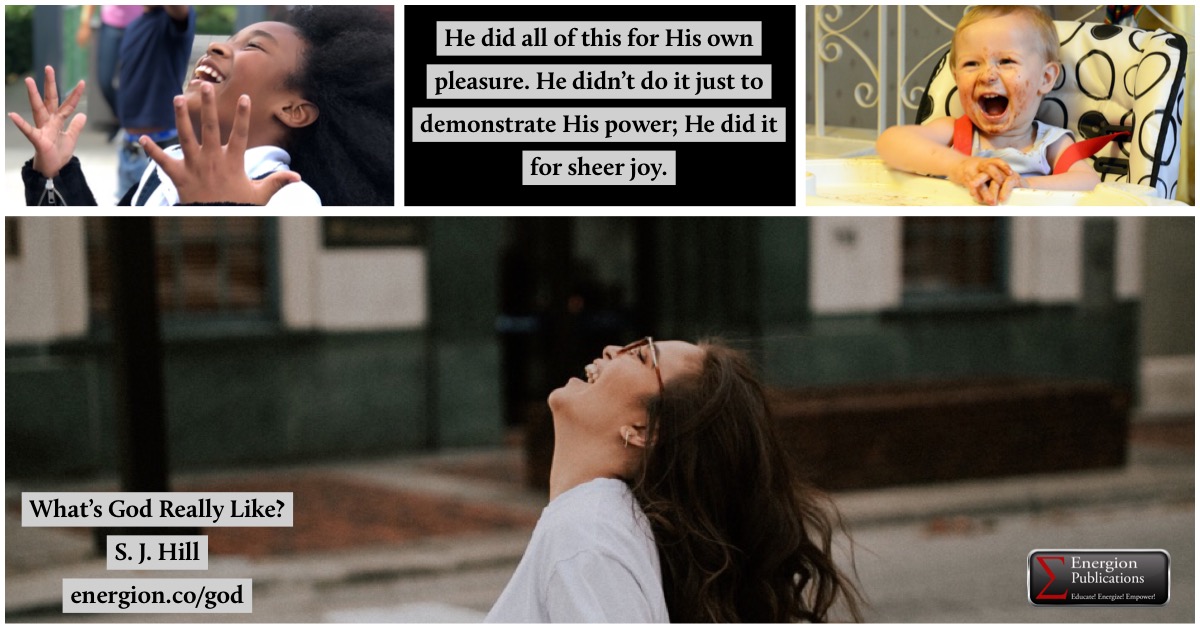
    The quote above comes from chapter 1 of S. J. Hill’s book, What’s God Really Like?, and I’d like to spend some time with this, looking at it from different angles. The first angle is one of worship.

    I was in a church committee meeting some years back where a room full of people were discussing young people and the worship service of the church. The question under consideration was why young people weren’t attending our worship services.

    After about 45 minutes of (fruitless, in my opinion) discussion, I asked the question: Might we instead discuss whether we can think of any reasons why the young people would attend our worship service?

    I, and every other person in that meeting, attend church out of ingrained habit. We have done it for years, it’s what we do, and come Sunday morning, come hell, high water, or several feet of snow, we’re going to find a church service and attend it.

    I don’t mean that that’s the only reason I go to church, but it is something I tend to do. If I don’t like one worship service, I’m going to attend another.

    But many people, oddly enough (!), require a reason to get up on Sunday morning and go to church. They want to accomplish something.

    At this point some of my friends start talking about “dumbing down” the worship service, or want something “relevant.” The tone indicates that “relevant” is some sort of weak effort to replace “real worship” which will involve actual pain and require grit and determination.

    “I barely stayed awake through that service,” says the parishioner, looking and sounding holy. Going through a boring worship service is a test of our commitment to God.

    Well, perhaps not.

    As I read passages like 1 Corinthians 14, I see the word “edify,” which is just a churchy sounding word for “build up” or something similar. The worship services at Corinth sound a bit chaotic, and, well, interesting. Paul encouraged them toward order, but in the end, if you apply all his rules, you still have something very different from what we do today.

    Our problem with 1 Corinthians 14 is that we try to apply the solution without having the same problem. We put a straight-jacket on a corpse. The corpse, in case you missed it, is our time of worship.

    Now a morbid, boring, and unattractive Christianity is not just about the worship service, but I think we might start there. You see, I think all those complaints about young people wanting relevant service are just whining. Whining because the young people don’t like what we did all our lives.

    But if you look at the state of Christianity in America today, I think you’ll see evidence that was we did all our lives—and I’m talking to my generation (I’m 61)—hasn’t worked all that well. Perhaps we need worship that is actually relevant.

    Relevant in several ways:

    1. In expressing our relationship with God. (Subtext here — we might need to have a relationship with God and not just a set of theological reflections.)
    2. In preparing us for actual service. (We tend to use the word “ministry” a lot. I think that allows us to separate ourselves from the word. How about “every member serving others” instead of “every member in ministry”?
    3. In help us to build our relationship to God.
    4. In helping us learn to relate to one another. (Hint: sitting in pews listening to a preacher, then heading out to beat the Baptists [or whoever] to lunch doesn’t build your relationships with other people.)
    5. In encouraging us in our lives as they are in this world.
    6. In helping us realize that “worship” doesn’t occur in a “service,” nor does it follow an “order of service,” but is a lifestyle. In fact, it is our lives (Romans 12:1-2).
    7. In helping us learn new and useful things.

    Is that what happens when you go to church?

    This just barely touches on this question. I’d like to discuss it some more. S. J. Hill is definitely right about one thing: The way we think about God is going to impact everything. If we think of God as interesting, involved, and yes, cool, we will thing that interesting and exciting things are part of worshiping God. If we think God is vindictive, we’re going to look for the right set of rituals to appease him.

    If we’ve really forgotten, as I think many of us have, to think about God seriously (serious and joyful are not contradictory!) at all, that’s also going to impact the way we worship.

    If God showed up on Sunday morning, would God enjoy what was going on?