Threads from Henry's Web

Tag: Jonah

  • When the Bible Story Shocks

    When the Bible Story Shocks

    I read Joshua 24, including Joshua’s farewell speech today. There are quite a number of texts in this chapter that are quoted regularly without any knowledge of their source or of the circumstances. One is Joshua 24:15 “… as for me and my house, we will serve the LORD.” Now there’s a pink elephant in the room, the genocide of the Canaanites, which is generally ignored. I will just point out that it cannot actually have happened quite that way, because the Canaanites survived in large numbers, as the book of Judges tells us. Yet there’s still the issue of the claim. That’s a shocking point in a story, but I’m going to ignore it today myself.

    I’m interested in the fact that the call to faithfulness presented here, described as a torah, or instruction (v. 26, “written in the book of the torah of God”), is embedded in a story. Joshua goes way back to give us the shocking information that Abraham worshiped other gods. There is a much abbreviated presentation of the history that has brought the Israelites to this place.

    But the use of story is also challenging. In the book of Jonah, God behaves in unprecedented ways. The book or Ruth presents a story that stands in contrast to specific instructions regarding the Moabites. While Daniel is commended for keeping to Torah, Esther appears to live without people realizing she’s a Jew.

    The actual stories present a much more complex picture of God related to his people and God’s people in their activities, ethics, and theology. The story of Samson in Judges is one of those surprises. We can dress it up for Sunday School as a servant of the Lord carrying out his mission for his people with miraculous support, but it really reads like someone who couldn’t ditch the stupid and kept stumbling into ways to kill Philistines, the enemies of Israel. He ends up kill a few thousand while committing suicide.

    I believe that theology is easy, but life is hard. Yes, we can debate theology all day, and it’s pretty near impossible to understand the trinity. A pastor friend of mine told me that with the trinity, if you think you understand it you probably don’t. But face it, as much as we enjoy debating theology, mistakes in the classroom have little impact.

    When they get into real life, however, theological ideas can end up healing the sick or burning people at the stake. And everything in between. That’s the value, I believe, in reading stories and placing all our theology in real life as much as we can.

    It’s not that there’s no truth. It’s not that there’s no right or wrong. It’s just that life manages to scramble our hopes of always having a clear knowledge of it. That’s why we need to exercise our faculties so we can tell.

    And when we read stories, and live our lives, we need to go deeper than just finding the moral. If you find just one moral of a story, you probably haven’t thought of it enough. If you learned just one thing from an experience, spend some more time thinking about it.

    Life is hard. Theology can help you.

    But only if you hone your theology in real life.


    (Image credit: Adobe Stock [105521664]. I have licensed this image, but it is NOT public domain.)


  • Reading Stories: Jonah, Ruth, and Esther

    Reading Stories: Jonah, Ruth, and Esther

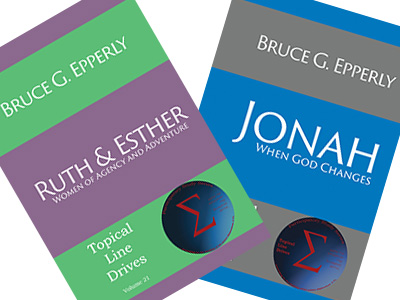
    ruth-esther-jonahI just posted my interview with Bruce Epperly about his new book Jonah: When God Changes on the Energion Discussion Network. I’m going to embed it here as well. I want to call attention to it along with Bruce’s next most recent (!) book Ruth & Esther: Women of Agency and Adventure.

    Sometimes we get different pictures of God from the narratives of scripture than we do from the affirmations. I don’t think the narrative should be neglected. We often geld the narrative in order to keep it from challenging our existing perceptions of God. But those perceptions frequently are desperately in need of a challenge.

    What happens when the good guy finds himself on the wrong side of everything (Jonah)? What if two Jewish characters survive in a foreign court in completely different ways (Daniel and Esther)? What if there’s a woman in David’s genealogy (and in Jesus’s) that really shouldn’t be there? Can a perfect, sovereign God regret things? If not, what actually happens at the beginning of Genesis 6?

    Here’s my interview with Bruce Epperly:

    And here’s Louis Armstrong’s Jonah and the Whale, just for fun:

  • How to Dig into a Bible Clause

    … fully demonstrated by Jacob Cerone at ἐνθύμησις (Jonah 1:4c). Just the one clause!

    Bravo! Write more!


  • The Jonah Problem Redux

    Bruce Alderman wrote an interesting post today on what has to be somewhere close to my favorite book of the Bible–Jonah.  He referenced an earlier post of mine from my Threads blog, but I’m not really commenting on that part.  I should also note that while I call Jonah somewhere close to my favorite book, that is a comment that causes my students in real life to burst forth with gales of laughter, since I have labeled way too many passages as my favorites.

    But the thing about Jonah is that there are so many different things you can get from it.  One key element is the way in which people get hung up on the miracle of the great fish, even though pretty much nobody would claim that’s the point of the book.  The great fish is largely a literary device to move the character forward.  You have the twist of Jonah heading off to the Spanish coast (to use an anachronistic name) but then winding up closer to Nineveh than when he started.  It’s an interesting note on the idea of running away from God.

    Bruce focuses on the hardship in which God places Jonah.  Often we’re afraid to comment on such things, but is God really being fair here?  He calls Jonah to go to Nineveh, makes him preach this unpopular message, and then turns and makes him into a false prophet.  I’m pretty certain we’re supposed to read that subtext in the story; I doubt a Jewish audience would miss it.

    So you have the intertwining of several messages at this point.  First, there is the message that God cares about people who are not Jews.  If, as is probable, Jonah was written during the time after the exile, this attitude to foreigners may well stand in opposition to the official position reflected in Nehemiah’s activities.

    Second, there is God’s focus on compassion over vengeance or judgment.  No Jew of the period would imagine that Nineveh hadn’t deserved destruction.  (Note also that if the general dating I referenced earlier is correct, Nineveh had already been destroyed at the time the book was written, making it an interesting “what-if” type of story.)

    Finally there’s the notion of the call of God on a person, and just how that may work out for the one who is called.  I wonder if Jews might have seen in this a bit of the impact of their call or chosenness on their own lives.  Being God’s chosen has not always been particularly pleasant for the Jewish people!

    I like to bring up Jonah when talking about spiritual gifts because inevitably someone is bound to comment on how nice it would be to be a prophet.  I have to suggest they think again.  Prophets don’t necessarily live happy lives.

    When teaching about how to study the Bible I use the phrase “the Jonah problem” in another way, however, which focuses on what Jonah does outside the city.  He’s waiting to see what God will do.  His interest is in the destruction of the city–or not.  So he hangs out waiting for God to act, when it turns out that God has already acted, but not in the expected way.  I define this “Jonah problem” as “looking for the wrong miracle.”

    I like to connect Jonah with Jeremiah 18.  Jeremiah is another excellent example of a prophet called into a very unpleasant situation.  He has to live in a city under siege and preach surrender, thus getting all the patriots up in arms against hm.  In Jeremiah 18 God provides him a vision to explain how it is that God can allow Jerusalem to be destroyed when he had earlier made an eternal promise to David.  (See Psalm 89:3-4, for example.)  God makes the claim there that he gets to change his mind.

    What I see in Jeremiah 18 is a fairly clear pointer to God’s major concern in prophecy.  We tend to look at prophecy as a way of learning what is going to happen.  God’s use of prophecy is to change people’s behavior.

    If a parent tells a child that he will not get to watch TV tonight unless he cleans his room, it is not the parent’s intent to inform the child as to what his evening will be like.  Rather, the parent wishes to get the child to clean his room.  If the room is cleaned, nobody becomes annoyed when the child gets his TV time.

    Perhaps we should consider giving God the same latitude.