Threads from Henry's Web

Tag: Job

  • Remembering – Lamentations 1:7

    Remembering – Lamentations 1:7

    7 Jerusalem remembers, in the days of her affliction and wandering, all the precious things that were hers in days of old. When her people fell into the hand of the foe, and there was no one to help her, the foe looked on mocking over her downfall.

    The Holy Bible: New Revised Standard Version (Nashville: Thomas Nelson Publishers, 1989), La 1:7.

    Memories are wonderful and dangerous.

    Recently a friend of mine told me something about a loved one dealing with cancer that brought back to mind a specific moment in the experience of our son James. Jody was overseas when he had some symptoms and I took him to the doctor. Tests and scans told us that cancer had recurred–for the fourth time. I had to let Jody know, and the only way to do this where she was located was through email. I had the duty of inflicting that pain on her at a time when I couldn’t do anything to support her. I had to tell James, who had sworn me to call him the instant I knew anything.

    It is not a pleasant memory. It happened in June, and pretty much every June I have a few days when that memory crowds me.

    But there’s something that happens when you have passed through a dark valley, and that’s the realization that life went on and that God was with you even when you were not with God. That realization of the Divine Presence is easy to lose in the valley.

    Psalm 23 is one of the best known passages of scripture. It has a key verse: “Even though I’m passing through the valley of the shadow of death, I will fear no evil, for you are with me.” I like keeping the “valley of the shadow of death.” There is good reason to translate this as “deep darkness” or something similar, but I think the traditional wording from the KJV has the right feel to it.

    When Job has gone through trouble, God shows up and lectures him. Job’s response, “Now my eyes see you” (Job 42:3). After all the theological debate of the book, the landing place is that God really was there, really did hear, really did know.

    To bring this back to the actual historical background of our text, when Israel went into exile, the event that is being lamented here, the question was: “Is God actually with us? Does God care?” In the ancient near east it was generally thought that when one nation conquered another, the god of the winning side was also proven to be greater.

    God comes to the prophet in exile, Ezekiel, and there is a simple but profound statement that opens the book that bears Ezekiel’s name. “… I was among the exiles by the river Kebar, and I saw visions of God” (Ezekiel 1:1). The river (or canal) Kebar was in Babylon.

    Even on what seemed to them the other side of the world, well away from their land, which many saw as “God’s land,” God was there. Our verse talks about remembering former glory. But there’s a present glory, the glory of the God who is with us. Always. Especially when life’s hardships, even torments, overwhelm us.

    Let’s try to remember that Glory.

    (Featured image generated by Jetpack AI.)

    A concept of Ezekiel’s Vision, (Credit: Adobe Stock ZenArt)
    See my paper on the vision of Ezekiel 1
  • A Robust Theodicy?

    A Robust Theodicy?

    As I conduct interviews on theodicy with various authors, I’d like to suggest this:

    We need a theodicy (and in fact a full theology) that is as comfortable in Job as in Deuteronomy. This would be the expression of a faith that isn’t forgotten in good times or repudiated in bad.

    Here again is the first video:

    I will be interviewing Dr. Bruce Epperly and Dr. Allan R. Bevere on Thursday, November 10, 2022 and will be posting those interviews over the next couple of days. Further interviews will be announced here.

  • Job 9:4-10 – A Sunday School Text Used Out of Context

    Job 9:4-10 – A Sunday School Text Used Out of Context

    I like reading the texts before I’ve read the lesson material so that I can see what I can learn from them without the direction of the lesson topic. So why do I call this text “out of context” when I haven’t even seen how it will be used by the lesson material.

    The reason is simply that the text trims out the material that would let us know the speaker or the point in the argument at which this text appears. If we look back to Job 9:1, we find that this is one of Job’s responses to his friends, the friends who have come to make sure his depression is as deep as possible.

    When you consider that when God appears in this story, God doesn’t think much of what has been said before God’s appearance, it is perhaps not helpful to take theology out of any of the speeches from chapter 3 through chapter 37. While God commends Job, it is not for Job’s speech.

    In my experience, most Christians who quote from Job at all quote from the speeches of Job’s friends, and don’t trouble to take note of who is speaking. That’s because Job’s friends maintain what most of us feel, which is that many, if not most of the bad things that happen to people are the result of their bad decision. God, according to this view, is in the business of rewarding good behavior and punishing bad.

    Job doesn’t really counter this so much as simply assert his innocence. In this passage he’s declaring God powerful, but also distant. That’s Job’s problem with all this. He’d like God to show up and answer his questions. God hasn’t done that.

    What is trimmed out of our reading is the fact that this is Job speaking (v. 1), and that he has just declared that God will not answer. His comments on God’s power are not so much praise as they are a declaration of God’s distance. At the end of verse 3 he declares that God won’t respond one time in a thousand.

    With all that trimmed, this can sound like a declaration of praise for the Creator. What it actually is, is a complaint about the distance of a God who allows Job to suffer and yet refuses to explain himself.

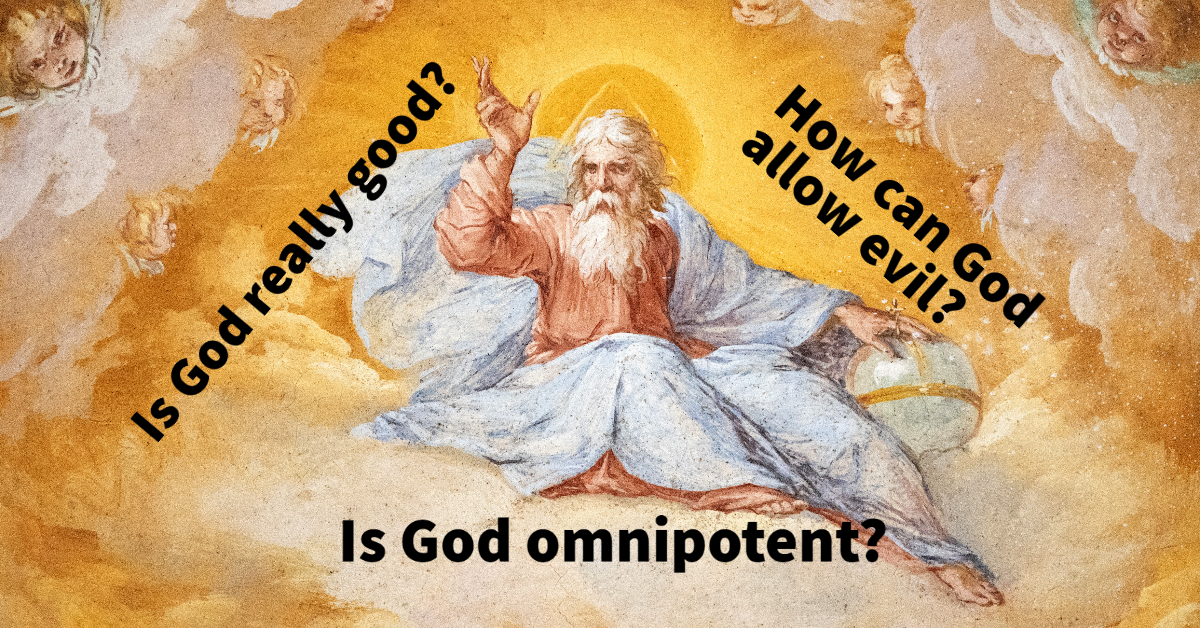
    Job is often referred to as a theodicy, a justification of God’s behavior. Theodicies usually try to explain how God can be good, all-powerful, and yet allow suffering or evil to exist. The book of Job doesn’t actually attempt any theodicy. Job is answered, insofar as he is at all, when God appears and challenges him. In the story, Job never finds out what was going on in the background. We, the readers are privy to the council, and to what God is proving through Job’s suffering.

    Equally interesting to me is the fact that Job is quite satisfied with the answer, even though on a logical basis it’s not much of an answer. What Job longs for is what he sees lacking: God needs to take note of him. Once this has happened Job is quite happy.

    One of the reasons for that, I suspect, is that Job simply sees that God truly is that great, and is in turn grateful that God has paid attention to his complaints at all, even though God doesn’t answer the questions Job has raised.

    So let’s go full circle back to the point about context. Sometimes texts can be used out of context. The problem is that we generally try to make scripture authoritative. If one uses a text out of context and pretends that this reading is authoritative because it is scripture, that presents quite a problem.

    When I was in elementary school we had a program of scripture memorization that included memorizing lists of four texts. We’d have four texts on the Sabbath (I was Seventh-day Adventist at the time), four texts on the state of the dead, and so forth. Today I would view a number of these texts as taken out of context. And for their purpose, some of them were.

    On the other hand there are allusions and literary borrowing. Revelation, for example, is filled with verbal allusions to various passages in Hebrew scripture. These are not used as proof texts, but rather form part of the literary fabric from which the report of John’s vision is woven. As long as we understand what is going on, there is no problem. The problem is that we often see only one use in scripture: proving doctrinal points.

    I’m reminded of the saying, “Good fences make good neighbors.” This is quoted in a pious way, indicating that by erecting effective barriers, we can live more peacefully. I actually think this is quite correct. Boundaries, well-defined and reasonable, are very helpful to relationships.

    That was not the meaning of this line when it was first written. You might take the time to read the Robert Front poem.

    Sometimes in our Bible reading we need to realize that we are reading a story, seeing a picture, getting a sense, and not learning a doctrine.

  • Football: I suspect God was indifferent to the ultimate outcome

    Football: I suspect God was indifferent to the ultimate outcome

    Finding God in Suffering: A Journey with JobBruce Epperly, author of the recently released book Finding God in Suffering: A Journey with Job, questions the view that God determines the outcome of football games (or, I suspect, any other sport), rewarding the faithful and punishing the unfaithful. The title to this post includes his money quote from his post, Is God a Seahawks Fan?. Here’s the full paragraph:

    I am sure that God was present on the playing field but not as a miracle worker or team mascot; God was there urging the players to achieve their best as team members, to be sportsmanlike, and to remain healthy amid a rough and tumble game. I suspect God was indifferent to the ultimate outcome.

    I found this post refreshing. God is involved, but God isn’t there to make your team win–or lose. He’s there with each person.
  • Quote: Prayers Make a Difference, But

    “I think my prayers make a difference, but they’re not omnipotent.”

    Listen to the whole interview by Doug Pagitt with Dr. Bruce Epperly, author of the recently released book Finding God in Suffering.

  • Bruce Epperly Interview and Sale

    Bruce Epperly Interview and Sale

    epperly_saleLast night I had the privilege of interviewing Dr. Bruce Epperly, author of several Energion titles out of a total of 28 books he has written so far. Bruce is always both interesting and challenging, and doesn’t avoid the hard questions.

    We placed his books on a special “buy 2 get 1 free” sale just before the interview, but I was so interested in the topic, I forgot to mention it on video! I’ve extended that sale by one day, so it will be good all day today and tomorrow. If you want to stock up on these titles, this is the time to do it. Note that the buy 2 get 1 offer works along with quantity discounts, so if you’d like to stock up for a study group, again, now is the time. Just go to Energion Direct, and you’ll see a section for the sale on Bruce Epperly’s books. You can make your choices from there.

    For those who may have missed it, I’m embedding the YouTube video below.

  • Interview with Dr. Bruce Epperly

    On Tuesday, January 6, 2015, I will be interviewing Dr. Bruce Epperly on his newly released book Finding God in Suffering: A Journey with Job.

    I’ve just completed a trailer for this event:

    You can watch the actual event here:

  • From My Editing Work: Claim Your Identity as a Theologian

    Finding God in Suffering: A Journey with JobFrom the forthcoming book Finding God in Suffering: A Journey with Job by Bruce G. Epperly.

    The book of Job invites us to claim our identity as theologians.  Job shouts out to us, “You are a theologian” because we have experienced the pain of the world and are trying to make sense of it.  Job shouts to us: “Don’t let the word ‘theology’ put you off.  By whatever word, we strive to make sense of the senseless and meaning of the meaningless.”  We become theologians the moment we begin to ask hard questions about life and the One who creates the universe and gives birth to each moment of experience.  Theology asks questions of life, death, meaning, human hope, and immortality.  It also raises questions about the meaning and purpose of our brief, and often challenging and ambiguous lives. For Job, theology and spirituality are intimately related.  As Episcopalian spiritual guide Alan Jones once asserted, spirituality deals with the unfixable aspects of life – or what I would describe as life’s inevitabilities.  Sooner or later even the most fortunate of us must make theological and personal sense of what is beyond our control, while taking responsibility for what we can change.

  • So Wrong Divine Intervention is Required

    In my recent reading from the book of Job I came across the following from Zophar. I’ll quote just a bit:

    “Shouldn’t the multitude of words be answered?
    Should a man full of talk be justified?
    Should your boastings make men hold their peace?
    When you mock, shall no man make you ashamed?
    For you say, ‘My doctrine is pure.
    I am clean in your eyes.’

    But oh that God would speak,
    and open his lips against you,
    that he would show you the secrets of wisdom!
    For true wisdom has two sides.
    Know therefore that God exacts of you less than your iniquity deserves.
    (Job 11:1-6, WEB)

    I once preached a sermon in which I labeled the three friends of Job with modern denominational labels. I didn’t do this because I had tagged a particular one of them with denominational characteristics. In fact, I can’t remember what label I put on each. What I was trying to illustrate is that Job’s friends have their disciples in our modern churches.

    Have you ever had an argument, or to be kind, a ‘vigorous discussion’ with someone, only to have it conclude with your opponent saying something like “I’ll pray for you!” By the tone, you know they won’t be praying for your health. What they’ll be praying for is that God will straighten you out. Now I don’t mind having someone pray for me, and I’m sure God can handle whatever they ask, but often the underlying meaning of that phrase is something quite different. To go to the title of this post, what you’re being told is that you’re so wrong (and so stubborn) that only divine intervention will suffice to set you straight.

    Notice how Zophar first assures Job that he doesn’t understand, then wishes God would explain things to Job, but in the final line of the quote, he says “But know this …” Zophar is sure Job doesn’t understand, but he, Zophar, has it straight. If you continue reading the chapter, Zophar brings up many things that Job doesn’t understand. The implication behind the speech, however, is that Zophar does.

    When Job responds, he says:

    “No doubt, but you are the people,
    and wisdom shall die with you.
    But I have understanding as well as you;
    I am not inferior to you.
    Yes, who doesn’t know such things as these?” (Job 12:2-3, WEB)

    It’s possible for an appeal to God or an appeal to prayer to be an act of humility. You’ll probably know by the tone. But generally such calls come from someone who is so sure he or she is deep in the counsels of God and doesn’t need instruction. But you do.

    As you’re thinking about that, however, consider how many debates you’ve been in, in which you were the one with a tame god on a leash, ready to be sic’d on your opponent. Then try Job 38:2 on for size:

    Who is this who darkens counsel
    by words without knowledge?

  • Book Notes: God’s Problem (Ehrman)

    Ehrman, Bart D. God’s Problem: How the Bible Fails to Answer Our Most Important Question-Why We Suffer. New York: HarperCollins, 2008. ISBN: 978-0-06-117397-4. 294 pp.

    I have previously noted that Bart Ehrman’s books are much more controversial on their jackets than on their pages (see notes on The Lost Gospel of Judas Iscariot and Response to Misquoting Jesus). This is not to say that there is nothing controversial. Rather, well-known issues are stated in a stark and controversial way.

    This book is no exception to this prior experience. I was both amused and annoyed that my copy from the library had been “annotated” by some previous user. That always annoys me, because defacing library books is vandalism and I don’t like it. But the form it took is interesting.

    On the title page the words “fails to” are crossed out of the subtitle, and and “s” is added to “answer” to that it says “How the Bible Answers Our Most Important Question.” Then there is a note that says simply “sin, In the 1st Book Genesis 3.” Of course, as any competent scholar would, Ehrman covers the role of sin in human suffering according to various Biblical authors.

    In the conclusion he also notes how people are divided between two groups. Those who announce their answer as though it was conclusive and obvious, as this annotator did, and those who really don’t want to discuss the topic at all.

    I have thought a great deal about the problem of suffering and am willing to talk about it a great deal, but I don’t actually think I have any very good answers. It was interesting to me that neither Ehrman nor I will give a definitive answer, but we have a certain amount of affinity for similar answers. The bottom line for me is simply, “That’s the way the universe works.”

    Of course there is also suffering caused by human evil, so the “sin” solution is certainly a part of suffering. But any of these leaves one with the question of just how God fits in. And there I would differ with Ehrman considerably. The problem of suffering itself is one thing; one can even ask the question why we should not suffer. The problem of suffering when one also believes in a “good” God is another matter entirely.

    And that’s why the book is titled “God’s Problem.” On one level this is simply a summary of how the various Bible writers answer the question of why we suffer. On another, it is Dr. Ehrman’s journey in dealing with the fact that we do suffer and the implications of that fact for our understanding of God. Some may dislike the idea of mixing one’s personal experience with a book of scholarship, even a popular one. I would disagree. I think the personal reflections, however much they differ from my own, enhance the book and help one to connect the various scriptural responses to real life.

    Let me look at these two levels separately. It was interesting to read this book nearly simultaneously with Bruce Waltke’s An Old Testament Theology. The books differ a great deal in size, intended audience, style, and the level of presentation, yet they very clearly illustrate a significant divide in Biblical scholarship. Do we look try to see the scriptures as ultimately unified, and thus reconcile apparent differences theologically or do we lay out those difficulties as starkly as possible?

    That question outlines extremes. There are many variations along the way, including a kind of unity in diversity. I like to refer to the unity of a large river system, rather than that of a carefully delineated pathway. But Waltke approaches the Bible as a unity to be brought into subjection to his christology, while Ehrman sees the Bible as many individual schools of thought and tends to demarcate these schools rather strictly.

    As an outline, I’m rather happy with Ehrman’s work. He points out what the major positions are. I think there could be some more work done on seeing how those positions might coexist. For example, the view that suffering is a punishment for sin can co-exist with the apocalyptic view that sees suffering as something inflicted by evil forces. I know people in real life who will respond with either of these options according to the circumstances. They don’t always have any logic other than whether they feel that a particular person is deserving of “discipline” or is demonstrating strength as they face the forces of evil.

    Scholars tend to try to keep things more logically disciplined than that, which is probably a good attitude for a scholar to have. But it can get in the way of describing real people who are quite frequently a great deal messier.

    In particular, I question some of Ehrman’s work on Job. I think he takes a view on Job that would require the final redactor to be some sort of idiot. See my notes on this on my Participatory Bible Study Blog.

    Those who would be very critical of Ehrman’s approach, however, should consider the almost casual way theologians often try to brush aside such objections. I did not include this topic in my notes on his book, but Waltke brushes aside major issues in this fashion, particularly when talking about genocide in Joshua.

    There he dismisses the problem by suggesting that those who were willing to repent and convert, such as Rahab were subject to destruction, while those in Israel who failed to maintain the standards, such as Achan, were also destroyed. Many people, myself included, would not see a “convert or die” approach as substantially more acceptable than genocide. In fact, any theory of inspiration that does not take adequate account of human failings and ideas runs aground on this problem. If God in fact said “kill them all, even babies” and intended this as a good thing, then God is monstrous. It is possible that God allowed them to think that, because that was what they were inclined to do. It is sufficiently difficult to explain God allowing such a thing, much less explaining why he would positively demand it.

    Yet of course the text says that God did just that. For me, that is a strong sign of how the Bible deals with people, still steeped in the culture and moral standards of the time, struggling with what God would have them to do. This is an aspect of the problem that Ehrman only touches on as part of the punishment for sin view.

    As for Ehrman, just as I noted in my review of his book Misquoting Jesus, I think he responds largely to a fairly conservative evangelical view of Biblical inspiration, such as would be espoused by Waltke. I don’t mean that a bit of adjustment in one’s view of inspiration solves all the problems. Hardly! But it does make the discussion much more interesting and offer more avenues for a solution.

    And this is where we come to the more personal issue. While I did not go on to get a doctoral degree, nor have I written such popular books, I really empathize with Ehrman’s experience. I came out of seminary with a “this can’t be” kind of feeling, and departed the faith at that point. Twelve years later I came back, but to a much more liberal theology. I came to the realization that I did believe in God, however much I might prefer not to, and thus I would have to deal more with my concept of God.

    I’m not trying to present my position as the better option, though obviously I prefer it since it’s mine! But if I’m to believe that the physical universe reveals its creator, then I have to be willing to adjust either the adjectives I use in referring to God or the meanings of those adjectives. In general, it may be more honest to use different adjectives.

    That’s why I have written that God is more interested in freedom than comfort. Ehrman discusses the “freedom of the will” explanation for suffering, though he correctly points out that the Bible isn’t that much concerned with such an explanation, and also that it fails to deal with natural disasters that are chosen by nobody. At the same time the Bible does address this issue from the direction of responsibility. Sin comes through one man and thus death (Romans 5:12). But the Bible tends to lay responsibility without really acknowledging freedom, something that puts Paul into contortions in chapter 9, from which he extracts himself (if one is generous) by breaking into a bit of doxology.

    By freedom, however, I mean something more than freedom of choice. Rather, God constrains the universe within laws rather than directing particulars. God didn’t want Hurricane Ike to destroy so many homes on the gulf coast; he wanted each hurricane to behave as hurricanes do. If you want to see God as loving, you also have to see him as willing to allow hurricanes to be hurricanes.

    Is that a solution? All I can say is that it works for me, but I know plenty of people, my wife being one, who do not find that very satisfying. I found it interesting that Dr. Ehrman and his wife also differ, more profoundly than I do with my wife, on the very issues involved.

    The bottom line here is that I deeply appreciate this effort to discuss such a difficult problem, and to relate it to one’s personal struggle. I disagree substantially with the conclusions, but largely because I start with different premises. My belief in God, with the kernel being “ground of all being” (Tillich) is fundamental, while my concept of God is more flexible. I’m much less likely to say, “I see that my old concept of God won’t fit with the suffering in the world, so there must not be a God” than to say, “My concept of God doesn’t fit with the suffering in the world, so I must have misunderstood God.”

    That difference is personal and experiential at root, I think, and would be very hard to reconcile. It lies way too far outside the realm of “mostly certain” knowledge. In the meantime, you could do worse than to read this book and see how it helps you think about the problem of suffering.