Threads from Henry's Web

Tag: incarnation

  • Psalm 23:4 – With Me

    Psalm 23:4 – With Me

    Even though I’m walking in a deadly dark valley
    I will fear no evil, for you are with me.
    Your scepter and your staff give me comfort.

    The words are few, but the message is deep. Even with God guiding us, we will find ourselves going through times of trouble and darkness. We will be in places where we will wonder what happens next. Journeying with God is not a constant triumphal parade in which everything that happens to us appears and feels glorious.

    God’s scepter and staff (rod and staff – KJV), meaning is authority and his support and presence give us the ability to live through the times of deep darkness and the fear of the shadow of death. God is there.

    This is a message (I think the message) in the book of Job. When God appears, 38 chapters in, God provides no answers to Job’s questions. God dismisses everything from the third through the 37th chapter.

    “Who is this that darkens counsel by words without knowledge?” God asks Job. Then he proceeds to ask Job questions. When the speech is done, Job responds,

    I had heard of you by the hearing of the ear,
    but now my eye sees you;
    therefore I despise myself,
    and repent in dust and ashes.

    Job 42:5-6 (NRSV)

    But even there, God changes the tune as he tells Job’s friends that they have not spoken of him in the right way, as his servant Job has done.

    It’s knowing that God is there that satisfies Job.

    In that deep valley, we can know that God, who, through Christ, is acquainted with our every trial and weakness (Hebrews 2:10-11 & 4:14-16). Like Job, we will try to find reassurance that God is actually hearing us and aware of our situation, but we have the assurance.
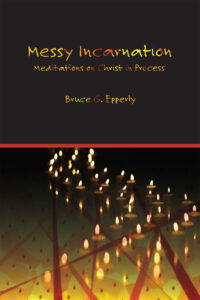
    I like the description of God, originated by process philosopher Alfred North Whitehead, as the “fellow-sufferer who understands.” There’s some more to this view of God, however. Let me quote Bruce Epperly, author of the book Messy Incarnation, which I publish:

    God is the fellow sufferer who understands and the joyful heart who celebrates. God cries along with the Bethlehem mothers, mourning the slaughter of their children. God experiences the hopelessness of parents separated from their children to fulfill the campaign promises of a self-interested political leader. God feels the terror of a child running for his life in a war-torn land and the panic of an adult on the streets of Minneapolis, Minnesota, crying for mercy, “I can’t breathe.” God places you on God’s knees in prayerful embracing. God never places God’s knee on your spiritual neck!

    Bruce Epperly, Messy Incarnation, p. 37

    I would like to emphasize here that God suffers with all sufferers, not just those we manage to care about. God loves the world and feels the pain brought about by evil. God’s caring is not limited and conditional as ours so often is.

    Yes, God can even care for me,. one who so often forgets, fails to recognize, and lives as though caring was optional and occasional. Even while writing this, there was a call to care, and it annoyed me. I acted, but not with grace. Yet God still cares and walks with me.

    Who is God calling you to care more for today?

  • Psalm 119:32 – Enlargement

    Psalm 119:32 – Enlargement

    The way of your commands I will run,
    As you broaden my understanding.

    A young man once commented to me that he thought that perhaps we were trespassing on God’s sphere with scientific discoveries, that we were approaching knowledge that God had kept to himself alone. I asked him this: Do you believe that God is so fragile that he can be threatened by what little we can learn of the incredible amount there is to learn about this amazing universe. And what we know as the universe may not truly be the universe, or all that there is.

    There’s a much more likely reaction. There’s an episode in Life, the Universe, and Everything, the third book in the Hitchhiker’s Guide series. The Krikkiters have lived for ages on a planet enclosed in a dust cloud and thus have not known that there were any other stars or galaxies. For reasons explained in the book, they build a spaceship and travel past the edge of the dust cloud that encases their galaxy, and come upon the incredible site of the galaxies and starts that surround them. Seeing this, they immediately determine two things. First, it’s very beautiful. Second, it’s got to go!

    We often act very much like that. Push our horizon a bit too far out and we want to settle back into things that are already well known. “We ain’t never done it that way before” becomes “we ain’t never thought of anything like that before.”

    We like a small and easily imagined universe, and with that we want a carefully delimited god suitable to our imagined universe. When we see something bigger, we may think it’s beautiful, but it’s got to go.

    In turn, we read scripture in such a way as to fit it into our limited universe, and so as to imagine it produced by a similarly limited god. If someone goes beyond those boundaries we are quick to yell “heretic” and “corrupter.”

    And we read the Psalms in this way. I have heard material from Psalm 119 and other Psalms used simply to explain why we ought to be so thankful to God for making up some very good rules. Many of these rules could be deduced from just looking around our little corner of the universe.

    The keepers of the acceptable often complain that those who speak of the power of God’s grace, and do not see the value of a path of holiness that is just about doing certain stuff and not doing certain other stuff as being against God’s law. Antinomian is the word.

    I teach a principle in Bible study that I call the hammer and saw principle. “Don’t criticize your hammer because it won’t saw boards.” Don’t criticize the law, conceived as a set of rules, because it won’t make people holy or even good. That’s not what it’s there for.

    Psalm 119 turns into a boring and trite piece of propaganda when read as high praise of a list of rules. But when read as the high praise of the God who stands behind those rules and invites people to ever greater things, it sounds very different.

    I used “broaden” in our verse today as a translation. In other translations you’ll find many ways of translating this Hebrew word. But it comes to the word party with a sense of widening and making something bigger. Combining various senses of a word can be dangerous, but I think it’s also dangerous to ignore where a word came from. We can lose the broader sense that the word brings to us when we totally ignore its origins.

    “Make my mind bigger.” This is what will bring on running in the way depicted by God’s commands. It doesn’t bring on checklist managing. It doesn’t bring on a life restricted from greatness by a list of petty limitations. It’s a life made possible by the broadening power of the God of the commandments.

    The law can be a most horrifying and destructive force when it is allowed to replace the Lawgiver. It is God who broadens. It is God who acts first. And it is a God of enlargement that is involved in it all. A giving God, a gracious God, is One who opens doors onto broad vistas of life now and in the future.

    I believe the Psalmist sees this as he praises God as revealed in the instructions, the Word that God has given.

    As a Christian reader of the Psalms, I have come to this particular verse on Christmas Eve, writing something that will be published Christmas morning. For me, the incarnation is the central doctrine of my faith. It’s one I won’t let go of. But more importantly it’s one I want to understand more and more.

    The incarnation is not just an historical event. Yes, I see it as something that happened in history. There was a time and place at which God became present (was revealed) in a human infant. But that moment also represents the timeless fact that God has always been and will always be with us.

    Glory came into a stable. Something that could not be contained was represented in the small, the ordinary, the limited. We try to make this seem better in so many ways. We want it to seem more dignified. But there is nothing more undignified that pure Glory contained in a human body. Philippians 2:5-11 gives a bit of the sense of that.

    But in the same mode, what is human, what is small, what is limited, was called to something greater by the touch of infinity. The incarnation in that place had/has/will have impact and meaning at all times and in all places. It says fundamentally who God is. It says that Infinity chooses to connect with the finite, indeed that Infinity created the finite and calls it to greatness.

    When we note that we cannot keep the law, or be worthy of God’s glory as noted in scripture, it’s not merely that we’re going to screw up and do stupid and destructive things, though we will. It is that we can’t even conceive of the glory to which we are constantly called by the same Infinity that showed up in a manger and showed us that yes, it could happen.

    Creation, redemption, first and second coming all combine into the ultimate reality of the God whose nature is such that God appears in a stable.

    To what glory is God calling you from your stable?

    (Featured image generated by Jetpack AI.)

  • Jumping the Christmas Gap

    Jumping the Christmas Gap

    Most of the time I’m suggesting that people lighten up when they get too deep into theology, so today, when people are lightening up, I want to talk a bit of theology.

    This day represents the core of my Christian faith in so many ways. When I get into discussions about what is essential in Christianity, I always jump straight to the incarnation. There are other ways of thinking about this, but this is the core of my faith, and the launching point for my understanding of ethics.

    All the examples, yelling, legislation, enforcement, and incentives in the world do not do what the incarnation does for me.

    It’s all about jumping gaps.

    You may go on to bridge gaps later, but we start with a jump. And as Christians (of orthodox theology) that’s the incarnation. Infinite God jumps the distance between infinity and the finite. Contemplating the vastness of the universe as we know it can make us feel very small. The distance between infinity and the finite is, by definition, greater than the difference between me and the universe with trillions of galaxies.

    I believe God crossed that gap. I can talk about this in many ways, but that sets the standard.

    I’m teaching through the sermon on the mount with my Sunday School class, and we’re dealing as a whole with passages on the law in Matthew 5:17-48. Verse 48 says to “be perfect as your Father in heaven is perfect.”

    Ouch!

    But it’s a really glorious ouch! This is the example set.

    One of my three favorite books of the Bible, the ones that I find most definitive for my theology, is Hebrews. Hebrews opens with this passage:

    1In old times God spoke to our ancestors through the prophets in many portions and in different ways. 2In these last days, however, he has spoken to us through a Son, one whom he has made heir of everything, and through whom also he created the universe. 3This Son is the brightness of his glory and the exact representation of his real essence. He sustains everything by his powerful word. He performed a cleansing from sins and sat down at the right hand of majesty in the {spiritual/heavenly} heights. 4Thus he became as much greater than the angels as the fame {reputation} he has inherited is of a more outstanding nature than theirs.

    Hebrews 1:1-4 (my translation, emphasis added)

    Across the impossible gap, God communicated with us.

    This differs almost infinitely from anything we would conceive of doing. For us, it would be a military campaign, or a program of political or religious persuasion. To but it bluntly and simply, God instead showed up on our level and said, “Hi! I’m the One.”

    Helpless.

    In a manger.

    Now I find that an amazing concept in itself, but I also see both an invitation and a challenge. The invitation, amongst many other things, says that more things than you can imagine are possible. I’ve set the standard, opened the path, connected with you, and I’m ready to work in you.

    As Paul says in Philippians 2:5-11, Jesus, the anointed one, didn’t consider the heavenly glory and power something to cling to, but rather emptied himself. Then in the next couple of verses he points us to the Way that this works. “Work out your own salvation with fear and trembling.” Sometimes we stop there. That’s because we haven’t gotten the incarnation. We think that the best way to get things done is to hassle and harangue, to push and force.

    The incarnation, on the contrary, says to us, “I value you enough to jump across infinity to reach you.”

    If you get that, you aren’t going to try to fly the gap the other way. You’ll realize that won’t work. That’s why the next verse in Philippians says, “For it is God who works in you, both to will and to do God’s good pleasure.” The book of Hebrews expresses this in 10:20 as “a new and living way, His (Christ’s) flesh.”

    I read and meditate on these verses, and what comes to me is this: How can I find it so difficult to jump the gap between myself and other people

    • Down the pew from me in church
    • Across the aisle
    • Of different denominations
    • Of different religions
    • Of different cultures
    • Of different skin colors
    • Of diffent opinions and lifestyles in so many possible ways

    “But they’re wrong!” someone retorts. Humorously, I’ve heard this more often about the color of the carpet, the placement of the pews, or the style of the music than about the apparently more weighty differences.

    When Jesus reached out to me, I was not right. I needed spiritual change. I needed other changes in my life. If Jesus waited for us all to be right, no salvation would ever happen. It would be like a doctor refusing to treat people who were not already healthy, only worked out on an infinite scale.

    But remember, reaching out is not about you fixing everybody. That’s because you and I are not all right ourselves. We cross the gaps in relationships, bring that connection to the infinite with us. The rest is up to God and the flawed human to whom we’ve crossed the gap. I don’t have the plan. I don’t have the power. I’m just hopefully letting God work through me.

    I’ve commented on this to many classes. People say they are not ready to be witnesses. Why? They have problems. They don’t know enough. They don’t have all the answers. Some suggest I go speak to people for them, using my greater training. Everyone is always a witness. The question is what kind. Is God working in and through you, or are you getting in the way.

    The distance between me and God is not measurably different than the distance between God and the worst sinner out there. With God providing the power, surely I can cross the gap to anyone.

  • Believing Impossible Things

    Believing Impossible Things

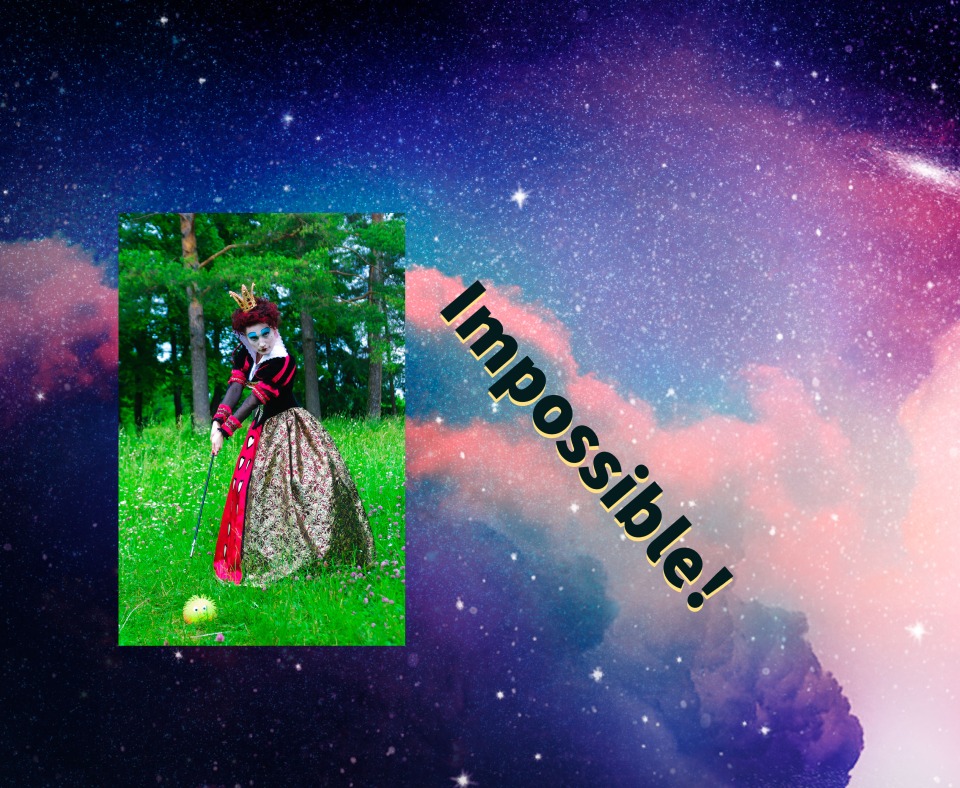
    In Alice in Wonderland, the queen says that sometimes she has believed six impossible things before breakfast. A fair number of years ago, someone told me that in response to points of my Christian faith. The aim was most likely to shock or offend me.

    How did I respond? I don’t recall what I said. It wasn’t terribly memorable. But I do know what I thought. Yes, indeed, I do believe a number of impossible things before breakfast, not to mention after breakfast as well. I have never understood the desire to make so many of the very difficult aspects of the Christian faith as rational as possible. If God can be explained rationally within the incredibly tiny sphere of my personal knowledge, there’s really no point. That’s a mini-god.

    Now I don’t mean here that all aspects of religious faith are irrational. There are things I believe that can be rationally explained. Various arguments for the existence of God can, for example, open up a crack through which some light may shine. The arguments of a historian may create a place in which a virgin birth, or a resurrection might just be hinted at as an explanation for so many things.

    But I believe in a God who created the universe. I was thinking the other day while I gazed at a picture of galaxies seen from the Hubble Telescope in a part of space that looked empty to the naked eye. The space was filled. Now it’s not entirely impossible to suggest that this was created by someone or something. But when you add to that the idea that the entire universe was created by Someone who actually cares about anything that happens to me, you are proposing something patently impossible. If you claim it is possible, other than in one’s imagination, I suspect you of not really comprehending just how far that is out of the boundaries of comprehension.

    As we come up to Easter, we will commemorate a God who became flesh, lived here, and ultimately permitted himself to be tortured and killed. I believe that happened. If you try to reply to that problem with the doctrine of the trinity, let me note that you have responded to an apparent physical impossibility with a logical impossibility, the idea that one person can really be three, and three can be one.

    Yet I believe all of those things. I have disappointed not a few people when I decline to try to make all these beliefs rational. The incarnation (a person being 100% God [whatever we mean by that] and 100% human at the same time) is both a logical and, should we be able to figure out what would be involved, would doubtless also be a physical impossibility.

    People who believe all these things can certainly also believe in a great number of truly rational and reasonable things. I believe in the laws of nature and live my life largely in accordance with them. (Some of that health stuff is overcome by my general desire to enjoy life!) I find often that I agree to a large extent with those who do not believe in God on matters of ethics, politics, and as far as it applies to daily life, rational interaction with the universe.

    But I still believe that God, one capable of creating all those galaxies, well past my imagination already in the physical universe, also, as one member of the trinity (three in one!) became flesh (100% divine and 100% human), died, and rose again from the dead.

    The same God also notices when a sparrow falls.

    Six impossible things before breakfast?

    Trivial!

  • Sunday School Today: Authority and Truth

    1893729389I think I titled the next chapter in my book When People Speak for God rather pretentiously: Authority and Truth. That’s what we’ll be discussing today in my Sunday School class.

    As I was reading the chapter, I came across the following, which ties into several things I’m thinking about these days:

    There is, however, a deeper claim that’s involved in both the virgin birth and the resurrection. These doctrines state that God is fundamentally interested in communion with human beings. In the virgin birth we have the statement that God is prepared to share our form and our condition and to become a part of that history. In the crucifixion, God says that he is prepared to carry that sharing all the way, to experience death. In the resurrection, he states that despite his willingness to share it, he’s above it, and thus able not just to communicate with us, but to redeem us.… (pp. 135-136)

    I call my view of inspiration incarnational, because I see God’s Word, however it is expressed when it is communicated with human beings, as a form of incarnation. The problem with this is that I think the orthodox doctrine of the incarnation is not well understood. (There is, of course, the sense it which it will never be well understood and will always be a mystery!) But the way people often hear the term “incarnational” in connection with inspiration is as a claim that the Bible is a mixture of divine and human. When I call scripture incarnational, I do not mean a mixture. I mean that it is all divine and all human. We can sense aspects of divine and aspects of human, just as we can with Jesus the man, but we cannot divide.

    Inspiration is all-the-way incarnation as well. God’s power is contained in the finite form. What we need is ears to hear and eyes to see.

    I’ll have more to say about this over the next few days.

  • A Note on Hebrews 1:3 (Orthodox Study Bible)

    I’ve said enough negative things about the Orthodox Study Bible that I need to mention when I find it quite helpful as well. Generally, this is when it is either quoting or referring to various church fathers.

    In the note on Hebrew 1:3a, “who being the brightness of His glory and the express image of His person …”

    The first half of v. 3 is quoted verbatim in the Liturgy of St. Basil the Great. The brightness of His glory expresses the Son’s nature, His origin from and identity of nature with the Father. He is the Father’s brightness because He is begotten from the Father beyond time and without change. Thus, the Nicene Creed speaks of “Light of Light.” As the sun does not exist without radiating light, so the Father does not exist without the Son (p. 1653, on Hebrews 1:3).

    I particularly liked the last sentence. It’s hard to use analogies for the trinity without falling into one or another heresy, but this one does a great deal. The note goes on to state that the “express image” speaks of the Son as distinct from the Father, thus bringing together the two elements of the incarnation—one with the Father and yet with us, truly an icon of God.

  • How Incarnational?

    Well, it seems to be my day for linking, which is not surprising. (For those who wonder why I’ve been blogging less, though I think I’m still blogging quite a lot, it’s because I have to file a form 990EZ for a non-profit with which I’m involved. It is really not that complex, but I’m a bit accounting challenged.)

    I’ve been following The Crowded Handbasket nearly since it’s inception, but this is the first time I’ve linked. There’s a rather good article there asking the question just how incarnational you are. Since I make a point of using the word “incarnational” regarding just about everything, I thought I should look and answer the question.

    As for my own position, I would have to use a descending graph line from points 3 to 5. I’m definitely “in” at 3, and then less and less so as I go. My own phrasing is that God was uniquely present in Jesus of Nazareth, not that God cannot manifest himself in any other way, but that he did so in a special way in that case. I also accept the “fully involved” term. Otherwise I’m a bit less exclusive than is defined by #5.

    Perhaps that will make for some discussion!

  • Peter Enns, Incarnational Inspiration, and Seminary Authority

    In 2005 Peter Enns, a professor of Old Testament at Westminster Theological Seminary, published a book titled Inspiration and Incarnation, and it is likely going to cost him his tenured position. I’m writing about this on this blog because of the implications of his incarnational view of inspiration for Biblical interpretation. I have not yet read this little book. I found out about it through this controversy. Let me comment to you the Christianity Today news article, and this review in JETS by G. K. Beale. The review is not particularly favorable, but it follows the kind of standards for writing and citation that would suggest it’s fair. (HT: Everyday Liturgy)

    What am I writing about, if I haven’t even read the book? Primarily I’m writing because of the impact on good education of seminary policies such as this one. Secondly, I know of other cases in which discussion of inspiration leads to this kind of reaction, to the detriment of serious consideration of the issues. Often the people in the pews are left without any sort of answers, or better any sort of structure in which to discuss answers because the theologians are avoiding them. Thirdly, I publish a book that uses the incarnational metaphor, Who’s Afraid of the Old Testament God?, by Dr. Alden Thompson, who has also elicited some controversy due to his view of inspiration. Finally, I hold an incarnational view of inspiration myself, as espoused in my book When People Speak for God.

    If you were to take the quotes and summaries by G. K. Beale in his review, not do any contortions to try to put a good face on them, i.e. take the more liberal interpretation, then you would have something like my own position. I will have to see when I get a copy of the book myself whether I think these things are fair with reference to Dr. Enns. I would simply note at this point that none of the material quoted appeared at all shocking to me, but then I’m not an evangelical.

    The problem I have here is with the seminary. First, let me say that I fully accept that a seminary belonging to or sponsored by a confessional body, has every right to control what is taught there. At the same time, the rest of us have every right to criticize their choices. The value of that criticism has nothing to do with changing the seminary. They’re not going to listen to me, and I wouldn’t even argue that they should. I’m not evangelical, I’m not Calvinist, and I don’t like the Westminster Confession.

    I criticize nonetheless because I believe we need to be aware of the problem of education that is constrained by a specific confession and that won’t allow anyone to question or work around the boundaries. The area of inspiration is one that has many lay members confused, and it is one where our young people who go to secular universities find themselves generally unequipped. When we constrain the playing field so thoroughly that we can’t discuss the type of issues that Dr. Enns raises, then I question the quality of the education that results.

    There is here a great gulf fixed between a secular, academic education, and an education at a confessional institution. I’m not sure how one should draw the boundaries if one belongs to a confessional church, but if one’s convictions are to be sound I think one has to have honestly explored alternate possibilities without the fear that stepping across the line will ruin one’s life.

    The combination of those elements is very difficult, and perhaps even impossible for a very confessional church, which is why I avoid such a thing. I am jealous of the ability to explore, to be wrong, and perhaps later to correct my course.

    In the final analysis, however, those who want to explore real answers to questions of inspiration will probably have to break the bonds in a more serious way, finding a less constrictive environment. The problem for many is that they have a firm faith and a strong commitment to their faith community, so it is hard to just move on. Such is the tragedy of the right of the seminary to manage itself, versus the need for thinking people to explore.

    While I found it necessary to step out of the community in which I grew up, I understand those who find that difficult, and who then spend years or decades in conflict with a community that they love.

    One final note–these are the folks who want to “teach the controversy” in public universities and in our high schools. The real goal is to put science within confessional boundaries, a straightjacket that will certainly not fit it.

  • Which Paradigm to Check

    David Lang has written an interesting post at Better Bibles dealing with the complementarian/egalitarian debate. Readers of this blog will realize that I’m not terribly moderate on this particular issue–I’m passionately egalitarian.

    David does make a good point about polarizing arguments, however:

    . . . In the process of trying to persuade those who disagree with us, we often become even more polarized in our views. We get so frustrated with the other person for not agreeing with us and so flustered by their arguments, that we begin to shore up our own arguments and press the text to say something more clearly or explicitly than it really does. This is especially true when we see the stakes as being high. . . .

    It’s quite true that overstating one’s case can both drive neutral parties away and alienate opponents so that dialog becomes much more difficult if not impossible. I would say on the other hand, speaking from personal experience, that one can be so careful not to overstate one’s position that it becomes unclear just what the position is.

    People will then congratulate you for being a peacemaker, but the problem continues. You can spend so much time framing a debate, that the debate itself gets lost.

    David’s comments are not without merit, however. And I will keep them in mind as I state things fairly forcefully. But perhaps I will restrain myself from time to time!

    But the key point to which I wanted to respond is this:

    As I’ve observed the gender role debate, I’ve seen this dynamic played out over and over again. There is a finite set of Biblical passages which the two camps must deal with. . . .

    It’s a simple statement and is perhaps not David’s main point, but it becomes my main point. Why? Because I do not believe that this debate is a matter of dealing with a finite set of Biblical passages. We are warned to check presuppositions, so the presupposition I want to check is this very one.

    To me, the issue is not a finite set of Biblical passages. I happen to believe, for example, that at least in some of his churches, Paul did not permit women to teach. I don’t think Paul would, in his context, have advocated ordination of women. The “finite set of passages” position seems to rest on the idea that the Bible is primarily a set of theological propositions, and if we can just straighten it out so that all of them say one thing, that is the theological answer.

    I would suggest instead looking for the principles on which the various individual judgments were based. To me particular counter-examples to male leadership, such as Deborah in the Old Testament and Junia in the New are that much more significant because of the fact that they occurred in overwhelmingly male dominated societies. That is an interesting factor, whether or not there are particular texts that speak against women in leadership or not.

    This leads me to believe that I don’t have to “deal with” all of these passages, at least in the sense of explaining that they really express an egalitarian ideal. What I’m looking for is what are truly the basic principles of the kingdom.

    When I have found those I try to apply them to living in a modern society. What worked in Paul’s churches may not work in today’s churches and vice-versa. What I must be careful to do is to make sure that my behavior today is based on the same principles.

    I take this a bit further, however. It is not merely Biblical passages that are involved, but also church traditions, and most importantly the present day guidance of the Holy Spirit. Now I don’t believe that the Holy Spirit will guide us into violating the principles that are expressed in scripture, but he certainly can guide us into seeing how those principles are to be applied in a modern context. All of this is accomplished using our reasoning powers–always under the guidance of the Holy Spirit, or so we’d all like to assume.

    The paradigm that I would like to see shift is one that expects us to explain all of the texts one way or the other, and takes a look at the general trend of scripture–the trajectory, if you please–to see where God is leading us.

    I do believe passionately that God is leading us to more equality in ministry. I believe this because I see it happening in scripture–some of the time. I believe it because women have stepped up throughout church history. I believe it because I see genuine calls and gifting amongst women in areas the complementarians would reject. But most importantly, I see anything less than equality in the church as unworthy of the incarnation. The Word becoming flesh dwarfs these kinds of human barriers.