Threads from Henry's Web

Tag: Hope

  • Romans 12:12 & 15:13 – Hope

    Romans 12:12 & 15:13 – Hope

    Rejoice in hope, stand your ground in the face of trouble, be devoted to prayer (Romans 12:12).
    May the God of hope fill you with all joy and peace as you trust in him, so that you might have abundant hope through the power of the Holy Spirit (Romans 15:13).

    Jody listed these two verses as a starting point for discussing hope. I’m tempted to wander for some time in the immediate context of these verses, but these posts are not supposed to be complete homilies.

    But my mind does wander a bit through various passages, and these reminded me of the end of 1 Corinthians 13, where we have the trio “faith, hope, and love” with the greatest being love. This greatest is not directly mentioned in either of the verses cited above, but you won’t have to look far in the context to find it.

    Now let me tell you that hope isn’t my greatest subject. I’m a realist. I like to know how things really are. I move forward by putting one foot ahead of another, and generally looking most closely at that next step. I’m good with what Jesus had to say, “Sufficient unto the day is the evil thereof!” (Matthew 6:34b). (Note that if you look at the context there, Jesus isn’t talking about hope or lack of hope, but rather about worrying, which he declares useless.)

    I, on the other hand, am very much convinced that every day has its full quota of annoyance. I’m much more likely to preach about duty than about hope. Why get up in the morning? Is it because things are going to be great and I’m going to enjoy them? No, it’s because that’s what I do. That’s what I should do.

    There’s a call here to realists, well, at least my version of realist. And that is to live in the light of hope. This hope comes in two different parts, at least.

    The first is simply the hope of eternity. This life, no matter what it brings, is temporary, and my life is eternal in Christ. That is great news. It is a hope that draws me forward from within the fog of my natural pessimism.

    But that hope seems very far away most of the time. There are mountaintop experiences when I can feel the grass of heaven’s feels under my feet and hands, and I can sense that glory, limited by my feeble vision. Those moments are good. But they are moments only.

    The other kind of hope is that God is with you now. You sense that in Romans 15:13, which speaks of a hope that brings joy as we believe. That this hope is present and not just future is emphasized in Romans 12:12, with three commands together. “Rejoice in hope, stand your ground in trouble, and be devoted to prayer.” Those are all present activities, not things we await in the kingdom.

    And the fact that we are to stand firm in trouble or tribulation suggests that rejoicing in hope is not limited to those times when we are on the mountaintop or otherwise feeling good. Rejoicing in hope is a daily activity that goes right along with the annoyances of daily life. We rejoice, we struggle, we pray, we stand firm. Hope is part of all of these things.

    Paul, we should remember, was no stranger to trouble. He was afflicted on a pretty regular basis. And yet he said to rejoice in hope. Now and in the future.

    Put some prayer and hope into the troubles of your day today!

    (Featured image generated by Jetpack AI.)

  • Psalm 119:166 – Hope

    Psalm 119:166 – Hope

    I put my hope in your salvation, LORD,
    and I put your commands into action.

    I’m thinking of this today from a distinctively Christian perspective, and less about historical meaning. I’m looking back at the text through another lens.

    In one of my favorite texts, Paul puts these two concepts together:

    … With fear and trembling work out your own salvation, for it is God who works in you both to will and to do his good pleasure.

    Philippians 2:12-13, my translation with the final word taken from the KJV

    This again brings together these two important concepts: Trusting and Doing. If one’s hope is in God’s salvation, then what’s the doing about? Paul makes it clear here (and I think it’s clear in the Psalm as well) that it all depends on God, and yet there is doing involved.

    The problem for us is mixing the two up, getting our hope from our efforts. For many, there is a fear that if we don’t demand effort, no effort will be made. So we try to make salvation, or many other lesser goals depend entirely on work that is simply not sufficient to support it.

    What would it do to someone’s morale if they are facing an impossible barrier, and are told, “You have to put your hope in your own efforts to get over this barrier”? The result is that hope dies and the person gives up. One human approach is to follow this up by calling the person a loser because they have failed to overcome a barrier that was, in fact, impossible.

    The book of Hebrews, also a favorite of mine, leads up to presenting Christ as the one God perfected on our behalf at the end of chapter 5, and then in 6:1 says, “let us be carried on toward perfection.” (I believe the passive, not middle is the correct translation of the verb here.) The idea being that having through Jesus we are now to be carried on to the kingdom.

    If we get this idea of identity, and of a hope provided by God, then the idea of putting God’s commands into action becomes something different. We are winners with every step, not because we have accomplished the goal, but because we are on the journey, being cared along to perfection.

    Given a couple of quotes recently, you might be aware that I’m reading Deanna Thompson’s commentary on Deuteronomy. I have another quote from that book:

    Moses’ act of remembering and retelling Israelite history, as Israel stands between its future and its past, makes an important theological point about Israelite identity: Israel’s relationship with the God who freed them from slavery is its identity, and after years of dishonoring that memory, it is time to remember, honor, and obey.

    Commenting on Deutereonmy 1

    The Bible is very much about trust and hope, but it is also very much about action. Our problem is often leaving one or the other element out, or getting them in the wrong order. Trust and hope make action possible. Knowing who we are is what frees us for action.

    So, after all, this verse of Psalm 119 is very clear and reminds us of the order. Trust in God and do. In that order.

    What will God free you to do today?

    (Featured image generated by Jetpack AI.)

  • Psalm 119:123 – Patience

    Psalm 119:123 – Patience

    My eyes have failed looking for your salvation,
    and for your righteous word.

    Any number of people have told me that I shouldn’t pray for patience. If I do, God will doubtless send me all kinds of trials and keep me waiting so as to teach me patience by experience.

    I think it doesn’t matter if you pray for patience or not. You’re going to get an opportunity to learn patience by experience.

    The psalmist is living, well, life! I think we can all relate. From childhood trips when we doubtless drove our parents nuts by asking “are we there yet?” to expectations of other people, to our hopes even in old age for new blessings to come–and even to looking for the end of long sentences–we have opportunities to practice patience.

    Usually we don’t. If you keep wondering why your patience is being tested so much, you might consider whether you are actually gaining patience or just repeating our experience of extended impatience.

    But one of the experiences of Christian life, and yes, the lives of people of other faiths, is that things we hope for, whether they are secular in nature or the result of a perceived promise by God is delay.

    One of the big ones for Christians is the wait for the second coming of Jesus. How are we doing with that?

    Well, I grew up as a Seventh-day Adventist. Back in 1844 (well, first in 1843), Adventists calculated that Jesus would return on October 22, 1844. The history books, not to mention we’re still hanging out on this planet, suggest that prediction wasn’t right.

    I don’t bring up SDAs in order to laugh at them, but rather to point out just how normal is this is. People continuously set dates for the second coming. Many more don’t set dates, but come up with various reasons to declare that the second coming is “really near” now. We’re obviously in the last days, because [list of things we don’t like about the world here].

    In growing up I remember evangelists coming by regularly, and in order to provide the appearance of an audience when really very few visitors showed up, we’d all attend. After a time I started to notice a problem. At one point I remember wondering why Russia (the USSR back then) wasn’t part of the prophecies of the end, considering how much the older folks talked about it. A couple of years later, Russia suddenly appeared in one of these evangelistic meetings as a really-truly sign that the end was really near.

    Our eyes just get worn out reading all the explanations of why the end hasn’t come yet and why we ought to keep hoping for it.

    There’s a good side to staying on the watch for God’s promises. I think that’s what the psalmist is pointing out. No matter what has happened, no matter how long he has had to look, he has kept hoping. That is a good thing.

    Trying to make up the result you want–not so much. Perhaps we would be better to “evangelize” about the good news that Jesus loves you now and invites you into his family, rather than trying to pin down the time when he appears in the clouds. Making new predictions can just be wearing on our eyes and our hopes.

    And as someone pointed out to me today, the one thing we can’t do is give up. Ultimately that is what patience is about. We practice patience when we keep moving forward and don’t give up.

    What opportunities will you have to practice patience today? Will you take advantage of them, or will you just demonstrate your skill at impatience?

  • Psalm 119:116 – Supported

    Psalm 119:116 – Supported

    Support me according to your word that I may live
    and don’t let my hope fail.

    As a note on translation, this verse is simply and sparsely expressed in Hebrew, which leaves some work to the translator in choosing precisely how to translate. Yet the overall result doesn’t change that much. Try comparing a number of translations. The words will vary, but the overall meaning remains similar.

    Sometimes we stress too much about translation details. It’s quite possible to get so hung up on precise words that we miss the message, which is unfortunate. I keep quite a collection of Bible translations and editions, and I deeply appreciate the vast majority of them.

    This verse fills an important role in the tapestry of Psalm 119. We find the psalmist grateful, determined, confident, hopeful, and fearful. We find him claiming accomplishments in one verse and calling for God’s help in another. The overall effect is a powerful picture of a person of faith carrying out life as one of God’s own.

    Our verse today covers much of this ground in one poetic couplet. The psalmist calls on God’s support that he may live. He recognizes the dependence on God for his very existence. If the creator and sustainer of the universe doesn’t sustain him, he can’t live. It’s as simple as that.

    At the same time he is expressing confidence. God’s sustaining power will provide life, and let him attain to his hope.

    Sometimes we have that kind of dual feeling. Confident, but feeling the need of support. Sports teams feel it with supportive crowds. The professional athletes are not underconfident. They know what they’re doing, but they’ll still acknowledge the value of that support.

    Sometimes we separate our efforts and what God does, but they are not so easily divided. If we hold that God is the creator, and that God’s creative power upholds the universe (Psalm 104 comes to mind), then we also know that our existence is dependent. At the same time, we know that those laws that God created are reliable enough that we don’t need to be concerned that the will end.

    For the believer, this covers everything, both physical and spiritual. The connection is there. Support me, and I will live. I hope, but I know that you, God, are the real hope, because you are the source and foundation of all hopes.

    Today, try to feel the support that God gives you. Look for ways in which he is taking you toward your greatest hopes.

    (Featured image generated by Jetpack AI.)

  • Psalm 119:82 – Waiting

    Psalm 119:82 – Waiting

    My eyes are failing from looking for your promise.
    I’m asking, “When will you comfort me?”

    The process of meditating on a verse like this is very different from the process of exegesis. I can dig out the details of this verse fairly quickly.. There’s not that much that’s controversial about the text or translation.

    But meditating is different. It’s not just about the verse itself, but about what that suggests. I had to go back and read the verse several times. I wonder if that’s because I really don’t like what the verse itself implies.

    Here’s one of the writers of scripture. We don’t actually know who wrote the Psalm, but it’s nice to think of David, simply because he had so many experiences that fit well into the message of the text. But whoever it was, it was someone who wrote poetry and that poetry became scripture. That person’s testimony is that his eyes wore out with watching for God to fulfill God’s promise and provide him with comfort.

    Comfort? That’s in one way a very uncomfortable thought. I don’t particularly like to wait. I like to know now. I like to receive now. Though these days I often fail, I like to do now. Waiting is bad.

    I’m reminded of Job. Many years ago, I heard about Job as a theodicy, an attempt to explain why, with a sovereign God, there is suffering. The problem is that the book of Job does no such thing. It makes no attempt to justify God’s actions. In fact, Job himself has no idea of what is going on.

    Not only does Job have to wait, but he has to suffer through all those long speeches. And what Job wants is to know that God hears him, that he is not alone in all this. He doesn’t really ask for an explanation. Job wants a hearing!

    When that hearing comes, it’s not all that helpful in content and explanation. What it does is show that God is aware of Job’s problem, and that is what Job wants.

    I don’t know what specific promise the psalmist was waiting for. If the author is David we know he had to spend years as a fugitive, waiting for the fulfillment of the promise that he would be king. It’s likely he had moments when his eyes were worn out with waiting and wondering when God would act.

    Each of us has things that we want, that we have prayed for, and even that we may believe God has promised us. When these things don’t happen, we want to head off in another direction or decide that God is not with us. But Job waited until he got that hearing. David waited until the crown came to him.

    There’s a promise in this verse, one that could be reaffirmed by God’s people throughout time. It’s worthwhile waiting. The hearing is coming. The crown is coming. Your reward is coming. Wait for it.

    Perhaps we might borrow some attitude from Habakkuk, who asks God a question and then stands at his post. “I shall take up my position on the watch-tower, keeping a look-out to learn what he says to me, how he responds to my complaint” (Habakkuk 2:1, REB). I also recall the character Puddleglum in C. S. Lewis’s The Silver Chair, who, confronted with the idea that there was no Aslan said (I paraphrase) “I’m on Aslan’s side even if there’s no Aslan to lead it.”

    There is hope in this verse because the backstory must be that the author believed the promise, waited on the promise, wore his eyes out looking for the promise, but he’s now here writing about it.

    What are you waiting for? Keep a look-out for God’s move!

    (Featured image generated by Jetpack AI.)

  • Psalm 119:74 – Wait

    Psalm 119:74 – Wait

    Those who fear you see me and rejoice,
    Because I wait for your word.

    Again, there are a number of ways to translate, especially the verb tenses. In a poetic form, that is challenging. I see this as a continuous state rather than a prediction. Those who see the psalmist rejoice, precisely because he is awaiting God’s word.

    We could discuss the value of recognizing God’s work in the lives of others. That is one of the things that helps create community. We recognize God’s grace in action and it’s time to rejoice.

    But the word that caught most of my attention today is the word “wait.” It can be translated “hope” as well as “wait.” We don’t like the word “wait” and even “hope” can be a problem when we remember that if we’re hoping, we don’t have it yet! And we’re back to “wait,” which we don’t like.

    But waiting is critical. Timing can be important and if you don’t learn to wait, you are likely to miss many things. You can miss something as easily by rushing and being too early as by being too late.

    And what is the psalmist waiting for? God’s word.

    With waiting there is listening, listening for God’s word. This can come to you in so many different ways. I recall once that I had been trying to make a decision. The situation was one were right and wrong seemed ambiguous. I was talking with a friend asking for prayer and advice, and as we were praying and talking about it, suddenly something became very clear.

    Did I hear a voice? No.

    Were there words written on tablets of stone? No.

    Did I have a vision? No.

    I believe God can speak in all of those ways. God has spoken in all those ways. But the “word of God” that I received after waiting that time was simply the sudden understanding of what was the right thing to do. In a flash I knew that one of the courses of action I was considering could not be carried out ethically, so there was really only one choice.

    Can you wait for that knowledge of what God’s word says about any situation?

    Here are some helpful books I publish on this topic

  • Advent Series at Energion

    Advent Series at Energion

    I’m sure all my readers know I own Energion Publications, and function as the CEO, now that we have a separate editor.

    This Advent I’m putting a quote from a different book each day of Advent. Here is a list with a couple of notes.

    1. As we begin the series, Deborah L. Roeger reminds us that “hope is not an afterthought for one who is devoted to Christ.
    2. First week, 2nd day, Jody Neufeld reminds us to spend time with the Lord who is our hope.
    3. First week, 3rd day, Edward W. H. Vick affirms our resurrection hope.
    4. First week, 4th day, Bruce G. Epperly calls us to hopeful adventure.
    5. First week, 5th day, Ron Higdon reminds us of hope for everyone.
    6. First week, 6th day, Allan Bevere reminds us of the continuity of hope through Scripture and through time.
    7. First week, 7th day, Richard Voelz tells us of hope that comes through loss.
    8. First week, Bonus, Alden Thompson calls our attention to hope in prayer as we see characters in the Bible pray from weakness.
    9. Second Week, 1st day, David Alan Black says all Christians should work for peace.
    10. Second week, 2nd day, Bruce Epperly asks us what it is that we put our hope in.

    There are many more to come, but this will give you an idea. Many of these books are on sale as well, so check out those that interest you.

  • Hope as an Anchor – Hebrews 6:19-20

    19We have this hope as an anchor for the soul, steadfast and firm and entering the inner side of the veil. 20Jesus entered there as a forerunner for us, becoming a high priest eternally according to the order of Melchizedek. — Hebrews 6:19-20

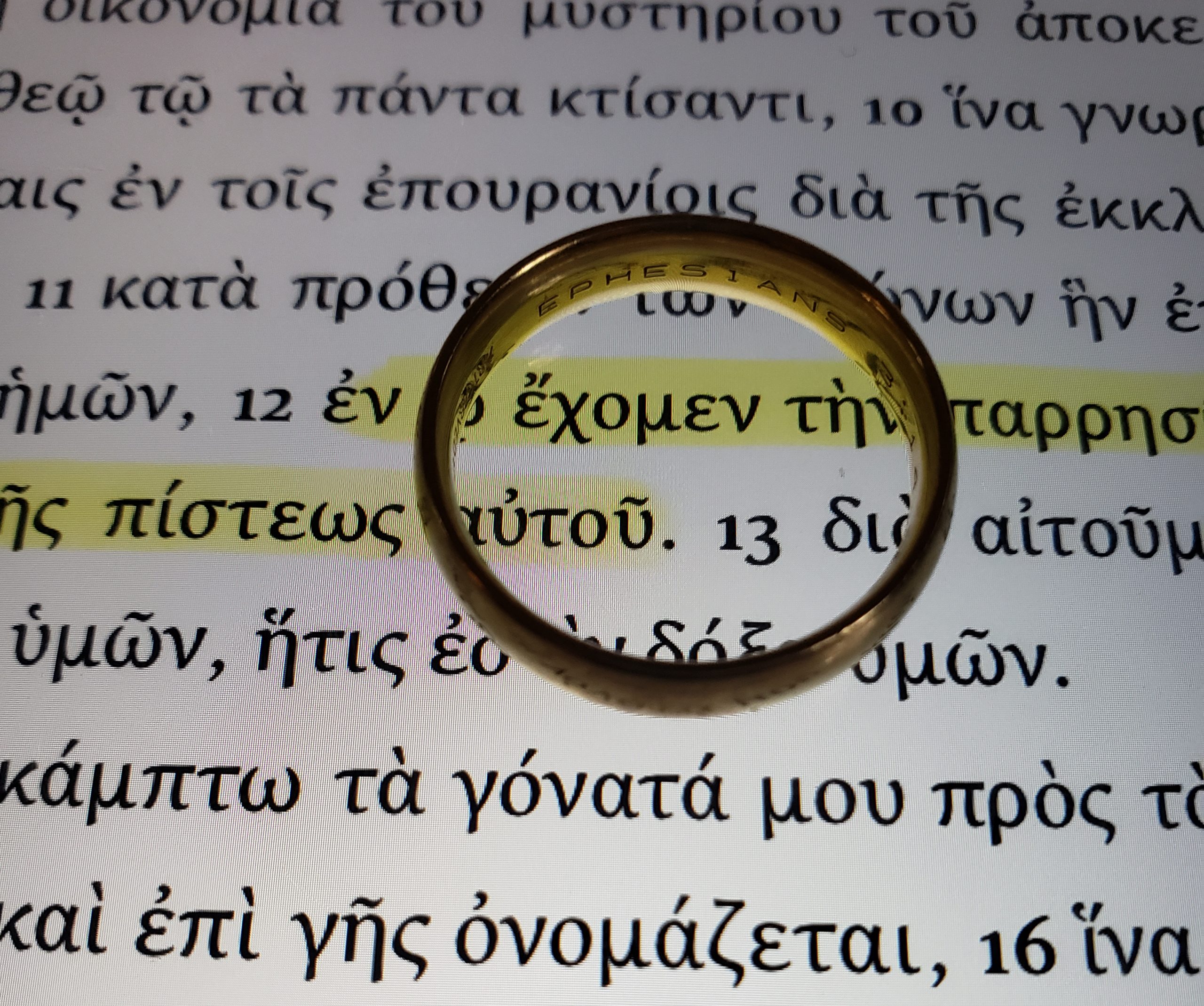
    When I joined the Air Force, my mother made me a quilt that had this text embroidered in it in Greek. That quilt stayed with me more than 20 years. Why “anchor” for someone in the Air Force? Well, two things. I had intended to joint he Navy, but then got a job closer to what I wanted with the Air Force, and then she thought my soul still needed an anchor–as indeed it did!

    Today, I was reading the Ancient Commentary on Christian Scripture (Hebrews), pages 93-94, [On the Epistle to the Hebrews 11.3] and I was very much struck by the comments of St. John Chrysostom. You can guess that I particularly appreciate his commentary on scripture by the number of posts I’ve made that consist mostly of a large quotation from him. In this case he talks about the importance of hope as an anchor.

    The foundation of this hope, the “meat” of it, is that God takes and oath and does not lie, and he says that we will be heirs. That’s the hope we’re talking about. Each of us needs some kind of hope. St. John Chrysostom notes that “we are already living amid God’s promises.” Then he adds: “. . . through hope we are already in heaven.” That’s intense hope.

    But some of us have a hard time holding onto hope. When things get discouraging hope gets weak! St. John points out that the apostle (he assumes Paul as the author) chooses his figure wisely. There are those who are founded on the rock as Jesus said (Matthew 7:24-27). Then there are the rest of us, who are not quite so steady. We need an anchor that holds us in place even though we are shaken. This is a message for the folks who don’t feel quite so anchored on a rock. Quoting again: “For the surge and the great storm toss the boat, but hope does not permit it to be carried back and forth, although winds innumerable agitate it, so that, unless we had this hope we should long ago have been sunk.”

    This passage fits especially well into the message of Hebrews, which is for people who have begun to follow Jesus but have been looking back because of hardships. The author repeatedly assures us that the goal is worth working for, but he also tells us that we must keep going. They weren’t people whose houses were fully founded on the rock. They were shaken, but they needed–and they had–an anchor so no matter how they were shaken, they would still end up in place.

    I think most of us are more like that. The house on the rock is a good ideal toward which we can strive, but I think we feel much more like an anchored ship weathering a storm. If that’s the case, Jesus still has the anchor to keep you safe. You’ll probably get wet, you’ll probably be shaken, but you’ll come out alright in the end.