Threads from Henry's Web

Tag: holiness

  • Luke 15:11-32 – The Prodigal

    Luke 15:11-32 – The Prodigal

    I’m not going to provide my own translation or paste the text from another one here today, as the passage is long, but I’d strongly suggest re-reading the story before you continue. Read it carefully.

    This parable is often called the parable of the prodigal son. Many commentators, however, have considered it much more about the prodigal father, in the sense of a father who was lavish and extravagant about his love and generosity. This latter view is not bad as the meaning of the parable.

    I’d like to suggest, however, that we can look at this parable in more than one way, and the meaning shifts as we do so.

    The first view is one that I heard many times before. The prodigal son has done many horrible things in his life, and finds himself at rock bottom. From that final landing place he manages to grasp just a little bit of hope. Maybe, he thinks, I can persuade my father to take me back as an employee. The lesson of the story seen from this point of view is that you should be willing to repent and come home, and the Lord will accept you.

    Not bad. Even true.

    But the next view is that this is the story of the father, a father who always loved his son, who gave him early access to his inheritance, and waited for his return as long as he was away from home. We can gather that he lived with this hope because he sees that son returning from a long way off and comes to welcome him. From this point of view, this is the story of the father’s grace, love, and willingness to accept the returning wanderer.

    Even better. Also true.

    But the third point of view is the other brother, the good brother, the one who stayed home and worked hard and thought he was pleasing his father. He’s satisfied with is goodness and believes his father owes him respect for his diligence in keeping the family business going and providing support for his father in his old age.

    Not very nice. But very true.

    Contrary to the way many read this story, I actually think the older son is the target. You see, I am the older son. Yes, I’ve done some wandering, but not as much as other people I know. In fact, I lived a quite respectable and productive life while I was out of the church. When I came back, I was ready to start teaching the Bible and diligently doing God’s work.

    I had to return, but not from a far country. Just from a little ways down the road. And yes, the father was there waiting for me. I was a respectable wanderer who returned in good time and was able to put what I learned in the meantime into God’s work. Many said it was part of God’s plan, that God had been preparing me to work.

    So now I can look at people who have wandered far from God. They’ve gone off and become addicts, criminals, God-haters. They’ve really hurt my heavenly Father. They’re the bad people who need real redemption and not just a little adjustment to their lives.

    But you know what happens? When they show up, the angel choirs break into hallelujahs. God welcomes them into his arms. There is great rejoicing over this one sinner who repents. Even, no, especially, the ones who fell the farthest, who behaved most despicably, who were the least respectable in human terms.

    And yet … there’s the father waiting, watching, jumping up joyfully, welcoming, feasting.

    And I’m left to keep on trying to do everything the father wants me to do. Why don’t I get the reward that I think I ought to get?

    It’s actually very simple. Even when I make the story about me, the older brother, it’s still God’s story. It’s still about the Father whose grace reaches everyone and who’s holiness is so far above that if I were to concentrate on it, I wouldn’t be so incredibly foolish as to try to compare my accomplishments to those of my wandering brethren. We all need to come into the Father’s care and receive the Father’s grace. None of us have anything of our own to bring.

    The story becomes also an invitation to let God take us to the place where we don’t feel superior to the returning prodigal, no matter how long he has wallowed with the pigs, or how much money and life he has squandered.

    In fact, the pig sty is closer to the Father than the management office on the Father’s farm.

    If you are living in that place of service, and waiting for your reward, and wondering why others you think are less worthy than you seem to cause all the rejoicing, consider saying this: “Father, I have sinned against heaven and against you, and am no longer worthy to be called your son.” He’ll interrupt you. You won’t get any further. Because he has been calling you his son all along.

    He’ll rejoice that you finally realized it.

  • Worship Is All About God

    Worship Is All About God

    Bad Ideas I Learned from Good Leaders #3

    “But that’s true!” some of you are thinking. And you’re right. The statement is true. Its usage can be a bad idea.

    I’ve rarely heard this statement from someone who was actually trying to make worship about God. To those of you who use it in that way, my sincere apologies. More frequently, I hear it as a church leader’s response to complaints about the worship service.

    Now let me make an excursus on complaints. If you are a church leader, you are inundated with complaints. You get tired of hearing complaints. You want people to come help or just shut up. This is not unnatural.

    But on the other hand, the people in the congregation have grown used to mediocre leadership by people who are overworked and tired, or who have simply turned their church activity into a dead routine, doing the same thing over and over.

    So people basically give up. The habitual church goers will keep on going, because that’s what they do. The church leadership will go on doing what they do because they have always done so. Both will piously utter the line: “Worship is all about God.” They do this to tell those on the other side that they ought to do it their way.

    I discussed this issue of church work in my first post in this series, Ask Them to Implement Their Own Suggestion. Some of what I suggested there applies here.

    Let me suggest another view. For us, worship is all about God. For God, worship is all about us.

    I came to this conclusion while doing an extended study of Leviticus. People tend to skip over Leviticus. If they’re reading the Bible in a year, they try to get through it as fast as possible and probably remember very little. But when I studied the book with the three volume Anchor Bible commentary (unfortunately out of print) written by the incredibly good scholar Jacob Milgrom, I started to learn differently. Dr. Milgrom made the comment, and I paraphrase from memory, that the tabernacle rituals taught in Leviticus were a training ground.

    It was not that God is going to be injured if we fail to follow a particular ritual. God can handle many different things in worship. Both Judaism, in creating the synagogue service(s), and Christianity in creating our own worship practices now worship God in ways that are very different from those prescribed there. But God wants to accomplish something in us through our worship, and it’s defined in Leviticus, “Be holy for I am holy” (Leviticus 11:44,11:45,19:2,20:7,20:26,21:9).

    And for those Christians who might complain about my basing all this on Leviticus, it’s quoted in 1 Peter 1:14-16: “Like obedient children, do not be conformed to the desires that you formerly had in ignorance. Instead, as he who called you is holy, be holy yourselves in all your conduct; for it is written, “You shall be holy, for I am holy.”

    One of the things I learned from this study was that it is, in fact, very much about God, and not our desires. That applies to the church leadership, who want to keep everything under control so they don’t have any unpleasant surprises. This applies to the members, who often prefer to have things that entertain them and make them feel good, rather than things that challenge them.

    The question to ask yourself is this: Is the worship service I conduct (if you’re a leader), or attend (if you’re a member) preparing me to be holy before God? If you’re place in this week after week isn’t changing, probably not. If you are simply warming the pew, probably not. But equally, if you are simply a performer entertaining the pew sitters, probably not. I don’t think God is going to accept the excuse that the people wanted to be entertained.

    If you’re going to claim that worship is all about God, then take action as thought that’s the case. If it’s all about God, as God demonstrated in the words of Leviticus, the purpose is to make that holy people. That means worship has to point people to God, help people connect with God, be aware of God’s presence, understand God’s gifts and God’s grace, and let God get to work.

    If the main purpose is getting the same back sides into the same pews next week, then worship is not about God.

    Perhaps we ought to change that.

    (Featured image generated by Jetpack AI.)

  • Psalm 119:43 – Power to Speak Truth

    Psalm 119:43 – Power to Speak Truth

    Never take the word of truth from my mouth
    for I place my hope in your judgments.

    Tomorrow morning I’ll be leading a discussion of John Wesley in my Sunday School class. The notes in the book we’re using point especially to Wesley’s view of prevenient grace and to Christian perfection. It’s interesting to take these two points together as the key to Wesley’s teaching.

    The first deals with God’s action before we ever turn toward him. In a sense, you can think of prevenient grace as God’s call to us. It is important to remember that it is an act of God that takes place before we take any action, including taking any thought.

    The second deals with God’s action after we have received prevenient grace. It is the work of God in us to lead us toward and prepare us for his glory.

    There is a key point here that is often missed, and that is that both of these, not just prevenient grace but sanctification, are entirely works of God. I find myself in disagreement with Wesley when he suggests that one might become wholly sanctified in this lifetime. But it is wrong to suggest that Wesley believed a human being might attain sanctification. Were a person to become wholly sanctified, that would be a work of God.

    One of the interesting things about humans is our ability to hear part of a message. Sometimes there is a genuine misunderstanding. But there is also the possibility, even the likelihood, that we will hear the things that fit in with our existing perception.

    I remember once hearing a sermon which, in my view, strongly took a certain point of view. I heard this at the early service, and was teaching a Sunday School class immediately afterward. The members of the class were discussing the sermon and concluding something that the preacher had explicitly stated was wrong. In fact, most of the sermon was intended to say that was wrong.

    I went through a 10 minute explanation of what I had heard, following which one of the class members said, “Yes, precisely, he said …” and repeated the misunderstanding.

    This led me to wonder whether I had heard the sermon correctly. I had a chance to chat with the pastor during the week and I asked him. He affirmed what I had heard in the first place. Then he said, “You know, sometimes I wonder why I bother.”

    Now this is not about my great hearing. Rather, I was quite inclined to hear the message the pastor was presenting, while most members of the class preferred something else. Then they heard something else.

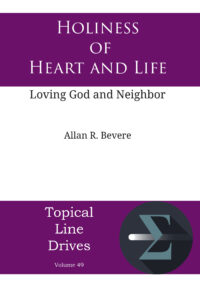
    For a modern view of Wesleyan holiness doctrine, read Allan Bevere’s short volume.

    We do that with scripture. This first, for example, is a balance of asking for God’s grace and favor while also pointing to ones own action. “I’m hoping real hard for this, like I ought to. Make it work!” It’s a very human prayer.

    But the easy thing to do with a great deal of Hebrew scripture is to hear what we expect to hear. We’ve been told this is all about rule keeping and our personal diligence in doing what God wants. As Christians, we look back at benighted writers of Hebrew scripture as not knowing about grace. But the writers of Hebrew scripture were well aware of God’s action and of the need for God’s action.

    We can come to Psalm 119 as a drumbeat of legal requirements and a super-pious, self-righteous expression of the wonder of all these rules. But that’s a bias of our superficial thinking.

    We generally like rules. We like to congratulate ourselves for obeying them. We like to feel powerful and express our personal sovereignty by disobeying them. We like to be in control of what we do about them. So we tend to read that into religious texts.

    But the Psalmist is very human individual looking with awe, hope, and wonder at a Creator God. He knows it’s God’s action, God’s life in him. I commend Psalm 104 as an indication of human dependence of God as understood in Hebrew scripture.

    Similarly, modern followers of John Wesley often take the doctrine of sanctification and treat it as a potential accomplishment of each person, and the attainment of it (supposedly) as a badge of honor and greatness. Getting into heaven is up to God, but being a good, church-going pillar of the community is an individual accomplishment.

    That’s false. The dependence on God starts not at birth, but at the first movement of the first subatomic particle that makes up part of your body. With the Psalmist, we put our hope in God and ask that God takes us to these places.

    Remember that whatever it is, it’s God’s.

    (Featured image generated by Jetpack AI.)