

Threads from Henry's Web

Tag: Hebrews 4:12-13

  • Psalm 119:38 – Raise Up Your Word

    Psalm 119:38 – Raise Up Your Word

    Carry out your word to your servant,
    the one who fears you.

    The Hebrew word I translate “carry out” carries a variety of freight in a variety of uses. One option is simply to build and establish. I might loosely render it as “Make your word real.”

    As I study and meditate on scripture, I find more and more that it’s God’s word coming and going and everywhere in between. I think this verse can become a very important and powerful prayer. I don’t mean powerful in the sense of bolts of lightning and claps of thunder, or mountains moving around. Well, at least not in the short term!

    I mean it is a fundamental prayer. In creation God spoke (Genesis 1:2). The heavens were made by God’s word (Psalm 33:6-9). God’s word goes out and does not return empty (Isaiah 55:10-11). It’s the call for God’s creative word to be in control.

    I’m reminded of Hebrews 4:12-13, which starts with “the Word of the God is alive and active” and ends with noting that all is laid bare to the one to whom we must give account. What’s lost in many English translations is that the “Word” of the first clause is the same Greek word as the “account” of the final clause.

    Now many commentators see this differently, saying the two word uses are unrelated. I disagree. I see here this prayer, to raise of God’s word (or promise), and to do so to the one who fears God.

    What does God’s Word discover when looking inside to see everything that is there? What is our account to God?

    I’d suggest that this is to be the Word of God, taken in. For us as Christians we say that we are in Christ and Christ is in us. “… [T]o whom God desired to make know the riches of the glory of this mystery among the nations, which is Christ in you all, the hope of glory” (Colossians 1:27).

    It is God’s Word, which is presented in many ways, but comes from and points to the creator of all things. This is what is to be seen when all is laid bare before God’s Word. That burns away the “scary” part of the fear of God and leaves the awe, wonder, and indeed warmth.

    Word of God, speak to me!

    (The featured image for this post [not the one immediately above] was generated by Jetpack AI.)
  • Hebrews 4:12 – ὁ λόγος τοῦ θεοῦ

    Hebrews 4:12 – ὁ λόγος τοῦ θεοῦ

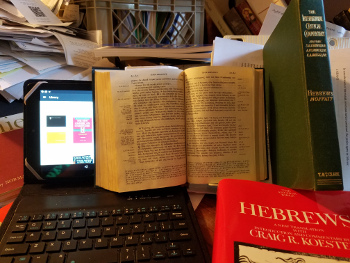
    What a mess my office is!
    What a mess my office is!

    I want to make a short comment on this, and the use of λόγος again in 4:13. I’m not going to go through all the arguments. I’ve just re-read David L. Allen (New American Commentary), Luke Timothy Johnson (NTL), James Moffatt (ICC), and Craig R. Koester (Anchor Bible), and the combined number of references and arguments is really quite astonishing and excellent.

    They differ on the referent of ὁ λόγος τοῦ θεοῦ. There are good arguments for using this as the “personified word,” and for not reading it as a reference to Jesus, but again, as I have time and again over the years, I end up disagreeing. I think this forms an excellent tie back to the prologue, which clearly outlines a high Christology. Now we have definitely been reading arguments taken from the written word, and references to spoken word (Hebrews 2:1-4). But the prologue points us to Jesus as God’s ultimate communication with humanity.

    This, in turn, points us to Hebrew 4:14-16, which summarizes one side of the coin of the high priesthood of Jesus. Here we are told, based on the arguments of chapters 2 & 3, that we have a high priest who is able to sympathize with our weakness. He is our brother (2:11). This will be brought together with the other side of the coin in Hebrews 7:26-28, which tells us that his brotherhood with us does not diminish his status in all ways with God. But right here it’s the one who is our brother, who can sympathize with our weaknesses, who is the one to whom we must give account.

    And there you can see how I think λόγος should be rendered at the end of verse 13. I think we do have a play on words, but we should also look beyond a gloss or even a simple dictionary definition, and note that Jesus is giving an account to us of God, while we give an account of ourselves to God. Except not so much. Because we have such a high priest who is able to take us all the way in to the throne of grace.

    This doesn’t take the written word of God, nor the word of God spoken by the prophets or apostles out of the equation. Wherever God’s word is, it is “alive and active,” but its ultimate representation is in the person of Jesus. To the question, “Is this the written word of the prophets or is it Jesus?” I’m saying “yes.” But mostly Jesus, because that’s where our author is pointing us everywhere.

    Jesus does not replace the written word. Rather he completes it. The New Testament doesn’t supersede the Old. It builds on it. If you’ve read Hebrews thus far, getting to the end of Chapter 4, you’ve experienced the work of someone whose respect for the Hebrew Scriptures is very great and shows clearly through. One should remember this when one gets to passages that talk about something old vanishing, such as Hebrews 8:13. The very foundation of his argument is not vanishing.

    He’s going to make the case that Jesus is the perfect High Priest (and we see functions of that priest in 12-13, God->Us, Us->God), that Jesus is the perfect sacrifice, and subtly, by the texts used in making those cases, he will let us know that Jesus is the perfect King.

    Yep! I read Hebrews 4:12-13 Christologically.