Threads from Henry's Web

Tag: Google Hangouts on Air

  • Completing My According to John Study

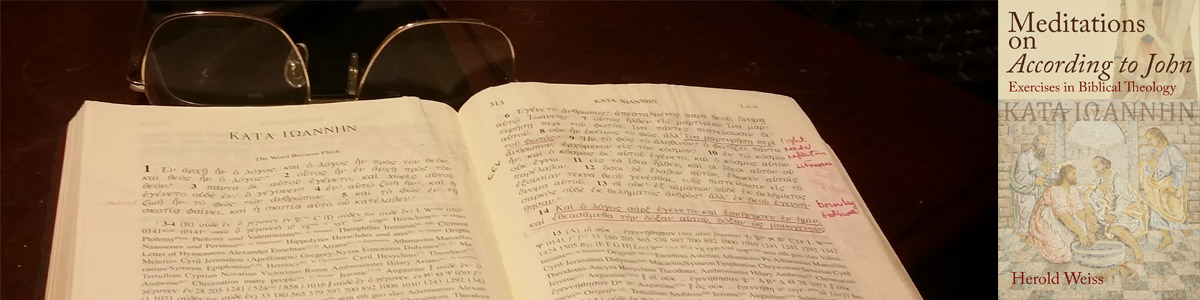
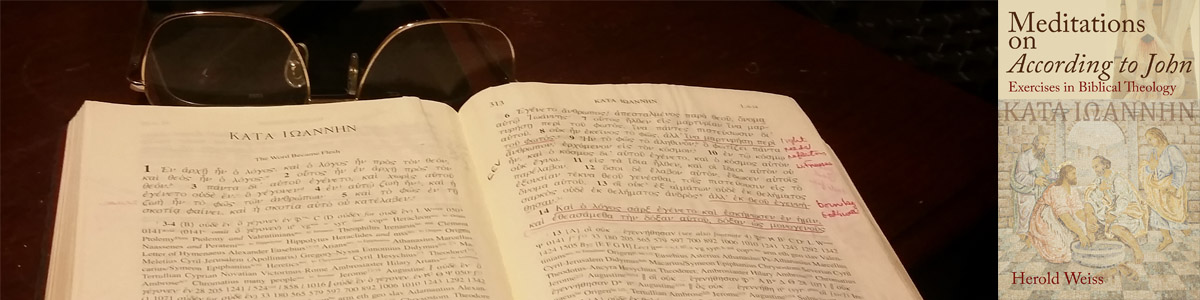
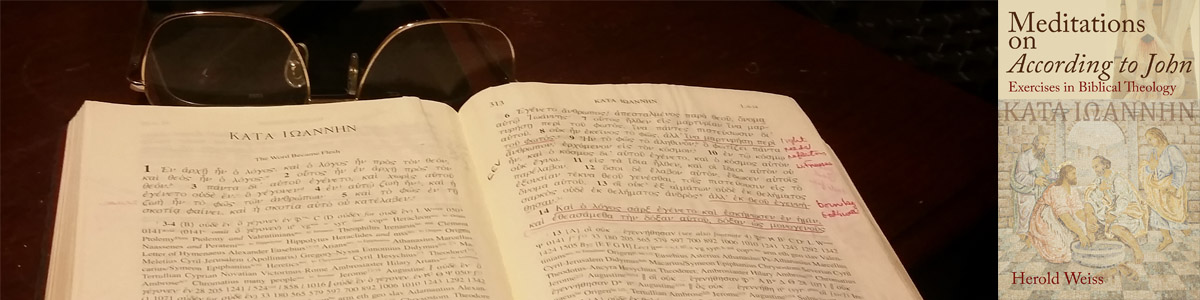
    john banner thumbAt the beginning of the year I began a journey through the gospel According to John, using as my guide the book Meditations on According to John by Herold Weiss. I began this study largely for myself. I admit it. My motivation was selfish. I wanted to force myself to stick with the study week by week and to look into it more deeply than would be required just to satisfy my curiosity. I wanted to be able to present something based on each chapter of the book. (The entire study is now available as a playlist: https://www.youtube.com/playlist?list=PLdArFvZynbMDmk-CI_5EvufFIIxKfqxLN.)

    The book is a bit alien to me. I stuck rigorously with the fundamentals of biblical studies, the languages, the history, the cultures, and the means of coming to some sort of idea of what that writer meant to say to his (or her) original audience. I avoided application because that is much harder to nail down, much less certain.
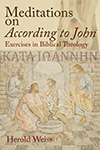
    9781631990120sI have frequently noted on this blog that I am not a theologian. That’s in the professional or academic sense. My training has not been in theology. I continue to maintain that. Teaching through one book does not make one a theologian. Nonetheless I do now have a much greater appreciation for the theological task.

    What Dr. Weiss has done in this book is opened up in a practical way some approaches to connecting theology with what one reads in scripture without at the same time trying to force scripture to fit in with our creeds. We tend to see this as an either-or situation. Either the creed is scriptural or it is not. Either the trinity, for example, is scriptural, or it is not. But it is not quite so simple. One can pick up some pieces that eventually formed a part of the doctrine of the trinity without imagining that the particular text actually operated in a trinitarian framework. Indeed, one can believe the doctrine of the trinity without believing that it is actually taught in scripture. There’s a difference between being able to trace the roots to various texts and affirming that those text teach what grew out of interacting with them, with other texts, and with the experience of people living the faith.

    Dr. Weiss made a valuable comment on that in his final interview for this study. (He graciously appeared twice to answer questions during the series.) He noted that very few of us really had the knowledge of philosophical language and categories of the time sufficient to really understand the results of those early councils that formulated the doctrine of the trinity. I would add that it is therefore not surprising that so many people, in talking about the trinity, fall afoul of one or another officially condemned heresy on the subject, without being aware that they have done so.

    I am the publisher of Dr. Weiss’s book. One might suppose that my sole reason for using it was that I publish it and want to publicize it. I don’t deny that publicity was in my thinking. I do want to publicize the book. But for me editing this book was a profound experience. This is not because I believe that every view that Dr. Weiss expresses is set to become the new academic orthodoxy, but rather because he challenges us constantly to look at the text and what it meant and can mean.

    One of the most critical issues is also probably the most controversial. Dr. Weiss challenges the common idea that the book is fundamentally sacramental. He believes that the view of operation of symbolic actions (and here I summarize a huge amount of text with some trepidation—I will provide a link to Dr. Weiss so he can correct me if I’m wrong) is more to be found in the washing of the disciples’ feet than in the traditional “sacramental passages such as the wedding at Cana, the discussion of eating Christ’s flesh and drinking his blood, or “born of water and the spirit” in John 3.

    Participation was small during these studies. The most watched episodes, other than interviews, are in the 20s for views, and the least watched episodes are in single digits. I actually expected it all to be in the single digits. After all, I’m not truly an expert on this gospel.

    This experience will impact my teaching in almost all areas. Some of the time I spent looking at the use of metaphors, of symbolism and how it can be layered, and the relationship between our experience, the text we read, the traditions we’ve inherited, and whatever creeds we follow will lead me to change the way I talk about almost any scripture. Of course, there are also many elements here that will remain applicable to this gospel alone. In fact, there are many ways in which I will be more wary of seeing symbolic meaning in something straightforward than I was before, because I have seen writers go a bit over the top with it.

    I’m writing this both as a summary and to personally thank Dr. Herold Weiss for this book. I think it’s a great gift to the church. I think that a serious read of the gospel of John alongside these essays would be constructive for almost anyone interested in reading the Bible more seriously.

    I’m now doing a preliminary read of Dr. Weiss’s next book, Meditations on the Letters of Paul, and I am also finding that they profoundly challenge me to think more and differently about that apostle. I’ll probably find occasion to use some of that material online in the future.
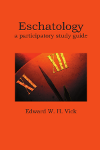
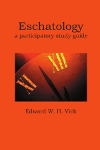
    9781938434105sNext week, August 20, I will begin a study of Eschatology. The first couple of weeks I’m going to lay out a road map, looking at definitions of major terms used. In this, I’ll follow the study guide written by Dr. Edward W. H. Vick, Eschatology: A Participatory Study Guide. The study will continue indefinitely every Thursday evening at 7 pm central time.

    Once I’ve drawn the road map with definitions, I will go into studying some specific passages and the way in which they are applied in eschatology. This study will be much more what I’m used to doing, as I look at the historical setting. At the same time, I will be pointing out how these passages are used in the various schools of thought about eschatology in the church today.

    I’d enjoy having your input here in the comments or during the Google Hangouts on Air. Watch this blog for announcements and links to each event.
  • According to John: Where Are You From

    According to John: Where Are You From

    john bannerI’ve been planning to create some short notes on John, discussions of topics about which I’ve gotten a number of questions. I recorded the first of these today, and here’s the embedded YouTube video:

    Tonight I’ve decided that I will focus much more on the trial of Jesus and the relationship between ritual, symbol, and spiritual reality. You can find more information on the Google+ Event Page, or you can view using the embedded viewer below.

  • Talking about Getting Published

    Tonight on our Tuesday night Energion hangout, Jody and I will be talking about how to get published, particularly by Energion Publications, but also with some general ideas. Join us at 7:00 pm central time tonight, July 21, 2015.

    Go to our Google+ Event Page for more information or watch using the YouTube embed below.


  • According to John: Interview with Drew Smith

    john bannerWe had lots of audio problems last time we tried, so we’re trying again! Tonight (7/16/15), Drew Smith will be my guest on my study of the gospel according to John. Drew got his PhD in New Testament from the University of Edinburgh, and wrote his dissertation on the gospel according to Mark. Tonight we’ll compare the theologies of the two books and ask Drew about adoptionism. Does the absence of a birth narrative in Mark mean support adoptionism?

    You can find more information on the Google+ Event Page, or view using the YouTube embedded below.

  • According to John: Jesus Wept

    According to John: Jesus Wept

    john bannerI’ll be discussing this tonight at 7:00 pm via Google Hangouts on Air. You can find out more on the Google+ Event Page. You can also view using the YouTube viewer below:

  • According to John: United by Love

    This is a late announcement, but I will be doing my According to John study tonight. The Google+ Event page has details. The YouTube viewer is embedded below. I’ll be working from Chapter 20 of Herold Weiss’s book Meditations on According to John.

  • Scheduled Interview with Dr. C. Drew Smith

    9781631991219Drew has agreed to a retake of his interview. We had significant audio problems. The content was so good, however, that I was hoping to ask him some of those questions and get a clearer result.

    The interview will be on July 16, 2015, and will be via Google Hangout on Air. To get the announcement, follow me on Google+ or subscribe to my YouTube channel.

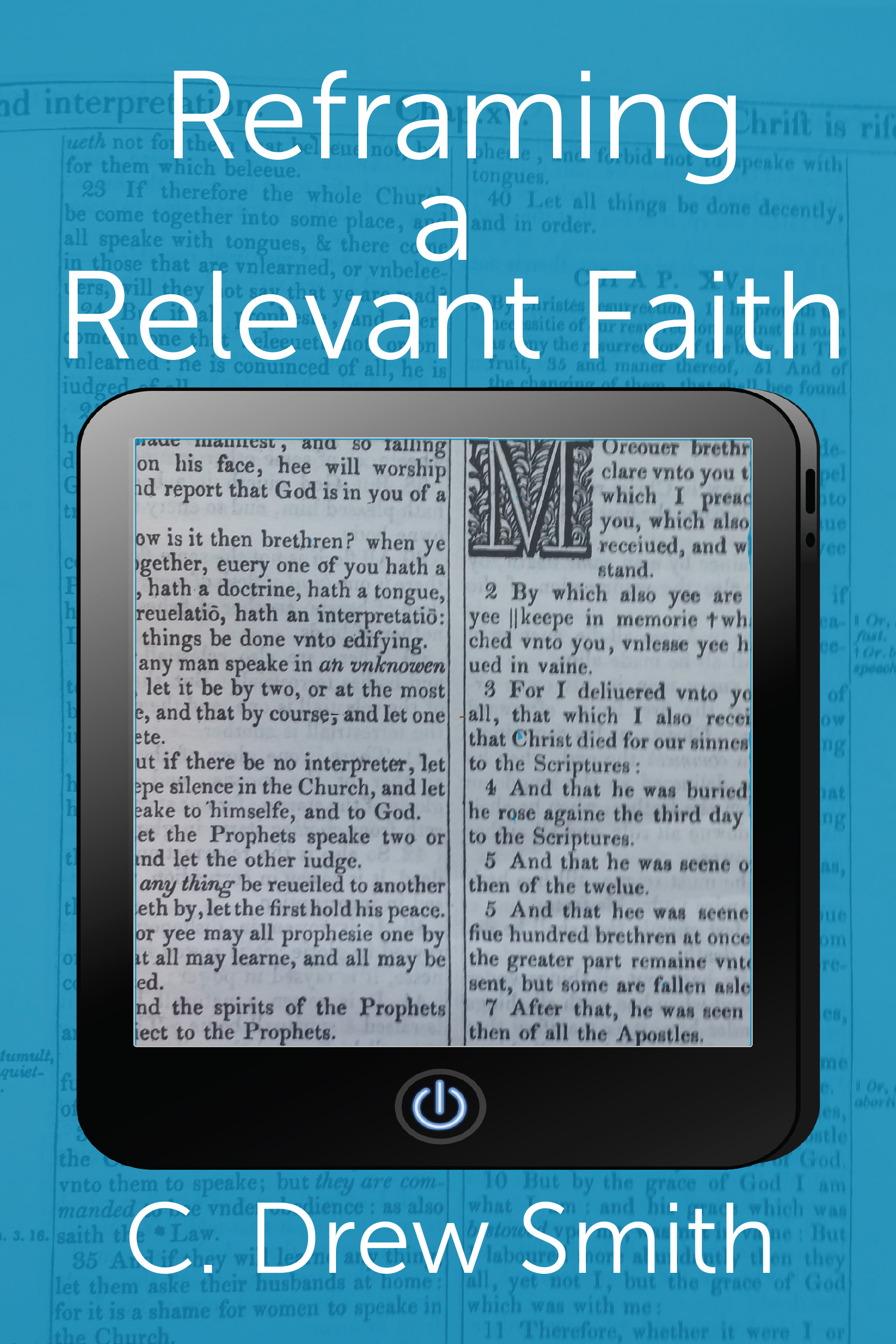
    Drew Smith is the author of Energion title Reframing a Relevant Faith.

    You can find the full schedule here.

  • Preaching from the Old Testament

    Preaching from the Old Testament

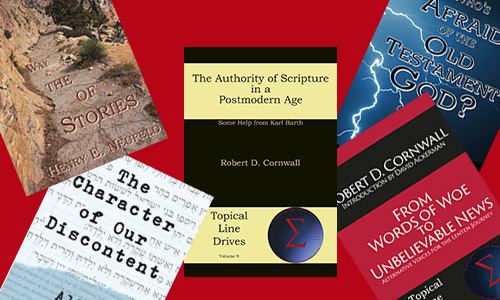
    violence and scripture booksNo, I’m not going to do it, but I’m going to ask Dr. Bob Cornwall some questions about it. He’s currently preaching a series in his church from 1st & 2nd Samuel. Bob is one of my Energion authors (see his book list here), and is editor of the two book series we publish in cooperation with the Academy of Parish Clergy, Conversations in Ministry and Guides to Practical Ministry. You can find more information about this event on its Google+ event page.

    I’m going to ask Bob how he handles the authority of the text he is preaching from, and especially whether he will deal with some of the more violent passages and how he will preach from them. There are quite a number of passages in the books of Samuel that could be very troubling to a 21st century conversation.

    This morning, I was reading one of those: 1 Samuel 15. You can read the whole thing if you want to get a general picture, but let me just summarize here. God tells Samuel to pass the order to Saul, King of Israel, that he should go and wipe out the Amalekites. He is supposed to designate them as herem, meaning that they are devoted to destruction, every person, every creature, every thing is to be destroyed. And lest we be tempted to soften the story, we are told that this included men, women, and even nursing babies.

    Saul disobeys God and doesn’t kill everyone. The best of the animals are preserved, and the king is taken captive. Saul blames this on the people. God blames Saul and says he has cut Saul off (or at least Samuel says God says this) from being king over Israel. This story opens the cycle of stories about the conflict between David and Saul, which ends with Saul’s death in battle and David’s accession to the kingdom.

    I have heard this story handled in a number of ways:

    1. Get a modern lesson from it, ignore the gory details, and hope nobody notices. I remember hearing it in my early years taught as a story about obedience. When God tells you to do something, you better do it. When I did ask about the killing, I was told that it was God, so it was OK.
    2. Emphasize the gory details. We’ve all become too cowardly to truly uphold God’s will in the world. (Yes, I’ve actually heard this.) We can just hope folks like this aren’t too serious.
    3. Some things in the Bible are less inspired than others, and this is one of the less inspired. Bloodthirsty people did bloodthirsty things and blamed God.
    4. When people lived in a violent world God worked within their context. So things that might be commanded then could be forbidden now, not because God has changed but because he is staying the same, and working with us where we are.
    5. The Old Testament God was violent. That’s why we stick with the New Testament. (If you take this approach, you should likely avoid texts like most of Revelation and Acts 5:1-11.)
    6. Let’s never read this in church and hope nobody notices.

    I could probably come up with some more given time. I’ll be interested to see how Bob Cornwall handles the text. He’s both a good preacher and accomplished scholar, so I expect his comments to be helpful.

    In the meantime, two things. Following a challenge on a similar text, I wrote two blog posts. The first was a story/dialogue discussing the text, titled The God-Talk Club and the She Bears, on my Jevlir Caravansary fiction blog. (In the God-Talk Club series I write dialogue without any intention of expressing my own point of view. It’s sort of an exercise for me in trying to express several views on a topic.) The second was a homily on the same passage, titled Real Guy Interpretation.

    Finally, I recently interviewed two authors, Allan Bevere, author of a book based on a series of Old Testament sermons he preached titled The Character of Our Discontent, and Alden Thompson, author of Who’s Afraid of the Old Testament God?. I’m embedding that video below.

  • According to John: We Must Work while It Is Day

    According to John: We Must Work while It Is Day

    john bannerWell, that and some additional news …

    Tonight (Thursday, June 25, 2015) via Google Hangout on Air I’ll be talking about chapter 19 of Dr. Herold Weiss’s book Meditations on According to John, title “We Must Work while It Is Day.” There’s a great deal of interesting material in this chapter, and I keep adding to it as I read and re-read the passages. I’ll be talking about what the Sabbath means to Christians and also about some basic concepts in eschatology, not to mention eschatology itself.

    I also want to give everyone a tentative schedule for the next few weeks and let you know what I’m planning after this series is done.

    Here’s the schedule (edited June 30 to add the interview with Drew Smith):


    July 2 – Chapter 20 – United by Love

    July 9 – Chapter 21 – Jesus Wept

    July 16 – Interview with Dr. Drew Smith, author of Reframing a Relevant Faith.

    July 23 – Chapter 22 – Rivers of Living Water (since I’m preparing for a Sunday School series in August on the time of the exile, I will doubtless reference Ezekiel’s temple!)

    July 30 – Chapter 23 – Where Are You From?

    August 3 – Chapter 24 – Abide in My Love

    August 10 – Closing interview with Dr. Herold Weiss

    I am also planning to schedule a re-do of my interview with Dr. C. Drew Smith, which may move some of these sessions, or it may simply fill the open slot on August 3. This interview is now on the schedule for July 16, with the later chapters moved down to fill in.

    9781938434105sI think I’ve mentioned a few times how far out of the box this whole series has taken me. I diligently pursued nuts and bolts of biblical studies, avoiding theology and liturgy as I would abominations (whatever those may be!). So to spend this much time thinking about theology from a biblical book was somewhat of a challenge. I’m going to move somewhat closer to my roots as we move forward, both in the sense of my approach, which will involved more nuts and bolts, and in terms of the topic, which will be eschatology, something rooted in my upbringing and education in the Seventh-day Adventist Church.

    I’m going to start by using the book Eschatology: A Participatory Study Guide by Edward W. H. Vick as a guide to learning the general terminology and getting a view of the map of ideas on this topic. That will be quite theological, of course. Then I plan to look at a number of apocalyptic and/or otherwise eschatological passages in scripture, looking for the author’s intentions in the text and then also at how those words have become part of the various views about eschatology in the Christian community today. The idea will be to understand how people come to their conclusions, why there is so much variety, and how one can find one’s own way through the material. This series will likely continue for some time, as I have the complete books of Daniel and Revelation, not to mention a large number of shorter passages elsewhere. And yes, I would treat the first six chapters of Daniel as material that is just as eschatological (or not) as chapters 7-12.

    If nothing else, I’ll have plenty of opportunity to learn new things myself! I have been gratified, however, to see that a few of these sessions have YouTube views in the teens, though most stay single digit. I really expected three or four to follow along the way. Over time, who knows! I am grateful to those who have listened and who have commented, either via the Q&A app or by e-mail. It has been a great experience already, and we still have several weeks to go.

  • Would You Like a World that Was Perfectly Square?

    Would You Like a World that Was Perfectly Square?

    Not sure? Tonight you can find out!

    0964440601On the Energion Hangout tonight I’ll be interviewing my friend Dr. Dolly Berthelot, author of PERFECTLY SQUARE: A Fantasy Fable for All Ages, and an all around great person.

    Let’s get the commercial part out of the way first. This book was first published in 1994, and its message is still relevant, possibly even more relevant, today. In fact, I suspect that in another 50 years, its message will still be on point and up to date. So I’ve taken up distributing the book. You can find the Energion catalog page at the link above or by clicking on the cover picture.

    And while we’re at it, you can find the interview tonight (7:00 pm central / 8:00 pm eastern) via the Google+ Event page, or you can use the embedded viewer here.

    With that out of the way, let me tell you about Dolly Berthelot. I encountered Dolly through the CommUNITY Dialogues™ program she offered through the Human Relations office here in Escambia County Florida. I believe I got involved through mutual friends at the Unitarian-Universalist Church of Pensacola (then Pensacola Unitarian-Universalist Fellowship).

    My view of diversity programs at the time was negative, to say the least. I had attended a number of these programs while in the USAF and also some with civilian organizations, and they were uniformly boring and generally useless. I remained committed, however, to the idea that we could learn to reap great benefits from our differences by listening to one another.

    I’d say that the key failures of diversity programs that I attended were rather straightforward. First, they had a tendency to tell you what a few differences were and basically explain that you had to get along anyhow. Then they’d attempt to make all the diverse people in the room drop all their differences, or treat them as unimportant, so they could get along. It appeared that the diversity trainers really didn’t like diversity. Their hope was that everyone would cut off the rough edges and get along, or just not mention anything that might be controversial.

    In CommUNITY Dialogues™, things were quite different. Dolly taught (and encourages) unity in diversity. We are all different, and this isn’t a problem to be solved, but an opportunity to be grasped. We need to make the most of our diversity because it’s a great thing.

    So now, 20 years after the book was first released, and quite a number of years after I enjoyed that dialogues program, I’m taking up distributing this book. For various reasons (I’ll get her to explain tonight), Dolly hasn’t been as active. But she’s passionate and ready to go with the message of unity in diversity. Join us!