
Threads from Henry's Web

Tag: feasts

  • Sacred Feasts – Lamentations 1:4

    Sacred Feasts – Lamentations 1:4

    The approaches to Zion mourn, for no pilgrims attend her sacred feasts; all her gates are desolate. Her priests groan, her maidens are made to suffer. How bitter is her fate!

    The Revised English Bible (Cambridge; New York; Melbourne; Madrid; Cape Town; Singapore; São Paulo; Delhi; Dubai; Tokyo: Cambridge University Press, 1996), La 1:4.

    I’m following my meditations in writing these posts, and the second line of this verse caught my attention. The main reason it did so is that it is one thing I hear commonly as a lament. I, and many people I know, frequently complain about low attendance. People aren’t in church. They aren’t in Sunday School. They don’t show up for church educational events or projects. Here we are making “stuff” available to them, and they don’t show up. The church is dying. Start preparing the funeral.

    The situation in Judah and Jerusalem was worse than anything I complain about. The people were in exile. They were gone. But what was happening before?

    I hate, I reject your feasts.
    I will not accept your assemblies.

    Amos 5:21 (my translation)

    When the assemblies were going strong, they weren’t actually going strong. Nobody was lamenting when people were all showing up. Well, God was lamenting and letting the prophets know that things weren’t going well.

    One of the most embarassing moments I’ve had in educational ministry was when, in response to questions around the church, I invited a friend who was a pastor in the Presbyterian Church in America. People in our Methodist/Wesleyan congregation were asking me about Calvinists,, and I thought providing them with a Calvinist speaker would meet the need.

    Nobody showed up. Nobody. I was the only one there to meet him.

    He was extremely gracious, and what was more we sat down to discuss ministry, theology, and education, and possibilities for doing more ministry. Here he was, with the person who had invited him to an empty room, and he took up the time to discuss how we, together, could serve the Church from our respective churches.

    We even joked that God must have ordained our meeting. Then we looked at each other and said, “All joking aside, that was true.” Without the numbers I desired, God was still working.

    Here’s a potential problem with lamenting. We can lament the wrong things. When your church or your meeting is empty, provided God has not ordained a one-on-one meeting as a surprise, there was probably something that needed to be lamented before.

    … Christianity was the revelation and the gift of joy, and thus, the gift of genuine feast. Every Saturday night at the resurrection vigil we sing, “for, through the Cross, joy came into the whole world.” This joy is pure joy because it does not depend on anything in this world, and is not the reward of anything in us. It is totally and absolutely a gift, the “charis,” the grace. And being pure gift, this joy has a transforming power, the only really transforming power in this world. It is the “seal” of the Holy Spirit on the life of the Church-on its faith, hope, and love.

    Alexander Schmemann, For the Life of the World, 45-46 (Schmemann was an Orthodox theologian)

    Maybe we’ve had a feast without the joy, the joy that only God can give. If we thought to lament this, perhaps we would have less physical emptiness to lament.

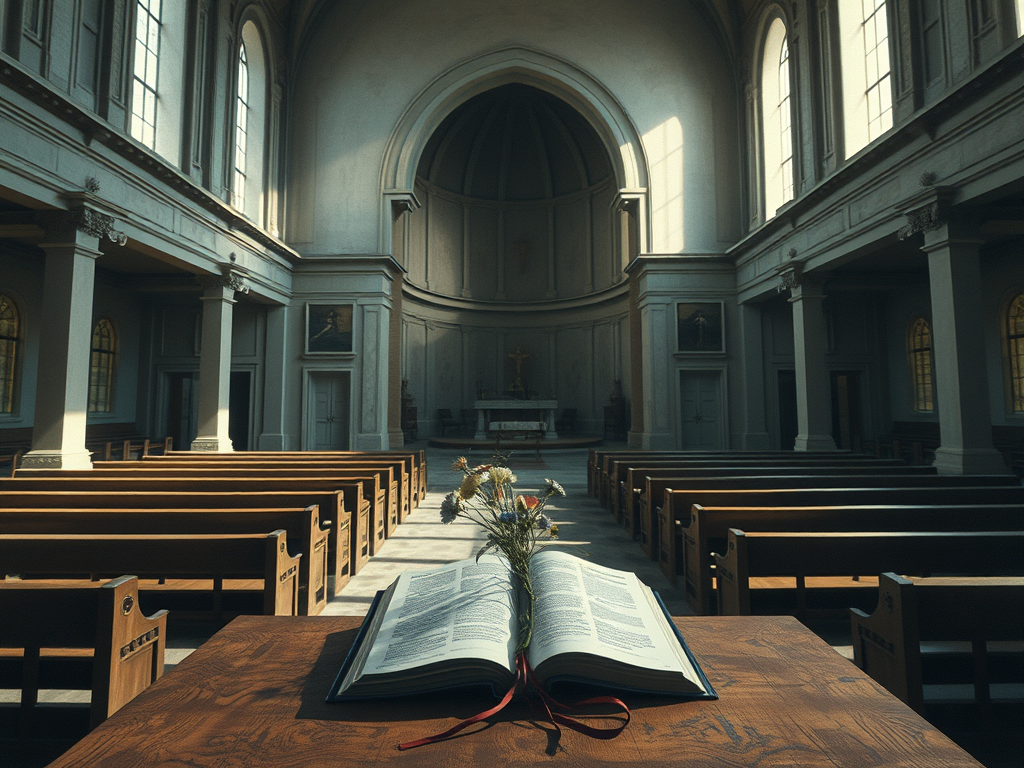
    (Featured image generated by Jetpack AI.)

  • Sunday School: History and Feasts

    Sunday School: History and Feasts

    Source: OpenClipart.org Gerald_G
    Source: OpenClipart.org Gerald_G

    I’m going to be teaching my home Sunday School class for the next four weeks, and it happens that the topics are all from the Israelite feasts. Tomorrow I’ll be talking about Passover, the next week about the Feast of Weeks, then the Day of Atonement, and finally the Feast of Booths. I’m using the titles from our Sunday School curriculum. I will doubtless ignore the curriculum other than for setting the topics. I always do.

    Though each feast has certain special elements of meaning, there are a number of things that I’d like to emphasize from these feasts in general.

    1. God acts in history. This is foundational to application of the scriptures in any way, I think. Whether this action is what we would describe as a supernatural intervention or a subtle presence is something to be discussed, but if God doesn’t act, we don’t have a subject.
    2. A feast or commemoration not only celebrates a point in time when we, as humans, have recognized God in action. It also magnifies that event and helps it resonate through the future. It becomes a lens through which we see the past, and a filter through which we understand our time. The Passover is not only a moment of salvation. It also explains what led up to it and drives what comes after it.
    3. A feast or commemoration is part of bringing ourselves in line with a saving event. Some of the “saving” that is to be accomplished through the event comes by bringing us in line. The wilderness experience of Israel shows the possibility of mentally and spiritually living in Egypt while physically traveling toward the land of the promise.
    4. God’s people extend not just through space in the present but through all time. I benefit by recognizing my place in this community that is not bound by time or space.
    5. God’s next action doesn’t negate his last one. We can commemorate receiving of the Torah, a return from exile, and even God’s presence with us in Jesus Christ without losing the value of the passover. The meaning of a commemoration or feast can be many-faceted.
    6. While we see new and different meaning, in that we have a different perspective, it’s good to move back to the event. Passover may look different to someone who also celebrates Easter, but also look at Passover for what it was for Israel and what it is for the Jewish people now.
    7. Feasts and celebrations have a history and setting. Without the story, the ritual loses power.

    Exodus 12 is a very important chapter to read when thinking about celebrations, feasts, and commemorations in general. How do we remember these events and participate in them as a people, as the body of Christ in the world?

    Ellen G. White was an important figure in the history of the Seventh-day Adventist Church in which I grew up. While I’m no longer SDA, I can still appreciate many of the things she said. Here’s an applicable quote:

    We have nothing to fear for the future, except as we shall forget the way the Lord has led us, and His teaching in our past history.