Threads from Henry's Web

Tag: Ezekiel

  • Remembering – Lamentations 1:7

    Remembering – Lamentations 1:7

    7 Jerusalem remembers, in the days of her affliction and wandering, all the precious things that were hers in days of old. When her people fell into the hand of the foe, and there was no one to help her, the foe looked on mocking over her downfall.

    The Holy Bible: New Revised Standard Version (Nashville: Thomas Nelson Publishers, 1989), La 1:7.

    Memories are wonderful and dangerous.

    Recently a friend of mine told me something about a loved one dealing with cancer that brought back to mind a specific moment in the experience of our son James. Jody was overseas when he had some symptoms and I took him to the doctor. Tests and scans told us that cancer had recurred–for the fourth time. I had to let Jody know, and the only way to do this where she was located was through email. I had the duty of inflicting that pain on her at a time when I couldn’t do anything to support her. I had to tell James, who had sworn me to call him the instant I knew anything.

    It is not a pleasant memory. It happened in June, and pretty much every June I have a few days when that memory crowds me.

    But there’s something that happens when you have passed through a dark valley, and that’s the realization that life went on and that God was with you even when you were not with God. That realization of the Divine Presence is easy to lose in the valley.

    Psalm 23 is one of the best known passages of scripture. It has a key verse: “Even though I’m passing through the valley of the shadow of death, I will fear no evil, for you are with me.” I like keeping the “valley of the shadow of death.” There is good reason to translate this as “deep darkness” or something similar, but I think the traditional wording from the KJV has the right feel to it.

    When Job has gone through trouble, God shows up and lectures him. Job’s response, “Now my eyes see you” (Job 42:3). After all the theological debate of the book, the landing place is that God really was there, really did hear, really did know.

    To bring this back to the actual historical background of our text, when Israel went into exile, the event that is being lamented here, the question was: “Is God actually with us? Does God care?” In the ancient near east it was generally thought that when one nation conquered another, the god of the winning side was also proven to be greater.

    God comes to the prophet in exile, Ezekiel, and there is a simple but profound statement that opens the book that bears Ezekiel’s name. “… I was among the exiles by the river Kebar, and I saw visions of God” (Ezekiel 1:1). The river (or canal) Kebar was in Babylon.

    Even on what seemed to them the other side of the world, well away from their land, which many saw as “God’s land,” God was there. Our verse talks about remembering former glory. But there’s a present glory, the glory of the God who is with us. Always. Especially when life’s hardships, even torments, overwhelm us.

    Let’s try to remember that Glory.

    (Featured image generated by Jetpack AI.)

    A concept of Ezekiel’s Vision, (Credit: Adobe Stock ZenArt)
    See my paper on the vision of Ezekiel 1
  • Psalm 119:54 – Songs

    Psalm 119:54 – Songs

    Your statues have been my songs
    In my home away from home.

    Mitchell Dahood (Psalms III in the Anchor Bible), suggests: “Your statutes have been my defenses, / in the house of my sojourning.” He gets the translation “defenses” via Ugaritic. It’s interesting to see some alternatives in the way we translate Hebrew poetry. It is very difficult to translate poetry, because words are often used with special nuances, and the context is less helpful. In this verse, if you admit the possible translation suggested from the Ugaritic cognate, it would be hard to argue against that by context.

    So let’s look at a couple of other translations.

    Your decrees are the theme of my song
    wherever I lodge. (NIV)

    No matter where I am,
    your teachings fill me with songs. (CEV)

    Note that both lines are subject to variations in translation. This is natural in translation of poetry and should be expected. Reading poetry in multiple versions is very helpful in getting more of the feel of a poetic text. It’s important to recognize when you are reading poetry, because principles of interpretation can function somewhat differently due to the nature of the text.

    I think it is very difficult for us to think of “statutes” or “decrees” as something to sing about. We see laws in general as a burden, and not a blessing. And there are many ways in which statutes, even divine statutes are not friendly at all. If you see God’s statutes as a checklist to complete so that you can find favor with God, you’ll likely find it very depressing. At least until you encounter God’s grace and the fact that that was never the purpose of any law.

    But looked at from another perspective, law can definitely be a cause of rejoicing, and I think the Psalmist is looking at it in that way. He is already one of God’s people. He is not working on a checklist to get God to accept him. What he is seeing is that there is a way of life and stability as he lives in this world, which he calls a “house of sojourning.”

    This can be read two ways. I think it should be read in both. The first is as a word spoken from exile away from one’s home on earth to another land. You could picture a Jew singing this very verse as an exile in Babylon, far from home. Yet there far away from home, he has God’s statutes to remind him both of who he is and who his God is.

    Even by the rivers of Babylon, God is there.

    The second is the sense in which we have a spiritual home that is not here. Yes, we’re fully engaged in this life, on this earth, in this place. God’s statutes teach us about the glory of the eternal home while at the same time offering guidance for living in this home, in a spiritual sense our home in exile.

    And by the rivers of earth, anywhere on earth. God is there.

    The following is a YouTube video I created 16 years ago back when I was running Pacesetters Bible School (now closed).

    Where will you come to realize that God is always with you today?

  • On Teaching from Ezekiel 24

    On Teaching from Ezekiel 24

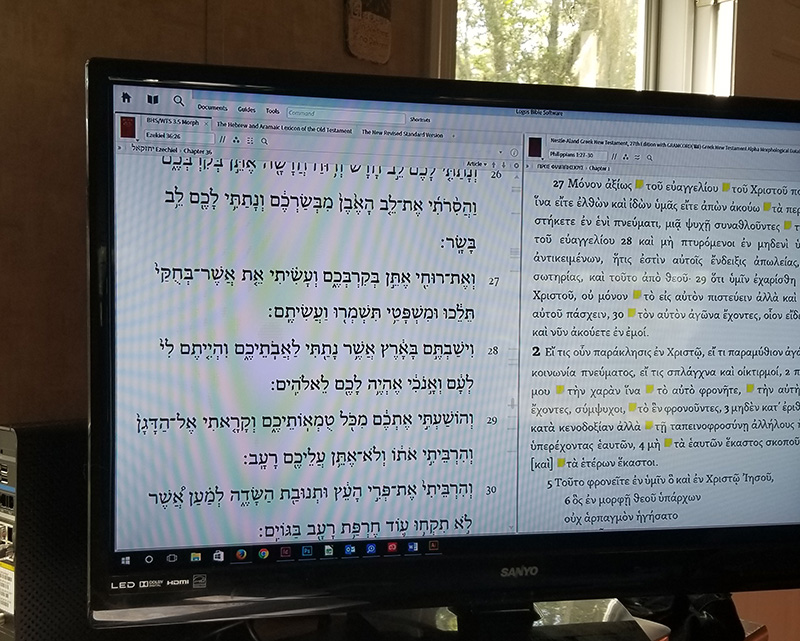
    I’ve been working my way through Ezekiel with my Sunday School class, at their request, since I have frequently said that Leviticus, Ezekiel, and Hebrews are the books most formative of my own theology. When this is done, I will have been through all three books with this group.

    One major difficulty in teaching through Ezekiel is that it is a rather dismal book. There are long passages promising and explaining judgment. There are various passages about the hardships Ezekiel endures as a prophet. At the same time, there are brief looks ahead toward a time of redemption, that the judgment is not intended to destroy and put an end to God’s people, but rather to restore and rebuild after a cleanup.

    One temptation in interpreting Ezekiel and many other books of Hebrew Scripture (which I refer to as the Old Testament when understood as part of Christian scripture) is to see the failures of Israel as theological and ritual. Theological in the sense that they are believing wrong stuff. Ritual in the sense that worship is going astray. This meets a frequent Christian assumption that the Israelite religion was largely about ritual.

    This is a mischaracterization of Israelite religion. Ritual was intended to teach. What is condemned by the prophets is not ritual as such, but rather the performance of ritual while failing to learn from the moral, ethical, and indeed spiritual lessons of such ritual. In modern terms, this is much like the Christian who goes to church and carries out whatever rituals are expected, but then heads out to be something quite different from what those rituals represent.

    As an example, we can participate in the ritual of the Eucharist, or communion as many protestants prefer to call it, and then fail completely to put the unity that this illustrates into practice. “The body of Christ broken for you and for many” is shared because we are all in Christ, and Christ is in all of us. To go out and be denominationally competitive after receiving the body of Christ is to miss the point of the “one body.” To go out and abuse those less fortunate than we are, no matter what our reason is for looking down on them, is to miss the lesson of that broken body. Just before his body was broken, Jesus said to “love one another as I have loved you.” Then he went and died for us. Skip all the arguments about the reason for this. He died. For us.

    The problem that Ezekiel is busy proclaiming is often expressed as idolatry, but then is brought home in the failure to care for those in need. In fact, when accusing Judah of sharing in the sins of Sodom, the lead point is: “She and her daughters had the pride that goes with food in plenty, comfort, and ease, yet she never helped the poor in their need” (Ezekiel 16:49 REB).

    The problem with idolatry is not that you walk the wrong way or go to the wrong place, or that the ritual is performed incorrectly. Rather, it is a matter of lowered standards. I like to use a definition of idolatry cribbed from Paul Tillich: “Making something ultimate that is not ultimate.” As soon as you start worshiping something less than God, you start looking lower. When the potential goal is lowered, less is done.

    This is the problem with using grace to deny law. The standard still needs to be there. I am a publisher. I am quite certain I have never produced the perfect book. But as soon as I dismiss the idea of a perfect book from my mind, knowing that I will not attain it, I will start working toward a lesser standard, and will, in turn, fail to meet that. Having failed, I lower the standard again, and fail to meet that.

    One of the key points in Ezekiel 24 is blood guilt. If we go back to Deuteronomy 21:1-9, we’ll see the extreme importance the Torah places on life, and on the unlawful and unjustified taking of life. There the people are given a ritual for dealing with someone who is killed, but without witnesses, there is no way to assign guilt. The nearest community takes on the task of atoning. Ezekiel is addressing this blood guilt. The people are not dealing simply with erroneous theology. They are killing one another. They have not just worshiped other gods. They have destroyed other people.

    Let me add a side-note here. I really, really don’t like the line “good in theory but bad in practice.” It is not that all theories work, but rather that a theory that cannot be put into practice is not a good theory. Similarly, I dislike having theology and doctrine lined up in opposition to how we treat people. “If you’re putting your doctrine above people, forget doctrine.” Rather, if your doctrine is one that justifies you in mistreating other people, reexamine your doctrine, because it has problems. Jesus says that all the law and the prophets hangs on the two laws, loving God and loving your neighbor. If it won’t hang there, it’s not a good doctrine.

    But it is not the idea of “doctrine” that is bad. The idea that loving one’s neighbor is central is itself doctrine, and I believe good doctrine. Replace your bad doctrine with a good doctrine, one that fits with what Jesus made central.

    Again, back to Ezekiel 24. I tend to jump around a bit. We don’t always go straight from the passage we’re studying to the way in which we will live for the following week.

    Here are some key points:

    1. The reason the passage is dismal is that the situation is dismal. On the bright side, Judah returned from exile. Many cultures effectively disappeared after the sort of events that had happened to Judah. Failing to recognize what it is that one needs to be rescued from likely means failure to rescue at all.
    2. Ezekiel loses his wife and is instructed not to mourn, illustrating in his own actions what was happening to people back in Jerusalem, which was under siege at the time. We like to think of prophetic voices speaking from on high and informing the dismally flawed lesser mortals below of the error of their ways. The true prophetic voice operates differently. It lives in a community. It shares with the community. It is God’s voice inside, not outside.
    3. The prophet, when called by God doesn’t get to have an easy life. So many today think that if God has called them to some activity or another, they must have an easy, obstruction-free journey. We look for leaders whose lives are better than ours. As Christians, we should recognize that we serve a leader who was not recognized as such by the society in which he lived. Ezekiel exemplified this with the people. He suffered among them and with them. Silently.
    4. Finally, we should be tremendously encouraged by these facts. Easy, positive, glowing platitudes don’t provide comfort to the person who is suffering deeply. Such things may actually instead suggest that the sufferer is despised by God and make things even more difficult. That was the message of Job’s friends, whose speeches God refers to as “darkening wisdom by words without knowledge” (Job 38:2). One who can suffer with, who knows what the bad side of life is like, is also one who can rescue. God made “the pioneer of their salvation perfect through sufferings” (Hebrews 2:10).

    I’ll close with a short quote from Bruce Epperly’s book, Walking with Whitehead, in which he builds on a well-known quote from Whitehead:

    God is the fellow sufferer who understands and the intimate companion who celebrates.

    Bruce G. Epperly, Walking with Whitehead, p. 39
    Featured picture credit: Image by Stefan Keller from Pixabay
  • Perspectives on Paul 10-28-30

    Perspectives on Paul 10-28-30

    I recorded this on 10-21-30 because of the approach of Hurricane Zeta on the evening of the 28th.

    Video

    PowerPoint

    PDF

    https://henrysthreads.com/wp-content/uploads/2020/10/102820.pdf
  • Ezekiel and the Bones

    Ezekiel and the Bones

    The lectionary readings called my attention to Ezekiel 37:1-14. I love the story, not to mention the song.

    So how about the song?

    Note: Here’s a comment from T. Henderson on this video on YouTube: ” That’s my Dad the second from the left. They couldn’t express more emotion because in that day they were under strict direction on what a black group could and could not do. Love the song though!” I like to get the historical context. You can read more of the discussion on YouTube.

    There’s a specific point I want to call attention to. Notice how God provides Ezekiel with very specific instructions as to what to prophecy, first in verses 4-6, and then following up specifically to the wind/breath in verse 9.

    Now God certainly could have said these things directly to the bones or to the wind. Could have, but didn’t.

    What God actually did is act through Ezekiel. The event takes place not when God gives the instructions, but when Ezekiel carries them out and makes a proclamation.

    There are so many things one can get from this passage, but for today, let me say just this. God likes to work through people, through human and other natural agencies. (Remember Balaam? Why didn’t God just send an angel and allow Balaam to see? God used a donkey.)

    We depend on everything from God, but sometimes what God is doing is providing you with the opportunity to be the agent of what you hope for.

    Featured image by Wolfgang Eckert from Pixabay

  • Ezekiel 36: Telling the Story

    Ezekiel 36: Telling the Story

    This was one of my texts from yesterday, though we worked from Titus 3:3-11, where I think vs. 3-8 parallels chapter 36 quite nicely.

    But my interest today is not in a specific verse, but rather in the way in which Israel’s story is told. Christians often have ambivalent, if not downright negative, feelings about the Old Testament or Hebrew scriptures. You’ll hear people say, “I’m more of a New Testament person.” In a certain sense, we should all be New Testament (Covenant) people. We are God’s people under terms of the new covenant. That’s why we call that portion of Scripture the “New Testament.”

    Nonetheless, Israel’s story is critical. One reason it is so useful is the way in which Israel told their story. Other nations record their triumphs and their successes, crediting the appropriate historical characters. Sure, one will have comments on how the gods favored this person or that, but the overall story is one of human triumph.

    Israel, on the other hand, records key failures. We focus on things like slavery in Egypt, and the human leader who brings out Israel is a reluctant leader, taking actions as God initiates. One of the key high points, the establishment of the Davidic monarchy, is told with amazing details about the failings of the human players. Then we have the exile, from which Israel emerges due to the intervention of a foreign monarch. Ezekiel 36 underlines this by not claiming that Israel had, themselves, reformed, but rather that YHWH would cleanse them, give them a new heart, restore them, and be their God. He wouldn’t even do this for their sake, but for the sake of their reputations, ending (Ezekiel 37:28) with the nations knowing that he is God because he makes Israel holy.

    Christianity joins this tradition as it is born out of the depths of despair and not the heights of triumph. We need to remember this as we strive for position and power. We serve one who did not. We honor (I hope!) a tradition that does not give its greatest honor to the powerful. We are sinners in the hands of a God who is making us holy. That is the story of salvation.


  • OT v. NT: God Does It

    OT v. NT: God Does It

    One of the differences some claim between the Old and the New Testaments is that in the Old Testament it’s about works, while in the New it’s about God’s grace. I’ve found vanishingly few Old Testament scholars who hold this difference, but in the pews it’s fairly common. One response, of course, is to read a good collection of the commands to action in the New Testament. On the other hand, one can read the Old, as I was doing this morning in preparation for teaching Sunday School.

    I’m studying Ezekiel 36 & 37, looking particularly at the actions of the Spirit there. There is a theme in chapter 36, and it’s important. While God talks about Israel’s failings, and the reason they were scattered, when it comes time for redemption, there is no discussion of the punishment having taught them their lesson so that from now on they will be good on their own power. Rather, the emphasis is that God is causing them to be gathered for God’s reasons and purposes.

    “I YHWH have spoken, and I will do it” (v. 36). “My Spirit I will put within you, I will make it happen that you will walk in my statutes, keep my judgments, and do them” (v. 27). Both those translations are a mite over literal, but I could get even more literal to connect the Hebrew vocabulary in v. 27 “I will do that … you will do.” The reform is presented here as a decision and an act of God, not of human beings.

    Human action is certainly called for, both here and elsewhere, including all through the New Testament. But the decision and cause is put back to God’s Spirit.

  • Greater Good than Before

    I will multiply on you people and animals, and they will increase and bear fruit. People will live on you as in the former times and I will do greater good to you than I did before. Then you will know that I am YHWH. (Ezekiel 36:11)

    Ezekiel here address the message to the mountains of Israel, which paints a nice word picture. This is part of my preparation to teach the Sunday School lesson this coming Sunday.

    I want to call attention to the phrase I have translated “do greater good to you than I did before.” I think that Israel is here learning the lesson that often to get greater good what we have now has to go away. We fear something new because we lose the old. But an earthquake, a fire, or even a hurricane can get us started on something new because we have to.

    I don’t mean that the destruction itself is good. What I’m suggesting is that sometimes we, like nature itself, become renewed after the things we cling to have been destroyed.

  • Translating Poetry

    On March 24, 2016, blog entry marked 11:40 AM, Dave Black talks about translating poetry and links to his essay on the topic from a Festschrift, available via Google Docs.

    Reading Dave’s comments about translating poetry reminded me of one of my favorite translations of poetry from any language to any other, Max Knight’s translations of Christian Morgenstern’s German poetry. You can find samples here. I particularly like Der Lattenzaun/The Picket Fence, but Die Trichter/The Funnels, which Knight translates twice, provides another good example.

    Translation is a creative activity. When the material is very technical, the room available for creative activity, or better the necessity for it, may be lower, but it’s still there. Communication is not easy, no matter what one is trying to communicate, and when one is trying to communicate many things (and often a good writer is doing just that), the translation becomes more difficult.

    In the case of Bible translation, we multiply these problems because we are trying to translate a variety of literary genres across a gap of history and culture, which, in addition, either have or have acquired theological meanings that may relate to times before or after their composition. There’s a great deal of freight in the text and hanging onto it for dear life lest it be lost along the way.

    Into this perilous swamp comes the translator, trying to jump from one foothold to another, always hoping the foothold is not the back of a sunbathing alligator. (Try translating that murky metaphor for comprehension by a desert-dwelling tribe. I dare you!)

    But I don’t see the difficulty of translation as a major problem for Christianity. The major problem I see is that we are afraid of the creativity of translation. We should, embrace it, enjoy it, learn from it, and live it.

    Now that I think about it, we’re afraid of the creativity of communicating, discussing, and embodying the message in our own language.

    As I read a passage like the first chapter of Ezekiel I see a prophet’s creativity challenged. Ezekiel struggles for words. (I wrote a bit about this earlier on the Energion Discussion Network.) One commentator “cleaned up” Ezekiel’s prose and made it rational and orderly, discarding a large portion of the chapter in the process.

    But Ezekiel the prophet is trying to be a translator for us, translating his experience of, his vision of God into terms that can communicate with us. It isn’t easy for Ezekiel. It isn’t easy for me. I don’t think it’s easy for any translator.

    I want the translator to be a good linguist, but I also want him to be able to feel and experience along with Ezekiel and then creatively transfer this vision of God to me as an English reader. Will I get precisely what Ezekiel got? No. Not a chance. But I can get a glimpse of God’s glory as Ezekiel did, as I hope the translator did, and as I hope is conveyed through a good, creative translation.

    Poetry especially deserves this sort of creativity. And we shouldn’t fear it. People often act as if any sort of creativity in Bible translation means the message is being lost. But that is our modern desire for a compendium of facts about God.

    I came out of my MA program in seminary with a compendium of facts and I promptly left the church. I came back struggling with texts I found hard to comprehend, hard to translate, and even harder to live.

    The struggle is greater than the catalog. Every. Single. Time.

    But the facts conveyed by a vision like Ezekiel 1 or a powerful, intricately structured poem such as Psalm 104 are actually relatively few. The glory conveyed is beyond comprehension. I’ll go for not one creative translation (even my own), but for many. I want to try to comprehend the “the love of Christ that surpasses knowledge” and there’s no way I’ll do that with just the facts.

    God could have provided us with a systematic theology, carefully tagged with paragraph and subparagraph numbers, footnoted with additional explanations, structured so as to miss nothing. God didn’t do that. I think God did it intentionally.

    That’s why I’m less critical than others of Bible translators, less willing to say they got it wrong. It’s not that I think they are without error. It’s just that I have such great respect for their willingness to get in there and try.

    I think it would be wonderful if we all encouraged them and gave them the freedom to creatively pass to us the message they experience.

    And all of us, with unveiled faces, seeing the glory of the Lord as though reflected in a mirror, are being transformed into the same image from one degree of glory to another; for this comes from the Lord, the Spirit. (2 Cor. 3:18, NRSV)

    Or perhaps:

    … And when God is personally present, a living Spirit, that old, constricting legislation is recognized as obsolete. We’re free of it! All of us! Nothing between us and God, our faces shining with the brightness of his face. And so we are transfigured much like the Messiah, our lives gradually becoming brighter and more beautiful as God enters our lives and we become like him. (2 Cor. 3:16-18, The Message)

    Or perhaps …

    It’s not by our efforts to get it all right that we remove the veil and see clearly. It’s by turning to the Lord. The Lord is the one who can make us see clearly in spiritual things, because the Lord is Spirit. So when we look in this way, we can contemplate the Lord’s glory and that is what will transform us from glory to glory. (1 Cor 3:16-18, my paraphrase, applying it now, good until the next time I read it)

  • Eschatology, Ezekiel, and the Glory of God

    Eschatology, Ezekiel, and the Glory of God

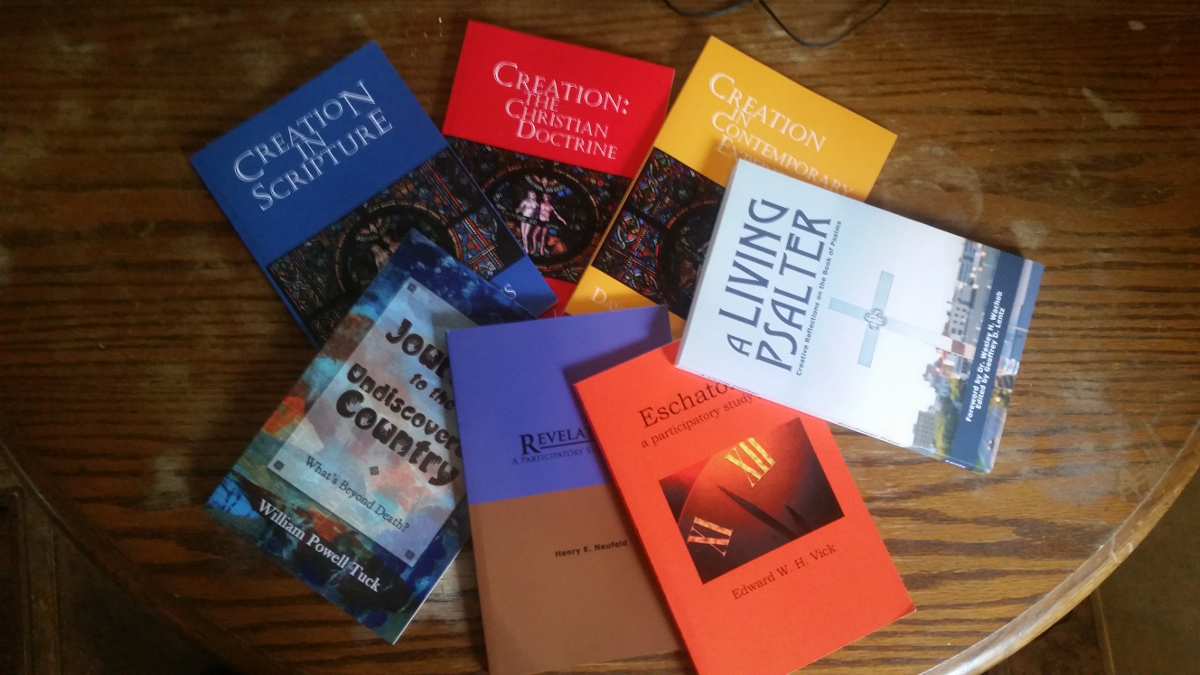
    Some Eschatology SourcesTonight I’ll continue my discussion of Ezekiel, which I see as a book that stands somewhat between classical prophecy and apocalyptic, though more on the side of classical prophecy. Nonetheless you’ll see aspects of the structure and language of Ezekiel in much of apocalyptic literature, enough so that I would suggest that being acquainted with Ezekiel is a prerequisite for serious study of Daniel or Revelation.

    We’ll be focusing on the glory of God and how it moves and is used symbolically in this book, right up to the temple vision. Depending on how I manage to use the time I may finish talking about this book. I’m obviously not covering this in detail, but I hope this may provide a start for those who’d like to study more.

    I’ll be following this study with some selections from Jeremiah and 2nd and 3rd Isaiah, and then I’ll move to some of the visions of Zechariah before going to Daniel. We’ll be doing a full verse-by-verse study of the book of Daniel. It’s important to get a look at these prophetic books so that we can see clearly where Daniel differs and think about why it does so.

    For tonight, you can view/listen through the event page on Google+ or using the YouTube viewer below.