

Threads from Henry's Web

Tag: Ezekiel 36

  • Ezekiel 36: Telling the Story

    Ezekiel 36: Telling the Story

    This was one of my texts from yesterday, though we worked from Titus 3:3-11, where I think vs. 3-8 parallels chapter 36 quite nicely.

    But my interest today is not in a specific verse, but rather in the way in which Israel’s story is told. Christians often have ambivalent, if not downright negative, feelings about the Old Testament or Hebrew scriptures. You’ll hear people say, “I’m more of a New Testament person.” In a certain sense, we should all be New Testament (Covenant) people. We are God’s people under terms of the new covenant. That’s why we call that portion of Scripture the “New Testament.”

    Nonetheless, Israel’s story is critical. One reason it is so useful is the way in which Israel told their story. Other nations record their triumphs and their successes, crediting the appropriate historical characters. Sure, one will have comments on how the gods favored this person or that, but the overall story is one of human triumph.

    Israel, on the other hand, records key failures. We focus on things like slavery in Egypt, and the human leader who brings out Israel is a reluctant leader, taking actions as God initiates. One of the key high points, the establishment of the Davidic monarchy, is told with amazing details about the failings of the human players. Then we have the exile, from which Israel emerges due to the intervention of a foreign monarch. Ezekiel 36 underlines this by not claiming that Israel had, themselves, reformed, but rather that YHWH would cleanse them, give them a new heart, restore them, and be their God. He wouldn’t even do this for their sake, but for the sake of their reputations, ending (Ezekiel 37:28) with the nations knowing that he is God because he makes Israel holy.

    Christianity joins this tradition as it is born out of the depths of despair and not the heights of triumph. We need to remember this as we strive for position and power. We serve one who did not. We honor (I hope!) a tradition that does not give its greatest honor to the powerful. We are sinners in the hands of a God who is making us holy. That is the story of salvation.
     

  • OT v. NT: God Does It

    OT v. NT: God Does It

    One of the differences some claim between the Old and the New Testaments is that in the Old Testament it’s about works, while in the New it’s about God’s grace. I’ve found vanishingly few Old Testament scholars who hold this difference, but in the pews it’s fairly common. One response, of course, is to read a good collection of the commands to action in the New Testament. On the other hand, one can read the Old, as I was doing this morning in preparation for teaching Sunday School.

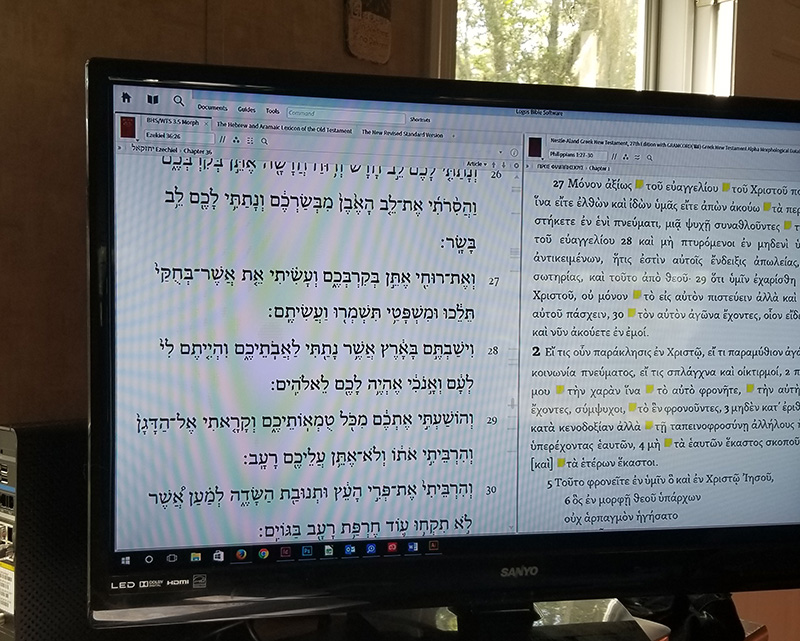
    I’m studying Ezekiel 36 & 37, looking particularly at the actions of the Spirit there. There is a theme in chapter 36, and it’s important. While God talks about Israel’s failings, and the reason they were scattered, when it comes time for redemption, there is no discussion of the punishment having taught them their lesson so that from now on they will be good on their own power. Rather, the emphasis is that God is causing them to be gathered for God’s reasons and purposes.

    “I YHWH have spoken, and I will do it” (v. 36). “My Spirit I will put within you, I will make it happen that you will walk in my statutes, keep my judgments, and do them” (v. 27). Both those translations are a mite over literal, but I could get even more literal to connect the Hebrew vocabulary in v. 27 “I will do that … you will do.” The reform is presented here as a decision and an act of God, not of human beings.

    Human action is certainly called for, both here and elsewhere, including all through the New Testament. But the decision and cause is put back to God’s Spirit.

  • Greater Good than Before

    I will multiply on you people and animals, and they will increase and bear fruit. People will live on you as in the former times and I will do greater good to you than I did before. Then you will know that I am YHWH. (Ezekiel 36:11)

    Ezekiel here address the message to the mountains of Israel, which paints a nice word picture. This is part of my preparation to teach the Sunday School lesson this coming Sunday.

    I want to call attention to the phrase I have translated “do greater good to you than I did before.” I think that Israel is here learning the lesson that often to get greater good what we have now has to go away. We fear something new because we lose the old. But an earthquake, a fire, or even a hurricane can get us started on something new because we have to.

    I don’t mean that the destruction itself is good. What I’m suggesting is that sometimes we, like nature itself, become renewed after the things we cling to have been destroyed.