You’re word is thoroughly tested. Your servant loves it.
Several translations use “promise” rather than “word” here. There is some reason to do that, but in this case I like “word” as having a broader meaning that includes “promise.”
In what way is God’s word thoroughly tested? We talk about being sure of God’s word, of it being true, of God being faithful, but what drives us to believe that?
This is a case where experience is very important. Many people play down experience as less reliable than scripture, and in one important way it is. The reason your experience is less reliable than scripture is that it has not had the same testing that God’s word given in scripture has.
Scripture is a recounting of the experience of lots of people with God. Even when scripture records a specific statement with “the Lord says this,” that is an experience of God. If you don’t think hearing from God is an experience, then I hope you’ll have a chance to experience it. If you don’t remember such an experience, read that of some of the prophets, such as Ezekiel 1 or Isaiah 6.
So if you have an experience of hearing from God, what’s the difference? The difference is testing. God’s word in scripture has been testing over the centuries over and over again and we have found it secure. We’re not questioning this any more. It has become the experience against which you can test your everyday experience for validity.
I personally believe that God can still speak today. How will you know if that happens? There are many things I could mention, but the key one is this: Read that tested word in scripture and become so familiar with with it that you know God’s voice beyond doubt.
Try listening for God’s voice today. Remember to check out the tested word as well!
(Featured image generated by Adobe Firefly using a prompt created by Gemini AI. Yes, I’m experimenting.)
When your Word is revealed, light shines, giving understanding to the naive.
This is a very important verse to me, and I think it is often misunderstood.
I was raised on Bible-based materials. I studied that way in school. I spent a good deal of time with it in school. I had a disagreement with my mother about when I first read the Bible through. She said it was when I was around 9 or 10 years old. I recall reading it all the way through in my early teens. As an elementary student at a school with a Bible-based curriculum I memorized Bible passages in large quantities, including the chapter I’m writing about, all 176 verses of it.
When I went to college and determined to study the Bible I majored in Biblical Languages, thinking this was the way to get back to the sources. With the weight I put on the value of scripture, I wanted to be as accurate in my knowledge as I possibly could because knowing the words contained in scripture was, I thought, of great value.
It took me a very long time to get past the collection of words and data from and about scripture. I used the word “naive” in my translation of this verse, and I was naive in my approach to scripture. It was not only not possible for me to get to a 100% bedrock understanding, based only on my study, it was also not particularly desirable.
That question drove me away from the church and from fellowship. I still enjoyed the study of and the text of scripture, but it was no longer a driving force as it had been. It was, instead, a bit of a hobby.
Then I came back to it again. Marcus Borg wrote a book titled Reading the Bible Again for the FIrst Time. While I don’t agree with everything Borg teaches, I enjoyed the book. I empathized with the experience, because by the time I read his book, I had had a similar experience. The reading of the Bible became something very different to me.
One very important change was that instead of looking for a simple, totally coherent system of beliefs about God, I began to seek to know God. When I began to seek to know God rather than about God I also began to see that the Bible points outside of itself to manifestations of God’s Word. By God’s Word were the heavens made (Psalm 33:6-9). This told me that God’s Word extended everywhere.
I also saw in the Bible a great deal of diversity. Instead of seeing repetition of “sameness,” I saw God working in multiple ways in the stories of the Bible. I saw even more diversity in the way the stories of the Bible came to be presented as they were. I saw the way in which the Bible pointed to people who heard from God and who spoke for God. I saw a church in the New Testament where hearing from God and sharing were part of worship (1 Corinthians 14, for example).
“Bible-based” no longer filled the requirement for me. “Based in the Word of God” came much closer, but only when we allow ourselves to understand that for those who are willing to listen, for those who are willing to see, for those who are willing to hear, and for those who are willing to imagine, God’s Word is everywhere.
God’s word is just waiting for an opportunity to enter, an opportunity to make the naive wise.
“I can never get away from your presence!” (Psalm 139:7b, NLT). No, for a God who is everywhere, that’s true. The problem is that we’re extremely capable of getting away from an awareness of God’s presence. The entrance of the data does not give light. The entrance of God’s Word creates knowledge and wisdom. It’s waiting for us to perceive the God’s presence.
I’m amused by our common expression regarding an especially powerful meeting: “God was sure present in our worship service today!” That’s not how it works. God is definitely present. The question is whether the worship service is conducive to helping us perceive that presence.
Similarly, a daily question, whether I’m in my home or my office, or traveling somewhere in my car, or taking a walk, or whatever I may be doing the question is whether I’m perceiving God’s Word in what I see. If I’m writing prose, poetry, or fantasy fiction, I can be perceiving God.
Mark Twain said, “Good decisions come from experience. Experience comes from making bad decisions.” Or something like that. I’ve found a number of variations, all attributed to Twain.
The prayer, “Teach me!” is one that is pretty much guaranteed an answer, positive at least in the sense that learning will take place. The psalmist asks the Lord to teach him.
It’s a bit of a dangerous request, looked at from one direction, but then from another, you might as well pray this pray, because God’s gonna get you in any case! The universe can be an unforgiving place, and most of us have some pretty clear places where experience came from bad decisions.
This is where I like to note that the entire created world informs us of its creator. The person who studies quantum physics studies God no less than the person who meditates on theology. Perhaps even more.
One big reason to be thankful for Torah in the broad sense–God’s instruction–is that it is evidence of God’s care, a gift that teaches.
When I am introduced to speak or teach, mention will doubtless be made of my MA in Religion, concentrating in Biblical and Cognate Languages, though the correct degree name will be shortened, and the language skill usually exaggerated. In my mind, however, there are many things that have contributed to my study of the Bible. I’ve never encountered a biblical scholar who found this surprising, but sometimes non-academics are surprised.
I thought I’d list some of the key experiences, many of them not of my choice, which have nonetheless been critical in forming my thinking and informing my study.
Bible memorization. As a preteen and early teenager I attended a small private school where we memorized substantial Bible passages. By substantial I mean that we memorized Psalm 119, all 176 verses, Genesis 1 & 2, many Psalms, Luke 2, and so forth. We also memorized scatterings of texts on various topics. This memorization, which I certainly would not have accomplished if it had not been required, has nonetheless stuck with me and helps me see the broader picture. I don’t have to go read Isaiah 53 or 58, because I memorized them, and though I could not repeat them in the KJV (which we used), I still have a fair idea what’s there.
Bible survey. At the same school we were required to memorize titles for most of the chapters (we covered the Psalms by knowing what chapters were in the five books). Along with memorizing, this again helped me with an overview, and made it much easier to find content that I need. I still surprise people by pointing them to a book and range of chapters even when I’m not sure of the specific verse they’re looking for. Further, we had workbooks which asked questions about the text of the entire Bible. These were not thought questions, but content questions. I think it’s unfortunate that people who teach critical and independent thinking often forget that having the facts at hand is useful in thinking, and those who teach the facts often forget that facts strewn about the landscape are not so helpful unless they are critically examined and ordered. Sometimes “Bible study” turns into a simple recitation of opinions, in part because students are so unaccustomed to reading the text and making their own judgment regarding the meaning.
History and historiography. There is an obvious benefit to knowing biblical history and related ancient history. I think some study of other history–any other history–is of great value as well. One of the problems we have with studying the Bible both “seriously and faithfully” is that we make up special methods for studying it as opposed to other texts. We also make up rules for studying biblical history which might not be accepted elsewhere. There’s no substitute for actually reading and studying some good texts on history unrelated to the Bible.
Sociology. I hated my undergraduate sociology, but I’ve come to value that area of study, though I still consider the one undergraduate course I took to have been seriously deficient. People are people, and studying how people behave and respond helps me read Bible stories more faithfully.
And yes, language. Learning to read the biblical languages is valuable in many ways, including being able to spot nuances in the way things are expressed more easily. One of the most important things I learned, however, was how complex the process of translation can be. When you are first learning to read another language (and often for much longer), you are really mentally translating the text into your native language. It can be a struggle and should give you a great appreciation for those who translate on a professional basis. It’s so much easier to criticize scattered renderings where you have a strong opinion than it is to produce a quality translation of a substantial portion of the source text.
English, my native language. The process of understanding an ancient text and then expressing it in modern terms will tax your knowledge of and fluency in your native tongue. Many times I have been trying to express something from the Greek or Hebrew text and have stumbled for lack of a good English expression. Many really bad ideas in biblical studies have resulted from this, such as claims that “English can’t really express this idea.” The real issue is can you use your native language creatively.
Church life. I don’t think you’ll understand the Bible unless you’ve experienced church. I don’t mean that church is such a good representation of what’s in the Bible. Usually not so much. But a great deal of the Bible story is about people trying to form and maintain communities, and if you haven’t actually tried, you may not understand them. I hate church politics, but at the same time church politics is a necessary thing. Politics is what happens when people try to act together. You can do it well or poorly, morally or immorally, but you will have to do it.
Experiencing family. I have nothing against folks who are single, and I remained single until I was 42, and then married and acquired a family all at once. When I was single I was always of the opinion that raising children was likely more difficult than I could imagine. I was right! But again, understanding people who thought of themselves as God’s family is easier after experiencing the parent side of being a family as well as the child side.
There are other things that have helped, but I hope I have made the point that there are many things other than languages, and indeed many things other than academic study that help one understand. These other elements are even more important if one wants to teach. Being able to clearly express a set of ideas involves not only knowing those ideas well, but also knowing the medium of expression (language, art, etc.) and the audience well. The hermit professor, sitting like Simeon Stylites atop an ivory tower, has little impact on the world around.
But further, I suspect not one reader of this post does not have one or more of the experiences I listed, or perhaps others I have not. That means that the person without the degree in biblical languages also has a contribution to make. We ought all be prepared to listen and learn.
Since I’ve been talking about Seventh-day Adventists starting yesterday, due to the date, I thought I’d use an Ellen G. White quote. A friend called my attention to this today in a phone conversation.
Every association of life calls for the exercise of self-control, forbearance, and sympathy. We differ so widely in disposition, habits, education, that our ways of looking at things vary. We judge differently. Our understanding of truth, our ideas in regard to the conduct of life, are not in all respects the same. There are no two whose experience is alike in every particular. The trials of one are not the trials of another. The duties that one finds light are to another most difficult and perplexing.
So frail, so ignorant, so liable to misconception is human nature, that each should be careful in the estimate he places upon another. We little know the bearing of our acts upon the experience of others. What we do or say may seem to us of little moment, when, could our eyes be opened, we should see that upon it depended the most important results for good or for evil. (Ministry of Healing, 483, emphasis mine)
I should note that I have found it much easier to appreciate Ellen White as a writer since I left the SDA church and quit trying to read her as a prophetess. While I think in many cases she was off the mark, she also was quite frequently very insightful.
I was thinking of titling this “In Which I Annoy My Evangelical United Methodist Friends,” since so many of them are talking about the Wesleyan Quadrilateral and trying to privilege scripture within it in some way. I am not entirely in sympathy with many of these approaches.
You see, the moment I decided to take a closer look at the United Methodist Church was when I read in the United Methodist Discipline (1992, I think), about the sources of our faith. It’s not that I thought this statement was unique. Neither was it because I thought that Methodists had discovered the way to understand scripture correctly. Rather, I thought it honestly described what we actually do. And by “we” I do not mean just Methodists, but all Christians who use the Bible. We do not understand the Bible without our experience and our tradition, which is just experience collected across space/people and time. Reason ties these things together. Without our reason, we don’t come up with any interpretation of scripture at all.
What privileges scripture, to the extent that it is privileged, is that it is the most universal, most tested, and most accepted source. My personal experience may be very important to me. In fact, it is. My personal encounters with God have an enormous impact on how I understand my faith. But the fact that I believe that God has told me a certain thing doesn’t make that determinative for someone else.
Each congregation has a tradition, built on the collected experiences of that group. There will be similarities within a denomination, but there are local traditions. There are family traditions as well, collections of the experiences of members of that family over time. Denominations have traditions of their own and stand within broader tradition streams. For Methodists we have the Church of England as a source of tradition. Yes, we do carry things from that background. Then we have many who have broken off based on various elements of our own tradition.
All of these experiences have an impact, conscious or otherwise, on how we understand and apply scripture. It cannot be any other way.
This is one reason why I dislike the inerrancy debates, even though I’ve participated. I do not affirm the doctrine of inerrancy. The usual response to that is for someone who does affirm it to ask me for my list of errors with the intention of providing his or her list of resolutions for those errors. I don’t have a list of errors in scripture. I believe the Bible is what God wanted it to be. But that’s a belief that derives from my doctrine of God and not from any observations about the Bible and history or the Bible and science.
Each item on such a list of biblical errors can be translated as “My errant understanding of subject X says that my errant understanding of scripture passage Y is in error.” Where’s the inerrant standard, inerrantly understood, that lets me determine whether the Bible is actually inerrant?
So I make a different affirmation: When you’ve heard the message God has for you in scripture, that message is true. I follow it with an additional note: To the extent you need to, you can discover God’s message for you in scripture. Or anywhere else, for that matter.
I have absolute confidence that God is speaking. I have similar confidence that my hearing is defective. That goes whether I’m feeling God’s presence as I listen to Mahalia Jackson singing “Just a Closer Walk with Thee,” hearing God’s voice in my head as I pray and spend silent time listening for it, or interpreting a passage of scripture.
So what advantage does scripture have over my general impressions? To paraphrase Paul, much in every way. I’m tremendously thankful to folks like Abraham who had to listen to God’s voice without having that huge body, the “great cloud of witnesses” (Heb. 12:1) whose testimony has been tested over and over again. It’s the church’s testimony and it’s of paramount importance as I work my way through my own experiences.
Here’s a discussion of this very issue. Thomas Hudgins and I don’t agree on all the details, but we do agree that these things work together to give us confidence in God.
But it’s also a training ground. Read about maturity in Hebrews 5:11-14. The Bible fails if we treat it as systematic theology, as a science text, or even as a history text. That failure is not because of some list of theological, scientific, or historical errors. Rather, it’s because God has chose to speak through the testimony (witness to experience?) of many different people at different times and places. He requires us to use discernment and to see what is right and wrong as the decisions are placed before us.
So back to the quadrilateral. I treat it both as quadrilateral and as equilateral. We can enter by any door. Any one of these elements may provide the right question and might contain the right answer. It will not always end at scripture.
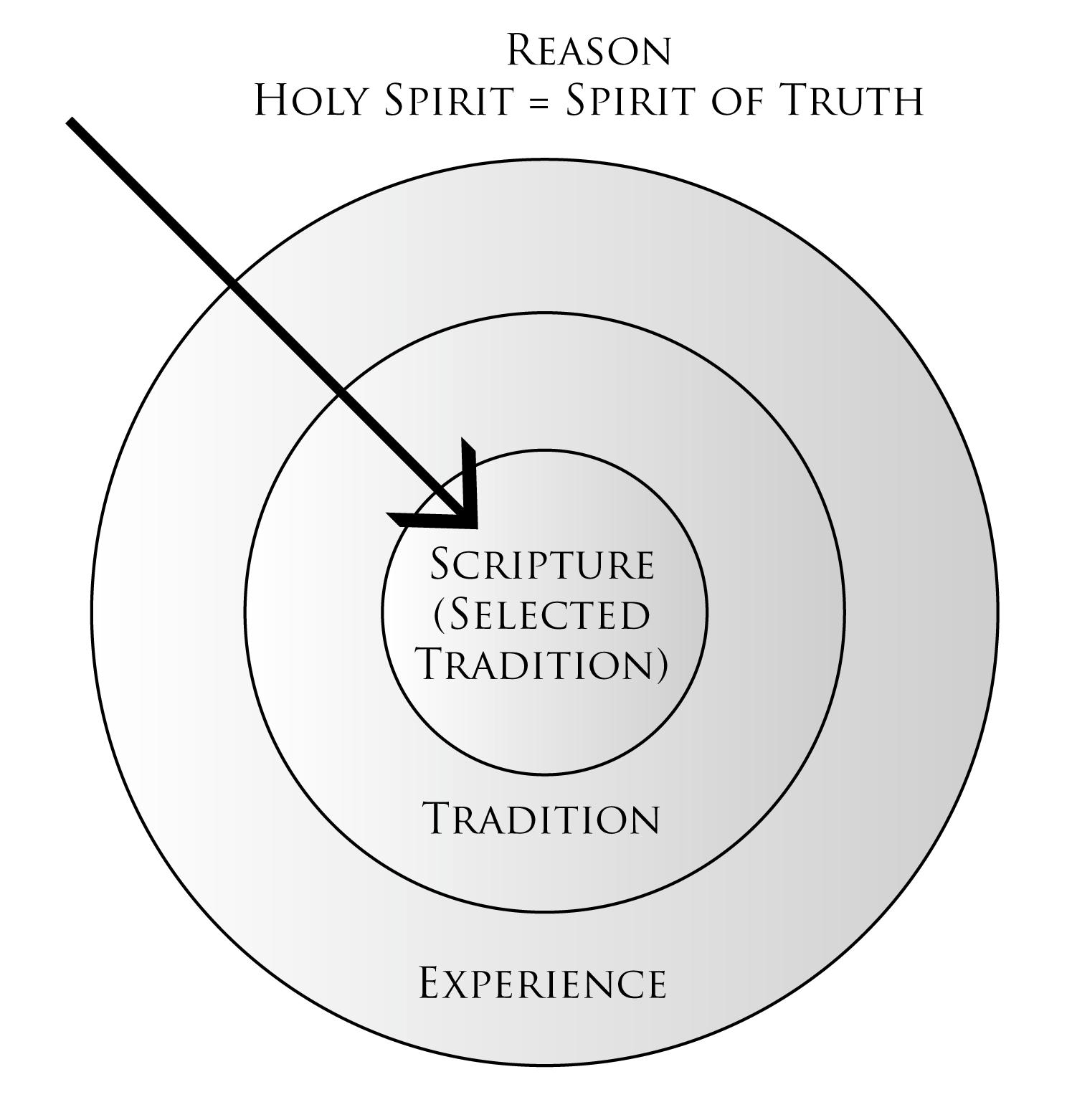
But … and it’s an important but … there is a problem with the way United Methodists use the quadrilateral all too often. We tend to use it as a four lane highway. Which of the lanes can I get my idea through? If I get my idea through one, that’s enough. Instead, we need to use this as a four layer filter. Every answer we get to a question needs to interact with all elements. How does it relate to scripture? How does it fit with experience? What can we learn about this sort of thing through tradition? All of those questions will, of course, be processed by our reason. But that’s what the Spirit of Truth is for, after all, to guide us into all truth (John 16:13)! I illustrated this process with the diagram to the left in my book When People Speak for God.
I believe that the nature of scripture is absolutely intentional on God’s part. Rather than giving us easy answers to easy questions he has given us a combination of testimony to God’s action in the world and principles (embedded in the testimony) by which we can make such decisions. When Jesus says, “On these two hang all the law and the prophets” (Matthew 22:40), he provides us with such a principle of interpretation. This is not a principle that helps you discover what the historical intent of a writer was. We have quite useful techniques of exegesis for that. But it provides us a principle for how we, as Christians living in the 21st century should apply it. Sometimes it says that the people who were doing their best to follow God didn’t live up to it. We should take those stories and try to hang the lessons we think we learn from them from the two commands as Jesus said.
It’s interesting to compare the stories of Patriarchs in Hebrews 11 to their sources in Hebrew scripture. Moses left Egypt, not fearing the wrath of the king (Hebrews 11:27), but he was afraid (Exodus 2:14). A biblical error? A contradiction? No! A testimony to what is seen by the eyes of faith.
We need to struggle with these stories if we’re to see where we are and where we need to be brought to greater maturity. How many of us need to learn not to fear the wrath of the king? But if we look earlier in that same passage, how many of us need to learn not to take God’s work into our own hands through violence?
Testimony, the telling of our own stories and experience, doesn’t give us the sort of systematic set of answers we might prefer. But it does train us to think, to discern, and to decide.
My guess is that’s what God was after in allowing scripture to come into being as it did.
Oh, and one more thing …
Tonight I’ll be talking with author Doris Horton Murdoch about testimonies in a Google Hangout on Air titled Lent: Season of Testimonies.
The following is an extract from Philosophy for Believers by Edward W. H. Vick, pp. 122-123. I’m the publisher. I was reading this section as I was thinking about my study in According to John tonight (Jan. 22, 2015). How does experience relate to the development of religions doctrine?
8 Experience and Interpretation
Question: How shall we decide between interpretations of something that happened, whether unique public experiences e.g. a thunderstorm, or private ones e.g. visions, inner voices?
You and your friends are given a sheet of paper on which a lot of lines have been drawn. You are each asked what it is you see in the jumble. Replies will be different. One will see a horse drinking. Another will see cloud formation. Yet another will see the lines as a jumble of graffiti. We see things differently.
There has been murder in the town. Those people who are aware of it will have very different experiences. The relative, the detective, the editor of the sensational newspaper, each has his different view point of the event based on his unique experience of the event. Since they each experience the same event in different ways, let us call the phenomenon ‘experiencing as’. One experiences it as a personal loss, another as a case for investigation, another as the prospect of sensational front page headline and report.
Now think of different ways of experiencing the same events. As the Chaldeans approached Jerusalem and threatened its destruction, the Jews in the city experienced it as intense fear of coming catastrophe. The prophet experienced the events as the prospective judgment of God on the city. The Chaldean soldier experienced it as prospect for slaughter and booty. The experiences are different because each brings their own immediate background into the process of interpreting the meaning of the event.
So there is an analogy between ‘seeing-as’ and ‘experiencing-as’. Believers see the world as a world where God is present. Non-believers see the world as a series of purely natural events. We must consider that (a) there can be alternative characterisations of the event of ‘seeing’, ‘experiencing’. (b) Something more than the fact that I experience X as Y is required to establish the validity of my interpretation. For when I try to establish my belief in its significance I must explain both what the experience was and in addition contend that it has the significance I give it. This means that I must make explanations, use arguments, give reasons. When others have similar experiences to mine and do not interpret them as I do, it appears that it is the argument I produce to support my interpretation that is the important thing. So the notion of the existence of God can collapse into something that looks like the notion of being convinced by an argument. But the argument is to be seen as the instrument leading to an interpretation. That interpretation makes possible the belief in and so the assertion of the reality of God. It also, when articulated, enables the believer to give some account of his belief.