Threads from Henry's Web

Tag: exile

  • Psalm 119:54 – Songs

    Psalm 119:54 – Songs

    Your statues have been my songs
    In my home away from home.

    Mitchell Dahood (Psalms III in the Anchor Bible), suggests: “Your statutes have been my defenses, / in the house of my sojourning.” He gets the translation “defenses” via Ugaritic. It’s interesting to see some alternatives in the way we translate Hebrew poetry. It is very difficult to translate poetry, because words are often used with special nuances, and the context is less helpful. In this verse, if you admit the possible translation suggested from the Ugaritic cognate, it would be hard to argue against that by context.

    So let’s look at a couple of other translations.

    Your decrees are the theme of my song
    wherever I lodge. (NIV)

    No matter where I am,
    your teachings fill me with songs. (CEV)

    Note that both lines are subject to variations in translation. This is natural in translation of poetry and should be expected. Reading poetry in multiple versions is very helpful in getting more of the feel of a poetic text. It’s important to recognize when you are reading poetry, because principles of interpretation can function somewhat differently due to the nature of the text.

    I think it is very difficult for us to think of “statutes” or “decrees” as something to sing about. We see laws in general as a burden, and not a blessing. And there are many ways in which statutes, even divine statutes are not friendly at all. If you see God’s statutes as a checklist to complete so that you can find favor with God, you’ll likely find it very depressing. At least until you encounter God’s grace and the fact that that was never the purpose of any law.

    But looked at from another perspective, law can definitely be a cause of rejoicing, and I think the Psalmist is looking at it in that way. He is already one of God’s people. He is not working on a checklist to get God to accept him. What he is seeing is that there is a way of life and stability as he lives in this world, which he calls a “house of sojourning.”

    This can be read two ways. I think it should be read in both. The first is as a word spoken from exile away from one’s home on earth to another land. You could picture a Jew singing this very verse as an exile in Babylon, far from home. Yet there far away from home, he has God’s statutes to remind him both of who he is and who his God is.

    Even by the rivers of Babylon, God is there.

    The second is the sense in which we have a spiritual home that is not here. Yes, we’re fully engaged in this life, on this earth, in this place. God’s statutes teach us about the glory of the eternal home while at the same time offering guidance for living in this home, in a spiritual sense our home in exile.

    And by the rivers of earth, anywhere on earth. God is there.

    The following is a YouTube video I created 16 years ago back when I was running Pacesetters Bible School (now closed).

    Where will you come to realize that God is always with you today?
  • Quick Note on the Chronology of Daniel 1:1

    Quick Note on the Chronology of Daniel 1:1

    For those who hold to the historicity of the story of Daniel and generally to an early dating, Daniel 1:1 is a critical text that presents some problems. As I proceed with my eschatology series, and starting going through the book of Daniel verse by verse, I’m trying to keep all the options in mind and explore interpretation based on the different views.

    As I talked about this last night (February 4, 2016; video embedded at end of post), I thought I was being confusing, and at one point said “Nebuchadnezaar” when I should have said “Pharaoh Neco.” I want to clarify the people and dates and how they apply to the text in question.

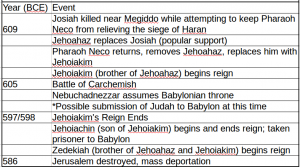
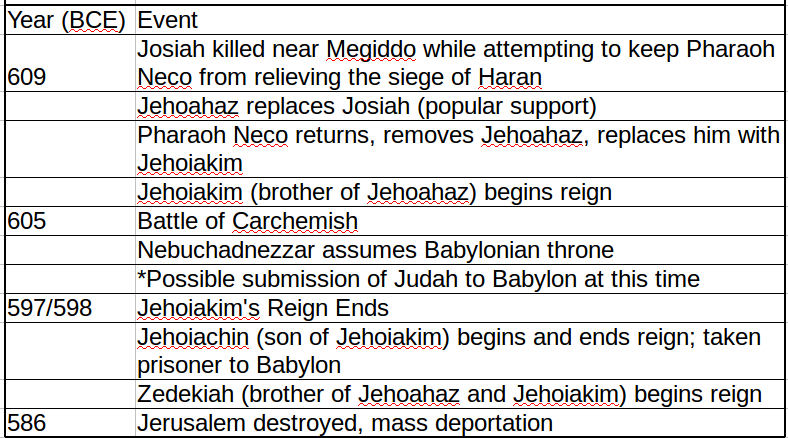
    First, here is a chart of the most critical dates. Note that you will find reference sources that differ on these dates by a year. It is beyond this post to discuss the different calendars and accession year vs non-accession year dating. The sequences involved are adequately handled by the dates I’m using.

    Click to view full size
    Click to view full size

    Biblical sources for this time period may be found in 2 Kings 23:29 – 25:30 and 2 Chronicles 35:20 – 36:23.

    Now for Daniel 1:1, my translation:

    In the third year of the reign of Jehoiakim, King of Juday, Nebuchadnezzar King of Babylon came to Jerusalem and put it under siege.

    Here is a list of the problems:

    1. Unless it is described in 2 Kings 24:1, which seems more likely to describe the events of 598/597 BCE, there is no siege and exile set for 605. It is nonetheless possible that there was one, as the Babylonians became dominant over the territory after winning the battle of Carchemish in 605. There might have been a small exile at that time. Even if 2 Kings 24:1 describes later events, Jehoiakim would have to first submit to Babylon before he could rebel. He was put in power by Pharaoh Neco.
    2. Nebuchadnezzar, as “King of Babylon” could not attack Jerusalem in 605, as he was not yet king of Babylon, but rather became king in that year.
    3. Even if there was a small set of exiles, or perhaps hostages, taken in 605, it doesn’t fulfill the description of the siege.

    The question here is how you evaluate the evidence. One critical element would be one’s determination on other grounds that the Book of Daniel is or is not historical. As an historian one would look for the most probable reconstruction of the evidence. Most scholars tend to support the later dating, even evangelicals, but you can find other arguments regarding dating via my Dating of Daniel Resources page.

    I’ll discuss dating and historicity further in my series, but for now I think this will clarify the issues discussed in the video.