
 No, not the authors of the biblical text, though that’s an interesting topic. I’m talking about disagreeing with a study guide author, in this case a study guide author I chose both to publish and then to use in my Sunday School class.
One class member was surprised—not shocked, annoyed, or disturbed, but just surprised—that I would make those choices.
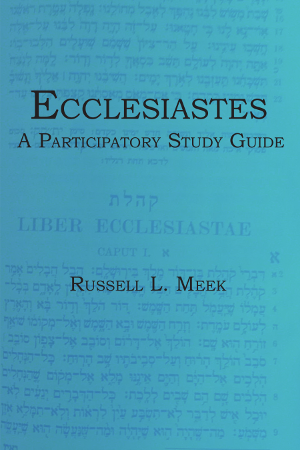
More on that in a moment. What is it that I disagree on? Well, it is fairly simple and quite broad: authors, date, and the translation of the Hebrew word hebel. Those are the subjects we’ve covered in the first two chapters. I consider Solomonic authorship unlikely. It sounds to me more like someone later writing in a way that will suggest to his readers hearing this later literature in the light of the life and times of King Solomon. Incidentally, while I haven’t studied it that much, this could be a textual relationship, and the methods taught in chapter 2 could be used to discover whether there is, in fact, such a relationship, or if it’s just a relationship of ideas, or none at all. On hebel, I tend to read it more negatively than does the author of the study guide.
This recalls to my mind some of the best times I had in college and graduate school. I would get together with a group of fellow students, sometimes with one of our professors, and we’d hash out issues. The goal wasn’t to find people you agreed with. That was pointless. The goal was to find brilliant people who thought differently than you did. Then you’d argue out the details and you’d all learn new things. The only time disagreement was a problem was when someone couldn’t be reasonably gracious about it. Vigorous disagreement and a spirited defense of one’s ideas was good. We tried not to get personal, and generally succeeded.
What I told my class was that agreeing with me wasn’t even a consideration in choosing what book to publish. If it slipped in, it could just as well be a negative as a positive.
These first two chapters of the Ecclesiastes study guide are brilliant, in my view, because they present views that will be controversial in many quarters, and they do so thoroughly, but in a way that a serious non-specialist can read and understand. You don’t just learn what the author’s opinion is and the names of some people who oppose it. You learn why he made those choices. The introduction to intertextuality is also excellent and gets Bible students to think of things that we often neglect. Just how do two texts/passages relate? Which might have influence the other? That involves sequence and availability. Which was written first? Is it likely that the earlier work was available to the later writer? What characteristics would show that two texts were related?
People from all parts of the theological and spiritual spectrum have an unfortunate tendency to read things they find agreeable. I’m hoping that through both teaching and publishing, I can get them to look at things that are very different. This is not simply to get an idea of the spectrum of ideas. It’s also so that people learn why. In the 21st century it is unrealistic for pastors to assume people won’t get exposed to these other viewpoints. Yet there are still pastors who think they can somehow protect their congregations from discovering this fact.
Bible students all too frequently simply accept what their study Bibles, their pastors, or some Bible teacher says as to authorship, dating, relationships between texts, and interpretation. They don’t understand why those things happen. This guide is attempting to teach people how to examine the nuts and bolts of the process, how to make such determinations for themselves.
I was reminded of the conversation in class during the sermon. My pastor was preaching from Matthew 5, including the portions that discuss divorce, lust, and adultery. I happened to agree with what he drew from the text, but I noticed that it would be nearly impossible for people in the congregation to rebuild his logic. It’s likely a bit much to expect a pastor to get any of that “other stuff” across in a 20-25 minute homily, but I think it is unfortunate that for many congregants, that one discussion will be all that they learn about that passage. They will go home with an interpretation (assuming they remember it), but will be unable to defend it, and would be unable to reproduce it or apply the same principles to another text.
I truly don’t look for authors who agree with me. I look for authors who will educate, because education in turn empowers people to take action.