Threads from Henry's Web

Tag: Doctrines

  • Christian Essentials: Incarnation at the Center

    One of my principles of constructive criticism is that one should generally be prepared to propose something positive. This doesn’t always work–sometimes you know one solution won’t work before you have an alternative, but generally I think it’s a good rule. So having said some negative things about the Together for the Gospel statement, I think I should say something about what I do believe.

    As I thought about this project, I came to realize more and more that there are differences between what I consider the core of my experience and the logical center of my beliefs. But as I thought even more about it, they seemed to come back together. I see both now as kind of the layers of an onion, but we start at the center and move out, the core being the most essential, and the outer layers less so. I have previously discussed the importance of distinguishing essential and non-essential doctrines in order to have some unity or coherence of the faith, but at the same time be able to include and celebrate appropriate diversity. I think my best reasonable length statement on this is Unity, Diversity, and Confusion. You can follow some links from there. I also listed four doctrinal items that I hold as essential, which I derived from Elgin Hushbeck Jr.’s Consider Christianity books. (You can see a brief summary at Understanding Christian Apologetics.) But neither of those provides either the reason why I would consider those things essential, nor does it put the life into it.

    I’m going to try to be brief on each of these entries (STOP LAUGHING!), but I will make a number of entries in this series. In the early stages I’ll be making statements that I will leave to back up later, and also I will use scriptures without developing their interpretation from the context, but I will try to remember to tie up all the loose ends as I go on.

    So what does put life into it? I believe the life gets there by putting the right thing at the center and then keeping it centered.

    (more…)

  • Van Till a Freethinker?

    With a hat tip to Dispatches from the Culture Wars, I’d like to call attention to the text of a speech given by Howard J. Van Till (The Fourth Day) to the Freethought Association of West Michigan. Van Till’s work on evolution in general and intelligent design in particular is amongst my favorite reading, and he provides some excellent insights into working with truth, and our view of what truth is, in the context of a religious institution.

    While I experienced some hostility as a graduate student in a Seventh-day Adventist institution, I never experienced this degree of hostility, but I did reject the idea of signing a doctrinal statement in order to be able to teach. That was one of the things that led me away from even seriously seeking work in an Adventist institution. Now as a member of the United Methodist Church, I often actually seem quite conservative.

    Readers who come from my current side of the aisle–mainstream Christianity outside the Calvinist or Catholic traditions–may find it hard to empathize with Van Till. Calvinism tends to be much more creedal, and thus to be much more explicit.

    But I am no less subject to having an ODoR (operational description of reality) than anyone else, and often being less explicit about it simply makes it harder to examine, rather than meaning that one is actually more open minded. I think Van Till has again provided some excellent insight into the nature of the controversy over creation and evolution, and the relationship of science and religion.

  • T4G: Interpretation and Egalitarianism

    In searching around the blogosphere, or more accurately taking a quick glance, I note that many bloggers are responding to the Together for the Gospel statement as though Article XVI (about male leadership in ministry) was a single aberration in an otherwise good document. In fact, for some, the tragedy of women being excluded from the conference (though not completely) was that they would be denied the otherwise wonderful Bible teaching involved.

    (Let me note a few entries that I read and that provide good links to others. These are not all examples of the tendency I noted above, but they will help you get the flavor of the discussion. Dave Warnock discusses this issue especially in his post Together or Divided?, and Michael Bird wrote an excellent post from a generally conservative viewpoint, but focussing on the complementarian/egalitarian issue in Together for the Gospel . . . Not Quite. Adrian Warnock has been blogging extensively on this from the conservative point of view. A good wrap-up can be found at Adrian Warnock’s blog.)

    I’m afraid I can’t agree with this viewpoint, however. I think that the issue of gender roles in church leadership is the single clearest example of a divisive viewpoint in this statement, not to mention one I believe is wrong. But I believe that the complementarian view comes directly from the statements on scripture and the approach to interpretation that is represented here. Now I don’t call this approach “conservative.” There are genuine conservatives who don’t accept the complementarian position, and even more important, there are complementarians who are not divisive.

    The reason I see this statement as divisive is simply that it claims that all these elements are part of the genuine gospel, and the clear implication that those who disagree are teaching a false gospel. This level of detail when defining essentials is very troubling to me. Now it may appear that I am creating an equally detailed statement by opposing this statement point by point. But let me emphasize that I do not regard my beliefs on Biblical inspiration or on egalitarianism are a part of the essential definition of the gospel. I do believe that inclusiveness is more consistent with what is fundamental than is exclusiveness. Exclusiveness is not worthy of the doctrine of the incarnation and the sacrament of communion. But that’s another post.

    The T4G statement places one’s theology, the data that one accepts as true, at the center of the issue, and even in doing this it fails to place the focus on the incarnation, in the instance of God’s reconciliation, and especially on his giving us the ministry of reconciliation (2 Corinthians 5:16-21). This emphasis is more dangerous than the complementarian attitude reflected in Article XVI, although that article does follow naturally from the doctrinal nature of the whole statement.

    There is a serious need here to define what truly is essential, and what is optional. My most fundamental problem with the T4G statement is that I believe it is almost all about non-essentials (other than statements on grace and salvation by faith, and even those are flawed), and skips many essentials.

    I’ll return to my article by article discussion in my next post on this topic.

  • T4G Article I: The Bible

    The first two articles of the Together for the Gospel statement relate to the Bible. I’m going to deal primarily with the first article in this short essay. The article reads:

    I find myself so fundamentally in disagreement with this article that practically every word requires some sort of response. Since I have written fairly extensively on Biblical inspiration in articles available on the internet, I will refer to those where possible and only summarize my difficulties.

    We affirm that the sole authority for the Church is the Bible,

    It’s interesting that the major portion of the history of faith in the world in general occurred without the Bible, and even more without the Bible as we have it today. If the Bible is the sole authority, God took his time about creating that sole authority. Where in the Bible is there a statement that the Bible is the sole authority? If one is to hold to this type of exclusive view of “sola scriptura” then there should be a basis in scripture for:

    • The canon of scripture, which is nowhere specified in scripture
    • The use and interpretation of scripture, again unspecified, though we have examples of some interesting approaches
    • The precise text of scripture.

    Note that I don’t have a major problem with these issues. The Bible is the foundation of my faith, but then I don’t make any claim that the Bible is the exclusive authority. One of the key errors that stands behind the T4G view is the understanding that when the Bible refers to the “word of God” one can apply all those things that are attributed to “the word” to the Bible. For a more detailed discussion of this issue, see the pamphlet What is the Word of God.

    Throughout Biblical history the church was led by prophets, apostles, and other leaders who were said to be in some sort of communion with God. There is no indication of a time when a collection of literature would become the sole authority. This does not mean that the Bible is not fundamental, or that it is not extremely important, or that it does not convey God’s word. In fact, I would say that its authority is foundational, but it provides the foundation for a structure. The Christian church is not founded on a book, but on a person.

    verbally inspired, inerrant, infallible, and totally sufficient and trustworthy.

    You will search the Bible in vain for scriptures that actually affirm these doctrines. Skipping over the more complex theological definitions, verbally inspired is generally understood to mean that the words of scripture, and not just the thoughts or the message, is inspired. Some of those who hold that the Bible is verbally inspired also hold that it was verbally dictated, that God provided the very words of scripture to the prophet. Others hold that God protects the words so that we can safely say they are God’s words, even though the personality of writers show through. The end result is very similar, because one assumes that each word is there by God’s direct choice; not God’s choice of a writer or a message, but his choice of a specific word.

    Inerrancy is normally understood as the claim that the Biblical autographs are without error in all it affirms, no matter what the topic, thus including science and history. A minority will hold that a particular translation or manuscript contains the perfect word of God. This latter position is clearly nonsense, because no matter what translation of manuscript one chooses, one also excludes the majority of the readers of the Bible throughout history from having such an inerrant scripture. Inerrancy of the autographs suffers from a lack of any autographs by which one might check the claim. If God was concerned that the autographs be without error, he was apparently inexplicably unconcerned with seeing that the actual copies that you and I can read are without error.

    Infallibility is a vacuous claim to make about a book, simply because the book does not, in fact, do anything. Interpretations can clearly be in error. It seems more important to me to understand how people get information from the book. Infallibility that is inaccessible is of little interest, and one need only read a few commentaries or books on Biblical theology to see that infallibility is apparently inaccessible.

    Totally sufficient and trustworthy causes me to wonder what it is that the Bible is totally sufficient for. Normally theologians will say “totally sufficient for salvation,” though many will maintain that under appropriate circumstances considerably less than that is sufficient. This claim seems to me to hardly go beyond saying that the Bible is what it is. I agree! And I think it is sufficient to its purpose. I also find it trustworthy, provided we are careful to understand what its purpose is. It is no trustworthy, for example, as a science text. That’s not a criticism, just an observation. It was never intended as a science text. It does not replace one’s personal communion with God. Again, it was never intended to.

    More important than the items of definition I have pointed out is a common failing of all these claims about scripture: They all rely on a particular approach to developing a Biblical theology of the Bible. The common approach is to take a passage such as 1 Peter 2:19-21 or 2 Timothy 3:16, and then decide on the basis of these texts what the Bible ought to be. Other than the circularity of this approach, which can be ameliorated through other theological approaches, I find it interesting that in the face of a substantial history of the Bible and how it came to be, so many theologians prefer to define what they want it to be, rather than simply observing what it is.

    2 Timothy 3:16 provides us with the word “theopneustos” or “God-breathed” which has been made to carry a great deal of freight. But when God breathed into Adam he didn’t make him inerrant, he made him alive. What exactly is the content of a text that is God-breathed? But this issue applies much more to verbal inspiration. The evidence against verbal inspiration is very strong in the text and the history itself. There are certainly words that are attributed to God, but there are also words that are clearly not attributed to God. The synoptic problem presents us with clear evidence that the gospel writers copied from one another, that there are different sources in the Pentateuch, Samuel, and Kings, just as examples.

    My point here is not to recite again the details of the inspiration of scripture, which I have deal with elsewhere (Inspiration, Biblical Authority, and Inerrancy and my posts on inspiration in my studies on Hebrews), but rather to suggest that we need to use a different method. If the history of the Biblical text were completely obscure, we might have an excuse to determine its nature by creating standards based on texts, but instead we have extensive material available. We know that one author copies from another, we know that there are various sources, we know that there are differing viewpoints. (I will comment on this issue a bit more in my entry on Article II.)

    We deny that the Bible is a mere witness to the divine revelation,

    I don’t get the phrase “mere witness.” To me, the most wonderful thing about the Bible is that it is a witness to divine revelation and to divine action in history. The fact that it is written by humans who are subject to error as I am makes it much more accessible. I know that one can live by faith because Abraham, Moses, and Jesus did. This witness is not mere, it is critical. The author of Hebrews uses it as a showcase for his argument in Hebrews 11.

    or that any portion of Scripture is marked by error or the effects of human sinfulness.

    But the copies that we actually have are marked by error. I do not mean extensive error, but Biblical inerrantists will not allow the smallest error in the autographs, and yet are satisfied with a 98% or 99% accurate copy. Of course one can’t determine that for certain again, because we don’t have the autographs. I don’t think this is a serious problem for Bible study, interpretation, and application, but that is because I don’t believe that inerrancy is relevant to those issues at all.

    The effects of human sinfulness are all around us. The very fact that we need to hear the word through prophets or read it in books is the result of sin and our separation from God. Without human sinfulness there would be no need for the Bible at all.

    Inspiration is an incarnational process, God breathing life into imperfect words in imperfect human language to be preserved imperfectly by imperfect copyists, read imprefectly by imperfect readers, preached by imperfect preachers, and discussed by very imperfect bloggers such as myself.


  • Is this the Gospel? (Overview)

    In an earlier post I responded to the Together for the Gospel statement, which I do not think represents any real “togetherness,” nor do I think it represents the gospel. Now I want to be clear that I am not suggesting that my side, whatever that may be, needs to exclude the writers of such statements. At the same time I do not want to minimize my concern over the approach to Christianity that this statement represents.

    In this entry I want to simply look through the 18 articles and point out where it is that I disagree. In later posts I’ll deal with individual elements. I will only use brief quotes, but you can get the full context of each statement from the link above.

    The Opening

    We are brothers in Christ united in one great cause

  • Unity, Diversity, and Confusion

    Recently I wrote a couple of entries, first on diversity and liberalism, and then on the Together for the Gospel statement. The issues I discussed in those two posts raise quite a number of questions about truth, unity, and Christian fellowship. Many might decide from my comments thus far that I don’t care about truth or correct doctrines at all. But that is not the case. “Doctrine” is simply teaching, and we all have some form of teaching. Even the doctrine that correct doctrine is not primary in salvation is itself a doctrine.

    Where are the boundaries where disagreement is permissible or not permissible? How can we tell what is essential and what is not? It’s easy to quote St. Augustine, “In essentials, unity. In non-essentials, liberty. In all things, charity,” but it’s a great deal harder to define precisely what one means. Two sincere people who accept the idea of unity in essentials and liberty in non-essentials can nonetheless get into quite a fight over just what is essential.

    I think we could view the situation as a sort of continuum.

    Unity by Exclusion Unity in diversity Disunity by confusion
    Doctrinal continuum arrow Non-doctrinal

    To the far left of this spectrum (no left-wing/right-wing implications intended), we have those for whom doctrine is central and absolute. I’m seeing the folks who wrote the Together for the Gospel statement I discussed in my post Who’s Together for What?. For them the way to defend the gospel is to be both very clear and detailed on what is truth, make sure people know it, and only respect those who are fully on track as bearers of the gospel. In the center of this continuum we have those who have a small number of essential doctrines on which they require unity, but outside of that boundary diversity is permissible within the community. On the far right of my continuum, we have those who hold nothing, or almost nothing, as essential, and thus have confusion because they are not defined as a community. Even greater confusion results when a community cannot agree on just where they stand.

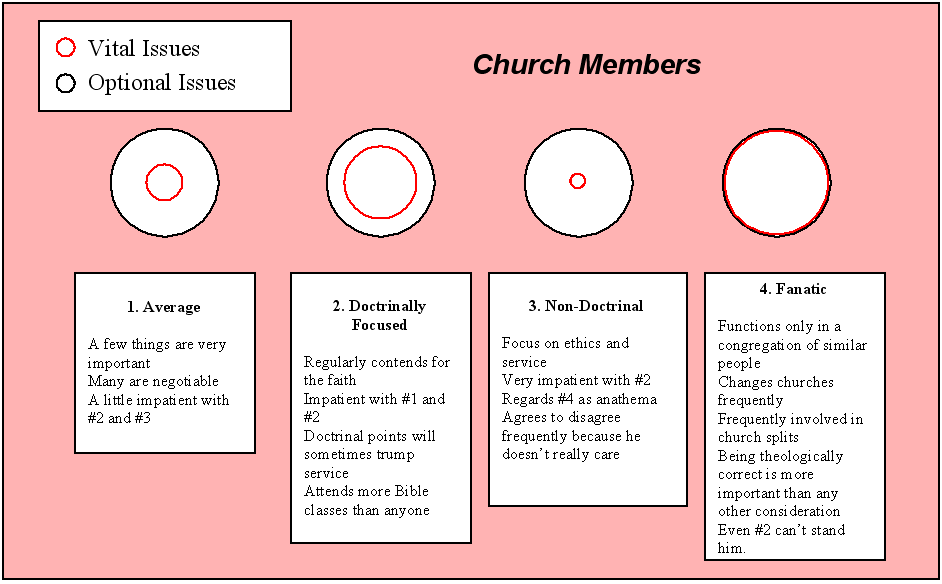
    Let me provide an illustration from another article I’m working on that looks at the type of people who might be part of such organizations:

    Church member attitudes toward doctrine and diversity
    Click the image for a larger view

    Churches that attain unity by exclusion tend to have a large number of essential doctrines. These churches tend to split, and the people in them tend to move from church to church looking for a precise match to their desires. I am not saying that such a church cannot practice unit and cannot teach the gospel; merely that it is difficult to maintain unity in that atmosphere.

    I believe the United Methodist Church, of which I’m a member, tends toward the other extreme. We tend to allow diversity in everything and require unity in nothing. We add to that a debate over where we should be allowing diversity, what is essential, and what is not.

    the-methotaku made a great comment on my previous post, Liberalism and Diversity, in which he started to do precisely what I had planned to suggest in this article–define the distinctives of Wesleyan and then United Methodist theology. Go back there and take a look.

    One reason it is often hard to define the essentials is that one can’t define “essential” without asking “essential for what?” Many people are tired of denominationalism, and I am also concerned when denominations promote themselves over Christianity as a whole. I like to call myself a “Christian, who is a member of a United Methodist congregation” rather than “Methodist.” Why? Because my primary identity is Christian. I don’t think John Wesley would have a problem with that.

    But in order to be a community in ministry to the world, I need to become part of a more tightly defined group. Rather than the very small number of doctrines I suggested as a definition for “Christian” I need some additional points that make one “United Methodist” rather than Presbyterian or Pentecostal, for example. When I define such items, I am not saying that these are additions to what makes me a Christian, rather, they define how it is that I am going to live my Christian witness in the world through a community.

    I can cooperate with anyone with whom I can agree on the essentials for that specific mission. That means that if I am dealing with an enterprise that is broadly Christian, I can cooperate with anyone who accepts basic Christianity. When I meet as a member of a congregation for worship, I expect some additional unity, though I still can allow diversity. I could easily form a small group that would share a larger number of “essential” doctrines–essential to our group, that is.

    But in each case I must try to keep these essential doctrines to the minimum required for that particular community. When I engage in charitable activity in general, for example, I don’t need to find people who agree with me doctrinally. All I need is to find people who agree that there is a human need to be filled.

    It is my prayer for the United Methodist church that we’ll reduce confusion by defining what it is that we find essential and learning to live with it. I don’t know where those lines should be drawn. I would suggest two things–they should be as inclusive as possible while allowing us to be defined as a community, and we should not use what defines us as a community to condemn those who choose a different one.

  • Who’s Together for What?

    A group of evangelical men has gotten together with the purpose of defending the gospel from, it would appear pretty much everyone. In their statement, T4G Affirmations and Denials, they say:

    We are brothers in Christ united in one great cause