
Threads from Henry's Web

Tag: divine presence

  • Remembering – Lamentations 1:7

    Remembering – Lamentations 1:7

    7 Jerusalem remembers, in the days of her affliction and wandering, all the precious things that were hers in days of old. When her people fell into the hand of the foe, and there was no one to help her, the foe looked on mocking over her downfall.

    The Holy Bible: New Revised Standard Version (Nashville: Thomas Nelson Publishers, 1989), La 1:7.

    Memories are wonderful and dangerous.

    Recently a friend of mine told me something about a loved one dealing with cancer that brought back to mind a specific moment in the experience of our son James. Jody was overseas when he had some symptoms and I took him to the doctor. Tests and scans told us that cancer had recurred–for the fourth time. I had to let Jody know, and the only way to do this where she was located was through email. I had the duty of inflicting that pain on her at a time when I couldn’t do anything to support her. I had to tell James, who had sworn me to call him the instant I knew anything.

    It is not a pleasant memory. It happened in June, and pretty much every June I have a few days when that memory crowds me.

    But there’s something that happens when you have passed through a dark valley, and that’s the realization that life went on and that God was with you even when you were not with God. That realization of the Divine Presence is easy to lose in the valley.

    Psalm 23 is one of the best known passages of scripture. It has a key verse: “Even though I’m passing through the valley of the shadow of death, I will fear no evil, for you are with me.” I like keeping the “valley of the shadow of death.” There is good reason to translate this as “deep darkness” or something similar, but I think the traditional wording from the KJV has the right feel to it.

    When Job has gone through trouble, God shows up and lectures him. Job’s response, “Now my eyes see you” (Job 42:3). After all the theological debate of the book, the landing place is that God really was there, really did hear, really did know.

    To bring this back to the actual historical background of our text, when Israel went into exile, the event that is being lamented here, the question was: “Is God actually with us? Does God care?” In the ancient near east it was generally thought that when one nation conquered another, the god of the winning side was also proven to be greater.

    God comes to the prophet in exile, Ezekiel, and there is a simple but profound statement that opens the book that bears Ezekiel’s name. “… I was among the exiles by the river Kebar, and I saw visions of God” (Ezekiel 1:1). The river (or canal) Kebar was in Babylon.

    Even on what seemed to them the other side of the world, well away from their land, which many saw as “God’s land,” God was there. Our verse talks about remembering former glory. But there’s a present glory, the glory of the God who is with us. Always. Especially when life’s hardships, even torments, overwhelm us.

    Let’s try to remember that Glory.

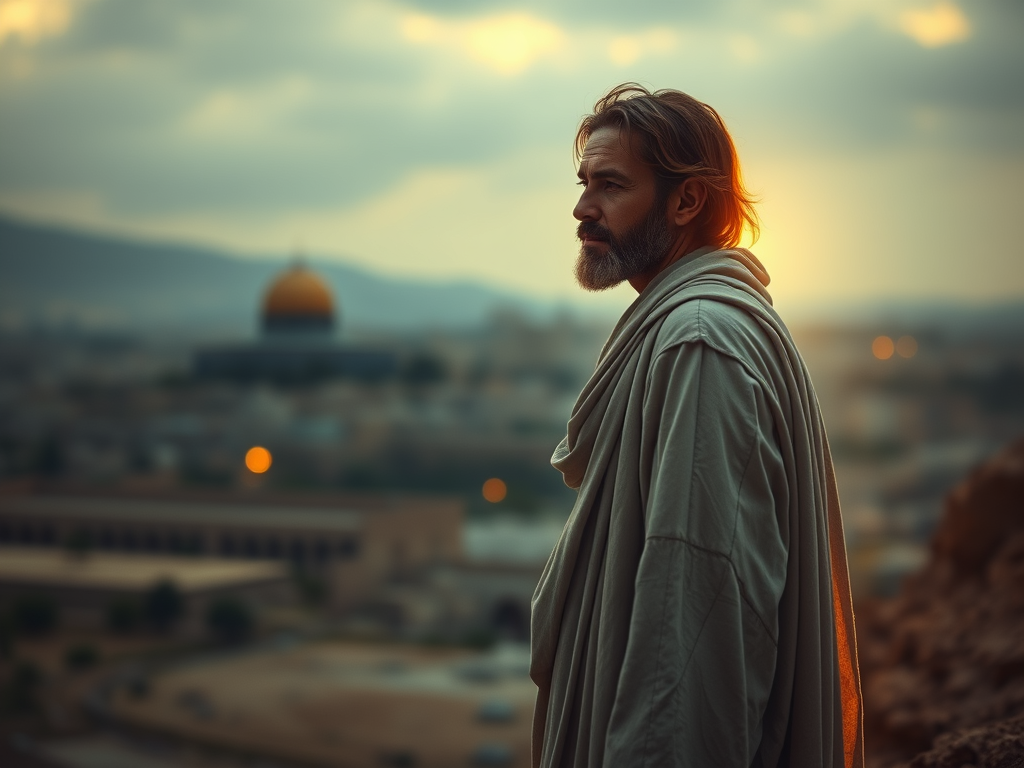
    (Featured image generated by Jetpack AI.)

    A concept of Ezekiel’s Vision, (Credit: Adobe Stock ZenArt)
    See my paper on the vision of Ezekiel 1
  • Psalm 23:6 – Pursued

    Psalm 23:6 – Pursued

    Surely goodness and lovingkindness will pursue me all the days of my life,
    and I will love in the LORD’s house forever.

    Well, this is the last verse of Psalm 23. It’s a bit shorter than Psalm 119!

    So which is better? A lot more people quote Psalm 23, and with good reason, but there is value both in something comprehensive and something compact and evocative. That’s why we have different kinds of literature in the Bible. It’s also why we all love different kinds of literature ourselves.

    So what is the impact of the ending of this Psalm? For me, it comes in the second half of the verse. I’ll live in God’s house forever. But I chose the first half to provide my title. I am pursued by God’s goodness and lovingkindness. It reminds me of Psalm 119:176. I may have gone astray like a lost sheep, but I cry out for God to seek me. When I do, I discover that God has been pursuing me all the time.

    Many times, the result of prayer is not a change in circumstances, but rather a change in perspective.

    After crying out to God in my trouble, I hear a voice that says, “Look the other way.” When I do, there God is. God has been there all the time. I can’t get away from God’s mercy and love.

    But the second half of the verse gives me another perspective. I’m going to live in God’s house forever. There are a number of view of this, each of which can help us understand God’s love for us.

    I’m going to look at three.

    First, we can think of this as the privilege of being in God’s presence in a place and time of worship. There is pleasure and comfort in being in God’s presence in such a place at such a time. Often this involves the enjoyment of our relationship to other people as well as our relationship to God. Conceive of a time of peace and joy and then think of that never ending.

    There’s a saying that we can’t live our lives in a spiritual retreat, and that we can’t stay forever on a spiritual high. Psalm 23:6 suggests that this is going to change down the road.

    Second, we can think of this eschatologically, meaning at the end. Yesterday, in writing about the heavenly banquet, I looked at some passages from Revelation. But if you look carefully you’ll see that Revelation is built with sanctuary imagery. In the Israelite temple you had a courtyard, then the holy place, and finally the most holy place, in which the ark of the covenant was kept. It represented God’s presence.

    That presence was separated from the people by that courtyard and earlier room, the holy place. Access was more limited the closer one got to the throne. But in Revelation, starting with chapter 4 and the command to John to “come up here,” we start to see sanctuary imagery all around, and the center of the action is around the throne of God, right in the Most Holy Place.

    Access was limited. Access will be unlimited. We will dwell in God’s house forever.

    But there is a third. If we jump just one verse to the next Psalm, we can learn what it is:

    To the LORD belongs the world and everything in it;
    The inhabited land and everyone living in it.
    For He established it upon the seas,
    Upon the streams he made it firm.

    Psalm 24:1-2, my translation

    You may think you have to wait, but God’s house is here now. You’re living in it. Your house is in God’s house. All your stuff? That’s God’s stuff. You? You’re God’s person.

    Now.

    What we all need is a change of perspective, a new understanding of what belongs to God. I frequently note what I believe is Jesus’ humor when he says, “Render to Caesar the things that are Caesar’s and to God the things that are God’s.” Just what is it that actually belongs to Caesar? There’s some practical advice for life in the saying, but there’s also a pointer to something greater.

    Just as you can turn, look, and find that God is already there seeking you, and was doing so before you called, so you can turn any direction, look, and see God’s house all around you. The change is in you. God was there all the time and will be there forever.

    You live in God’s house, because God owns all the houses and all the stuff.

    Live in God’s house today!