Threads from Henry's Web

Tag: dialogue

  • Recommending a New Blog: Dr. Dolly’s Musings …

    Recommending a New Blog: Dr. Dolly’s Musings …

    There’s a new blog, Dr. Dolly’s Musings … and I want to recommend it highly. Dr. Dolly Berthelot is an author with Energion Expand (an imprint of my company) with titles PERFECTY SQUARE and Scars to Stars. She has also been a friend and partner in various diversity and dialogue programs over the years. I consider PERFECTLY SQUARE to be one of the best approaches to understanding and managing the value of diversity.

    My company, Energion Publications and all its imprints were founded with a key value and mission of publishing diverse voices and helping to generate more dialogue between very different voices. This value and mission remains.

    I believe you will learn a great deal from Dr. Dolly’s Musings …. But don’t think this will be dry facts. Dolly is one of the most versatile users of words and imagery that I have every encountered. Just when you think she’s found the limits of her imagination, she’ll surprise you.

    We differ in background and some beliefs, but we share the desire to see people learn to work together and produce great value for all of us, not just economic value, but community as well, which is a value beyond price.

    You can read her introductory post here.

  • The Demand for Opinions

    The Demand for Opinions

    There has always been a tendency for crowds to call for others to support them. If you do not, you are contributing to the other side, however they define that.

    Social media has multiplied that demand and given the demanders a megaphone. If you do not express an opinion–the right opinion according to them–on this or that issue, you are letting other people by with something.

    This attitude spans the political spectrum. There will be those who will think I’m talking about them, and those who think I’m talking about their enemies. Both are correct. I’m talking about the way we talk about just about everything.

    Don’t imagine I’m talking about politics alone or even primarily. I first encountered this sort of attitude over religious viewpoints. If you weren’t arguing for a particular viewpoint, then you were obviously arguing for the opposite, variously defined.

    In particular, I saw this in denominational authority. I was a student at the Seventh-day Adventist seminary at Andrews University. If you were not defending the authority of the SDA General Conference, you were obviously a rebel. You couldn’t just go on about your business. Note, however, that while my experience was with the SDA church, this is by no means exclusively an issue in the SDA church.

    Social media simply magnifies the call. I see posts every day that demand that someone speak out about this or that. And there is a point to speaking out. Speaking out can be a good thing. In addition, we have those who claim that if we don’t post something about their favorite cause we are heartless. We don’t care.

    I believe we have a different problem. We are trying to generate good results starting from a mob mentality. We have an effort to create a mob of people without serious knowledge of an issue who will say yes, click ‘Like’ or Share. When this is done, we can feel that we are truly fighting evil. I’d say “as defined by,” but really, we have undefined opposition to undefined evil in the pursuit of undefined good.

    Now there are a number of voices out there who are well-informed. I do not condemn pastors for preaching their understanding of Jesus and applying that to the moral actions of their congregations. I don’t condemn an informed politician (may their tribe multiply) in advocating a position.

    What I do is choose myself not to play this game. I choose a small number of issues, largely in the realm of spirituality and community, and I advocate for those. I understand them fairly well. I can speak of them to some effect, though I am not extremely optimistic. I was chastened by overhearing someone in the hall of the church admin building telling someone else what a beautiful answer “Henry” had to their question. I did not recognize, nor would I have endorsed the answer attributed to me. They didn’t know I overheard.

    What I suggest is choosing what you will spend your time on and ignoring the calls for proclamations on other things. Be prepared to defend what you say and make your presentation most effective.

    I could say that the times call for genuine dialogue and grace to our enemies, but that has always been true. Firm opinions, carefully researched, and presented with conviction will go a long way. There is a place here for negatives, for calling evil “evil” no matter who is carrying it out.

    But the need for clearly presented information is much greater than the need for opinions.

    That’s my opinion!

  • Psalm 119:63 – Companion

    Psalm 119:63 – Companion

    I’m a companion to all who fear you,
    and to those who keep your precepts.

    My thoughts today took me onto the subject of companionship and friendship. Who are your friends? Why are you friends with various people?

    In scripture we have a tension between two views of the relationship between God’s people and those around them. You can see these in the contrast between the books of Ruth, Jonah, and Esther on the one hand and Nehemiah/Ezra/Daniel on the other.

    The first reflect the value of connections with foreigners, as when Esther enters the court of the king without revealing her Jewish identity, Jonah is sent to reach out to Israel’s enemies with God’s message, and Ruth becomes an ancestor of King David. Ezra and Nehemiah both wrestle with accommodation between the returned Jewish exiles and people of the surrounding nations. Daniel makes a public embrace of his Jewish identity throughout his life.

    In the New Testament we have the embrace of gentile believers into the church and an evangelistic message that was constantly in contact with unbelievers, but then in Revelation we have a repeated call for separation, for God’s people to come out from among those who are doing evil.

    We like to have a clear mandate. Either we’re friendly with everyone or we’re separate. Make it easy. But what we actually have is a variety of responses to a variety of circumstances.

    I think every parent faces something similar. A parent is concerned if their child gets in with bad companions. On the other hand, they are also joyful when that same child is a leader, helping others in their age group make better choices. If your child is influencing someone for the right, they may be dealing with someone who was also inclined to worse choices, and thus was someone you might be hoping they’d avoid.

    This is actually one of my favorite subjects, our identity and our mission. Both elements are generally involved in our lives. We can be someone who always gets along, but does so by not having any real identity. Nobody can really dislike such a person because there really isn’t anything there to dislike. Or to like, for that matter.

    Such a person can always be out in the world, connected with anyone, staying out of conflict. But who are they? Does anyone know? Do they actually have any influence?

    On the other hand, a person can have an extreme identity. This can involve such intense views, so regularly expressed that nobody can doubt who that person is. They may also be separated from others, either by the choice to only associate with those who are in agreement with their many opinions, or by the choice to live separately. There are Christian groups, for example, who live in separate compounds or communities with association with outsiders strictly limited.

    Having strong opinions or a clear identity does not have to be combined with isolation. One can be connected and have firm convictions.. It often depends on how one chooses to express those views. One can also be a companion of those who do good things without being out of contact with those whose views and actions are more questionable.

    This requires firm convictions, including the conviction that one should be connection with others, that one should be able to exchange ideas and have influence. In fact, I would suggest that these two can work together quite well. I believe in dialog as the primary way of having influence in the world of ideas. By this I mean making your communications always be an exchange, not a monologue. For such an exchange to take place, you can’t give up identity, otherwise you have nothing to give in the exchange.

    So your being a companion of some doesn’t mean you have to be the enemy of others. And your companionship with God doesn’t mean you have to neglect others who may disagree with you in one way or another. In fact, the better your companionship with God, the better your capability to meet others comfortably. Having that identity as God’s companion, you are free to treat all others as also God’s creation, worthy of respectful, but content-filled and robust exchange.

    What can you do today to make yourself more comfortable with your own identity so that you can carry out your mission to others who are, like you, God’s creation? As you do so, is there someone God would have you befriend, for the benefit of both?

    I’m listing here some books that I publish that relate to comments I’ve made above. Note that some of these books are varied in their own mission and identify. That may help you adjust your own!

    (Featured image generated by Jetpack AI.)

  • Psalm 119:51 – Confidence

    Psalm 119:51 – Confidence

    The arrogant taunt me scornfully,
    but I do not swerve from your instruction.

    The most common reason people express to me for not talking about their faith to others is that someone may make fun of what they believe.

    Now I can’t tell you that people won’t do that to you. They will. And it’s more universal than you might think. I’ve found that many Christians are unaware of what their comments on atheism sound like to an atheist, or actually to anyone who doesn’t believe as they do. When we produce “zingers” or “mic drops” regarding people who do not share our beliefs, they may cause high fives among those who share the taunter’s viewpoint, but they don’t make friends, and they don’t convince.

    Actual confidence in your beliefs doesn’t require you to put others down. Confidence will, however, give you a defense against those who taunt you. You know that the snide remark doesn’t actually make your own beliefs wrong. It’s the result of under-confidence and over-expression.

    This doesn’t mean that you can’t have dialogue about your faith or even debate it. But the dialogue of a confident person doesn’t require demeaning one’s opponent or trying to get cheap, but ignorant laughs. Dialogue requires that one listen to an opponent’s point of view and respond to what that person actually believes.

    This also applies to debating with or having dialogue with Christians in other tradition streams. For example, the Calvinists I encounter don’t resemble the Calvinists described to me by fellow Wesleyans. On the other hand, the descriptions I often hear from Calvinists of Wesleyans don’t much resemble anything I believe.

    This verse gives us antidotes to all of these problems: Sticking to God’s instructions. Doing so will help you to withstand taunters and to avoid being a taunter yourself.

    Who in your world might you need to understand better?

    (Featured image generated by Jetpack AI.)

  • On Listening to One Another

    On Listening to One Another

    On the various Energion Publications web sites, we have been emphasizing listening in commemoration of Pentecost. This Sunday is Pentecost Sunday, but we’re going to continue the topic for a few weeks into what’s called “ordinary time” in the church calendar. It’s precisely in ordinary time that you need to remember the lessons of receiving and listening to the Spirit.

    We need to continue listening even when we can’t see the flames of fire or hear God’s voice, or detect other signs of God speaking. God speaks in many ways, sometimes yes with thunder and lightning, but at other times God speaks through those who are around us.

    Hearing God in Others

    One element of listening that we often neglect is listening as the Spirit speaks to us through other people.

    This was a lesson I started to learn in Guyana, South America, where I lived as a teenager. My parents went there as missionaries with my father assigned as Medical Director of Davis Memorial Hospital in Georgetown. Thus I spent a good portion of my teen years among people of a different culture.

    I would often get rides to various places with the hospital’s driver, Brother Carr. (Note that when I was growing up as a Seventh-day Adventist, I was taught to address my elders as “brother.” That was so ingrained that I can’t actually remember his first name.) There was another gentleman who worked security and also some other functions around the hospital, and was occasionally a backup driver.

    I recall discussing world events with these two men. Different country, different race, different culture, different perspective on just about everything. Those conversations have stuck with me. One day one of these men took me to the seawall which keeps the Atlantic Ocean from flooding Georgetown. After explaining the history, starting with settlement by the Dutch, we turned to current events, which at the time involved Mainland China replacing Taiwan in holding China’s permanent seat on the security council of the United Nations. Elements of that conversation have stuck with me.

    Why do I bring up all of this now?

    Very simply, there are good reasons to not only read books, watch videos, and listen to sermons/lectures on a variety of subjects. It’s important to learn about these things from more than one perspective. This can involve expanding your circle of friends. Intentionally expanding your circle so that you meet more people who are not exactly like you.

    Difference can include:

    1. Differences of faith, including those with a secular or humanist view as well as those of other religious groups
    2. Differences of race, even beyond those we talk about most
    3. Differences of nationality, to include people from countries that are less like our own
    4. Differences of theology within our own faith tradition, such as Reformed, Wesleyan, or Open/relational or progressive, moderate, and conservative
    5. Differences in levels of wealth and privilege (While some object to the term “privilege,” I openly confess to being privileged. It was a foregone conclusion I would go to college and if I wanted, to graduate school. I have never feared starvation. My life is filled with reasons for thanksgiving!)
    6. Differences in geography, such as living in an urban, suburban, or rural area

    There are certainly many more, but these are some of the many things that I think many of us don’t interact with enough. For example, I sometimes give money to someone who is homeless, but it’s much harder to get me to say hello. (I publish two books, The Vicar of Tent Town and The Fringe, both of which challenge stereotypes of what it means to be homeless.)

    Some Books

    And now for a short commercial … well, not really. Some thoughts!

    I was thinking about four books that I publish, all by African-American authors. I’m writing about them here, rather than on my company blog because these thoughts are my own, apart from any marketing plan. (No, I don’t deny wanting to sell the books, but if I was writing marketing text, I’d do it in “company” space!)

    I want to recommend these four books for specific things in which they can give you a different perspective. In the case of three of the books, the reason I’m listing them here is not the central reason the author wrote the book, nor the reason I published it.

    Let’s start first with Dr. Terrell Carter’s book I Have to Live with Them?: Understanding How Black and Brown Christians Navigate Their Relationships with White Christians in the American Church. This is the one book of the four that is precisely intended to help readers understand the dynamic of race relations in the church. It’s written by an African-American pastor who pastors a predominantly white congregation. This one is in the Energion Publications Topical Line Drives series, which means it’s short and to the point. It’s not meant to break major new ground. It’s meant to get you to the starting gate. Dr. Carter has two other titles with Energion as well, which you can find on his author page.


    The second book in this list is not written to address any of the issues I’m discussing here, but it does. It’s The Seven: Taking a Closer Look at What It Means to Be a Deacon by Dr. Lonnie Davis Wesley, III. This is, unsurprisingly, a book about the ministry of deacons in the church, and it’s written by someone who pastors a large Baptist church in Pensacola, Florida, Greater Little Rock Baptist Church. As an aside, if you live in the Pensacola area, visit this church. I strongly commend it.

    The reaons I’m talking about the book here, however, is because of the background it gives you about the black church in America. It will teach you things about deacons in the church. It will develop your understanding of the early church and what led to their being deacons. If you’re dealing with problems of church polity, you will find scriptural ideas in here that just might help. But it will also help you look at all these things with new vision.


    The third is Grant Me Justice: A Mother’s Journey from Murder and Mourning to Mercy and Dancing. This book deals with grief, anger, and the search for justice, but it also tells an important story, the story of a mother and what gave her perspective on what was happening. It’s a story also of grace. And it’s a story that will help many see things from a very different perspective.

    An important lesson to learn in reading this book is that hearing the stories of others can provide so much help to each of us in understanding our own journey of faith. God’s grace is high and wide, and its sufficient. God doesn’t have a perspective problem. Stepping into the shoes of a grieving parent as you peruse the pages of this book can change you in many wonderful ways.


    Last, but not least (these books are in no order of precedence), I have a children’s book. The book is What Color Am I? It’s the 8th book in the Kamden Faith Journey series. This entire series is about a grandmother helping her grandson in his faith journey. It provides an opportunity for parents to read with the children and discuss important topics with them. In this book Kamden sees a Black Lives Matter protest and asks his Nana for an explanation. What are they doing? Why are they angry?

    The response is gentle, faithful, and powerful. I wonder if you, reader, have looked at these various issues from the perspective in this book. It brought tears to my eyes as I created the book layout.


    Conclusion

    Whether it’s with these books or others and whatever the subject or your situation, try to find an opportunity to listen to someone whose perspective differs greatly from your own. It may benefit them, but it will definitely benefit you.

    Note: Featured image for this post was generated using Jetpack AI as a test.

  • As Everyone Trades Scripts – Again

    Immediately after the last election I wrote this. Please read it before you read this.

    I want to reiterate it today. I have meant it sincerely following every election in which I have been a voter, and I registered to vote at the first opportunity.

    Speaking with respect is not agreement. It is a way to maximize the range of dialog. I believe deeply in the value of dialog, even with people who I may believe have not earned respect. Those in the military learn how to show respect to someone they may not respect because of that person’s rank and position. That could be a valuable lesson.

    Especially with people who have not earned respect.

  • Identifying Hatefulness

    Identifying Hatefulness

    There are many people concerned about hatefulness right now, and one might think that this concern came largely from opponents of the president-elect. I’ve found, however, that the concern comes from all sides. (“Both sides” is a very dangerous concept in a complex world.)

    Let me suggest a simple test. When you find a blog post, Facebook status, Tweet or something else in the form “Did you know that (derogatory term here) (name of person) did (disgusting thing) and is unfit to feed pigs,” just substitute your own favorite politician/candidate/commentator in the (name of person) block and ask yourself how you’d feel. If it would make you very angry, then it’s just possible that it’s a hateful statement.

    I know the standard retort: “But (name of person) actually did it whereas (MY name of person) is actually innocent. Truth counts!”

    That’s really not the point. It’s not even an issue of whether the person deserves to get called out on it. The problem is that we need discourse that is both civil and truthful if we’re going to get anywhere but deeper into fruitless conflict. You do not increase the value of a truthful comment by adding insult to it. “The other side started it” and “we have to respond” are not adequate either. How effective has your response been with regard to whatever it is you’re responding to?

    There are many proposed policies right now that make my blood boil. I occasionally start writing posts that I have to delete, not because I think they’re false, but because I think they won’t advance the discussion.

    To identify a couple of such issues, let me say that I consider a border wall on our border with Mexico or a registry of Muslims to be misguided, based on faulty data, and, in fact, morally wrong. It’s much easier to discuss and support those positions than some of the more personal (and even moral) claims made against specific persons. On the other hand, if I were in the Senate (not going to happen!) I would certainly have to consider such personal issues and, based on the best evidence available to me, vote for or against particular confirmations. Suggesting a free pass is silly. The losing side does it after each election.

    Let me reemphasize. I oppose hateful, insulting speech not because I think the “other” side hasn’t triggered some of it, but because I think it’s both wrong and ineffective. It does nothing to convince new people that your position is right. I’m not arguing for fairness, but for effectiveness.

  • Why I Believe in Dialogue, Respect, and the Gospel Commission

    Why I Believe in Dialogue, Respect, and the Gospel Commission

    angrymanfist-300px_redI’ve recently said and written a few things about the gospel commission, including my claim in my concluding presentation for my video series on eschatology that eschatology is all about the gospel commission. You’ll hear more about this in my foreword to Dave Black’s new book Running My Race. It’s in the final stages of production and should be available soon.

    This isn’t a new perspective on my part, but as soon as I start using words like “evangelism,” “mission,” or “the Great Commission,” I start getting questions about whether I believe in dialogue or whether I’ve started to think that all non-Christians are horrible people.

    On the other hand, each time I start talking about respect, interfaith dialogue, inclusion, and similar topics, someone is bound to ask me whether I’ve given up on evangelism and mission. Perhaps I no longer think Jesus is important.

    So let me put both of these things together. First, I am never going to abandon the Gospel Commission. It’s what being a Christian is about. I follow Jesus and I help others follow Jesus. I am a witness to Jesus as I follow Him. I proclaim his good news, and that good news is the central fact of my life. If I didn’t believe that, I would not be a Christian publisher. Frankly, while there are many things I enjoy about publishing, it’s hard work, the pay isn’t as good as it is for my other occupation (small network technical support), and I’d hardly keep at it without this greater “joy set before me.”

    Second, I believe that respect and love for one’s neighbor are central to the gospel. If I don’t love my neighbor as myself, I am not following Jesus Christ, and in turn I can hardly be effective in making other disciples, who would, in turn, be expected to love their neighbors as they love themselves. (There’s a “loving God” thing in there too, but see 1 John 4:20 for my emphasis in this case.)

    Contrary to the perception of many Christians, not only is respectful dialogue not opposed to carrying out of the gospel commission, it’s essential to it. But there are reasons it so commonly doesn’t seem so.

    Evangelism is tainted, I believe, by two false directions, each of which bears an abundance of poisonous and rotting fruit.

    The first false direction is the idea that evangelism is about giving the maximum possible number of people their “get out of hell free” card or, seen more positively, getting them their ticket to heaven. In this diversion from the gospel message we look for ways to get people to say the right prayer, then wipe the sweat from our brows (evangelism is hard work!), and say, “One more person saved.”

    This leads to other spiritually dangerous activities, such as promising people prosperity if they accept Jesus, emotionally manipulating them, or even converting them at sword point or gun muzzle. We can justify whatever behavior we might engage in on the grounds that even if we did use underhanded methods, the person should thank us for not burning in hell forever.

    This can also (or even in turn) lead to other shallow approaches to faith, such as the meme I saw on Facebook today built around the old idea of the wager of faith. As I understand faith, the wager simply isn’t—it isn’t faith and it isn’t even a wager, since there’s nothing of value on either side. Believing in Jesus isn’t an “in case” sort of thing. It’s not a wager, it’s a total commitment. Pascal’s Wager is an intellectual approach to a spiritual problem.prohibitionsign2-300px
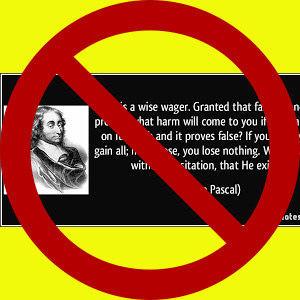
    Further, this sort of evangelism doesn’t actually represent love for one’s neighbor. It’s a sort of concern, but it’s more like the hunter has concern for the deer. No, I don’t mean the killing part, though that can happen as well, but rather the concern is for how the deer will fill the hunter’s needs.

    The second false direction is one of church growth. In this case, evangelism is simply the process of adding members to the church, and more specifically your church. At least this has a longer term goal, i.e., to get the person into a church community. But far too often, this simply feeds into another selfish numbers game. The value of the person is not in who they are or who they can be, or even what God wants them to be, but rather on church statistics. While evangelicals are more likely to go for the first diversion, even progressive churches can fall for this second one.

    As the saying goes, however, sitting in church doesn’t make you a Christian any more than standing in a garage makes you a car. I think we can identify what’s really important to us by what we pay for and what we report on, and in many of our churches I’m afraid that the concern is increasing membership, which, in turn, is to produce increasing financial support, which will allow us to get more members.

    What I believe about evangelism is this: It’s a lifestyle. You live as a disciple of Jesus, and you will, in turn, make disciples. I don’t mean that we should all shut up. Of course you talk about your faith because it’s not just important it’s fundamental. There’s another dichotomy between living our faith and proclaiming our faith, but I think it’s also false. Talking about our faith is one way we live it. If we’re talking too much, that’s ineffective living of our faith. I do not keep silent about something that is fundamental.

    In looking at motivation, I can say that it is a command, and it is. But at the same time it simply follows essentially from what Jesus has done for me. I will share a good thing. Sharing a good thing doesn’t mean forcing others. It’s a natural and friendly thing to share, just as it’s a natural and friendly thing—not to mention loving—to let the other person make their own decisions, including about how long they want to listen.

    Conversion, in turn, is something between God and the person converted. It’s gotten almost cliched to say that I can’t convert anyone; God does. But unfortunately we turn right back around and pretend it’s all about us. Grab hold of that mustard-seed of faith (I usually feel that I have somewhat less than that, but whatever) and trust God with salvation, conversion, and the spiritual health of others.

    Further, however, trust God to let you know how you need to be involved, and listen. Listen to God. Listen to other people. God loves each person involved more than you do. He even loves you more than you do.

    In studying eschatology (and I just completed a video series), I’ve found that God is deeply concerned about the spiritual health of God’s earthly children. I see the story of Revelation as being one of repeated opportunities, with the bottom line message that God does have this under control. Our part is to follow Jesus and make disciples.

    That doesn’t require being rude, obnoxious, manipulative, violent, or disrespectful. It requires love, and love values the other person, not some imaginary thing I think that person should be.

  • Why I Believe in Courtesy

    Why I Believe in Courtesy

    Loud-Speaker-Detail-300px
    Louder Is Not Truer

    (Image Credit: OpenClipart, )

    It seems that many people believe that in order to be firm in one’s convictions, one must be arrogant, loud, and generally rude. Rude and angry speech is praised as telling it like it is. Courtesy is often ridiculed with the incredibly overused term “political correctness.”

    I object to political correctness when it is politically enforced, when the law mandates the use of one term over another. Let’s see, perhaps like Florida state employees being ordered not to use the term “climate change.” Not what you were thinking of? I believe it’s the same principle.

    I believe in referring to people as courteously as possible, not because I am unsure of my beliefs, though I think uncertainty is certainly appropriate in many cases, but because I believe that is the best way to communicate what I believe. Shouting loudly may impress people who already agree with me, but it turns off those who are in opposition.

    If you truly care about communicating your ideas and about persuading others, you need to learn to practice a firm sort of courtesy. This may involve using labels for others that they can accept. It may require you to drop cute one-liners that impress you.

    One of my objections to speech codes is that by forcing people to be courteous (sort of) when they would not do so on their own initiative, it’s harder to identify those who can safely be ignored, i.e., all those folks who think their point is to be made by loud, obnoxious presentation.

    Courtesy, friendship, and openness to dialogue are not enemies of the truth. Rather, they are essential to communicating it.

  • When to Cut Off Dialogue

    I’ve read recently about people cutting off dialogue because of certain behaviors of those on the other side. And indeed, there are times when dialogue becomes futile because someone else refuses to be honest or refuses to engage.

    I’m writing this simply to appeal to those who want to see more dialogue, more working together, more actual exchange of ideas, and more true debate in which we actually engage one another’s thinking to be the good guys. Just that. You can respond to another person rationally and with sanity even if they are not likely to do the same thing. If this is done in a public forum, neutral parties who may be influenced will see what you do and be positively influenced by the way you debate as well as by the point you make.

    This can involve the determination that you’ve said enough on a subject and are going to just sit back while someone else raves. If they bring nothing new to the debate, you don’t have to answer.

    Dialogue will not prosper when we place too many preconditions on starting it. Be willing to let the other guy argue badly. The benefits of true dialogue are simply too great for us to allow obnoxious people to stop it.