Threads from Henry's Web

Tag: communication

  • Lazy Labeling

    Lazy Labeling

    I frequently hear various people complain about labeling. We shouldn’t label people, they tell me. But labeling is essential. Language wouldn’t function without labels.

    For example, sitting right next to me as I write this is a cat. I label him “cat” and I tell you he’s a cat, and we communicated. Behold, the cat, also named, labeled, that is, Li’l Mo.

    Li’l Mo, a Cat!

    Thus the label is useful. None of you are shocked at the picture after being told it would be that of a cat.

    But …

    A Tale of Two Cats

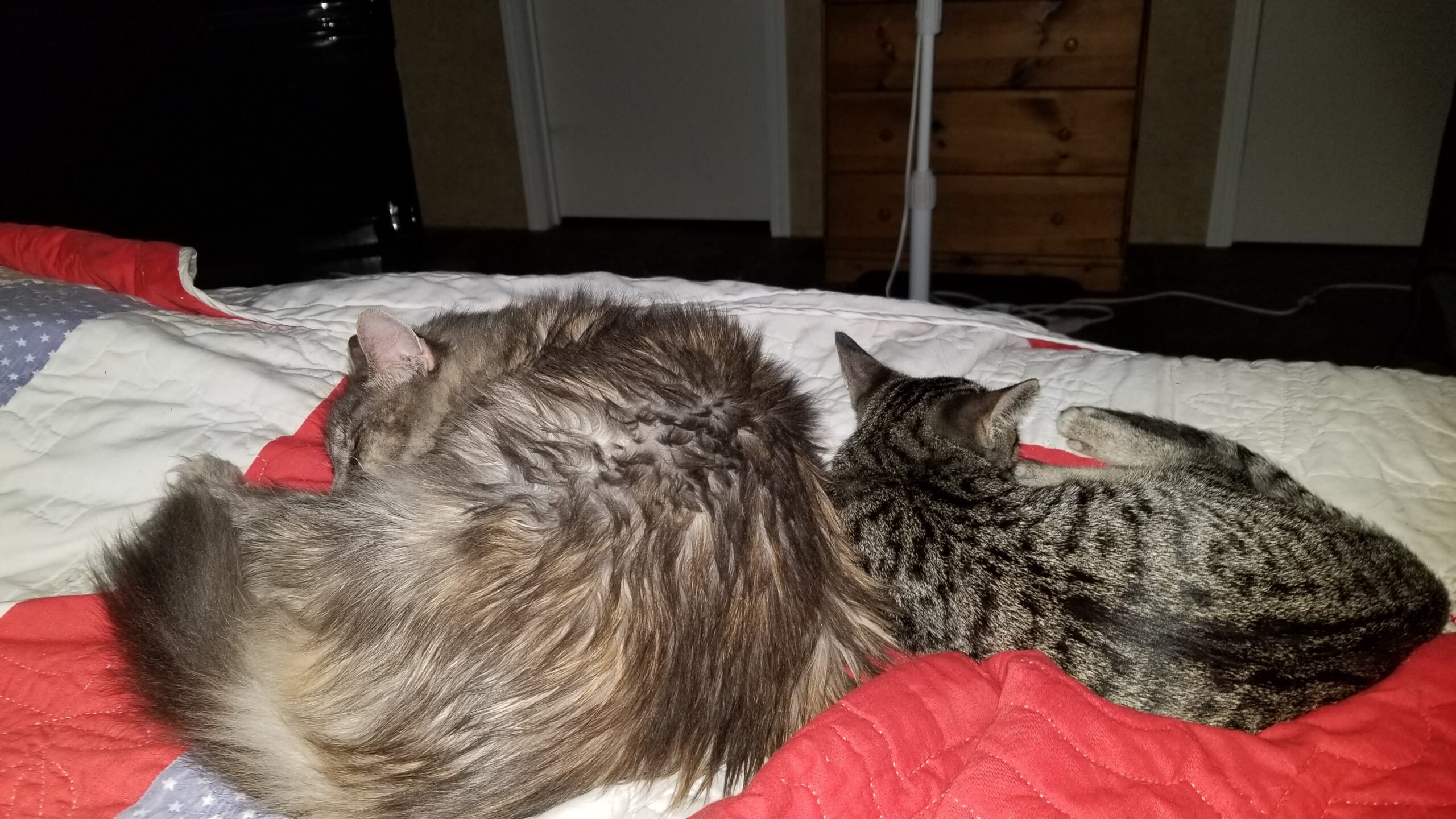
    Now behold two cats.

    The cat with longer fur is Cheena. In this video, which was taken only a couple years before Cheena crossed over the rainbow bridge at 16 years of age, Li’l Mo is about 6 months old.

    I credit Li’l Mo with extending Cheena’s life by perhaps a year because she seemed to gain new energy with him around. She mothered him, in the way a crotchety old aunt might, not too clingy, but playing with him and occasionally putting him in his place. As long as she was alive, she remained the dominant cat.

    So we have two animals labeled cats, one labeled Li’l Mo, and one labeled Cheena.

    Where Labels Cause Problems

    I have repeatedly noticed something interesting when I describe these two cats. I love both. I remember Cheena fondly and frequently.

    Cheena was very set in her ways. She would spend her time sleeping on the bed, specifically on my side. She didn’t want a lot of attention but about once a week she’d spend an hour or so on my lap. She adored having her hair brushed every night. She was picky about her food. She was dignified, and would take what I called “princess strolls” through the house, head high, looking left and right, making sure everything was in order.

    She also hated the vacuum cleaner, and would hide at the opposite end of the house when I brought it out. As most animals do, she hated the vet, but unlike any other cat I’ve had, she was very sweet about it. I remember after I picked her up from surgery after her foot got infected (Li’l Mo bit it!), the vet offered me a carrier box as they saw I hadn’t brought one with me. “No,” I said, “I don’t need it.” A couple of members of the staff followed me and watched as I carried her across a waiting room filled with dogs and a few other cats while she just hung out against my shoulder. Not a peep or a wiggle.

    Cheena was generally unconcerned with the activities of the humans as long as she got dinner on time and found me in my chair where she could sit on my lap.

    When I tell people about Cheena, they often say, “Well, she was a cat.”

    Mo, on the other hand flies around the house like a mad cat. Princely strolls are only occasional and generally short. He also hates the vet, but I wouldn’t even think of taking him there without a carrier. Oddly, he’s totally cooperative with the staff, and totally uncooperative the entire rest of the time. He’s unafraid of the vacuum cleaner. If he deigns to notice it at all it’s to chase it and pounce on it. He has no concept of riding peacefully on my shoulder. He is deeply concerned about his food being on time.

    When I tell people about Li’l Mo, they often say, “Well, he’s a cat!”

    And therein lies the problem, though it’s usually not an issue with cats. It’s not important, except to me regarding my cats, and perhaps to the cats, that people notice their individuality. But in many other cases, it very much does matter.

    A Personal Example

    A friend of mine for some years never conducted what I would regard as a complete conversation. Whether the issue was religious, political, or even how to accomplish some task, he would jump in when I was half-way through explaining my position and say, “Yes, I understand completely.” He would then carry on the conversation in a way that made it clear to me that he had checked off my view as matching some compartment he had created in his mind, and I was stuck in that compartment. Discussion would die.

    I found this very frustrating, as he was a person with interesting ideas and I would have enjoyed exploring our differences more seriously. But once I was placed in the compartment, the discussion was over. He never appeared to be thinking of me negatively. He’d usually put me in a compartment that was agreeable to him., but it was still frustrating.

    Lazy Labeling

    And that is the problem with labeling. Not the use of labels in itself, but refusing to use accurate, or at least carefully chosen labels. This doesn’t mean we can’t use general labels. Cheena and Li’l Mo are (or were) indeed cats. They’re also individuals.

    My views might generally fall into a category chosen, but they might also differ in important ways.

    Make the Effort

    In relationships and discussions of ideas, be willing to do the work of understanding and labeling accurately. Your life will be enriched for the effort.

  • On Listening to One Another

    On Listening to One Another

    On the various Energion Publications web sites, we have been emphasizing listening in commemoration of Pentecost. This Sunday is Pentecost Sunday, but we’re going to continue the topic for a few weeks into what’s called “ordinary time” in the church calendar. It’s precisely in ordinary time that you need to remember the lessons of receiving and listening to the Spirit.

    We need to continue listening even when we can’t see the flames of fire or hear God’s voice, or detect other signs of God speaking. God speaks in many ways, sometimes yes with thunder and lightning, but at other times God speaks through those who are around us.

    Hearing God in Others

    One element of listening that we often neglect is listening as the Spirit speaks to us through other people.

    This was a lesson I started to learn in Guyana, South America, where I lived as a teenager. My parents went there as missionaries with my father assigned as Medical Director of Davis Memorial Hospital in Georgetown. Thus I spent a good portion of my teen years among people of a different culture.

    I would often get rides to various places with the hospital’s driver, Brother Carr. (Note that when I was growing up as a Seventh-day Adventist, I was taught to address my elders as “brother.” That was so ingrained that I can’t actually remember his first name.) There was another gentleman who worked security and also some other functions around the hospital, and was occasionally a backup driver.

    I recall discussing world events with these two men. Different country, different race, different culture, different perspective on just about everything. Those conversations have stuck with me. One day one of these men took me to the seawall which keeps the Atlantic Ocean from flooding Georgetown. After explaining the history, starting with settlement by the Dutch, we turned to current events, which at the time involved Mainland China replacing Taiwan in holding China’s permanent seat on the security council of the United Nations. Elements of that conversation have stuck with me.

    Why do I bring up all of this now?

    Very simply, there are good reasons to not only read books, watch videos, and listen to sermons/lectures on a variety of subjects. It’s important to learn about these things from more than one perspective. This can involve expanding your circle of friends. Intentionally expanding your circle so that you meet more people who are not exactly like you.

    Difference can include:

    1. Differences of faith, including those with a secular or humanist view as well as those of other religious groups
    2. Differences of race, even beyond those we talk about most
    3. Differences of nationality, to include people from countries that are less like our own
    4. Differences of theology within our own faith tradition, such as Reformed, Wesleyan, or Open/relational or progressive, moderate, and conservative
    5. Differences in levels of wealth and privilege (While some object to the term “privilege,” I openly confess to being privileged. It was a foregone conclusion I would go to college and if I wanted, to graduate school. I have never feared starvation. My life is filled with reasons for thanksgiving!)
    6. Differences in geography, such as living in an urban, suburban, or rural area

    There are certainly many more, but these are some of the many things that I think many of us don’t interact with enough. For example, I sometimes give money to someone who is homeless, but it’s much harder to get me to say hello. (I publish two books, The Vicar of Tent Town and The Fringe, both of which challenge stereotypes of what it means to be homeless.)

    Some Books

    And now for a short commercial … well, not really. Some thoughts!

    I was thinking about four books that I publish, all by African-American authors. I’m writing about them here, rather than on my company blog because these thoughts are my own, apart from any marketing plan. (No, I don’t deny wanting to sell the books, but if I was writing marketing text, I’d do it in “company” space!)

    I want to recommend these four books for specific things in which they can give you a different perspective. In the case of three of the books, the reason I’m listing them here is not the central reason the author wrote the book, nor the reason I published it.

    Let’s start first with Dr. Terrell Carter’s book I Have to Live with Them?: Understanding How Black and Brown Christians Navigate Their Relationships with White Christians in the American Church. This is the one book of the four that is precisely intended to help readers understand the dynamic of race relations in the church. It’s written by an African-American pastor who pastors a predominantly white congregation. This one is in the Energion Publications Topical Line Drives series, which means it’s short and to the point. It’s not meant to break major new ground. It’s meant to get you to the starting gate. Dr. Carter has two other titles with Energion as well, which you can find on his author page.


    The second book in this list is not written to address any of the issues I’m discussing here, but it does. It’s The Seven: Taking a Closer Look at What It Means to Be a Deacon by Dr. Lonnie Davis Wesley, III. This is, unsurprisingly, a book about the ministry of deacons in the church, and it’s written by someone who pastors a large Baptist church in Pensacola, Florida, Greater Little Rock Baptist Church. As an aside, if you live in the Pensacola area, visit this church. I strongly commend it.

    The reaons I’m talking about the book here, however, is because of the background it gives you about the black church in America. It will teach you things about deacons in the church. It will develop your understanding of the early church and what led to their being deacons. If you’re dealing with problems of church polity, you will find scriptural ideas in here that just might help. But it will also help you look at all these things with new vision.


    The third is Grant Me Justice: A Mother’s Journey from Murder and Mourning to Mercy and Dancing. This book deals with grief, anger, and the search for justice, but it also tells an important story, the story of a mother and what gave her perspective on what was happening. It’s a story also of grace. And it’s a story that will help many see things from a very different perspective.

    An important lesson to learn in reading this book is that hearing the stories of others can provide so much help to each of us in understanding our own journey of faith. God’s grace is high and wide, and its sufficient. God doesn’t have a perspective problem. Stepping into the shoes of a grieving parent as you peruse the pages of this book can change you in many wonderful ways.


    Last, but not least (these books are in no order of precedence), I have a children’s book. The book is What Color Am I? It’s the 8th book in the Kamden Faith Journey series. This entire series is about a grandmother helping her grandson in his faith journey. It provides an opportunity for parents to read with the children and discuss important topics with them. In this book Kamden sees a Black Lives Matter protest and asks his Nana for an explanation. What are they doing? Why are they angry?

    The response is gentle, faithful, and powerful. I wonder if you, reader, have looked at these various issues from the perspective in this book. It brought tears to my eyes as I created the book layout.


    Conclusion

    Whether it’s with these books or others and whatever the subject or your situation, try to find an opportunity to listen to someone whose perspective differs greatly from your own. It may benefit them, but it will definitely benefit you.

    Note: Featured image for this post was generated using Jetpack AI as a test.

  • Why I Believe in Courtesy

    Why I Believe in Courtesy

    Loud-Speaker-Detail-300px
    Louder Is Not Truer

    (Image Credit: OpenClipart, )

    It seems that many people believe that in order to be firm in one’s convictions, one must be arrogant, loud, and generally rude. Rude and angry speech is praised as telling it like it is. Courtesy is often ridiculed with the incredibly overused term “political correctness.”

    I object to political correctness when it is politically enforced, when the law mandates the use of one term over another. Let’s see, perhaps like Florida state employees being ordered not to use the term “climate change.” Not what you were thinking of? I believe it’s the same principle.

    I believe in referring to people as courteously as possible, not because I am unsure of my beliefs, though I think uncertainty is certainly appropriate in many cases, but because I believe that is the best way to communicate what I believe. Shouting loudly may impress people who already agree with me, but it turns off those who are in opposition.

    If you truly care about communicating your ideas and about persuading others, you need to learn to practice a firm sort of courtesy. This may involve using labels for others that they can accept. It may require you to drop cute one-liners that impress you.

    One of my objections to speech codes is that by forcing people to be courteous (sort of) when they would not do so on their own initiative, it’s harder to identify those who can safely be ignored, i.e., all those folks who think their point is to be made by loud, obnoxious presentation.

    Courtesy, friendship, and openness to dialogue are not enemies of the truth. Rather, they are essential to communicating it.

  • Revelation Requires Interaction

    In my book When People Speak for God I used the story of the one-ended telephone cord. Edward Vick makes the same point in much more profound language than I used.

    But even should someone intend to make known to me what I would otherwise never come to discover by myself, I shall not in fact know it unless I respond. The intention to reveal oneself, and the intention to know the other are not sufficient in themselves. Revelation takes place when there is giving and responding, an interaction between agents who are both free and purposive. Revelation is communication. Revelation takes place when what is ‘provided’ is grasped, what is ‘offered’ is ‘taken’, what is spoken’ is ‘heard’ (From Inspiration to Understanding, 174 [in advance copy]).