Threads from Henry's Web

Tag: chronology

  • Quick Note on the Chronology of Daniel 1:1

    Quick Note on the Chronology of Daniel 1:1

    For those who hold to the historicity of the story of Daniel and generally to an early dating, Daniel 1:1 is a critical text that presents some problems. As I proceed with my eschatology series, and starting going through the book of Daniel verse by verse, I’m trying to keep all the options in mind and explore interpretation based on the different views.

    As I talked about this last night (February 4, 2016; video embedded at end of post), I thought I was being confusing, and at one point said “Nebuchadnezaar” when I should have said “Pharaoh Neco.” I want to clarify the people and dates and how they apply to the text in question.

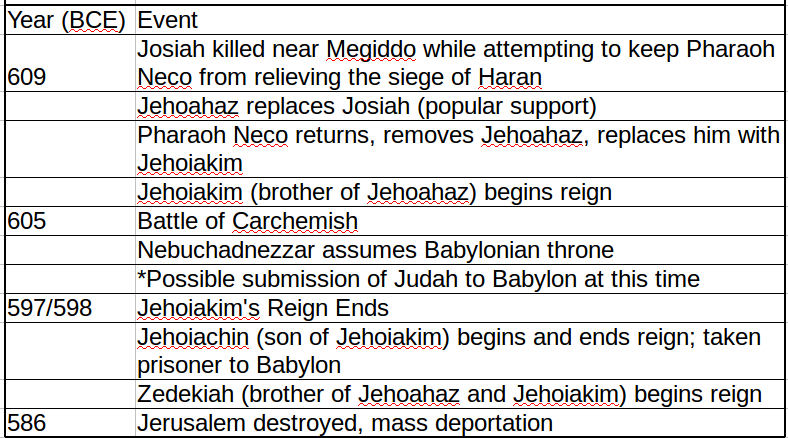
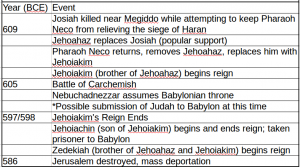
    First, here is a chart of the most critical dates. Note that you will find reference sources that differ on these dates by a year. It is beyond this post to discuss the different calendars and accession year vs non-accession year dating. The sequences involved are adequately handled by the dates I’m using.

    Click to view full size
    Click to view full size

    Biblical sources for this time period may be found in 2 Kings 23:29 – 25:30 and 2 Chronicles 35:20 – 36:23.

    Now for Daniel 1:1, my translation:

    In the third year of the reign of Jehoiakim, King of Juday, Nebuchadnezzar King of Babylon came to Jerusalem and put it under siege.

    Here is a list of the problems:

    1. Unless it is described in 2 Kings 24:1, which seems more likely to describe the events of 598/597 BCE, there is no siege and exile set for 605. It is nonetheless possible that there was one, as the Babylonians became dominant over the territory after winning the battle of Carchemish in 605. There might have been a small exile at that time. Even if 2 Kings 24:1 describes later events, Jehoiakim would have to first submit to Babylon before he could rebel. He was put in power by Pharaoh Neco.
    2. Nebuchadnezzar, as “King of Babylon” could not attack Jerusalem in 605, as he was not yet king of Babylon, but rather became king in that year.
    3. Even if there was a small set of exiles, or perhaps hostages, taken in 605, it doesn’t fulfill the description of the siege.

    The question here is how you evaluate the evidence. One critical element would be one’s determination on other grounds that the Book of Daniel is or is not historical. As an historian one would look for the most probable reconstruction of the evidence. Most scholars tend to support the later dating, even evangelicals, but you can find other arguments regarding dating via my Dating of Daniel Resources page.

    I’ll discuss dating and historicity further in my series, but for now I think this will clarify the issues discussed in the video.

  • Reading the Bible Chronologically

    A number of bloggers have responded to Marcus Borg’s article at the Huffington Post on reading the New Testament chronologically. Responses include Gaudete Theology, Bill Heroman, and Philip J. Long. I’d suggest reading those responses before reading my few comments.

    Here are some points that struck me:

    1. Borg contends that there is a trajectory of conformity to the culture. The earliest materials are radical while the later items have accommodated. I’m wondering how much this would differ from simply the fact that early Christians found themselves having to continue living in the empire, and that there would be more questions to answer about culture. In other words, if Jesus or Paul were to answer enough questions from people living from day to day, they might appear less radical than the distilled essence we get from them now.
    2. The New Testament, as a “book,” is the creation and possession of the church. I happen to believe that it is God’s creation through the medium of the church, but nonetheless without the church there is no New Testament. At a minimum, we need to recognize that reading it in a way so substantially different from the way the church created it will result in seeing a different picture.
    3. The historian may want to see the individual documents and read a history. I have great sympathy with than enterprise, but as I noted in point #2 the reading becomes different.
    4. If one postulates a different chronology, the book changes again. For example, folks like William R. Farmer and David Alan Black don’t accept Markan priority. While I am not fully convinced of this position myself, I do believe they have each, in very different ways, poked some serious holes in the consensus view.
    5. Viewing the gospels as products of the church rather than formative of it seems to privilege the written word above the oral at a time when that probably was not the case. In other words, the stories of Jesus told in the gospels were likely formative, and because of that became part of the written record. The gospel writers didn’t choose which stories to record in a vacuum. They were aware of which stories were more influential.
    6. I think #5 holds whether the gospels were written by eyewitnesses or not. Eyewitnesses will have been telling the stories for decades before writing them down. What was formative for the church would be in the gospels because of that, if nothing else.

    Obviously, I’m not recording well-researched and supported theories. I’m just noting some questions and observations.


  • The 24/7 One Year Chronological Bible

    The greatest difficulty I have in reviewing this Bible edition is distinguishing between what interests me and what might be helpful for people who are wanting to put more spark in their Bible study.

    24/7: A One Year Chronological Bible from Tyndale House is directed at a particular purpose, and it fulfills that purpose quite well.  I tend to emphasize the translation in discussing Bibles, but individual readers tend to look for a particular edition, often buying a Bible not for the translation, the Biblical text it uses, but for the features of that edition.  What most people look for in a Bible edition is a single volume that will generally be “their” Bible for study, for reading, for use in church–pretty much everything.

    If you look at this Bible from that point of view, it’s not going to make it.  It doesn’t have any study notes (no surprise), and it would be very difficult to find verses as needed.

    My point is not to criticize this edition for not doing what it does not intend to do, but rather to emphasize that it’s good for a particular purpose.  It provides a new approach to reading the Bible through and becoming acquainted with its story.

    There are a number of ways to think of the Bible story.  One is to think of the books are they are collected and put together, the story of the formation of the Bible. This is important, and relates to the process of canonization and thus to the history of the church, our community of faith.  Another way is to look for theological themes.  This Bible provides a way to address the story line, the record of how God has acted.

    In addition, it’s designed for the spiritual discipline of Bible reading.  Biblical materials are arranged chronologically, so that you will hear Psalms in the editors best guess as to where they belong, and you will read the messages of the prophets at the time when they were written.

    There are some obvious difficulties with this approach, one being that not everyone will agree on where things belong.  Psalm 104 is placed with a large group of Psalms, some other wisdom literature, and portions of (1st) Isaiah just after the fall of the northern kingdom.  I know of people who would argue both substantially earlier and substantially later.  Obviously they have to put it somewhere, and that’s not a bad choice.

    Several books whose dating might be controversial are placed in traditional positions.  The book of Jonah is placed right after the narration of the reign of Jeroboam II with a note that Jonah’s ministry occurred during this period, which assumes that the book is not pseudonymous, and many scholars believe.  All of second and third Isaiah is placed inside the reign of Hezekiah, and Daniel is placed in the late 7th/early 6th century.

    These aren’t bad choices, as the reasoning for other dating would have to be explained to the average Bible reader, and there is also an argument for hearing the books in one sense as they were intended to hear.  Whether pseudonymous or not, Jonah bears the name of a prophet from the reign of Jeroboam II, Isaiah internally claims to be written in a period spanning the reign of Hezekiah, and Daniel provides a 7th-6th century chronology for itself.  Nonetheless, I think it’s worth noting.

    Now let me get more to the purpose of the book.  It’s intended to provide a year long reading program, allowing the reading to experience the Bible story in a new way, one that would be very hard to do normally.  I think that’s a laudable goal, and the editors are completely successful.  This shouldn’t be your first reading Bible, but if you’ve read the Bible through at least once, it will be a good way to experience it again.

    One of the great errors of many deep Bible students is to get so focused on the trees (such as the details I discussed above) that they don’t get a picture of the story.  This Bible will help fulfill that need.

    Positives:

    1. Single column text aids reading
    2. Good arrangement with readings identified in the text.  There’s a guide in the back, but you won’t have to use it.
    3. Use of the NLT text.  The NLT is extremely well suited for a Bible of this type
    4. Approximate timeline
    5. It isn’t your “carry to church” Bible and it nowhere pretends that it is.

    Neutral:

    1. There is a Christian symbol chosen and featured each month of reading.  This doesn’t do anything for me, but I’m guessing it will for others.
    2. Scripture index, necessary for looking up particular texts, but not needed for the main purpose of the book.

    Negative:

    1. Size and print size. This could also be positive, but it strikes me as negative based on the purpose.  It’s a bit small.  That makes it portable, which could be useful, but at the same time a bit harder to read and to use.
    2. Binding.  I don’t know about this, but my wife believes the binding will not be durable enough if one is reading through it in the year.

    Since I cited my wife, I should mention her other comments.  She didn’t like the print and binding that much, but she very much liked the idea of having a Bible arranged chronologically.  She thinks more devotionally than I do, so that’s worth mentioning.

    Despite the comments on binding and print, in general this is a wonderful addition to the available tools for students of the Bible.

    Now we just need to start using them.  We are richer in Bible study tools right now in the English language, yet our Biblical knowledge continues to deteriorate.  That indicates a lack of desire or will, I think, as there is certainly no excuse for someone who reads English and wants to know the Bible not to do so.