

Threads from Henry's Web

Tag: canon

  • Starting a Study of Proverbs

    Starting a Study of Proverbs

    The Sunday School class I co-teach is beginning a study of Proverbs. I’m not leading this one. I’m relaxing a bit, I hope. But I have indicated I’ll do a bit of blogging on the material.

    The assignment before the beginning of the study tomorrow was to read introductions to the book, both from the resource text we’re using (The Daily Study Bible volume on Proverbs) and from various Bible editions. I’m not going to try to provide my own introduction, except to note that I read multiple introductions that seemed to me to provide an excellent launching point for a new reader.

    My interest is the place of Proverbs in the biblical canon. Why is it that we have a collection of proverbs in the canon of scripture?

    While we work with the canon of scripture all the time, we don’t often think about it as much. The “canon” refers to those books which are canonical, which means they’ve been accepted by church law as authoritative in the church. This is a fairly strict legal definition in the Roman Catholic and Eastern Orthodox traditions. In Protestantism, it’s a bit less fixed. The general concept remains.

    People often start talking about scripture with the concepts of inspiration and truth, and if a book is determined to be “inspired,” it is then scripture. That’s not precisely how this happened. There was a long process of history, tradition, discussion, and finally definitive determination. The determination can be better termed a determination that a particular set of books was and is authoritative rather than that these books were inspired.

    Now that may catch you a bit off-guard. Surely these books are inspired! In fact, I believe just that. But being inspired is not sufficient to make them scripture. I personally hold that God has inspired other writings which are not scripture, but I do not advocate that such writings become part of scripture. The key difference is that the selected writings were seen as authoritative.

    “Authoritative” involves the value of the material over time and space. For example, an ancient prophet might have sent a message to a particular individual that was specific to that individual. That message might have been from God, inspired by God, and sent by God’s authority, but if we discovered it today, as interesting as it might be, it would not be authoritative.

    In my view, accepting the value and authority of scripture today involves accepting the validity of the choices made over time, and the belief that we have the inspired scriptures that God intended as authoritative scripture. God can and does act through the events of history and the actions of groups in order to bring the message.

    So in Scripture we have the central authority. The question then becomes why does this particular passage, or in this case this particular book belong in the canon, and as part of the canon what is it supposed to accomplish.

    It’s almost cliché to talk about different types of literature and how we interpret those. But it is almost equally cliché that we expect the end point of this interpretation to be some specific doctrinal conclusion. In other words, we expect all of scripture to end up providing us with data.

    I would suggest (and have suggested) that while scripture is valuable for forming doctrine and guiding practice, this isn’t the main thing. In my book When People Speak for God, I suggest that we come to the Bible for information, but God comes to us in scripture for conversation. And eventually this conversation is to result in transformation.

    Wisdom literature as a whole, and Proverbs in particular challenges a couple of assumptions often held about how we get scripture, and I think in turn about what scripture is to do for us. Wisdom literature comes from living. It’s collected wisdom of a culture. It leads us to ways of thinking, rather than to provide set conclusions. It’s not just about the wisdom it passes on, but it’s about how that wisdom is collected. It doesn’t come in visions, dreams, or direct divine speech. It comes through the process of living.

    As an example, take Proverbs 26:4 & 5.

    Don’t answer a fool according to his folly,
    lest you become like him.
    Answer a fool according to his folly,
    or he’ll become wise in his own eyes.

    Proverbs 26:4-5, my translation

    So which verse do I follow?

    (Hint: James 1:5)

    (Featured image generated by Jetpack AI.)

  • Dr TK Dunn on the Importance of the Old Testament

    This is an extract from a longer interview, which I will also embed. I think Dr. Dunn has some valuable comments on the relationship of scripture and what it means for our study.

    And here’s the full interview from which that was extracted.

  • The Danger of Serious Bible Study

    The Danger of Serious Bible Study

    I believe it’s important to study the Bible. Many approaches are useful in this, and I’ve discussed them elsewhere. But the idea of serious Bible study can become a problem.

    I’m sure some readers are scratching their heads. How can it possibly be a problem to study the Bible seriously? Isn’t that obviously the right thing to do. Well, yes and no. Yes, if you understand serious Bible study to involve a variety of approaches that help you get an overview as well as deal with details. No, if by serious you mean spending hours over each word or phrase and never getting beyond looking at the text under a microscope.

    It’s important to do fast reading, so as to get a good overview. It’s important to read multiple texts. These days I’m listening to the Bible using Audible as I walk on my treadmill. Now one thing I can tell you is that it’s very easy for me to get distracted and miss things. It’s also hard for me to remember where things are because I’m listening and not seeing chapter and verse numbers. It’s also impossible for me to stop and go over some little item over and over rather than continuing to get the big picture.

    Do I miss some things? Certainly. But I also see some things that I wouldn’t see if I was reading directly from the Hebrew text, for example.

    Once at a table in a church office I was reading from the Contemporary English Version, a translation designed primarily for those for whom English is a second language. It’s easy reading. Someone stopped to see what I was reading and immediately asked, “Why would you read that when you can read Greek?”

    The answer was simple. Because I read English approximately 4x as fast as I read Greek. It’s easier for me to get an overview of an entire book and also of the entire Bible.

    I once set about to see how quickly I could read the entire Bible. I had a great deal of work, but I’m a reader and almost always have some book. I simply decided that when I wanted to read it would be the Bible until I had completed it. I finished it in about 10 days. Again, people would ask why. Surely I couldn’t give the text the attention it deserved.

    My answer would be that while reading slowly and agonizing over each detail, you can’t give the overall picture the attention it deserves.

    Right now I’m writing daily meditations on one verse per day from Psalm 119. Thus I read one verse and then spend the day on it. That’s not quite the opposite extreme, because I’m meditating on it through my work day, not spending hours working through lexicons and commentaries. But it’s close. That’s also an important part of Bible study.

    Each verse has a context. Too often we regard that as the verse before and the verse after or something similar. But that verse resides in a section of a book that might or might not be equal to a chapter, and that section resides in a book. That book is part of our canon of scripture, and we can see that canon divided into different sections. Is this among the wisdom books, the prophets, history? That is also context.

    Because the Bible was given to the community of faith, we also have to look at the entire canon of scripture and what a particular text means in that canonical context.

    “Seriously” in this context means at every level from every angle in every possible way. There is no one way. If we think the scriptures represent God’s word, a message from God to God’s people, then it’s rather important. If you don’t believe that, it’s another matter. But if you believe that “seriously” is very, very serious indeed!

    So read your Bible fast or slow or anything in between. Spend hours on a single verse of minutes on a whole chapter. Try to combine these and get a picture of what God’s word is in your mind so as you look at a verse, you see it fitting into a larger picture automatically because you are so well acquainted with that larger picture.

    You’ll be rewarded!

    (Featured image generated by Jetpack AI.)
  • Identifying Extremes – Examining Everything (An Example)

    Identifying Extremes – Examining Everything (An Example)

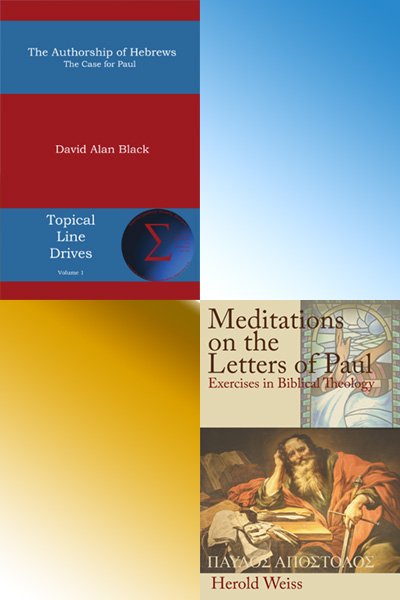
    book cross-hatchThis morning Dave Black posted some things about reading Hebrews from the Good News Bible (TEV) and also on authorship and canonicity. I’m not posting to enter into a debate on this point, but rather to note an attitude.

    Dave says:

    The undeniable reality is that questions of canon and authorship matter. Of course, both sides demonize the other. Proponents of Pauline authorship are dismissed as obscurantists, while proponents of Hebrews’ non-Paulinity are accused of succumbing to the spirit of the age. But why should we tolerate this kind of judgmental divisiveness? Maybe we need another conference on campus to discuss the issue!

    Good points! I am deeply concerned when people who are treated with intolerance by one group, move to another, and then treat their former group with intolerance. Is there justification for some reaction? I know many people personally who have been treated badly and many of them have been deeply hurt. There’s some justification here for anger. I publish books by authors who have lost their jobs over theological positions.

    But is the justification enough? I don’t think so. Our response to intolerance needs to be greater tolerance. That doesn’t mean we have to accept and approve behavior. What it means is that we need to look for a freer exchange of ideas and better treatment of people.

    There are those who wonder why I publish a book like Dave’s The Authorship of Hebrews. Not only do I publish that book, but I requested it. Dave didn’t push it on me. I don’t accept Pauline authorship of Hebrews. I don’t believe we can know the author’s name with any confidence. Yet Dave’s work on this topic shifted my position from one that excluded Paul from the list of possible authors to accepting that his authorship is a possibility. More importantly, Dave demonstrates how to challenge an academic consensus—with detailed, careful scholarship.

    Now let me provide a contrast and a comparison. In the lower right of my little graphic today we have the cover for the forthcoming book from Dr. Herold Weiss, Meditations on the Letters of Paul, which I’m currently editing. First, the contrast. Contrary to Dave Black’s acceptance of Pauline authorship of Hebrews, not to mention the pastorals, Dr. Weiss accepts a minimal Pauline corpus. He even rejects Colossians. So his meditations are on a substantially smaller set of writings that Dr. Black’s would be. Now for the similarity: Besides the fact that I enjoy and have learned much from both writers and both books, neither of these men has ever asked me to accept something because it’s in their tradition, or just because they said so. They are both willing to debate and discuss.

    I can give you numerous reasons why I publish books from a variety of perspectives, and I’ve done so before. But there’s a personal reason. I like them and I benefit from them. I have published some books that I really wish had been better. I do not claim any sort of editorial infallibility. In fact, I would claim feet of clay. But I have learned from and benefitted by reading each and every book I have published.

    Let me suggest a response to Dave’s little book. How about looking at some of the vocabulary comparisons excluding the pastorals, or even working from a minimal Pauline corpus? I’d like to play with that. I don’t know if it would be meaningful, but somebody could look at it.

    Just a thought …

  • Reading the Bible Chronologically

    A number of bloggers have responded to Marcus Borg’s article at the Huffington Post on reading the New Testament chronologically. Responses include Gaudete Theology, Bill Heroman, and Philip J. Long. I’d suggest reading those responses before reading my few comments.

    Here are some points that struck me:

    1. Borg contends that there is a trajectory of conformity to the culture. The earliest materials are radical while the later items have accommodated. I’m wondering how much this would differ from simply the fact that early Christians found themselves having to continue living in the empire, and that there would be more questions to answer about culture. In other words, if Jesus or Paul were to answer enough questions from people living from day to day, they might appear less radical than the distilled essence we get from them now.
    2. The New Testament, as a “book,” is the creation and possession of the church. I happen to believe that it is God’s creation through the medium of the church, but nonetheless without the church there is no New Testament. At a minimum, we need to recognize that reading it in a way so substantially different from the way the church created it will result in seeing a different picture.
    3. The historian may want to see the individual documents and read a history. I have great sympathy with than enterprise, but as I noted in point #2 the reading becomes different.
    4. If one postulates a different chronology, the book changes again. For example, folks like William R. Farmer and David Alan Black don’t accept Markan priority. While I am not fully convinced of this position myself, I do believe they have each, in very different ways, poked some serious holes in the consensus view.
    5. Viewing the gospels as products of the church rather than formative of it seems to privilege the written word above the oral at a time when that probably was not the case. In other words, the stories of Jesus told in the gospels were likely formative, and because of that became part of the written record. The gospel writers didn’t choose which stories to record in a vacuum. They were aware of which stories were more influential.
    6. I think #5 holds whether the gospels were written by eyewitnesses or not. Eyewitnesses will have been telling the stories for decades before writing them down. What was formative for the church would be in the gospels because of that, if nothing else.

    Obviously, I’m not recording well-researched and supported theories. I’m just noting some questions and observations.


  • Can the Bible Be Alone?

    Clayboy asks whether “the Bible alone” is an oxymoron.  Now I sympathize with the question, because I have been dealing in another forum (the issue arises in the last 100 messages or so) with someone who seems to think that a text can have meaning with no context at all, or more precisely that the obvious meaning of English words to a 21st century audience is somehow “the meaning of the text” as opposed to something built on the context in which it was actually uttered.  Using all that ancient language and culture stuff is changing what the text actually says.

    But that is a caricature of sola scriptura, but it is one which many people in the pews of our churches hold.  They believe that by sitting down with the Bible, and perhaps a concordance, they can discover what God actually said, and they don’t need to depend on anyone else–no tradition, no outside sources, no experts.  It’s an interesting view, but I don’t believe it is what the reformers intended by sola scriptura, and I’ve never encountered anyone who could be called “Biblically trained” who held that position.  (I responded on YouTube to someone who made that claim, and yet couldn’t get his English straight, much less his Greek.)

    But there is a more serious issue with the actual sola scriptura position, part of which has been raised in other discussions around the blogosphere.  Without tradition we do not have a Bible.  It is the tradition of the church that produced the canon as we have it, and there is not a 100% agreement even now with respect to just what books should be included in the canon, and whether the canon should be (or is) open or closed.

    But there is also the question of inspiration and just what can demonstrate that a book is inspired by God–God-breathed.  There are numerous ideas, but the question I would raise is just where those standards came from.  For example, why did the early church think there should be apostolic authority behind those books to be included in the New Testament canon?  To a certain extent I can accept the standard, though not completely.  For example, I don’t care whether Hebrews was written by Paul or some other person, whether Revelation by the apostle John or some other John, or whether the pastorals are genuinely Pauline or not.  I regard them as authoritative scripture in any case.

    Why?  Tradition.  It’s as simple as that.  I don’t even regard the books of the Bible as the only ones that are inspired, nor as the only ones that give me guidance.  They are the books that God guided the church to accept as the general authority for the church, and I submit myself to that general authority.  (The sense in which I do so is another topic!)

    There’s a sort of chicken and egg debate as to whether the church or the Bible comes first.  I don’t really see the answer to that as either possible or important.  The Bible and the community of faith grew together, with one supporting the other.  People lived as followers of God for many centuries without the complete canon, and yet somehow they managed.  Abraham believed God, as our lectionary passage for the coming week says, and it was counted as righteousness (Gen 15:6, loosely).

    Somehow Abraham managed to recognize God and believe him without a canon and also with precious little tradition.

    I do believe that the Bible is foundational, but one of the reasons I believe that is that it is the most tested source of tradition and experience–the experience of the community of faith with God passed down from generation to generation.

    It should be no surprise to anyone that one of the things that attracted me to the United Methodist Church was the Wesleyan Quadrilateral.  When I came to that in reading the United Methodist Discipline (and yes, I read the first hundred pages or so before I joined) I was hooked.  I do emphasize, however, that the quadrilateral should be more of a four layer filter than a four lane highway.

    In any case, my answer would be that the Bible cannot be alone, but more importantly is not, and has never been, alone.  We should not be afraid either to drive people back to the Bible as the source or to to admit that the history of our faith, God-guided I firmly believe, was the instrument God used to produce it.