Threads from Henry's Web

Category: Technology

  • Tech Fun: Old and New Meet

    Tech Fun: Old and New Meet

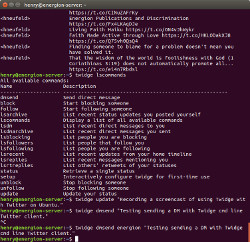
    terminal-102516-250x242Some of you may not be aware that I blog a few tech subjects, sometimes related to my IT work and sometimes not, on hneufeld.com. I thought I recent post would be of broader interest. It shows old technology meeting new – Past Meets Present: Command Line Twitter Clients on Linux.

    How many of you remember using a computer that was managed by typed commands at the command line? I’m guessing the number is not large, because people I help with their computer issues generally have no idea what I’m talking about by “terminal” or “command line” or any of a number of other ways to say it.

    Twitter, on the other hand, is very current. Not quite the latest any more, but still today. Enter Twidge. I show you the video of using this from the command line. Showing how old I am, I found it only slightly more cumbersome than a graphical interface, and I could come to like this approach myself.

    Here’s the video:

  • Better Learn to Live with Technology

    Mark Bauerlein at First Things doesn’t like laptops in the classroom (HT: Dave Black Online.) Even the title of the post says something about his view of technology. For what it’s worth, I write things by hand on my tablet. I teach Sunday School using notes, book, and Bible references on my tablet as well. If a speaker is boring, I might well be reading e-mail. The solution? Improve your content.

    I agree with one of the commenters who said he used a laptop in class and if he ended up in a class where the teacher banned laptops, he dropped the class or found a section with a different teacher.

    Just so!

  • Early Internet (or not) Experiences

    Ed Brayton brought back memories talking about how he first got online. I first encountered Ed on the Compuserve Religion Forum, and since then I have enjoyed reading his blog, Dispatches from the Culture Wars and The Panda’s Thumb, of which he was a founder. We have another connection, in that he is co-founder and president of Michigan Citizens for Science, and I’m a founding member and board member of Florida Citizens for Science.

    I first got online using a Sharp PC-1500 with a Radio shack RS232 port attached, and I believe it was at 150 bpsbaud, though I don’t remember very clearly. That was in the early 80s. The experience was not all that exciting except for the fact that I did get logged in. I went on to get involved just a bit with FidoNet, and operated The Wind Dragon Inn in Bellevue, NE. I had a 20 MB hard drive, a 1200 baudbps modem and I thought I was pretty wonderful.

    It was a few years before I expanded to the Religion Forum which was where I first encountered Ed. But I think I’m dating myself. (Also corrected my misuse of baud and bps.)

    Enhanced by Zemanta
  • Boon or Doom: Is That Really the Question?

    An article today on MSNBC.com asks the question:

    Will the Large Hadron Collider save the world, or destroy it?

    That, I think, is a major problem with the view of science held by way too many people. There are too reactions. First, we ask what it will do for us and how soon. Second, we ask whether it’s going to destroy us all.

    If we’re reasonably certain it won’t destroy us, then we don’t want to pay for it unless it produces immediate results.

    But knowledge doesn’t really work that way. Ideas that later turned into practical applications, such as radio and television, not to mention cell phones and various medical procedures (as noted in the MSNBC.com article) took a great deal of time to develop from much of the basic thinking and research that was necessary before they could become a reality. Nobody could have predicted what would happen when electricity was first observed.

    I’m reminded again of the comment by Henry Hazlitt in his little book Economics in One Lesson. He said that almost all errors in economics could be explained by looking at the problem over too short a term or over too narrow a range of people.

    If we are to continue scientific progress, money will have to be spent on things for which there is no immediate use. That’s what discovery is about, after all–discovering things. If they remain to be discovered, we don’t know what they are, and the scientists can’t tell you what they are. The have to find out.

    I expect neither salvation nor destruction tomorrow. I simply expect one very important new step in the gathering of knowledge.

    (Please note that the MSNBC.com article does not get hung up on the initial question. It does a fairly balanced job of discussing the issue. Personally, I had no intention of being balanced. Also, Peter Kirk wrote an interesting post on this today from a slightly different perspective.)

  • Candidates on Technology Issues

    Here is a good article that barely touches on the technological issues which could impact and be impacted by federal government policy over the next 4-8 years. It’s something that we need to think about, no matter what side of each issue we’re on.

    And just to remind us of the great need for education, there’s this comment (2nd on the list):

    . . . That is an example of the same idiotic thinking that gave rise to the stupid solar car race. Ever notice that they pace that race with a bicycle? Why not just ride bicycles? . . .

    . . . which goes to show us that some people have no idea how technology is developed. Early bicycles required some development too, not to mention cars.

  • Using God as a Label for our Fears

    Way back in the prehistory of this blog I posted an entry about fear and human-animal hybrids. Yesterday I got the latest edition of this type of fear in my Breaking Christian News e-mail. In it was a story headlined Prayer Alert: Ethical Outrage as Scientists Create “Human-Sheep”. Now I’m always mildly skeptical when I see an article that doesn’t so much report the event as it reports the outrage of the reporter to the event.

    For example, consider this quote, part of a preface to the story from reporter Teresa Neumann:

    I will never forget my feelings of disbelief and revulsion when I read Toffler’s assertion that in our lifetime we would not only witness the advent of human cloning, but fully human-animal hybrids as well. Those feelings returned with a vengeance yesterday when I read that researchers in America have just “created” a sheep with half-human organs. Who does man think he is? Where will this lead? What must God think? What should our response be? Do we run to the caves and cower in shame, calling for the wrath of God to come quickly upon the earth, or—like Abraham or Jonah—do we plead forgiveness and ask God to change the hearts of man, thus changing the society we live in? Let us pray…

    So much, I guess, for objective reporting. Personally, I think I will pray for those Christians whose fear and revulsion somehow allows them to think that man is getting too close to God. I’ll let you all in on a secret–getting to the point of assuming God’s power is quite a distance away from us humans.

    The link from the BCN story is to CBN which takes essentially the same approach. Again, the primary story is about the debate:

    A bio-ethical debate is raging at a Nevada university, where scientists have created the world’s first sheep with half-human organs.

    For a more news-oriented report, see this story in The Mail.

    We often use God as a convenient label for what we don’t know, and as long as that’s not all he is, I don’t have a major problem with that use. But when God becomes the label for our fears, then I believe we have a problem in our faith walk. Somehow God has made it through the crusades, the inquisition, and the mutually assured destruction policy with nuclear weapons. I doubt he’s particularly threatened by a few human organs grown in sheep. It does make me think about a nice horror movie based on the idea of killer sheep with superhuman intelligence, chasing sheep dogs and farmers from their land and taking over the world. Baaaaaaah! Sheep Rule!

    There’s a continuing residue of thinking from the Tower of Babel (Genesis 11) that often makes Christians believe that we might get too close to God and bring on his wrath and destruction. Perhaps we should apply a little logic. Any tower in the ancient near east would be considerably less lofty than the Empire State Building, or the Sears Tower, or the Twin Towers. The Twin Towers fell, but it was evil human beings using natural weapons that accomplished their fall.

    Interestingly enough, the builders of the Tower of Babel were also not so much trying to usurp God’s power as they were trying to get protection from God’s wrath. Their fear was driving them.

    There is the very valid question of safety, but safety concerns do not come from the possibility of offending God by mismanaging his universe. There is a concern with the possibility of viruses. I have no knowledge in the relevant areas, but I found this blog entry that discusses a few of those issues. My plan here is not to lay all fears to rest, but rather to suggest rational discussion leading, I hope, to appropriate safety measures. Fear will produce retreat; wisdom will produce caution. Progress means risk–it’s worth taking just a little.

  • Memories of Robots Future

    I’m not adding much to this one (on the immediate future of robots), but it brought back memories. I’ve been a science fiction fan since I first laid eyes on my first Heinlein book in my brother-in-law’s house. In our home we didn’t do fiction, though I’d read some in high school literature. It was a strange new world. In any case, I became something between a fan and an addict, probably leaning toward the addict side. I also enjoyed imagining what the future would be like. I will still criticize the future vision of any story that purports to have one, not that I’m likely to get it any better than the author did. It’s just fun.

    In any case, fast forward to graduate school, 1980 at Andrews University, Berrien Springs, MI, and a computer show. I don’t recall who sponsored it, or most of the technology that was there. I was just getting interested in PCs. A friend of mine and I stopped by a company representative who had a few machines there. We started talking with the representative about the future, and suggested that somewhere down the road, perhaps a couple of decades, computers would be driving cars. We were just talking about specialized devices with specially marked roads, recognition of major obstacles–simple stuff. He told us flat out that we were nuts. Computers were not capable of doing such a thing.

    Well, it’s 2007, and of course, and the next crop of robots are doing and planning to do things that we did not really envision in that conversation. As so often happens, reality is getting ahead of science fiction. You have to keep your imagination well-honed to stay ahead of reality.

    I think we’re looking at an exciting couple of decades ahead.