
A Video for My Book Identifying Your Gifts and Service

 By this question, I meant to ask whether Jesus actually cured people of illnesses, not whether he accomplished spiritual healing. I asked the question of Dr. Bruce Epperly, author of the book Healing Marks, when I interviewed him last night in an excursus to my series of studies on the gospel According to John. Here’s the video:
I’ve found it quite interesting to discuss Bruce’s views on this with other Christians. His theology, as a process theologian, is different from what you will hear in most churches, especially those which hold healing services. Yet the actions are similar. He describes a different spiritual process (no pun intended), shunning the word “supernatural,” and yet he is describing something very similar to what I hear from charismatic believers.
I have been called “liberal charismatic,” because I take a fairly open view of doctrine (though I don’t think it is unimportant), and also believe that all the gifts of the Holy Spirit are as available today as they were to the early church.
So what do you think? Was Jesus a healer? Can healing take place in churches today?
Dave Black posted some notes on the difference between being a cessationist and a continualist (his term). I agree with his comments.
Most commonly when we talk about “cessationism” we are talking about the gifts of the Spirit. Do these gifts, particularly the more spectacular of them, continue to operate in the church today? (I know that people divide these gifts differently, but in general, the question winds up whether the more spectacular of them, however, grouped, continue.)
The fruit of the Spirit is much less controversial on paper, but do we show the evidence of the Spirit working in our churches? I maintain that the sign of the Spirit’s work that Paul was looking for in 1 Corinthians 12-14 was not the gifts, but rather the one Spirit under which those gifts operated. The gifts of the Spirit put some power behind the fruit of the Spirit, but without the fruit, they are not a sign of the functioning of God’s Spirit.
In my experience, when people are looking for a gift of the Spirit they’re not that interested in gifts of helping or administration. What they want is miracles or prophecy. That is quite often a sign of a very wrong spirit, a spirit that seeks to dominate and stand out rather than to serve.
So I like Dave’s list of things that need to continue. How many continue in your church? In your life? In mine?
It leads one to pray, no?
Charisma magazine has a great article on Gordon Fee (HT: sunestauromai).
I particularly was struck by these two paragraphs:
For the most part, though, Pentecostals remain resistant to—or indifferent toward—theology and scholarship. After all, modern Pentecostalism was birthed in spiritual experience, not intellectualism. As the movement spread, Pentecostals simply didn’t see a need for theological pursuits. “We don’t need scholars; we just need the Holy Spirit!” has been the mainstream Pentecostal cry for the last 100 years.
Among evangelicals, few have looked to Pentecostals for in-depth biblical teaching. A commonly held view has been: “Pentecostal theology? What’s that?”
I encountered the first attitude in an introductory class I taught on studying the Bible. One young lady quit the class, saying that though I was teaching good things she didn’t need any of it, because she had the Holy Spirit. I can testify that she displayed very great need of learning to study the Bible more diligently!
I have exemplified the second attitude. When a friend of my daughter came home from ministry school with a book on Pentecostal theology. I remember remarking that I didn’t know there was such a thing! Of course today that’s exaggerating things somewhat. In my own publishing efforts I hope to bring together the work of conservative, liberal, and charismatic scholars to the benefit of all.
Gordon Fee has made a wonderful contribution over the years. I regard his commentary on 1 Corinthians in the NICOT series
In any case, check out the article, and especially the comments on prosperity theology. It is no wonder that a serious student of Paul would be very critical of modern prosperity or “health and wealth” theology.
. . . and on the subject of enjoying God, he’s really right.
I don’t mean to throw more fuel on the fire of this “hearing God” thing. Personally I think John Piper’s original article should be much, much less controversial than it is. The main thing that seems to be happening is that people are extending what he actually said to cover a great deal more ground. He may be right or wrong on many other things, but on this one he’s right, and I enjoyed that article.
Adrian is also right about enjoying God. What is it with gloomy Christians? It seems almost as though some people are afraid that we might enjoy ourselves too much in church and miss out on all the serious stuff. In a perpetual search for doctrinal correctness, they fail to call people to joy as well.
Now I’m not suggesting here that truth is unimportant. I think it is very much important to be right. Otherwise I would not respond to things in Christianity that I think are going dangerously wrong–even, for example, to respond to some of the hostility I sense to joy. I think it is true that we are supposed to enjoy God.
My seminary experience, however, tells me that one can get a great deal of knowledge of God without enjoying him and without finding a relationship with him. My own seminary experience, heavily focused on Biblical studies was a progressive experience of learning more and more scripture and becoming more and more isolated from the community, and even from private devotion and worship. My life became totally centered around knowing stuff about God, and God himself faded into the background.
Again, don’t get me wrong here. The knowledge is good, but it needs to go with a living experience, and I think that experience will be reflected in joy, a joy that stays with you even in sorrow. Without that joy I would not have made it through the last several years of my life, and I thank God for it. The same several years have made it clear to me also, however, that a sense of euphoria based on little or no foundation won’t work either.
I hope all Christians will seek the joy that comes from experiencing God’s presence and hearing his voice, wherever and whenever they can.
You know, John Piper has come on my radar on women’s ministry issues, and some of my comments have been pretty negative. But this article on his DesiringGod.org web site is something that resonates completely with me. For my skeptical friends, no, this is not the evidence you keep hoping I’ll provide. It’s simply an example of where someone else’s experience of God parallels mine so completely that I have to simply say “Wow!”
Let me tell you about a most wonderful experience I had early Monday morning, March 19, 2007, a little after six oclock. God actually spoke to me. There is no doubt that it was God. I heard the words in my head just as clearly as when a memory of a conversation passes across your consciousness. The words were in English, but they had about them an absolutely self-authenticating ring of truth. I know beyond the shadow of a doubt that God still speaks today.
. . . continue reading from DesiringGod.org.
Hat tip: Adrian Warnock’s Blog.
OK, that should be a sufficiently provocative title! 🙂
Peter Kirk commented on an earlier post and gave me some advice–advice which I would normally consider quite good sense. Here it is:
But maybe you are going a bit too far, at least to keep yourself out of trouble, in suggesting that those who do not accept women’s ministry may be guilty of blasphemy against the Holy Spirit.
Now I would normally take that advice, because heating up a debate such as this is commonly quite unhelpful, but in this case, I’m not going to, and instead I’m going to make my reasoning explicit, paint a target on myself, and see who wishes to take target practice. I do not mean to destroy dialogue, but I have claimed repeatedly that there must be a balance between expressing one’s views forcefully and allowing room for conversation in any dialogue. Often what passes for dialogue consists entirely of watered down arguments and sentiments, and results in a mental fog rather than an exchange of opinions. I would reference my responses to the Adrian Warnock interviews with Wayne Grudem as an example. I responded with some vigor to a number of points, yet at no time was I actually angry with Adrian or with Wayne Grudem. I know that some things that I said did offend a couple of people, but I think I said what was necessary in order to be honest.
Now I’m going to refer back to my response to that interview on a couple of points. First, however, a correction. I quote from my own post:
I would note however, that while I disagree with the idea of male-only church leadership, I am not particularly offended by churches that follow such a practice. Anyone who dislikes their view can go find another church, and there are plenty of those. What I object to is that this doctrine is made an essential of the faith. . . .
I am going to refine that position in this post, because I don’t think I drew the line correctly, and I think that my response has become more vigorous due to some experiences since that time.
In the same post, I also partially defend Grudem’s use of the term blasphemy for the views of another, from his viewpoint:
Now I know that Dr. Grudem retracted his acceptance of the term “blasphemy” when used of Steve Chalke (with whom I am not acquainted). I’m a little less happy with that retraction than others are. Don’t get me wrong here please. I appreciate the humility and the willingness to dialogue that it represents. But I wonder if at root there isn’t some justification for the word form Dr. Grudem’s point of view on the atonement. Now I can’t speak for him, but what suggests this to me is my own reaction from the other side. The claim that penal substitutionary atonement is the essence of the atonement tempts me to use the word blasphemy because I believe it paints such a wrong picture of God, one different from the revealed and experienced God. Now I’m also going to resist use of the term, though my own use of anti-God could easily be as provocative. Thus I understand both John Piper’s desire to use the term, and Wayne Grudem’s initial agreement.
Again, I want to refine that comment just a bit in this post by being more specific about why I use (and used) the term “blasphemy” in that particular context, and why I can understand its use by another against my own position. A bottom line point here, however, is that if anyone who is a part of the family of Jesus believes that I am in danger of blaspheming the Holy Spirit, my preference is that they say so. I may disagree with them, but I get the opportunity to examine my own beliefs and question myself, which is a good thing. I regard that as part of the attitude of repentance.
I need to say just a few words about the unpardonable sin. It is commonly equated, and quite scripturally so, with the phrase “blasphemy of the Holy Spirit.” I am not going to fully defend my position on this in a post that will already be quite long, but I do not believe that blasphemy of the Holy Spirit is a single act, nor is the unpardonable sin singular. I have commented on this briefly in the Participatory Study Series pamphlet Repentance and Rejoicing:
One of the tasks of the Holy Spirit is to convict of sin. If we turn away the Holy Spirit so much that we no longer hear His voice, we will no longer ask for pardon and it will, in fact, be too late.
I discuss this a bit further in my personal testimony, and also in a sermon which was broadcast on the radio here in Pensacola, and will be podcast via the Pacesetters Bible School New Blog within the next few weeks.
In summary, I believe that we are all more or less on the path between pardon and the unpardonable sin, which elicits the stern warning of Hebrews 6:4-6. There is a point of standing up against the urging of the Holy Spirit at which you will no longer hear the Holy Spirit speaking. When you get to that point, you will no longer as forgiveness, and thus will no longer be forgiven. Thus the unpardonable sin is that sin for which you do not ask pardon, and every time you resist the Holy Spirit, you head that direction. Fortunately, God’s grace is greater than our sin, and constantly pushes us to listen.
To go even further, however, I believe that every time we resist truth in any area of our life, we build habits of resistance that start to shut our ears to new light and to correction. If I become so angry with Wayne Grudem (see above), for example, or John Piper for their comments on penal substitutionary atonement, that I refuse in the future to hear anything they say, I have taken a step away from being corrected. Now obviously I can’t physically read or hear everything that anyone might desire. I’m talking about the attitude.
So this brings me to the actual point of this post. (I imagine you thought I was never going to manage that!) I start from the simple position that the Holy Spirit gives gifts in the church as he wills in order to do the work of ministry. Unlike our federal government, God doesn’t give unfunded mandates. The Holy Spirit can accomplish your call and your congregation’s call through you provided that you let him. The presence of the gifts of the Holy Spirit in the church indicate God’s intention that those gifts be used in ministry.
Every time I close myself off to that call, every time I place a barrier in the way of the Holy Spirit carrying out his ministry in and through me, my family, or my congregation, I am speaking against the Holy Spirit, putting up my views and my agenda as greater than God’s. That is not only a form of idolatry, but when done in the face of the conviction of the Holy Spirit it is, I belive, a step on the road to blasphemy of the Holy Spirit. That blasphemy will become unpardonable if I get to the point of being unable to hear what the Spirit is saying to the churches (Revelation 2-3).
Now one caveat here. While I am now more offended than I was previously by churches who deny women a place in ministry according to their gifts, I do believe there is a substantial difference between believing that something is right and failing to do it and not being aware that something is right. Both are dangerous, because our awareness of the Holy Spirit–God’s breath in Christ’s body–is key to our Christian life. But the first can be disastrous in a short period of time, while the second erodes. If completely honest, those with the second error correct their course.
This does not merely apply to women’s ministry. It applies to all forms of restrictions on ministry. I have seen churches where ministry was artificially restricted based on age, on economic status, on whether one was part of the founding families of the church, on intellectual ability or lack thereof, or on a buddy system with the elders and pastor. All of these things are, I believe, a way of flying in the face of the work of the Holy Spirit.
My bottom line is this: Be open to what the Holy Spirit is actually doing. While you need some structure from sound doctrinal beliefs, it’s easy to be wrong and to place your own agenda above God’s agenda. The one way to be safe is to maintain that attitude of repentace, to remain correctable.
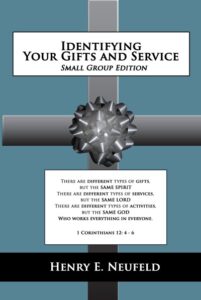
Finally, after many delays, every one of them my fault, my new edition of this book has gone to the printer. Titled uncreatively Identifying Your Gifts and Service: Small Group Edition, it fills a need, expressed by a number of people who have taken my class series of the same name, for an edition of this book that could be used by small groups in a continuing study of spiritual gifts. The original edition was really simply my way of gathering my handouts and exercise sheets into one binding to use in my own teaching. It was just a workbook.
We will be offering a pre-publication price of $10.00 rather than the $12.99 cover price form now until March 13, 2007 in celebration of this release.
Commercial announcement over–back to our regular programming!)
I have long been an advocate of the full involvement of women, indeed of all people in the ministry of the church. It is the essence, I believe, of gifts based ministry. If you believe that the Holy Spirit gives gifts for service, and then you deny the use of those gifts to certain members who have them based on race or gender (amongst other things), then I believe you are flying in the face of the very concept of spiritual gifts.
In fact, to deny the work–any of the work–of the Holy Spirit in certain members of the body of Christ, is a step along the road toward blasphemy of the Holy Spirit. Such denial is to say that the Holy Spirit has gifted and chosen someone, but you know better. If it is now “Christ living in us” rather than us living our own life, how is it that you justify making these distinctions. The clear trajectory of scripture is toward erasing such boundaries.
(26) You’re all God’s children through faith in Christ Jesus. (29) For as many as have been baptized into Christ are wearing Christ as a garment. (28) There is no longer Jew nor Greek, slave or free, male or female, for you are all one in Christ Jesus. — Galatians 3:26-28
I know many deride the idea of trajectories as being too loose a form of interpretation, allowing people to go anywhere they please. But with such a clear destination point for the trajectory as that, how can we possibly miss the trajectory? There had to be a difference in Paul’s churches between Jews and Greeks because of the culture. That was the one element he personally fought in his lifetime. Slave and free took somewhat longer. Male and female is one that we’re looking for today. But I think that God’s desire, God’s goal for all his children has been plain to see all along.
God doesn’t like his children lording it over one another.
I have taught this repeatedly. Authority, especially spiritual authority, is dangerous. You create the potential for abuse as soon as you place them in charge and insulate them in any way from accountability. This is true in the home when a man is made “head of household” answering only to God, with his wife answering to him. It is true when one of the church offices is placed above all others. There are a number of teachers who emphasize that the pastor is the final authority in the church and insulate him from challenges because one cannot touch God’s anointed. But all of these options fly directly in the face of the gifts teaching of 1 Corinthians 12-14. God gives the gifts as he wills. They are all important, they are all needed in the church. None of them are to make one of us Lord over another. To fail to recognize this will ultimately result in abuse. If you’re teaching it, though you may not be abusing anyone yourself, you’re opening the door.
I come to this position from an entirely positive point of view. My mother was a professional woman, a Registered Nurse who worked in missions with my father, who taught and led in churches. My father was an MD who did much less public speaking than my mother, and yet was behind her all the way. So I grew up with the idea that a woman could be strong and could take a leadership role. Similarly, I married a woman who is a spiritual leader, and is also a Registered Nurse. We sometimes teach as a team, and people are blessed by the different perspectives on the same subject we offer. The positive feedback on those sessions reinforces my belief in ministry.
This morning when I looked over the blogs I normally read, I found Suzanne McCarthy’s entry at Better Bibles Blog. Suzanne has arrived at similar positions to my own, as far as I can see from reading her blog entries, but now I know that she got there the hard way. It is one thing to know that there are potential problems. It is another to have the testimony that such things are real. It is important, however, because people will avoid the danger signs as much as possible. Just as the church has avoided the issue of giving equal weight and authority to women for two millenia, so humanity in general will avoid the idea of giving up their improper authority over others. As my wife frequently says, Denial is not just a river in Egypt.
The rest of us would like to pretend these things don’t really happen, that it’s all just theory. Theory is nice, when you can avoid watching it play out in practice. But there is no such thing as “good in theory, bad in practice.” A valid theory works out in practice, and this one does so on a regular basis. I’m tremendously thankful to people such as Suzanne McCarthy who find the courage to give their testimony on an issue such as this. There is so much shame involved, though there should not be. The only appropriate shame should be that of the abuser, not the abused. It is a comment on how far we are still from Paul’s ideal of being all God’s children, one in Christ, that we can still reflect shame on the victim.
And that’s another trajectory in scripture–reconciliation. Jesus Christ wants to bring us all closer. He places his Spirit in everyone, not just the guys, not just the older folks, not just the ordained, and not just the church elders. Everybody shares in God’s Spirit. When we deny this to our fellow-believers, I repeat again, we are starting down the path to blasphemy of the Holy Spirit. At the end of that path is the complete lack of reconciliation, the inability to even hear the voice of conscience or the voice of God, and finally spiritual death.
Thank you, Suzanne, for your courage in bringing this forcefully to our attention.