
This will continue the discussion, dealing more with definitions. In the area of soteriology (the study of salvation) we frequently make the same statements in terms of words and structure, yet mean something quite different by it. “Jesus died on the cross to save us from our sins” means quite different things, depending on who is saying it.
Category: Soteriology
-

Perspectives on Paul: Introducing Salvation
We’re going to start our look at Paul’s soteriology by reading Galatians 2:15-3:18 and looking at Bruce Epperly’s fourth lesson in Galatians: A Participatory Study Guide, “The Dynamics of Grace.” Here’s a quote:
Three key words are present in Galatians – grace, justification, and faith. Put simply, grace is God’s love embodied in the life, death, and resurrection of Jesus Christ. The cross of Christ is victorious over sin and liberates us to live freely through God’s Spirit. Grace can’t be earned, but is God’s loving gift for all who have gone astray. Earning God’s love by following the law ends up separating us from the grace of God. God gives us everything, but we want to justify ourselves as if the cross and resurrection never occurred. We can’t nullify God’s grace by our dependence on Jewish law; but we can diminish our experience of grace. (p. 34)
Tonight I’m going to talk about some views of what salvation is, what we are saved from, what we are saved to, and how this is accomplished.
-
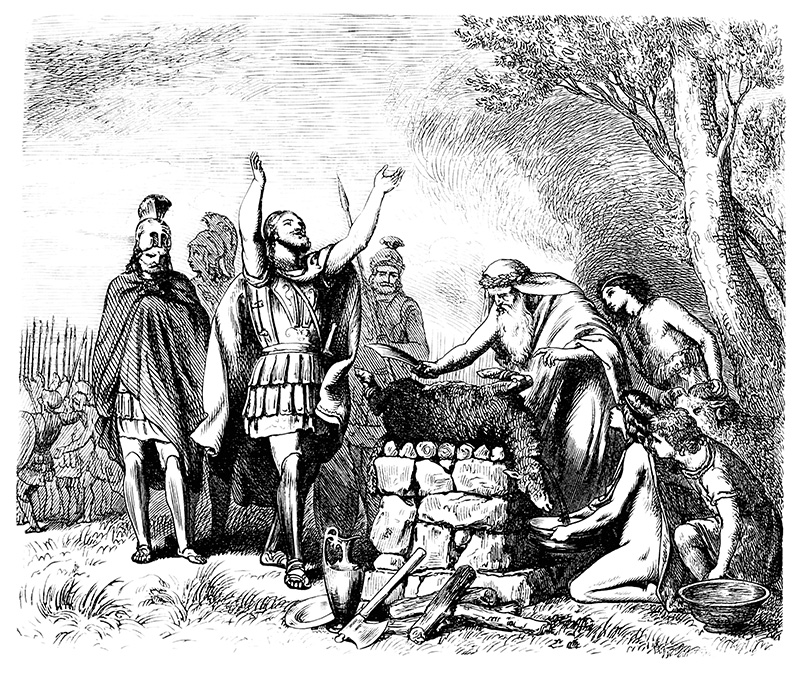
Sunday School: Thinking about Sacrifices
Credit: Adobe Stock 46272514 I’m preparing to teach tomorrow, and the main text is Hebrews 4:14-5:10. The quarterly is kind enough to stop just before the author tells his readers/hearers that the topic is difficult and they’re not very bright!
Nonetheless, the idea of priesthood brings up the idea of “sacrifice” and “sacrifices,” and these are two concepts that I don’t believe modern audiences are prepared for. We tend to get locked into one of two unhelpful modes.
On the one hand, we may believe sacrifice is critical, and its primary, or even only purpose is to atone for sin. This feeds into the penal substitutionary atonement theory (or I prefer metaphor), in which the sacrifice of Jesus is specifically as a substitutionary death taking the punishment for our sins. The reason I prefer metaphor to theory here is that a theory should be an explanation that deals with the relationship between various facts. A good theory is a singular thing because it is the best explanation of the data. A metaphor, on the other hand, is one of many ways of looking at a set of events. In this sense I reject a substitutionary atonement as a theory, but accept it as a valid metaphor.
On the other hand, because the whole idea of substitutionary atonement, sometimes even referred to as “cosmic child abuse,” is so foreign to our way of thinking about things, that we reject everything that relates to it. But there is a least one really good thing about substitutionary atonement (and I believe there are others): A person convinced that Jesus died as a substitutionary sacrifices for his or her sins will be convinced that wrath and punishment have been averted.
This is not the place to cover this in detail, but I am doing so in my video series on perspectives on Paul. I started in Paul’s Gospel vs. Another Gospel, then went on to part 2, and this coming Thursday night I will be doing part 3. I’m thinking there may be yet more parts, because I’m looking verse by verse at some defining statements about the gospel in various Pauline and disputed epistles.
I think there’s a better background against which to think about sacrifice, and that is communication within a relationship. The priesthood and sacrifices were part of the way in which ancient people carried on communion within an ongoing relationship with their god(s). The Israelites had specific ways of offering various sacrifices, ways of representing their God, and expectations.
I like to think of gifts that I give my wife. One of the traditional gifts for someone with whom we are romantically involved is roses, often a dozen, maybe two dozen. I have only done that once in our relationship. I mean the dozen. There have been a scattered number of times on which a gift has included roses, but that is much less frequent than in other relationships.
So am I neglecting my wife and being unromantic by not giving her the traditional gift? I don’t think so, and she’ll surely read this post and let you know if I’m wrong. We’ve established a different tradition that fits her personality and mine. That tradition has to do with surprise and variety. I look at various places where I can buy flowers. The grocery store even works out frequently. I look for flowers of a different color or a different type than she has had recently. I often buy enough for a couple of arrangements in vases. More importantly, I try to bring the flowers into the house when she is not expecting them.
It is true that flowers are frequently a way of expressing regret for a wrong action, but that wouldn’t work all that well in our relationship. In fact, the only thing that does work is sincere regret, directly expressed (no weasely political apologies), and a discussion of how we can improve as we move forward. Flowers as a sacrifice for sin are not functional in our relationship, yet they are given.
I’d like to suggest thinking of the reason why you might do something for another person, or have something done for you and the various reasons you might give or receive a gift. Then start looking at the sacrificial system again. There are still many things that will not connect. For example, in those cultures that practiced human sacrifice, the killing of the human victim—the ideal one being a firstborn son—was seen as giving that child to God. So also with the animal sacrifices.
If you think of the sacrifices in this way I think it will be easier to follow how sacrifice was replaced by the “mitzvah” (good deed) in Judaism, and by a combination of giving and symbolic acts in Christianity. You might even start to think about the Sunday liturgy at your church and what it says about what God would like to see happening in your relationship to him. Is it possible God might prefer a “mitzvah” of some sort?
I’m going to build on this, but I think this is a good foundational metaphor to use in looking at sacrifice. Then we can adjust for the people involved and how they viewed what was good and bad in a relationship.
-
Penal Substitution is ONE of the Ways to Talk about the Atonement
I think The Truth Is … Out There on the Wesley Bros. Blog did a good job of expressing this.
To my liberal brothers and sisters: Yes, I do believe in penal substitution.
To my conservative brothers and sisters: No, I don’t believe in it as the one and only way to believe in or discuss the atonement.
One of the ways. Your mileage may differ. In fact, I hope it does.
-
The Relevance of Atonement Theories

Discussion Ahead traffic sign in woman’s hand on a white background On the Energion Discussion Network we have two essays posted in answer to the question “Do atonement theories continue to speak to the human condition?” The “yes” answer, written by Dr. Allan Bevere appeared yesterday. The “no” answer appeared today, written by Rev. Steve Kindle. I find both of these articles well worth reading.
In the past I have been accused of rejecting penal substitutionary atonement because of the fact that I don’t see it as central, or as the explanation of the atonement. In fact, I don’t see any theory of the atonement as a single explanation of the atonement. Our theories of the atonement are metaphors, used to carry across some of the meaning to us.
As does Allan Bevere, I do find pretty much all theories of the atonement relevant in one way or another. Where I tend to be concerned is where a metaphor begins, in some people’s minds, to become the reality, i.e. that rather than believing in the cross of Christ we believe in our particular metaphor, the one that may best speak to us. I recall a professor from whom I took a class in exegesis of Romans from the Greek text. What was remarkable about the class was that his favorite theory, or metaphor, for the atonement as the moral influence theory. Now I have a bit of a liking for that metaphor myself, but it is not the metaphor Paul uses in Romans. There is some overlap. But this professor, because that was his very most favorite metaphor, taught nothing but, twisting Paul considerably in the process.
I’d add one more caveat. Relevance is a word that points both ways. A metaphor, to be relevant must communicate to one who hears. If it doesn’t, it isn’t working as a metaphor. I think quite often we need to correct the presentation of some metaphors to make them function better. If they don’t carry something over, they aren’t relevant in that case, however great they might be otherwise.
-
Exclusivism, Inclusivism, and Pluralism in Soteriology
This past week on the Energion Discussion Network two answers were posted to the question “Can the great religions be vehicles of salvation for their followers?” Answering “Yes” was Dr. Herold Weiss, and answering “No” was Dr. H. Van Dyke Parunak. Both are authors published by my company, Energion Publications.I enjoyed reading the responses for a number of reasons other than the actual answer given to the question. Quite frequently we respond to an article based on whether we agree with the answer or not. The well-argued, well-presented article is one that supports our own point of view. The scattered, poorly presented one is the one we oppose. In my experience only a few people can say, “This was a well-written article even though I disagree vigorously with its conclusion.”
I’m going to do precisely that in this case. Both of these responses to the question are well-written, and they are even well reasoned. It may seem odd to say that when they come to opposite conclusions. It’s important, however, when you read something this short regarding a topic this complex, that you ask yourself just where the author is coming from. Having edited books by both men, I have a leg-up in doing that, but if you read carefully you can clearly see the approach each takes to revelation (particularly scripture), theology, and finally doctrine. These approaches can be experienced at length in Dr. Weiss’s book Meditations on According to John: Exercises in Biblical Theology, and Dr. Parunak’s book Except for Fornication: The Teaching of the Lord Jesus on Divorce and Remarriage.
You can get some idea of the difference simply by counting the number of scriptural quotations in each post. My quick count gives me eight quotations by Dr. Parunak and one by Dr. Weiss. There are some who will think that gives the answer. Dr. Parunak is being more scriptural than Dr. Weiss. I would suggest that this is something like determining how scholarly a book is by counting the footnotes. I have a book on my shelves which has an overwhelmingly large number of footnotes. But if one eliminates footnotes to the author’s own works, footnotes to unreliable sources, and simply incorrect footnotes, the count drops dramatically. The notes give the impression of scholarship, but unless they are also carefully and correctly done, they are not themselves good scholarship.
So the question here is how scripture is used in each case. If you think of it this way, Dr. Weiss is actually inviting you to read more scripture, as he refers to broad theological concepts. You’d need to read at least the books of John, Romans, and Galatians, to actually pick up on some of the ideas he’s presenting.
So now, in turn, am I intending to put down Dr. Parunak’s work based on changing the way I count from a quotation count to a necessary reading count. Absolutely not! This is, in fact, one of the best exercises I’ve seen in years of the way in which the approach an author takes to scripture impacts his or her results.
For Dr. Weiss, scripture is a varied landscape, reflecting a variety of viewpoints, backgrounds, cultures, and even theologies. This landscape invites us to study and to form theology. He would never (and in my experience has never) simply quote a text and say that the text settles the issue. He would always apply that text to a study of the theology of the book of the Bible it came from and as part of the work of its author, particularly its human author. He demonstrates this in a range of books, but particularly in his book Creation in Scripture in which he looks at the variety of views on creation that are contained in the Bible. Some people wonder how he can do this. Surely the creation story is not told repeatedly, even if one accepts that there are two stories in Genesis, which many do not. But Weiss is talking about views of creation, how God is understood to be the creator: Theology, not science or history.
In the YouTube video below you can watch me interview him about the gospel of John, though Colossians comes up at well!
Dr. Parunak, on the other hand, sees scripture as more directly from the hand of God, in the sense that all scripture presents a unified picture of doctrine that can be deciphered by the interpreter, and can and should be tested and result in a high degree of certainty. So he will draw a more direct connection between a particular scripture passage. He does not have room for a variety in scripture such that we could say that one theology differs from another.
You can see me interview Dr. Parunak below, and you’ll hear him express this for himself:
Though I find the question of pluralism interesting, I find the way in which we answer it even more interesting.
If you want to explore these ideas further, let me recommend a little book by Rev. Steve Kindle, I’m Right and You’re Wrong: Why We Disagree about the Bible and What to Do About It. If you’re more interested in the issue of biblical inspiration, try my own book When People Speak for God, The Authority of Scripture in a Postmodern Age (Bob Cornwall), or the more intense From Inspiration to Understanding: Reading the Bible Seriously and Faithfully.
My point here is not to critique either approach. I am not forced to publish anything. I wouldn’t have published books by these two authors unless I found their contribution valuable. But you and I as readers have to answer for ourselves the question of what we believe, and to do that we need to get behind the question of what an author believes to why he or she believes that. “Because the Bible says it,” is not really an answer unless you also know how that author or speaker reads and interprets the Bible.
So what about my answer to the question posed? Can the great world religions be vehicles of salvation for their adherents? I must note first that I regard my discussion of methology as much more important than any answer I might give here. Let me use Dr. Weiss’s terminology, which he discusses in his book Finding My Way in Christianity, pages 192 & 193. Exclusivism, he says, is the belief that all are saved through the sacrifice of Jesus and must confess in order to do so. Inclusivism says that there may be those in other faiths who are saved, but they are saved by the sacrifice of Jesus. Pluralism says that any religion may provide salvation and that Christianity does not have an exclusive hold on the true salvation story (I am using my own wording though working from Weiss’s material).
As I look at the question, I find it very difficult to answer without implying something I don’t mean. I am saved by the grace of God, not by a faith tradition, or a particular set of doctrinal beliefs. So just because someone says “Lord, Lord” doesn’t mean they are on the right road. My church membership is not what saves me. So in the sense that I believe God’s grace comes to me without consideration for my merit, in which I include meritorious beliefs as well as meritorious acts, I cannot exclude anyone. How wrong would I have to be in order to be excluded from God’s grace?
On the other hand, since I do believe that God was in Christ reconciling the world to himself, i.e., I believe that the incarnation is conceptually an exclusive event, and I also believe that there is just one God, however differently we may understand God, then I also see no salvation outside of Jesus, not because one has to understand this in a particular way, but because that was God’s ultimate act, one I see not merely as historical, but also as timeless and unbound by geography. God said that God was not too far away, that God was able to understand and to feel, and that God was able to deal with our guilt, our brokenness, and yes, our healing.
I find that both a message worth proclaiming, and at the same time a call for humility. How wrong can I be and yet be the subject of God’s grace? And in that case how wrong should I allow someone else to be and still consider them to be under God’s grace?
Actually I have an easy answer to that one. Nowhere has God made me the one to decide. I am simply convinced that if infinite God was willing to become finite and limited and live life as I must live it, that God isn’t going to miss any useful option in seeing God’s grace become effective on God’s children. I must sincerely doubt that God’s grace is less effective than mine.
As such, I’m going to trust God to get it right.
As a follow-up I’m going to discuss these issues with two other Energion authors, Dr. Allan Bevere and Dr. Bruce Epperly. This will be live via Google Hangouts on Air on January 26, 2016 at 7:00 pm central time: Exclusivism, Inclusivism, and Pluralism Hangout (January 26).
-
Doctrinal Standards – The New Works
I’ve had some interesting conversations about God’s grace recently, and especially about its limits.
Most people these days seem to firmly resist the idea that we need works in order to earn God’s favor, but many seem to think that we need to have correct beliefs. If we don’t believe the right things about the way grace is sufficient for all our sin, then, well, it won’t really be sufficient. Because, while grace can apparently handle murder, lying, cheating, stealing, and adultery, it is not up to dealing with a failure to discover the correct doctrine about grace. Amazing, isn’t it, that God could be so easily stopped? We seem to have replaced justification by works with justification by correct belief.
I think it’s hard for us to believe that grace is actually sufficient. We want to insert ourselves in there somewhere. Having been told that we can’t work our way in, we still find a distinction, this time about whether we have come to a correct doctrinal understanding.
Now two points:
1) I’m not saying that beliefs are not important. In fact, while I have no difficulty thinking that God can accept a person who is completely wrong in their understanding of grace and how it works, I do think that many people suffer a great deal by not understanding just how gracious God is. Misunderstanding can hurt. It doesn’t make God hate you, but it’s uncomfortable nonetheless. I know many people who live their lives worried that an angry God is going to send them into eternal torment because they forgot to confess one deed or failed to understand some command. That’s sad. Personally, I think grace is sufficient not just for my sin, but also for my stupidity.
2) I’m not a universalist. I think there is real evil in the world and that people sometimes take a turn that way. I know there are those who think there is good in the worst of us, but I think there are those who are just evil. The problem is, with our ability to mask evil with a pretense of goodness, and our ability to obscure goodness through just plain bad judgment, I suspect we aren’t up to figuring out who actually is truly evil.
I could be wrong about any of that. I think it’s important to recognize my potential to be wrong. I think it’s also important for me to try to be as right as I can. But no amount of my wrongness can actually limit God.
-
What Makes a Doctrine (of Creation) Christian?
I put “of creation” in parentheses, because the question might be answered in similar ways for other doctrines. What follows is a short quote from a book, Creation: The Christian Doctrine by Edward W. H. Vick, my company is about to release. I’m doing a number of “final” things on it right now. This caught my eye.
The Christian doctrine of creation is not simply an explanation of the origin of the universe. It holds that God is transcendent and free, that the creatures are contingent and free, that the ongoing world of history and events in the world are purposive, that within that human history the purpose of creation is being revealed, that the Redeemer is the Creator. It also teaches that the creation reaches its fulfilment at the end, at the eschaton.
All statements of faith are statements about God and his activity.
Christian statements about God are at the same time statements about Jesus Christ.
The Christian doctrine of creation results from addressing these questions: What is the meaning and significance of Christian faith? How are we to understand that faith? What is entailed in the fellowship with God that constitutes Christian faith?
Note that Dr. Vick continues in great detail. The whole book is a bit over 130 pages (it may vary by a page or two once formatting is complete), and is intended as a companion volume to Creation in Scripture by Herold Weiss.
What do you think?
-
The Gospel in the Sermon on the Mount
Scot McKnight asks the question: Is the Sermon on the Mount the Gospel? I think it’s an excellent question, and my answer would be yes. But I see this as similar to the question of whether the gospel can be found in the Old Testament, or in the law generally, to which I again answer yes. If we get law out of its place, and make it the means of salvation, it becomes bad news. Law in its place, following grace, is definitely good news.
I wrote about this some time back in an essay titled A Fruitful Faith, which I originally published in my preblogging days (July 29, 2003), but have just moved to the Energion.com site.

-
Seeking Sinless Perfection

- Image via Wikipedia
Because I have some online watches for names of Energion Publications authors, I found the post In Search of Sinless Perfection, which quotes Alden Thompson. This comes from a Seventh-day Adventist background, but I must mention that I have been surprised by how much from my own SDA background simply translates into Methodism. One may easily underestimate the impact of the fact that Ellen White, early SDA leader viewed as having the prophetic gift, was a Methodist before she joined the Adventist movement.
In any case, Ellen White quotes aside, Loren Seibold, author of the article gives a number of the reasons I have for questioning the idea of sinless perfection. Certainly the Wesleyan doctrine as actually taught by Wesley (try here
for more, though you may find the account less plain than you imagined) seems less problematic than its various descendants.
I love the introductory story, which ends:
Then the perfect man hung up on me.
Perhaps not the ending one imagined for a conversation with a perfect man!
I too am a believer in sanctification. Where I must get off this particular train, however, is where one gets a personal knowledge that one is perfect. I just can’t see how that would work.

