Threads from Henry's Web

Category: Social Media

  • Scrolling Your Way to Falsehood

    Scrolling Your Way to Falsehood

    In cybersecurity, Zero Trust is the rule that no source gets a free pass—you don’t trust the email; you verify the sender. That same principle is no longer just for IT departments; it’s now essential for anyone scrolling through a newsfeed.

    Zero Trust in Cyber Security

    A friend once received an email appearing to come from me, recommending a product. The name on the account was mine, but the actual address wasn’t. Fortunately, he called to verify before buying anything.

    I got an email this morning with a sad story and a request that I send free books. I’ve donated hundreds of books. But something looked off. I checked it carefully, and found substantial evidence that it was a scam. People get donated books and then offer them for sale online. They may get few responses, but any books they sell are pretty much pure profit.

    A client of mine–well, numerous clients–receives a phone call purporting to be from their bank. It’s not. It’s from someone planning to steal from them.

    I teach people that it’s important never to trust that the caller or the email sender or even the person who comes to your door is who they claim to be. Always verify. Failure can mean substantial loss.

    A Dangerous Experiment

    Over the last couple of weeks I did an experiment. I started scrolling more in social media. Not directed search for topics of interest, but just following the feed. “Doomscrolling” is the term, I believe.

    I wondered if somewhere out there, a hidden wealth of joy and wisdom was waiting for me.

    No. I didn’t actually expect that. I just wanted to verify.

    And I found precisely what I expected, for the most part. I actually found a couple of feeds, such as someone who comments on court cases, that provided good, well-sourced information complete with context. But I didn’t find that many.

    I also found numerous feeds that simply created news with no basis in fact at all. They provided nicely formatted news stories that could easily persuade one that they were created by a professional journalist. In fact, they may have been created by such a journalist.

    I found a few commentary and analysis feeds that provided useful analysis of verifiable news. I know. I looked up the facts on which they based their analysis up and found good sources. I also found completely wasted words analyzing falsehoods in detail.

    I must note that I also found a number of feeds with fun stuff, cat pictures/videos, dog pictures/videos, positive stories of human activity. Well, on this latter one I must note that I found many feeds, and only a few of them were not engaged in scamming themselves. Once you notice it’s easy to spot the fakes. They have long, heart-wrenching stories that totally defy all probability and have a link embedded near the end. But there were a few genuine posts around.

    I also found that the “doom” in “doomscrolling” is real. This stuff is depressing. It’s also addictive. Both of these points I expected, but I really didn’t expect as much as what I found. It’s a depressing world out there and social media will feed it to you as fast as you’ll take it in.

    And the Result?

    In the end I learned the lesson I had already learned before I took this vacation from sanity: Zero trust is useful in social media and news services just as it is in security.

    More precisely, I’d say this: Take control of your input, what you feed your brain. Choose what you’re going to read. Choose what you’re going to think about. Vigilantly test your sources.

    Older people may be thinking, “Yes, that’s good advice for all these young people wasting their time on social media.”

    But this advice isn’t just for younger people scrolling on smartphones. You can “doomwatch” television just as easily. You can absorb sensationalism and half-truths from the evening news if you let TV editors decide what matters.

    Zero trust may sound negative. It is not. It is a positive decision to think, to check, and to decide, and not be a passive consumer of any source.

    You’re the gatekeeper.

  • The Demand for Opinions

    The Demand for Opinions

    There has always been a tendency for crowds to call for others to support them. If you do not, you are contributing to the other side, however they define that.

    Social media has multiplied that demand and given the demanders a megaphone. If you do not express an opinion–the right opinion according to them–on this or that issue, you are letting other people by with something.

    This attitude spans the political spectrum. There will be those who will think I’m talking about them, and those who think I’m talking about their enemies. Both are correct. I’m talking about the way we talk about just about everything.

    Don’t imagine I’m talking about politics alone or even primarily. I first encountered this sort of attitude over religious viewpoints. If you weren’t arguing for a particular viewpoint, then you were obviously arguing for the opposite, variously defined.

    In particular, I saw this in denominational authority. I was a student at the Seventh-day Adventist seminary at Andrews University. If you were not defending the authority of the SDA General Conference, you were obviously a rebel. You couldn’t just go on about your business. Note, however, that while my experience was with the SDA church, this is by no means exclusively an issue in the SDA church.

    Social media simply magnifies the call. I see posts every day that demand that someone speak out about this or that. And there is a point to speaking out. Speaking out can be a good thing. In addition, we have those who claim that if we don’t post something about their favorite cause we are heartless. We don’t care.

    I believe we have a different problem. We are trying to generate good results starting from a mob mentality. We have an effort to create a mob of people without serious knowledge of an issue who will say yes, click ‘Like’ or Share. When this is done, we can feel that we are truly fighting evil. I’d say “as defined by,” but really, we have undefined opposition to undefined evil in the pursuit of undefined good.

    Now there are a number of voices out there who are well-informed. I do not condemn pastors for preaching their understanding of Jesus and applying that to the moral actions of their congregations. I don’t condemn an informed politician (may their tribe multiply) in advocating a position.

    What I do is choose myself not to play this game. I choose a small number of issues, largely in the realm of spirituality and community, and I advocate for those. I understand them fairly well. I can speak of them to some effect, though I am not extremely optimistic. I was chastened by overhearing someone in the hall of the church admin building telling someone else what a beautiful answer “Henry” had to their question. I did not recognize, nor would I have endorsed the answer attributed to me. They didn’t know I overheard.

    What I suggest is choosing what you will spend your time on and ignoring the calls for proclamations on other things. Be prepared to defend what you say and make your presentation most effective.

    I could say that the times call for genuine dialogue and grace to our enemies, but that has always been true. Firm opinions, carefully researched, and presented with conviction will go a long way. There is a place here for negatives, for calling evil “evil” no matter who is carrying it out.

    But the need for clearly presented information is much greater than the need for opinions.

    That’s my opinion!

  • Disinformation on Facebook

    Disinformation on Facebook

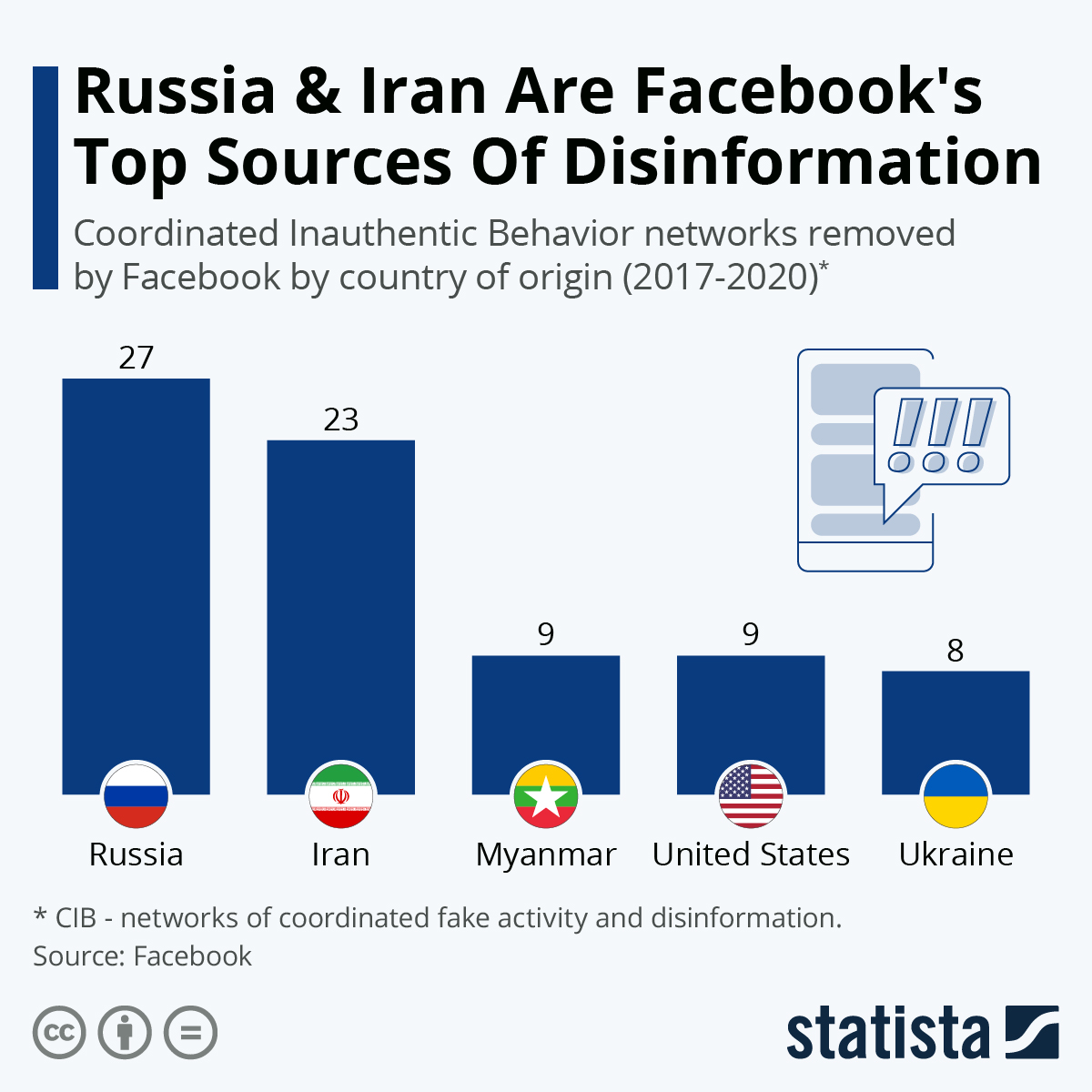
    The chart below is produced by Statista, and gives a visual of where disinformation originates on Facebook. It is built on Facebook data. You can read more about it here.

    It is worth noting where these attacks come from, with Iran just a little bit behind Russia.

    Infographic: Russia & Iran Are Facebook's Top Sources Of Disinformation | Statista You will find more infographics at Statista