
Threads from Henry's Web

Category: Personal

  • How My Business – and My Marriage – Work

    When Jody and I began our courtship we were treated to quite a lot of advice. One of the things we heard quite frequently was that we were too different to make a good couple. Just what those differences were, well, differed according to the observer. Underlying this type of advice was the assumption that we needed a certain sameness in order to be compatible.

    Jody and I are not the same. Not even close. She loves change and adventure. She wants excitement. I like things to stay the same. I’m pretty good about discussing exciting ideas. I’m less likely to be there when the creative ideas make me change my routine. She makes decisions quickly and intuitively. I tend to spend days tearing apart every little detail. So, yes, we’re different.

    Differences do cause conflict. Thus there are many people who think that if we just clear up the differences we will have peace, tranquility, and comfort. And perhaps this is so.

    But with the peace, tranquility, and comfort come stagnation and even a bit of boredom. Jody hates boredom. I’m OK with it, but only within limits.

    There are several ways you might imagine a marriage such as ours to work. We could compromise on everything. She makes a decision in 30 seconds, I take four days. Easy! Give it two days to simmer, and then make the decision. I like Bach and Haydn. She likes contemporary praise music. Again, easy! Find a compromise service that uses elements of both. I like a lengthy, topical sermon that deals with the details. She likes a vigorous call to action. Surely we can find a preacher who mixes those elements!

    Alternatively, we could go the conversion route. Either I convince her that decisions require more time and cogitation, or she convinces me that fast action is essential. She persuades me that in order to worship properly one must have active, exciting, “now” music, or I convince her that worship truly occurs only with the traditional and time-tested. We file down one another’s rough edges and try to become mirror images of each other.

    Or …

    We could consider the fact that we have different approaches to just about everything to be a strength, and embrace it. Or perhaps not merely embrace it, but celebrate it and nourish it. Are there moments when Jody’s fast, intuitive decision making is just what we need? At those moments, I need to listen to her. This decision needs to be made quickly. On the other hand are there times when an idea needs thorough consideration? Indeed there are.

    It’s not easy to recognize which is the best approach at any given moment. The starting point is for me to recognize that quick decision making is a gift, a positive point, and for her to recognize that serious deliberation is also a gift. Notice that we do not give up our gifts in favor of the other’s, nor do we compromise and become something between. Rather, as a couple, we become capable of responding to a greater range of situations with a greater range of responses.

    Tonight I’m going to interview author Bob LaRochelle about his forthcoming book A Home United, which is designed to help couples who come from different faith communities work through and benefit from their differences. Even those who come from very different faith communities can benefit from his advice, questions, and exercises.

    For us, for example, the perception was that we would have difficulties just because we attended different worship services at the same church. There were definitely differences, but they were not problems. Rather, they were opportunities. And we continue to face these opportunities as we move along. It’s easy to see problems, and to hope the problems go away. If, instead, you are patient enough to discover how the differences can benefit you, you’ll reap great rewards.

    Join me tonight at 7:00 pm central time (June 23, 2015) for this interview using the viewer below.

    After we had been married for some years, we became partners in business as well. I remember friends asking me to make sure who is in charge so that we don’t have problems making decisions. This suggests that in the business relationship, one of us works for the other.

    There are areas in which one of us rules. In terms of organizing events, scheduling, how much we can take on, and things that are related to that, Jody takes the lead. In terms of editorial practice (what format, punctuation, and grammar rules we enforce, for example), I take the lead. On any particular project, one or the other of us will be the lead editor. These areas are divided between us.

    But on the big decisions we use a simple approach that has also worked in our marriage: Two yesses, one no. It’s consensus or we don’t take a move. If we’ve published your book, you should know that neither of us said, “No.” We don’t take on one of these major projects without agreeing. That doesn’t mean that we both like each book equally. Absolutely not! But we choose not to say that “no” unless we think it is really necessary. So there are “Henry” books and “Jody” books to go along with “both of us” books.

    That’s three sets of strengths: Mine, hers, and the ones that result from the combination.

    One little book that helped me understand how this works is PERFECTLY SQUARE™. I encountered this book before we were married, and just recently we’ve begun to distribute it. In the following video, you can hear author Dr. Dolly Berthelot do some readings from it and explain the basic concept. I think the “shapes” idea, especially when you think about combining shapes, helps understand how all this works.

    And if you’re wondering how it is that so many of our books tend to fit what I want to talk about in blogs, I’ll admit that I’m often thinking about the subject of books I’m editing, so it’s not entirely unnatural that I want to write a few notes about it. That’s one of the benefits of my business! At the same time, one of the things that determines whether we’ll publish a book is the importance of its subject matter to people who are trying to live their lives and make things work.
  • Doing Something

    I’ve been trying to think of something useful to say about the  nine people killed at Emanuel African Methodist Episcopal Church in Charleston and failing miserably. My wife beat me to it.

    What she said.

  • When I Need to Restore My Focus

    This:


    Not the best recording of her on YouTube, but my favorite.

  • Sunday Fish Stories

    Yesterday was a great Sunday for me, though I still feel as though my previous week never really ended!

    There are times when I feel that I heard precisely the right message for the time and place, not just for me, but for all there. There’s kind of a sense with a congregation hearing what they need to hear, or so I imagine at least. Yesterday at First UMC Pensacola was like that as Dr. Wesley Wachob told fish stories. He did this thing with Louis Armstrong’s Jonah and the Whale and really had the congregation going. The idea was “fish that are called to fish.” He ended briefly with the gospel message as Jesus calls disciples away from their fishing nets (Mark 1:14-20), but he spent most of his time in Jonah.

    Here’s the Louis Armstrong song with some humorous animation I found on YouTube:

    http://youtu.be/9pVBBaJ54ac


    In the evening we hosted quite a number of teenagers in our home. I think the count was 14, but I lost track. They were lively, energetic, and very smart. It was fun talking with teenagers about the meaning of the tabernacle, the temple, and sacrifices. And I wasn’t even the one to introduce it; they did!

    I believe we generally underestimate our young people and don’t treat them like significant persons, called and gifted by God, and capable of thinking. Sometimes this is because they don’t act like we do when they think something is important. They can shift topics in an instant, and it can be hard to follow, but it’s also worth it.

    We need to get our young people involved and active earlier. They have a great deal to contribute.

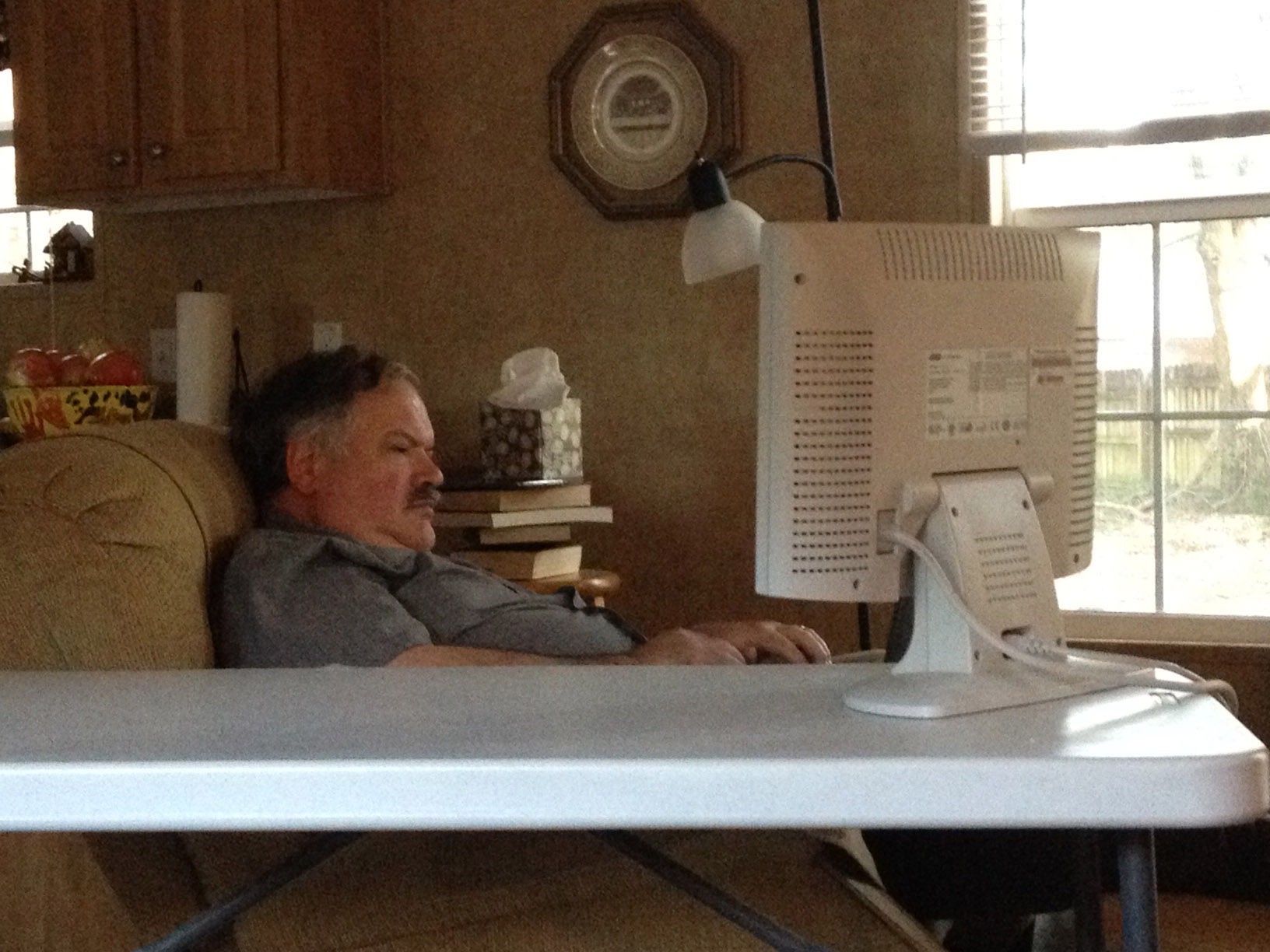
  • My Lazy Version Workspace

    I’m doing a considerable amount of correction work that requires two monitors, and I didn’t want to spend the hours at my desk or worktable. Thus:

    lazy_work_setup

    It’s good to be my own boss!

  • When a Teen Refuses Treatment

    My wife has some good comments on a current case. Dealing with cancer in a young person is always heartbreaking. The number of people who are sure they know what the right answer is, is quite astonishing, in my view.

  • Received Next Round of ALGNT

    And what is ALGNT?

    I’m glad you asked! That’s Aprenda a Leer el Griego del Nuevo Testamento. Thomas Hudgins has just forwarded the latest round of corrections. You haven’t lived until you’ve laid out a Greek grammar written in Spanish, always assuming Spanish is, for you as for me, a second language.

  • Merry Christmas

    My favorite from my own Christmas essays is God Does Things Backwards. I commend it to you today.

  • Something Positive To Watch This Morning!

    https://www.youtube.com/watch?feature=player_embedded&v=p2zUf06iy1A

  • Where I Work

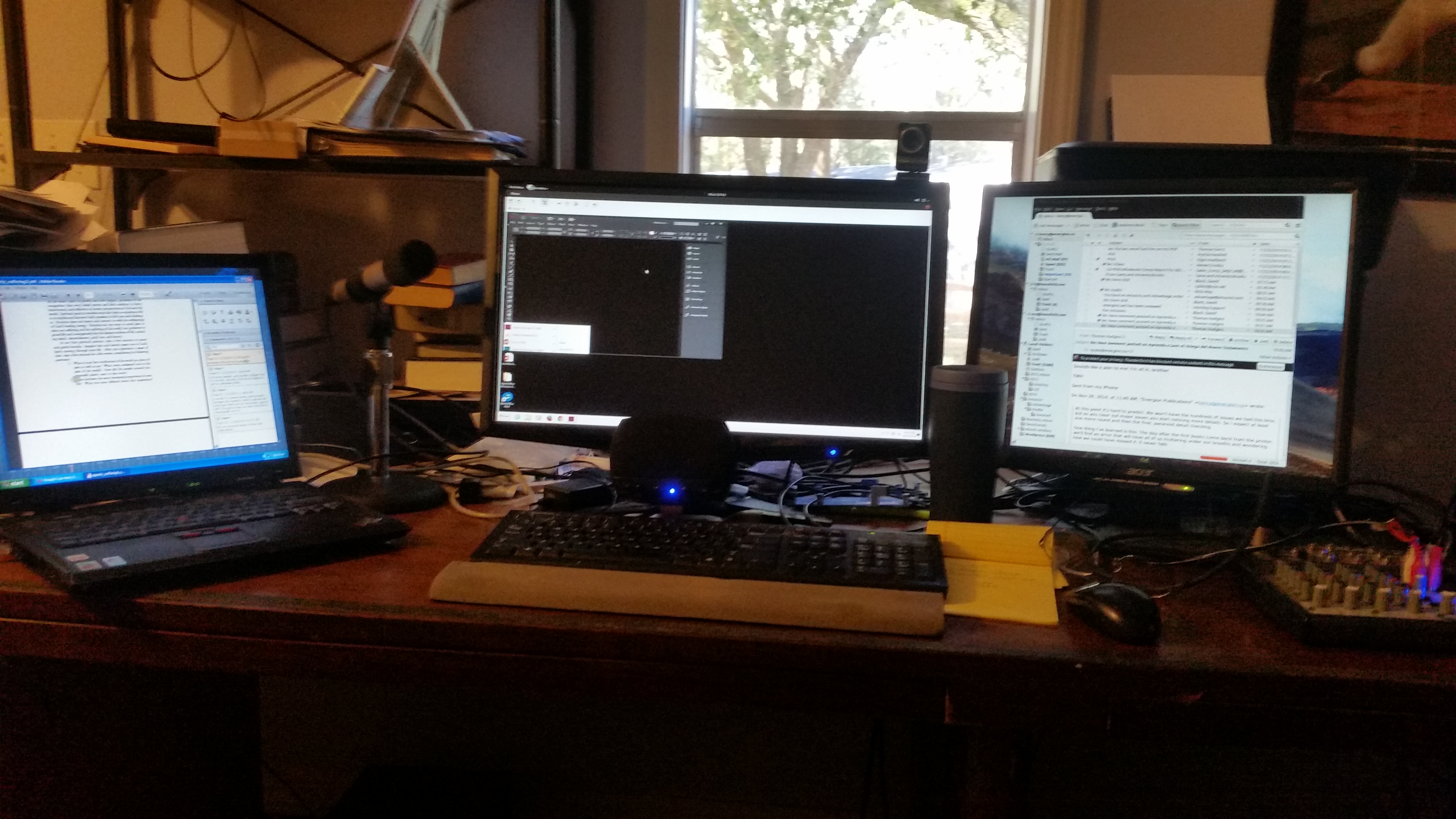
    I don’t do that much blogging that’s personal. I mostly do opinion stuff. So heres a picture of my work area a couple of days ago and I’m going to say a bit about it.

    work_area_112614

    I work in a 12×24 portable building that I had finished inside. It’s well insulated and it’s air conditioned. The walls are largely occupied by book cases, but I have three work spaces. The first is a desk, also covered with books and papers. Here’s where I do reading and stuff. The second is a small computer stand that I use to work on computer systems. For those who may not know, I do two types of work. First, I publish books, and second I do IT support work. While I work most of my time at publishing, I still make more money working on computers.

    The third area is the one in the picture. It’s a large table that I use both for publishing work and for programming. I do some custom programming for businesses, though in most cases I’ll point people to existing applications that can handle their needs. I also do my web work here. At the time I took this picture I had just finished editing and formatting work on Finding God in Suffering. For that book I had a marked PDF on the laptop to the left in the picture. I kept up with my business e-mail on the monitor to the right, and I was remote controlling a separate computer in order to do page layout on the center monitor.

    The reason it is remote control is that my main desktop computer, which is also the Energion Publications file server, runs Ubuntu. It has two monitors. I also use an old laptop when I want an additional document visible. At the time I took this picture I was preparing to switch to working on Aprenda a Leer el Griego del Nuevo Testamento, which required me to have three different documents visible. On this one I used the laptop to display the original manuscript so I could consult it for anything that changed accidentally in the process of conversion. On the main monitor I’d be working in InDesign on the page layout. On the monitor on the right would be an annotated PDF containing corrections needed.

    As I noted, I remote control another computer in the main monitor. This is a full Windows 7 system. I used to work with InDesign in a Virtual Box window on the Ubuntu machine, and it did work. In fact, it worked fairly well, but the remote control works better. In fact, it’s nearly indistinguishable from sitting in front of the actual computer.

    You may wonder why I’m sitting in front of an Ubuntu system if I want to use some Windows only software. The answer is that other than Adobe Creative Cloud and occasional use of Microsoft Office to do some VBA work, all of my preferred applications are on the Ubuntu machine. I’m especially happy with web development on it. Also, while one could simply get another monitor rather than using the old laptop, I haven’t moved that direction yet.

    All of the equipment here is either used or something I refurbished, with the exception of the monitor in the center, which I bought new for its specific purpose. That’s an advantage in doing computer work as well. All of the hardware I described above cost me less than $200.

    OK, back to your regular programming … if you lasted this long, which I doubt!