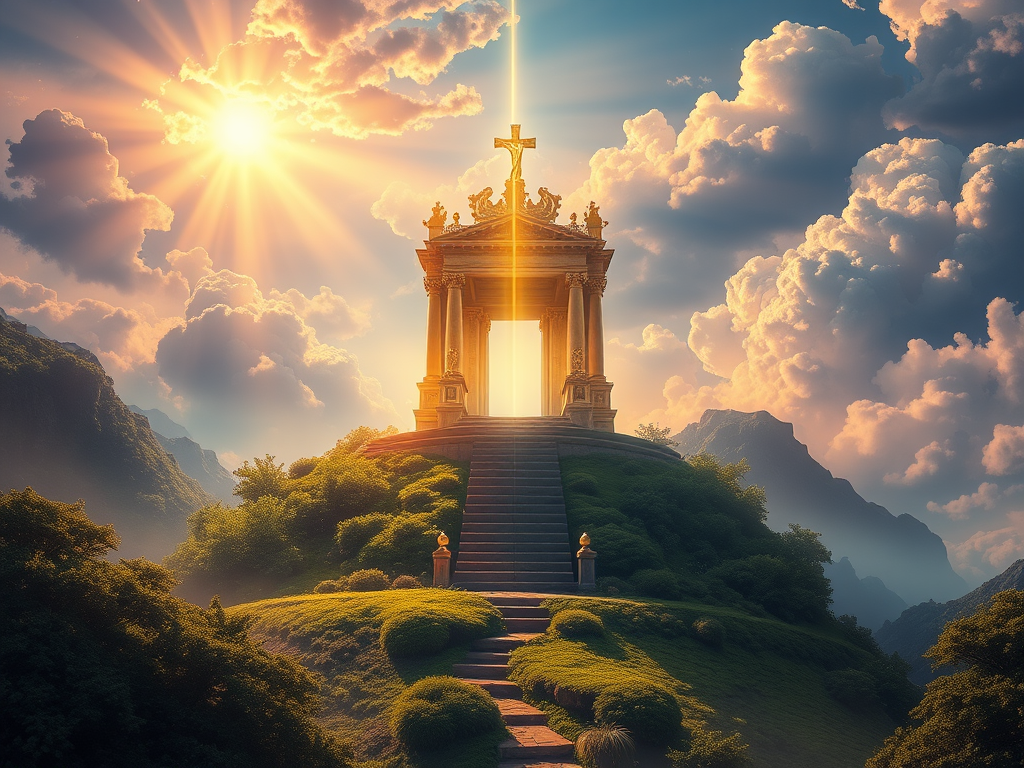
This is translated into modern English by Gemini AI, according to my prompts. You can find the original sermon on ResourceUMC.org.
Note that this is divided into sections, and following each section there are comments on the updating of the language. Bold text indicates that there is a related note and is not used for emphasis. I invite readers to check the accuracy of this work, as this is experimental use of AI, at least from my point of view.
The New Creation “Behold, I make all things new.” – Revelation 21:5
- What a strange scene is opened to our view here! How far removed from all our natural understandings! Not a glimpse of what is revealed here was ever seen in the non-Christian world. Not only do the modern, uncivilized non-Christian peoples have not the slightest conception of it, but it was equally unknown to the refined, polished non-Christian peoples of ancient Greece and Rome. And it is almost as little thought of or understood by the majority of Christians: I mean, not just those who are Christian in name only, who have the form of godliness without the power; but even those who, to some extent, fear God and strive to work righteousness.
- It must be acknowledged that, after all the research we can make, our knowledge of the great truth delivered to us in these words is still exceedingly limited and imperfect. As this is a point of mere revelation, beyond the reach of all our natural faculties, we cannot penetrate far into it, nor form any adequate conception of it. But it may be an encouragement to those who have in any degree “tasted of the powers of the coming age” to go as far as we can go, interpreting Scripture by Scripture, according to the analogy of faith.
- The Apostle [John], caught up in the visions of God, tells us in the first verse of the chapter, “I saw a new heaven and a new earth;” and adds (Revelation 21:5), “He who sat upon the throne said” (I believe these are the only words which he is said to utter throughout the whole book), “Behold, I make all things new.”
- Very many commentators hold a strange opinion that this relates only to the present state of things, and gravely tell us that the words are to be referred to the flourishing state of the Church which began after the persecution of non-Christian authorities. No, some of them have even discovered that all which the Apostle speaks concerning the “new heaven and the new earth” was fulfilled when Constantine the Great showered riches and honors upon the Christians. What a miserable way this is of nullifying the whole purpose of God, regarding that grand chain of events concerning His Church, yes, and all humanity, from the time John was on Patmos until the end of the world! No, the line of this prophecy reaches farther still: It does not end with the present world, but shows us the things that will come to pass when this world is no more. For,
- Thus says the Creator and Governor of the universe: “Behold, I make all things new;”—all which are included in that expression of the Apostle, “A new heaven and a new earth.” A new heaven: the original word in Genesis (Genesis 1) is in the plural number. And indeed, this is the constant language of Scripture—not heaven, but heavens. Accordingly, the ancient Jewish writers are accustomed to reckon three heavens; in conformity to which, the Apostle Paul speaks of his being “caught up into the third heaven.” It is this, the third heaven, which is usually supposed to be the more immediate residence of God; so far as any residence can be ascribed to His omnipresent Spirit, who pervades and fills the whole universe. It is here (if we speak in human terms) that the Lord sits upon His throne, surrounded by angels and archangels, and by all His flaming ministers.
Notes on Translation Choices:
- Sermon Title: “The New Creation” is kept.
- Revelation 21:5 Quote: Modernized the biblical language.
- 1: “Heathen”: Consistent with our previous discussions, replaced with “non-Christian world” or “non-Christian peoples” to avoid potentially offensive connotations while accurately reflecting Wesley’s distinction.
- “Form of godliness without the power”: A classic Wesleyan critique of nominal Christianity.
- 2: “Exceedingly short and imperfect”: Kept, emphasizing the limits of human understanding regarding revealed truth.
- “Mere revelation”: Highlights that this knowledge comes solely from God’s disclosure.
- “Tasted of the powers of the world to come”: Kept as a direct biblical allusion (Hebrews 6:5).
- “Interpreting Scripture by Scripture, according to the analogy of faith”: This is a key hermeneutical principle for Wesley, emphasizing consistent interpretation based on the overall coherence of Christian doctrine.
- 3: “Caught up in the visions of God”: Kept, referring to John’s experience in Revelation.
- “I saw a new heaven and a new earth” / “He that sat upon the throne said… Behold, I make all things new”: Kept as direct biblical quotes (Revelation 21:1, 5). Wesley’s note about it being the “only words” uttered by God on the throne in the book is kept.
- 4: “Very many commentators entertain a strange opinion”: Wesley expresses strong disagreement with the interpretation that the “new heaven and new earth” refers to the Church’s flourishing after Roman persecutions.
- “Heathen persecutions”: Clarified with “persecution of non-Christian authorities.”
- “Constantine the Great poured in riches and honours upon the Christians”: Historical reference kept, as this event (the Edict of Milan, 313 AD) is often seen as a turning point for the Church, but Wesley argues it did not fulfill this prophecy.
- “Nullifying the whole purpose of God”: Modernized “making void the whole counsel of God.”
- “Line of this prophecy reaches farther still: It does not end with the present world, but shows us the things that will come to pass when this world is no more”: This is Wesley’s core argument for the literal, future fulfillment of the prophecy.
- 5: “A new heaven and a new earth”: Kept as the central prophetic phrase.
- “Not heaven, but heavens”: Wesley’s point about the plural “heavens” in Genesis and elsewhere, indicating multiple celestial realms.
- “Ancient Jewish writers are accustomed to reckon three heavens” / “Apostle Paul speaks of his being ‘caught up into the third heaven’”: Historical and biblical references (2 Corinthians 12:2) to the concept of multiple heavens, with the “third heaven” being God’s immediate dwelling.
- “Omnipresent Spirit, who pervades and fills the whole universe”: Emphasizes God’s immanence.
- “Lord sitteth upon his throne, surrounded by angels and archangels, and by all his flaming ministers”: Kept the vivid biblical imagery of God’s heavenly court.
The New Creation “Behold, I make all things new.” – Revelation 21:5
- We cannot think that this heaven [the third heaven, God’s immediate dwelling] will undergo any change, any more than its Great Inhabitant. Surely this palace of the Most High was the same from eternity, and will be, world without end. Only the inferior heavens are liable to change; the highest of which we usually call the starry heaven. This, Saint Peter informs us, “is reserved for fire, against the day of judgment and destruction of ungodly men.” In that day, “being on fire,” it shall, first, “shrivel as a parchment scroll”; then it shall “be dissolved, and shall pass away with a great noise”; lastly, it shall “flee from the face of Him who sits on the throne, and there shall be found no place for it.”
- At the same time, “the stars shall fall from heaven“; the secret chain being broken which had retained them in their various orbits from the foundation of the world. Meanwhile, the lower or sublunary heaven [the atmosphere of Earth], with the elements (or principles that compose it), “shall melt with fervent heat”; while “the earth with the works that are therein, shall be burned up.” This is the introduction to a far nobler state of things, such as it has not yet entered into the heart of humanity to conceive—the universal restoration, which is to succeed the universal destruction. For “we look,” says the Apostle, “for new heavens and a new earth, in which righteousness dwells” (2 Peter 3:7).
- One considerable difference there will undoubtedly be in the starry heaven when it is created anew: There will be no blazing stars, no comets there. Whether those horrifying, eccentric orbs are half-formed planets in a chaotic state (I speak on the assumption of a plurality of worlds); or such as have undergone their general conflagration [fiery destruction], they will certainly have no place in the new heaven, where all will be exact order and harmony. There may be many other differences between the heaven that now exists and that which will exist after the renovation; but they are beyond our understanding: We must leave eternity to explain them.
- We may more easily conceive the changes which will be brought about in the lower heaven, in the region of the air. It will be no more torn by hurricanes, or agitated by furious storms, or destructive tempests. Harmful or terrifying meteors will have no more place therein. We shall have no more occasion to say,There like a trumpet, loud and strong, Thy thunder shakes our coast; While the red lightnings wave along, The banners of thy host!No: All will be then light, fair, serene; a vivid picture of the eternal day.
- All the elements (taking that word in the common sense, for the principles of which all natural beings are compounded) will be new indeed; entirely changed as to their qualities, although not as to their nature. Fire is at present the general destroyer of all things under the sun; dissolving all things that come within the sphere of its action, and reducing them to their primitive atoms. But no sooner will it have performed its last great office of destroying the heavens and the earth (whether you mean thereby one system only, or the whole fabric of the universe; the difference between one and millions of worlds being nothing before the great Creator); when, I say, it has done this, the destructions wrought by fire will come to a perpetual end. It will destroy no more; it will consume no more; it will forget its power to burn—which it possesses only during the present state of things—and be as harmless in the new heavens and earth as it is now in the bodies of people and other animals, and the substance of trees and flowers; in all which (as recent experiments show) large quantities of ethereal fire are lodged; if it be not rather an essential component part of every material being under the sun. But it will probably retain its vivifying power, though stripped of its power to destroy.
Notes on Translation Choices:
- 6: “Inferior heavens”: Refers to the physical heavens, distinct from the “third heaven” (God’s dwelling) discussed in the previous section.
- “Starry heaven”: Refers to the celestial sphere with stars.
- “Reserved unto fire, against the day of judgment and destruction of ungodly men”: Kept as a direct biblical quote (2 Peter 3:7), describing the fiery end of the current heavens.
- “Shrivel as a parchment scroll” / “be dissolved, and shall pass away with a great noise” / “flee from the face of Him that sitteth on the throne, and there shall be found no place for it”: Kept as vivid biblical descriptions of destruction (Revelation 6:14; 2 Peter 3:10).
- 7: “Stars shall fall from heaven”: Kept as a direct biblical quote (Matthew 24:29, Mark 13:25).
- “Secret chain”: Refers to the gravitational forces understood in Wesley’s time (after Newton).
- “Lower or sublunary heaven”: Refers to the Earth’s atmosphere.
- “Elements… shall melt with fervent heat” / “the earth with the works that are therein, shall be burned up”: Kept as direct biblical quotes (2 Peter 3:10).
- “Universal restoration, which is to succeed the universal destruction”: This is a key theological concept for Wesley, emphasizing the renewal that follows destruction.
- “New heavens and a new earth, wherein dwelleth righteousness”: Kept as a direct biblical quote (2 Peter 3:13).
- 8: “Blazing stars, no comets there”: Reflects 18th-century astronomical understanding and fears associated with comets.
- “Half-formed planets, in a chaotic state (I speak on the supposition of a plurality of worlds)”: This shows Wesley engaging with contemporary scientific theories, including the idea of other inhabited planets.
- “General conflagration”: Refers to the predicted fiery destruction of the universe.
- “Leave eternity to explain them”: A humble acknowledgment of human limits.
- 9: “Lower heaven, in the region of the air”: Refers to the Earth’s atmosphere.
- “Hurricanes, or agitated by furious storms, or destructive tempests” / “Pernicious or terrifying meteors”: Examples of atmospheric disturbances that will cease.
- Poetry: The stanza is from Charles Wesley’s hymn “He comes! he comes! the Judge severe!” and is retained in its original poetic form. “Thy” changed to “Your” for consistency with the rest of the prose.
- “Lively picture of the eternal day”: Describes the transformed atmosphere.
- 10: “Elements (taking that word in the common sense, for the principles of which all natural beings are compounded)”: Wesley clarifies his use of “elements” in the Newtonian sense (fundamental components of matter).
- “Fire is at present the general destroyer”: Refers to fire’s role in the current world.
- “Primitive atoms”: Reflects contemporary atomic theory.
- “Last great office of destroying the heavens and the earth”: Refers to its eschatological role.
- “Difference between one and millions of worlds being nothing before the great Creator”: Reiterates God’s immense power.
- “Forget its power to burn”: Personification of fire’s transformation.
- “Bodies of men and other animals, and the substance of trees and flowers; in all which (as late experiments show) large quantities of ethereal fire are lodged”: Wesley references contemporary scientific (alchemical/pneumatic) theories about “ethereal fire” or “phlogiston” as a vital component within matter.
- “Vivifying power, though divested of its power to destroy”: Speculation on fire’s transformed positive role.
The New Creation “Behold, I make all things new.” – Revelation 21:5
- It has been already observed that the calm, placid air will be no more disturbed by storms and tempests. There will be no more meteors, with their horrifying glare, frightening the poor children of humanity. May we not add (though at first it may sound like a paradox) that there will be no more rain? It is observable that there was none in Paradise; a circumstance which Moses particularly mentions (Genesis 2:5-6): “The Lord God had not caused it to rain upon the earth.—But there went up a mist from the earth,” which then covered the abyss of waters, “and watered the whole face of the ground,” with moisture sufficient for all the purposes of vegetation. We have every reason to believe that the case will be the same when Paradise is restored. Consequently, there will be no more clouds or fogs; but one bright, refulgent day. Much less will there be any poisonous dampness or pestilential blasts. There will be no Sirocco in Italy; no parching or suffocating winds in Arabia; no keen north-east winds in our own country,Shattering the graceful locks of yon fair trees;but only pleasing, healthful breezes,Fanning the earth with odoriferous wings.
- But what change will the element of water undergo when all things are made new! It will be, in every part of the world, clear and limpid; pure from all unpleasing or unhealthy mixtures; rising here and there in crystal fountains, to refresh and adorn the earth “with liquid lapse of murmuring stream.” For, undoubtedly, as there were in Paradise, there will be various rivers gently gliding along, for the use and pleasure of both humanity and beast. But the inspired writer has expressly declared, “there will be no more sea” (Revelation 21:1). We have every reason to believe that at the beginning of the world, when God said, “Let the waters under the heaven be gathered together unto one place, and let the dry land appear” (Genesis 1:9), the dry land spread over the face of the water, and covered it on every side. And so it seems to have done until, in order to the general deluge which God had determined to bring upon the earth at once, “the windows of heaven were opened, and the fountains of the great deep broken up.” But the sea will then retire within its primitive bounds, and appear on the surface of the earth no more. For, indeed, there will be no more need of the sea. For either, as the ancient Poet [Virgil] supposes,Omnis feret omnia tellus, — every part of the earth will naturally produce whatever its inhabitants want — or all humanity will procure what the whole earth affords by a much easier and readier conveyance. For all the inhabitants of the earth, our Lord informs us, will then be isaggeloi—equal to angels; on a level with them in swiftness, as well as strength; so that they can, quick as thought, transport themselves, or whatever they want, from one side of the globe to the other.
- But it seems, a greater change will be brought about in the earth, than even in the air and water. Not that I can believe that wonderful discovery of Jacob Behmen, which many so eagerly contend for: that the earth itself, with all its furniture and inhabitants, will then be transparent as glass. There does not seem to be the least foundation for this, either in Scripture or reason. Surely not in Scripture: I know not one text in the Old or New Testament which affirms any such thing. Certainly it cannot be inferred from that text in Revelation (Revelation 4:6): “And before the throne there was a sea of glass, like unto crystal.” And yet, if I am not mistaken, this is the chief, if not the only Scripture which has been urged in favor of this opinion! Neither can I conceive that it has any foundation in reason. It has indeed been warmly alleged that all things would be far more beautiful if they were quite transparent. But I cannot understand this: Indeed, I believe quite the contrary. Suppose every part of a human body were made transparent as crystal, would it appear more beautiful than it does now? No, rather it would shock us beyond measure. The surface of the body, and in particular “the human face divine,” is undoubtedly one of the most beautiful objects that can be found under heaven; but could you look through the rosy cheek, the smooth, fair forehead, or the rising bosom, and distinctly see all that lies within, you would turn away from it with loathing and horror!
- Let us next take a view of those changes which we may reasonably suppose will then take place in the earth. It will no more be bound up with intense cold, nor parched up with extreme heat; but will have such a temperature as will be most conducive to its fruitfulness. If, in order to punish its inhabitants, God did of oldBid his angels turn askance This oblique lobe,thereby occasioning violent cold on one part, and violent heat on the other; He will, undoubtedly, then order them to restore it to its original position: So that there will be a final end, on the one hand, of the burning heat which makes some parts of it scarcely habitable; and, on the other ofThe rage of Arctos and eternal frost.
- And it will then contain no jarring or destructive principles within its own bosom. It will no more have any of those violent convulsions in its own depths. It will no more be shaken or torn apart by the impetuous force of earthquakes; and will, therefore, need neither Vesuvius nor Etna, nor any burning mountains to prevent them. There will be no more horrifying rocks or frightful precipices; no wild deserts, or barren sands; no impassable swamps, or unfruitful bogs, to swallow up the unwary traveler. There will, doubtless, be inequalities on the surface of the earth, which are not blemishes, but beauties. For though I will not affirm thatEarth hath this variety from heaven, Of pleasure situate in hill and dale;yet I cannot think gently-rising hills will be any defect, but an ornament, of the new-made earth. And doubtless we shall then likewise have occasion to say, —Lo, there his wondrous skill arrays The fields in cheerful green! A thousand herbs his hand displays, A thousand flowers between!
Notes on Translation Choices:
- 11: “Horrid glare, affrighting”: Modernized to “horrifying glare, frightening.”
- “May we not add… that there will be no more rain?”: Wesley’s interesting speculation, based on Genesis 2:5-6 and the return to a paradisiacal state.
- “Abyss of waters”: Refers to the underground water source in Genesis.
- “Refulgent”: Kept, as it’s a powerful word for shining brightly.
- “Poisonous damps, or pestilential blasts”: Refers to unhealthy airs or diseases.
- “Sirocco” / “parching or suffocating winds in Arabia” / “keen north-east winds”: Specific examples of harsh weather, retained for historical context.
- Poetry: The two poetic stanzas are retained in their original form. These are from John Milton’s Paradise Lost, reflecting Wesley’s literary engagement.
- 12: “Clear and limpid; pure from all unpleasing or unhealthful mixtures”: Describes the purified water.
- “Liquid lapse of murmuring stream”: Poetic phrase, kept.
- “No more sea” (Revelation 21:1): Wesley takes this literally and offers a theory for how it might be fulfilled, referencing the original creation (Genesis 1:9) and the flood.
- Virgil Quote: Omnis feret omnia tellus: Retained the Latin, followed by Wesley’s translation. This classical quote supports the idea of the earth spontaneously producing all needs.
- isaggeloi—equal to angels”: Retained the Greek and Wesley’s translation, from Luke 20:36, emphasizing the elevated state of resurrected humans.
- “Quick as thought”: Kept, emphasizing swiftness.
- 13: “Jacob Behmen”: Jacob Boehme (1575–1624), a German Christian mystic whose teachings were influential in some Pietist circles. Wesley explicitly rejects Boehme’s speculative idea of a transparent earth.
- “Transparent as glass”: The specific belief being critiqued.
- Revelation 4:6 (“sea of glass”): Wesley dismisses this as support for Boehme’s idea.
- “Human face divine”: Kept as a poetic phrase.
- Wesley’s counter-argument on transparency: His vivid illustration of a transparent human body is retained to show why he finds the idea aesthetically unappealing.
- 14: “Intense cold” / “extreme heat”: Describes the current temperature extremes.
- “Bid his angels turn askance / This oblique lobe”: A poetic allusion, likely from Milton, referring to the tilting of the Earth’s axis (causing seasons and climate zones) perhaps as a result of the Fall or judgment. Wesley believes it will be restored to an “original position” for a perfect temperature.
- “The rage of Arctos and eternal frost”: Another poetic allusion (likely Milton) for extreme cold.
- 15: “No jarring or destructive principles within its own bosom”: Refers to internal geological forces.
- “Violent convulsions in its own bowels” / “earthquakes” / “Vesuvius nor Etna, nor any burning mountains”: Specific examples of geological activity that will cease, implying a perfectly stable earth.
- “Horrid rocks or frightful precipices; no wild deserts, or barren sands; no impassable morasses, or unfruitful bogs”: Examples of challenging terrain that will be removed.
- “Inequalities on the surface of the earth, which are not blemishes, but beauties”: Wesley explicitly states that some natural variations will remain and be beautiful.
- Poetry: The three poetic stanzas are retained in their original form. The first is a rhetorical question that he doesn’t affirm, the latter two express positive visions of the new Earth’s landscape. The last one is likely from a hymn.
The New Creation: Earth, Animals, and Humanity Renewed
- And what will the general produce of the earth be? Not thorns, briers, or thistles; not any useless or foul weed; not any poisonous, harmful, or unpleasant plant; but every one that can be beneficial, in any way, either to our use or pleasure. How far beyond all that the most vivid imagination is now able to conceive! We shall no longer regret the loss of the terrestrial Paradise, or sigh at that well-crafted description by our great Poet [John Milton]:Then shall this mount Of Paradise, by might of waves, be moved Out of his place, pushed by the horned flood, With all its verdure spoiled and trees adrift, Down the great river to the opening gulf, And there take root, an island salt and bare!For all the earth shall then be a more beautiful Paradise than Adam ever saw.
- Such will be the state of the new earth with regard to its lesser, inanimate parts. But great as this change will be, it is little, it is nothing, in comparison of that which will then take place throughout all animated nature. In the living part of creation were seen the most deplorable effects of Adam’s rebellion. The whole animated creation—whatever has life, from the largest leviathan to the smallest mite—was thereby made subject to a futility that inanimate creatures could not experience. They were made subject to that cruel monster, DEATH, the conqueror of all that breathe. They were made subject to its forerunner, pain, in its ten thousand forms; although “God made not death, neither has He pleasure in the death of any living thing.” How many millions of creatures in the sea, in the air, and on every part of the earth, can now only preserve their own lives by taking away the lives of others; by tearing in pieces and devouring their poor, innocent, unresisting fellow-creatures! What a miserable fate for such countless multitudes, who, insignificant as they seem, are the offspring of one common Father; the creatures of the same God of love! It is probable not only two-thirds of the animal creation, but ninety-nine parts out of a hundred, are under a necessity of destroying others in order to preserve their own life! But it shall not always be so. He who sits upon the throne will soon change the face of all things, and give a clear proof to all His creatures that “His mercy is over all His works.” The horrifying state of things that currently exists will soon be at an end. On the new earth, no creature will kill, or hurt, or give pain to any other. The scorpion will have no poisonous sting; the adder, no venomous teeth. The lion will have no claws to tear the lamb; no teeth to grind his flesh and bones. No, no creature, no beast, bird, or fish, will have any inclination to hurt any other; for cruelty will be far away, and savageness and fierceness be forgotten. So that violence shall be heard no more, neither wasting nor destruction seen on the face of the earth. “The wolf shall dwell with the lamb” (the words may be literally as well as figuratively understood), “and the leopard shall lie down with the kid: They shall not hurt or destroy,” from the rising up of the sun, to the going down of the same.
- But the most glorious of all will be the change which then will take place on the poor, sinful, miserable children of humanity. These had fallen in many respects, both from a greater height and into a lower depth, than any other part of creation. But they shall “hear a great voice out of heaven, saying, ‘Behold, the tabernacle of God is with men: And He will dwell with them, and they shall be His people, and God Himself shall be their God.’” (Revelation 21:3, 4). Hence will arise an unmixed state of holiness and happiness far superior to that which Adam enjoyed in Paradise. In how beautiful a manner is this described by the Apostle: “God shall wipe away all tears from their eyes; and there shall be no more death, neither sorrow, nor crying, neither shall there be any more pain: For the former things are done away!” As there will be no more death, and no more pain or sickness leading to it; as there will be no more grieving for, or parting with, friends; so there will be no more sorrow or crying. No, but there will be a greater deliverance than all this; for there will be no more sin. And, to crown all, there will be a deep, an intimate, an uninterrupted union with God; a constant communion with the Father and His Son Jesus Christ, through the Spirit; a continual enjoyment of the Three-One God, and of all the creatures in Him!
Notes on Translation Choices:
- Sermon Title: “The New Creation” is kept.
- 16: “Foul weed” for “fetid weed”: More common modern term.
- “Conducive, in anywise, either to our use or pleasure”: Modernized slightly to “beneficial, in any way, either to our use or pleasure.”
- Milton Quote: The excerpt from John Milton’s Paradise Lost is retained in its original poetic form. Wesley uses this to contrast the sadness of a lost paradise with the glory of the new Earth.
- 17: “Meaner, the inanimate, parts”: Refers to the less complex, non-living parts of creation.
- “Animated nature”: Refers to all living creatures.
- “Adam’s apostasy”: Refers to Adam’s rebellion/fall.
- “Leviathan to the smallest mite”: Illustrates the full range of animal life.
- “Subject to such vanity”: Kept as a direct biblical allusion (Romans 8:20).
- “Fell monster, DEATH”: Strong personification of death.
- “God made not death, neither hath he pleasure in the death of any living”: Kept as a direct biblical allusion (Wisdom of Solomon 1:13).
- “Horrid state of things which at present obtains”: Modernized “obtains” to “exists.”
- “No creature will kill, or hurt, or give pain to any other”: This is a direct statement of the radical transformation of the animal kingdom, going beyond mere metaphor.
- “Scorpion will have no poisonous sting; the adder, no venomous teeth… The lion will have no claws to tear the lamb”: Wesley provides concrete examples of the removal of harm from animals.
- “Wolf shall dwell with the lamb… and the leopard shall lie down with the kid: They shall not hurt or destroy”: Kept as a direct biblical quote/allusion (Isaiah 11:6-9), explicitly noting Wesley’s emphasis that it can be understood literally.
- 18: “Children of humanity”: General term for humans.
- “Fallen in many respects, as from a greater height, so into a lower depth”: Emphasizes the unique severity of humanity’s fall.
- Revelation 21:3-4: This is a core text for the new heavens and new earth, and the lengthy quote is retained to capture the full scope of God’s dwelling with humanity, removal of suffering, and absence of death.
- “Sickness preparatory thereto”: Clarified.
- “Grieving for, or parting with, friends”: Specific examples of sorrow removed.
- “Greater deliverance than all this; for there will be no more sin”: This highlights the ultimate victory.
- “Deep, an intimate, an uninterrupted union with God; a constant communion with the Father and his Son Jesus Christ, through the Spirit; a continual enjoyment of the Three-One God, and of all the creatures in him!”: This comprehensive description of resurrected life in perfect communion is central to Wesley’s vision of future glory.
(Featured image generated by Jetpack AI.)