Threads from Henry's Web

Category: Ecclesiology

  • Is Waking Up Always Good?

    John Meunier (Trouble Enough) has been reading William Abraham’s book Waking From Doctrinal Amnesia and making a few comments. Since the Wesleyan Quadrilateral was one of the things that attracted me to the United Methodist Church in the first place, I’m not sure that this is an amnesia I’d like us to wake up from.

    John has a few interesting comments in two posts: Why Not Divorce and The Incarnation and the Ad Council. Sorry John, I don’t have an answer to your main question in this one. I have heard so many forms of church organization taught as scriptural that I’m beginning to think that the most unscriptural thing to do is to claim that the structure of your congregation or denomination is “scriptural.”

    Both posts are worth reading.

  • New Life Church Behaving Responsibly

    I’m not one to spend a great deal of time criticizing the media for their treatment of Christianity, but I do think that in general journalists in this country have a really good idea for what’s not the most important story, and as soon as they detect such a thing, they print it immediately. That’s why I like to look at stories from multiple sources because then I can gather together the few facts, and the scattered actually interesting things that they all print.

    A case in point is the MSNBC story 2nd Colo. pastor quits over ‘sexual misconduct’ which informs us that another minister at New Life Church has resigned over sexual misconduct. It turns out that the sexual misconduct was by an adult with another adult, both unmarried, several years ago. I’m not trying to make light of the sin here, but considering that New Life Church has around 200 staff members, the possibility that someone had committed a sexual indiscretion within the past six or seven years was pretty good. It is something that should be dealt with, with a key factor being that it is thoroughly contrary to the expressed standards of that church, but is just isn’t news.

    But there was some real news in the story; it was just not deemed worthy of the headline. The report says:

    The church’s outside Board of Overseers was asked to examine the “spiritual character”? of its 200 staff members after Haggard resigned last month from the church and as president of the National Association of Evangelicals.

    “We recognize there will be increased scrutiny of our church in the wake of the scandal,”? Brendle said.

    Now that’s responsible behavior, and it’s good news here. We’re not going to have perfect churches, and we will have scandals involving church leaders as long as human beings are leading churches. That’s not an excuse; it’s just a fact. We need to deal with problems as they occur. Hypocrisy is serious sin, and we need to be especially careful about living up to our expressed standards. But in the case of Ted Haggard and New Life Church, the church structure responded promptly and efficiently and dealt quickly with the problem. Then they went the extra mile and brought extra scrutiny on themselves.

    I think that responsible handling of a situation is more newsworthy than one young adult leader who was guilty of a sexual indiscretion.

  • Grudem and Church Leadership

    In part 9 of Adrian Warnock’s interview with Dr. Wayne Grudem the subject turns to church leadership. While I disagree with much of what Dr. Grudem says about church leadership, I could wish he would show some similar sensitivity to different points of view on male-female authority issues that he does on church leadership. Certainly the Bible says at least as much about leadership among God’s peopple as it does about women in teaching or leadership positions.

    The problem comes down to the process of application. Those who claim a “clear teaching” on a particular topic in scripture, generally ignore the very serious process of determining just how one command becomes applicable and another does not. Because of this, while we can often agree on Biblical exegesis (in 1 Timothy 2:8-15 there is an instruction for women not to teach), we often tend not to be able to agree on whether and how such a command might apply in another time and place. Our explanations can be ad hoc, and are based on how we want to understand the passage rather than on how God would want it applied in our lives and churches. Dr. Grudem thinks this is true of egalitarians. I think it’s true of complementarians. Dr. Grudem thinks that slavery is a bad trajectory, and in fact is generally unhappy with looking at trajectories (see part 4), and yet we do, in fact, have to look at the direction in which scripture is going on a particular teaching, else we will apply scripture inappropriately.

    (more…)

  • Grudem Interview #8 – Arguing from Numbers

    I’ve had a day or so delay in responding to sections of Adrian Warnock’s interview with Wayne Grudem, so I’ll take on the last couple of sections and do my own reflections post today. This post takes a small sample from Part Eight – What Does the Future Hold for the Church? The main part of the post simply expresses Dr. Grudem’s hope and optimism that his side is going to win. He does kind of limit it a bit with the following:

    Yes, I have great confidence that this issue will eventually be resolved, and that the vast majority of God’s people who take the Bible as the Word of God will adopt and practice a complementarian position, and will put it in their statements of faith.

    That “God’s people who take the Bible as the Word of God” phrase is theological code for “those who agree with me.” I know this will be seen as disrespectful, but this is the kind of qualification one uses on a statement when speaking for publication with a political aim–in this case, to make it appear one’s position is strong. The easy response to opponents is then, as has been demonstrated in this interview, simply to claim that they aren’t really taking the Bible as God’s word. If you allow me to define the terms, then I take the Bible as God’s word, and Dr. Grudem might not. The point is that as qualified, the statement doesn’t convey factual knowledge, but rather simply tries to comfort a particular audience.

    (more…)

  • Response on United Methodist Apportionments

    Some time ago I posted an entry that dealt broadly with apportionments and accountability in churches. A very good friend of mine, Dr. Bob McKibben, author of Holy Smoke! Unholy Fire!, which I publish, wrote me an impassioned and information filled e-mail in response. Some of the contents of that e-mail were not appropriate to post publicly, but I asked Bob to edit it, and he was willing.

    Bob is pastor of Pine Forest United Methodist Church, in the Pensacola District of the Alabama-West Florida Conference of the United Methodist Church.

    I have now persuaded him to become an occasional contributor to the Pacesetters Bible School news blog, and as his first posting we will have Inspired and Empowered – Apportionments and Connectionalism. I’m posting a link here because I’m hooked into the Methodist blogosphere, while Pacesetters Bible School, as an interdenominational organization, is not so linked.

    Head over there and check it out. Please comment there.

  • Denominational vs Non-Denominational

    My wife and I have had several discussions recently about apportionments in the United Methodist Church. For those of you who are not Methodist, apportionments are funds paid by the local church to their conference or other higher authority to support the work of the broader church. Many of these funds go to administrative functions that are just not very sexy. Others go to agencies whose mission (or lack of it) concerns us.

    But at the same time if one claims membership in an organization, then one ought to support that organization. For us personally, that means tithing. We don’t ask each time we put a check in the offering plate whether we would personally vote for every project to which the money goes. That’s the money we give to the local church, and the church as a whole is responsible at that point for how it is used. Similarly, since our congregation has a sign out from that shows the cross and flame, and reads “United Methodist Church,” we owe something to the organization to which that name and logo belong.

    Sky Lowe-McCracken (Hat Tip: Locusts and Honey MBWR #85) talks about this issue in his post The United Methodist Connection – Plus or Minus?. He weighs various points about the connection, which he says has been very good to him, as a pastor. But what about the laity?

    (more…)

  • The Church that is Always Emerging

    God was in Christ, reconciling the world to himself. 2 Corinthians 5:19

    Do you feel the depth of that statement? Can I recommend that you stop now and read 2 Corinthians 5, or at least verses 11-21 before you continue this?

    I often think that we Christians don’t nearly get the meaning of this passage, which is one of the better scriptural expressions of the meaning of the incarnation that we have in scripture. But then it goes on to bring it home to us, by saying that God has given us the ministry of reconciliation.

    To parphrase a question I was once asked after a sermon: If this is the message that we were given at the start, whatever happened to Christianity? Why do we have such a terrible time getting along? Why have we had such a long history of persecuting one another? We easily forget that we are a religion that results from the ministry of a man who spent his time breaking up traditional ground, who found extraordinary ways to make God’s message and God’s kingdom have an impact on a world that was not anxious to receive it. More than 2,000 years alter, we act a bit more like warring tribes protecting our precious doctrinal turf from the heretics down the street, often from people whose positions can only be distinguished from our own by theological experts.

    Enter the emerging church. I’ve not really spent much time on the emerging church, though I’ve read a couple of books and have generally liked what I see. I think part of my problem is that I’ve never called myself an evangelical, and so I don’t quite full feel the issues and the call that they do. Nonetheless I have felt that the movement was a good one for Christianity.

    Via MSNBC I found a Washington Post story on Brian McLaren, a leader in this emerging church movement. The article is titled Evangelical pastor challenges tradition. The emerging church movement does indeed challenge tradition. It tries to make the message of Jesus relevant to the modern world. And while I often wonder about some of their doctrinal positions, which sometimes are to my left even though they use the term evagelical and I don’t, they have one thing that is very traditional: Challenging tradition.

    What’s more traditional than doing what Jesus did? Some of the criticisms sound very much like the criticisms of Jesus. Emergent people don’t teach enough doctrine. They’re giving up the basics. They’re question non-negotiable doctrines. But of course we’ve been negotiating these doctrines for centuries, with some of the current basics being quite recent in their current incarnation. At other times we’ve been negotiating such doctrines with the stake and torture implements.

    It’s a conversation. That’s what the emergent church people say. And I agree. The one thing that has to continue is the conversation. It’s a conversation between various Christians, churches, groups, and ministries. It’s also a continuing conversation between each Christian and God. It’s also a conversation between us and the world. I would suggest that the greatest thing we can do as Christians is get other people listening to God–listening to the Spirit of Truth. We think that teaching them a set of doctrines is going to give meaning to their life, but there are thousands, probably millions of people who live in quiet despair with an evangelical theology.

    It’s not the fault of the evangelical theology. There are also many Christians who live fulfilled lives with an evangelical theology. The problem is that any theology that doesn’t get you into the big conversation is still going to leave you dead.

    Thank God for the emergent church. The church ought to always be emerging. It can’t be any harder than Jesus, emerging from heaven, and coming to earth.

  • Worship that Builds

    Peter Kirk has a post on one of my favorite topics, order in worship, titled God is not a God of disorder but of peace. I want to call attention to a couple of points in his post.

    First, on the context of the passage from which his title was taken, he says:

    It seems to me that this verse gives a general principle, which here is being applied specifically to gatherings of the church but can be applied more widely. I don’t think the specific application here is only to prophecy, but to everything described in verses 26 to 32. Indeed the point is basically to support the last part of verse 26, “Everything must be done so that the church may be built up.” (TNIV). Thus it does apply to “untoward” manifestations of any kind, but of course that depends on exactly what is considered “untoward”.

    This is a good point, because Paul is talking about order in the worship service throughout 1 Corinthians 14. We tend to pick the verses from that chapter that best suit our own style of worship. Those who speak in tongues have one set of verses that talk about positive aspects; those who prefer not emphasize the verses that speak against it. But in order to understand the entire chapter, one needs to realize that the whole question here is what activities will be constructive, or building, in a worship service.

    (more…)

  • Suzanne McCarthy on Complementarianism

    Suzanne McCarthy has been blogging on complementarianism over on the Better Bibles Blog. I have been following her posts with interest, and I would like to commend them to my readers. The entries to date are: Modes of Communication I, Modes of Communication II, Modes of Communication III. Suzanne obviously doesn’t subscribe to the “snazzy but inaccurate title” school of thought–just tell them what you’re talking about. 🙂

    I’ve written about this topic a few times myself, largely out of my frustration with the number of women I see in the church who are gifted and called from my observations and yet are not being used to their full potential. Even amongst those who claim to affirm leadership roles for women in the church there is often an inertia, or perhaps a sort of default that suggests that women must be exceptional to be in leadership.

    What Suzanne has done in these last several entries is point out some of the inconsistencies in how one applies the complementarian position, and I think she makes some good points. I’m not sure I’m going to get the time or the tolerance any time soon to read her complementarian source material.

    Nonetheless, it seems to me that the key here is that the wrong principles are being used. We’re setting up the category of “women” as a spiritual entity, with a prescribed set of spiritual roles. That ignores the reality that while women and men are truly different–and I’m not egalitarian in the sense of saying women and men are somehow interchangeable!–women differ from women and men differ from men as well.

    The principle I would suggest is that we observe both the men and the women, as well as our children and young people, and simply choose for leadership roles those whom God has gifted for those roles. If we do so honestly, I think we will find that God is, in fact, calling many women to leadership and wonderfully gifting them for it.

    When we ignore the call and gifts of God, we’re putting God in a box and we are a barrier to the building of the kingdom. Let’s not do that!

  • Unity, Diversity, and Confusion

    Recently I wrote a couple of entries, first on diversity and liberalism, and then on the Together for the Gospel statement. The issues I discussed in those two posts raise quite a number of questions about truth, unity, and Christian fellowship. Many might decide from my comments thus far that I don’t care about truth or correct doctrines at all. But that is not the case. “Doctrine” is simply teaching, and we all have some form of teaching. Even the doctrine that correct doctrine is not primary in salvation is itself a doctrine.

    Where are the boundaries where disagreement is permissible or not permissible? How can we tell what is essential and what is not? It’s easy to quote St. Augustine, “In essentials, unity. In non-essentials, liberty. In all things, charity,” but it’s a great deal harder to define precisely what one means. Two sincere people who accept the idea of unity in essentials and liberty in non-essentials can nonetheless get into quite a fight over just what is essential.

    I think we could view the situation as a sort of continuum.

    Unity by Exclusion Unity in diversity Disunity by confusion
    Doctrinal continuum arrow Non-doctrinal

    To the far left of this spectrum (no left-wing/right-wing implications intended), we have those for whom doctrine is central and absolute. I’m seeing the folks who wrote the Together for the Gospel statement I discussed in my post Who’s Together for What?. For them the way to defend the gospel is to be both very clear and detailed on what is truth, make sure people know it, and only respect those who are fully on track as bearers of the gospel. In the center of this continuum we have those who have a small number of essential doctrines on which they require unity, but outside of that boundary diversity is permissible within the community. On the far right of my continuum, we have those who hold nothing, or almost nothing, as essential, and thus have confusion because they are not defined as a community. Even greater confusion results when a community cannot agree on just where they stand.

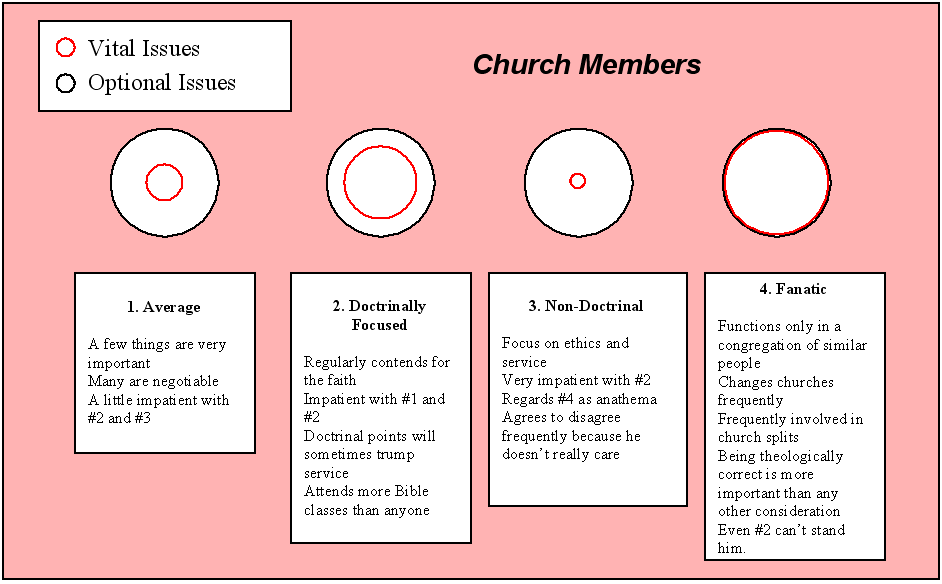
    Let me provide an illustration from another article I’m working on that looks at the type of people who might be part of such organizations:
    Church member attitudes toward doctrine and diversity
    Click the image for a larger view

    Churches that attain unity by exclusion tend to have a large number of essential doctrines. These churches tend to split, and the people in them tend to move from church to church looking for a precise match to their desires. I am not saying that such a church cannot practice unit and cannot teach the gospel; merely that it is difficult to maintain unity in that atmosphere.

    I believe the United Methodist Church, of which I’m a member, tends toward the other extreme. We tend to allow diversity in everything and require unity in nothing. We add to that a debate over where we should be allowing diversity, what is essential, and what is not.

    the-methotaku made a great comment on my previous post, Liberalism and Diversity, in which he started to do precisely what I had planned to suggest in this article–define the distinctives of Wesleyan and then United Methodist theology. Go back there and take a look.

    One reason it is often hard to define the essentials is that one can’t define “essential” without asking “essential for what?” Many people are tired of denominationalism, and I am also concerned when denominations promote themselves over Christianity as a whole. I like to call myself a “Christian, who is a member of a United Methodist congregation” rather than “Methodist.” Why? Because my primary identity is Christian. I don’t think John Wesley would have a problem with that.

    But in order to be a community in ministry to the world, I need to become part of a more tightly defined group. Rather than the very small number of doctrines I suggested as a definition for “Christian” I need some additional points that make one “United Methodist” rather than Presbyterian or Pentecostal, for example. When I define such items, I am not saying that these are additions to what makes me a Christian, rather, they define how it is that I am going to live my Christian witness in the world through a community.

    I can cooperate with anyone with whom I can agree on the essentials for that specific mission. That means that if I am dealing with an enterprise that is broadly Christian, I can cooperate with anyone who accepts basic Christianity. When I meet as a member of a congregation for worship, I expect some additional unity, though I still can allow diversity. I could easily form a small group that would share a larger number of “essential” doctrines–essential to our group, that is.

    But in each case I must try to keep these essential doctrines to the minimum required for that particular community. When I engage in charitable activity in general, for example, I don’t need to find people who agree with me doctrinally. All I need is to find people who agree that there is a human need to be filled.

    It is my prayer for the United Methodist church that we’ll reduce confusion by defining what it is that we find essential and learning to live with it. I don’t know where those lines should be drawn. I would suggest two things–they should be as inclusive as possible while allowing us to be defined as a community, and we should not use what defines us as a community to condemn those who choose a different one.