
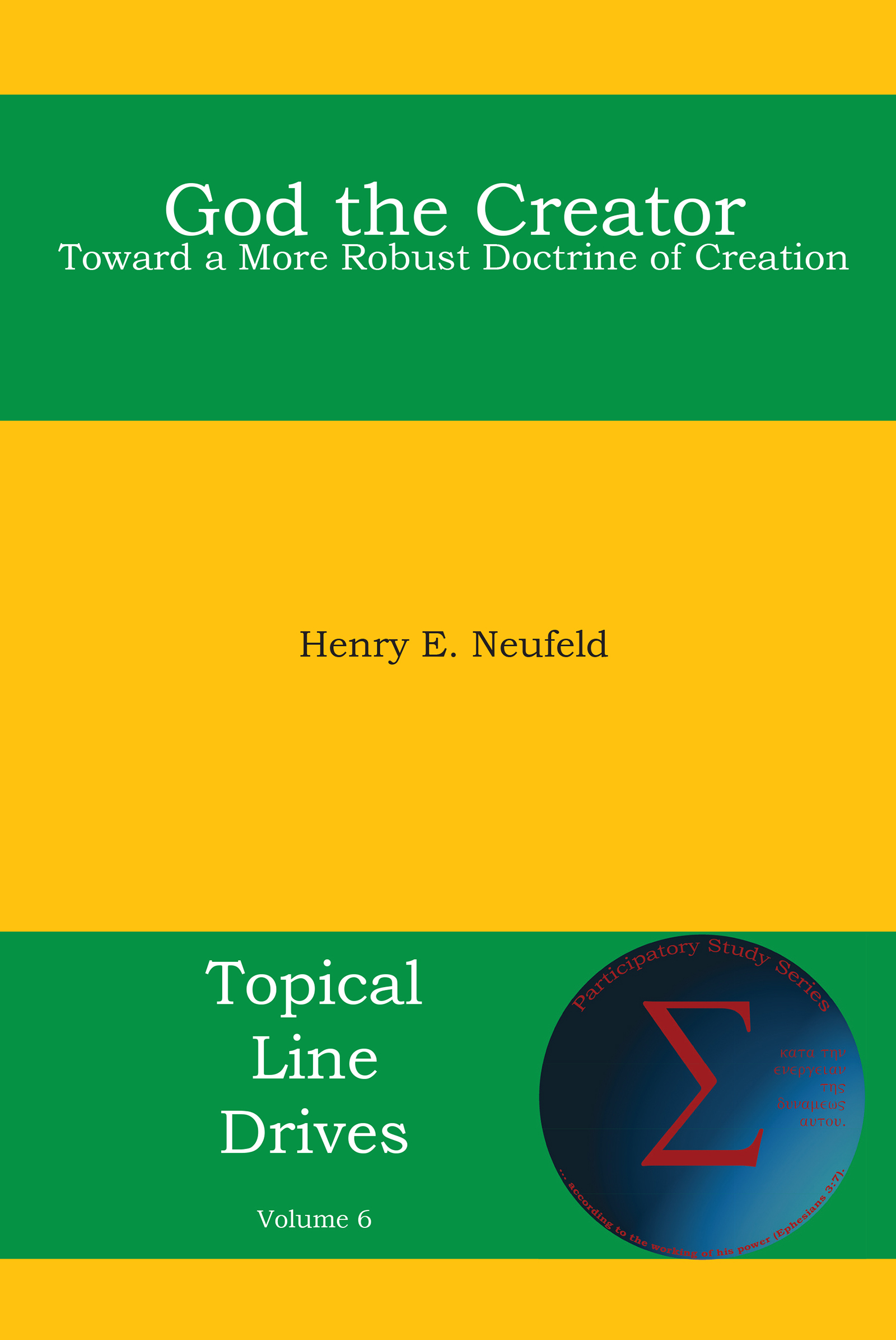
I was recently interviewed by fellow Energion author Steve Kindle regarding my newly released book God the Creator: Toward a More Robust Doctrine of Creation. The video is below.
Category: Flood Geology
-
Creationism vs Anti-evolutionism

- Image via Wikipedia
According to Todd Wood there’s a real difference, and I agree, although I think real creationists are a bit thin on the ground. He writes about this on the Center for Faith and Science International web site. One of the requirements, in my view, is the admission that the foundation of young age creationist thinking is accepting Genesis 1-11 as history and building from there. To claim that one accepts young age creationism based solely on current scientific evidence is simply no believable.
That is precisely where Todd Wood and Kurt Wise (author of Faith, Form, and Time–the one creationist book you should read if you want to understand it) are refreshingly honest. They admit they start with their conviction about what the Bible says and that there is much science to be done to back up such a view.
What caught my attention in this article is the reference to George McCready Price, a Seventh-day Adventist who pioneered modern day creationism and flood geology. I got to Price’s writings by starting with Frank Lewis Marsh and his small book Evolution or Special Creation. Marsh was somewhat more accessible than Price.
Despite the fact that I believe that to read Genesis 1-11 as history is generally to misread it, I appreciate the faith stance of Todd Wood and Kurt Wise and their honesty in admitting their starting point in faith.
(I’m experimenting with Zemanta. I may have overdone the linking!)

-
Debunking Flood Geology
This video from AIG Busted is informative, humorous, and quite sarcastic. Hat Tip: Exploring Our Matrix.
-
Origin Models: An Abundance of Christian Views
“The enemy of my enemy is my friend” is an interesting philosophy in politics and war. Usually the amity between “enemies of enemies” lasts about as long as hostilities between those particular enemies. Wesley Elsberry has posted an excellent article on problems with the “two model” approach to the creation-evolution debate.
To summarize, though you should go read his excellent post, anti-evolutionist strategy depends on the notion that if the theory of evolution falls, then creationism will be the only alternative. One response to this has always been to ask just which alternative theory would win, considering Hindu, Native American, and many, many other creation myths available. But if one simply considers the various Christian views that gather under the umbrella of intelligent design (ID), then the question would be which ID wins if evolution loses.
The problem is that none of these approaches is actually a coherent theory, and to the extent that they approach having the elements of a theory, various of their bodily appendages are sticking out of the edges of the big tent. ID is at best an observation, or better a supposition, not a theory. That is, it explains nothing, but rather points out things that it alleges cannot be explained without proposing an alternative, that is if we take seriously the suggestion that the intelligent designer is not God.
Partially under this big tent of ID, we find young earth creationists, old earth creationists, ruin and restoration creationists, and the occasional theistic-mostly-evolutionist. The problem is that each of these views would tend to produce very different results in the fossil record and in the behavior of living organisms.
A few years back I reviewed the book What is Creation Science?, and noted that they tried to distinguish debates about the age of the earth, a global flood, and the idea of special creation, apparently to be understood in a vacuum. They wanted to argue them separately.
But consider the common statement by creationists that new species appear abruptly in the fossil record, precisely as you would expect them to appear had they been specially created by God. Is the age of the earth and the question of a global flood irrelevant to this point? Hardly! This statement would generally match an old earth creation model, because in that model the age of the earth is accepted at about 4.5 billion years, and these species are supposed to have appeared over long periods of time. I’m not certain why God would want to create in that fashion, but that’s not my subject today.
Because of the long periods of time available, creatures would have been fossilized, and if God created in the phased pattern suggested, then one would expect new species to appear and disappear abruptly. I’m ignoring the great difficulties with fossil preservation and discovery here. There will always be a first specimen of a particular species, and a last specimen of a particular species. The “abrupt” separation is a matter of classification, a binary choice that doesn’t mirror the actual history in detail, nor it is intended to. We would always assume there are many, many creatures who lived and died but weren’t fossilized or whose fossils have yet to be discovered.
But the young earth creationist shouldn’t use this argument, because by his view all of life should have appeared abruptly in the fossil record, and then continue forward without disappearance, except for a few extinct species. How many species should become extinct in a matter of a mere 6 to 10 thousand years?
I don’t know if there are young earth creationists who don’t believe in a global flood. Normally the two go together because they are derived from the same approach to interpreting Genesis 1-11. But if the young earth creationist believes in a global flood he shouldn’t believe in any substantial number of fossils at all. A mere period of less than 2,000 years from creation to the flood should produce very, very few fossils. They should all be the result of the global flood.
So if our hypothetical young earther believes in a global flood, he shouldn’t be looking for any sign in the fossil record of the origin of species; that all happened in one week, so you wouldn’t have any of the intermediate states fossilized. One should then look for a different principle of sorting for fossils, as indeed various creationists have done. It is not my purpose to examine those views here except to point out that they are each different.
Then there is the difference between old earth and young earth creationists over the entrance of sin into the world. Was human sin the cause of all physical death? I’m not going to go into detail, but again this would have an impact on the evidence that we would be likely to see.
Thus even leaving out other religions, just Christianity can produce quite a number of alternative views. Which one is supposed to replace the theory of evolution as a model? Again, ID is deceptive by trying to pretend that these views have enough in common to belong under a single tent. It is also deceptive in suggesting that it actually proposes an alternative model. It really proposes that we have either the theory of evolution or, well, not!
Even the fig leaf garment of one of the rather weak creation models is here removed, yet we are all supposed to believe that we are hearing a debate between two substantial theories. Actually all we are hearing is the proposal that we dump around a century and a half of scientific progress and refinement in favor of saying “I don’t know.”
I’m rather interested in this specific point because Florida is working on a so-call academic freedom bill, which proponents claim has nothing to do with religion, or even with ID (see the Florida Citizens for Science blog. But what they can’t produce is the alternative scientific information they propose should be in the classroom, but which is not allowed there now. The only beneficiaries of their law would be ID or some one or other of the more specific creationisms that are available. We thus know from the start that their effort is deceptive.
As one final note I believe this is also an indication that ID bears a closer resemblance to theology, where multiple alternative explanations for one thing can coexist and be bundled loosely, than to science, in which competing theories are constantly tested in the hopes of discarding those that don’t make it and keeping those that do. Theology studies something that is very hard to get into the lab by its very nature. ID seems to bear some resemblance to that.
-
Joe Meert in Conversation with John Baumgardner
The Florida Citizens for Science blog has an interesting account of a conversation between Joe Meert (Florida Citizens for Science vice-chair) and John Baumgardner, geophysicist and young earth creationist. It’s worth reading. Joe asks the right questions.
You can find it here.
