Threads from Henry's Web

Category: Book Reviews

  • The Most Ungodly Thing in Your Church

    The Most Ungodly Thing in Your Church

    I was sitting in the pastor’s study at his invitation. He had a question for me. “Is mowing the lawn really considered one of the pastor’s duties here?”

    I had to think about that, and then I realized the problem. The previous pastor liked to ride the tractor and do the mowing. It was relaxing and meditating time for him. But there were others in the church who were quite ready to do that job. I was able to point out precisely who to contact. A few days later I was pleased to see a church member, one who also enjoyed that sort of work, mowing the grass.

    That may seem like an extreme case, but it’s also one that had a prompt, happy ending. Over more than two decades in the publishing and public speaking business, I’ve had the privilege of visiting many dozens of local congregations across nearly every denomination you can name. I love the local church, and I have immense respect for the men and women who step up to lead.

    But over those years, I’ve developed a quiet, heavy burden for the pastors I meet.

    So many of them are completely drained. Congregations quietly expect their pastor to be a spiritual giant, a captivating preacher, an expert counselor, a financial expert, a human resources manager, and a tech-savvy administrator—all while keeping up a flawless family life and an uninterrupted smile. (And let’s be honest, most of us would crumble trying to do just two or three of those jobs at once!)

    When visiting a church as a guest speaker, I got into a habit of pulling a few members aside and asking a simple, quiet question:

    “What is the mission of your church?”

    Almost without fail, the answer was a blank stare or a vague guess. Very few had any clear idea.

    These congregations didn’t have bad pastors. They had overworked, overwhelmed pastors. The truth is, the most ungodly thing in many of our churches is the pastor’s job description.

    I don’t mean the official one written on paper by a staff-parish relations committee (or whatever group handles that in your church). I mean the unspoken, heavy stack of expectations stored in the minds of the congregation. We expect our pastors to carry the entire weight of the church on their own shoulders, and then we wonder why so many burn out and walk away from ministry after just a few years.

    Simply preaching a sermon telling the congregation to “get focused” won’t fix this. What pastors and congregations actually need is an operational model that is spiritually grounded, scripturally sound, and practically workable.

    An Unexpected Blueprint
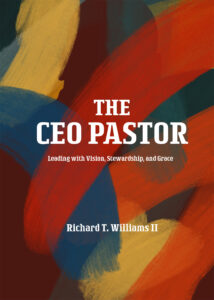
    That is why I want to share a new book that gets right to the heart of this problem.

    As many of you know, my company, Energion Publications, is providing publishing services for a new imprint, New Fire Press, and they have released a title called The CEO Pastor: Leading with Vision, Stewardship, and Grace by Pastor Richard T. Williams II.

    While Energion is not the primary publisher of this book, I want to give it my genuine, wholehearted backing. Having edited and published dozens of ministry handbooks over the years, I can tell you that this one stands out for its practical wisdom and deep respect for the pastoral calling.

    Pastor Williams serves as the Lead Pastor of Metropolitan United Methodist Church in Montgomery, Alabama, and is the Founder and Executive Director of The Beacon Center. He isn’t writing from a quiet academic office; he’s writing from the active, messy, and beautiful front lines of community ministry.

    He addresses the exact tension that paralyzes so many church leaders: the constant tug-of-war between shepherding people and managing an organization.

    Rev. Richard T. Williams II
    Rev. Richard T. Williams II

    Reclaiming the corporate acronym, he introduces the Chief Executive Overseer—a leader who faithfully holds the shepherd’s staff of care in one hand and the steward’s keys of administration in the other. In God’s kingdom, good structure and vibrant spiritual life aren’t enemies; they are partners. Stewardship, when done with order and integrity, is a genuine form of worship.

    A Practical, Hands-On Guide

    Rather than offering lofty theories, Pastor Williams provides real-world frameworks, clear checklists, and honest case studies to help church leaders:

    • Cast Vision with Clarity: Moving beyond vague slogans so the congregation actually understands its mission and knows where it’s going.
    • Empower Lay Leaders: Drawing on the biblical wisdom of Exodus 18 (Jethro’s advice to Moses) and Acts 6 (deacons handling administration so apostles could focus on prayer), shifting the church away from unhealthy dependency toward a shared priesthood of all believers.
    • Operate with Integrity: Setting up transparent financial structures and healthy accountability that protect both the pastor and the church.

    Yes, as a publishing service provider, part of my job is helping market books. But my primary, lifelong calling is equipping people for ministry and building the Kingdom of God. I warmly support this book because I believe it offers a realistic path to rescue weary pastors from burnout and help local churches find their calling again.

    Whether you are a solo pastor running on empty, a denominational leader looking to support clergy, or a faithful layperson serving on a church committee, I encourage you to read this book—and more importantly, put its principles to work in your congregation.


    Let’s change those ungodly job descriptions in our churches, and start holding both the shepherd’s staff and the steward’s keys together.
  • Book Recommendation: Man’s Search for Meaning

    Book Recommendation: Man’s Search for Meaning

    A friend mentioned this book on Facebook, and since I have greatly appreciated it over a number of years, I thought I’d post about it here.

    Frankl has a powerful story of surviving the holocaust and speaks of what sustained him in that experience.

    Key quote:

    Man is that being who invented the gas chambers of Auschwitz; however, he is also that being who entered those chambers upright, with the Lord’s Prayer or the Shema Yisrael on his lips.

  • Do Liberals and Conservatives Really Need Each Other?

    Do Liberals and Conservatives Really Need Each Other?

    Early in my college days I encountered a man who would have a substantial influence on my life. It started as he explained textual variants and alternate possible translations in Genesis 1 for 2nd year Hebrew. I’d taught myself that far, and hadn’t done badly figuring out the rules, but my knowledge was less than practical. That man was Dr. Alden Thompson, now professor emeritus at Walla Walla University, and author of several books, two of which I publish.

    While showing me things that I had never seen before, and wasn’t sure I wanted to see, Alden displayed a gentleness and spiritual depth that had a profound impact on the way in which my theological understanding would develop. It is an approach he has modeled for decades and truly grown into even more as he moves forward.

    Looking at the divisions in his beloved Seventh-day Adventist Church, Alden doesn’t want victory for liberals or conservatives or any of the many other variations one might find. What he wants is conversation and an appreciation of the gifts that all bring to the table.

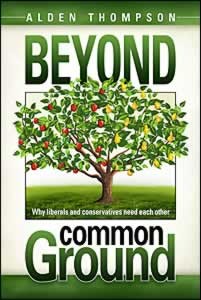
    Even though I don’t publish it, as we approach celebration of Consider Christianity Week, I wanted to call attention to Alden’s book, Beyond Common Ground: Why Liberals and Conservatives Need Each Other. Alden is talking about faith and a church organization, but the principles he discusses apply broadly, most importantly, learning to listen to and value the diversity. He matches that with a willingness I often don’t find in either liberal or conservative circles: A willingness to recognize the fear that new ideas and change may bring and to honor the need of solid ground for some people.

    While Beyond Common Ground is written very personally and is anchored therefore in its author’s community, it discusses issues I have seen trouble, divide, and sometimes destroy communities of various types. Consider reading this engaging and challenging book as you think about Christianity during Lent, and of course during Consider Christianity Week.

    Here’s a short video interview with Alden:


  • Book Notes – Hebrews: A Commentary (NTL)

    Book Notes – Hebrews: A Commentary (NTL)

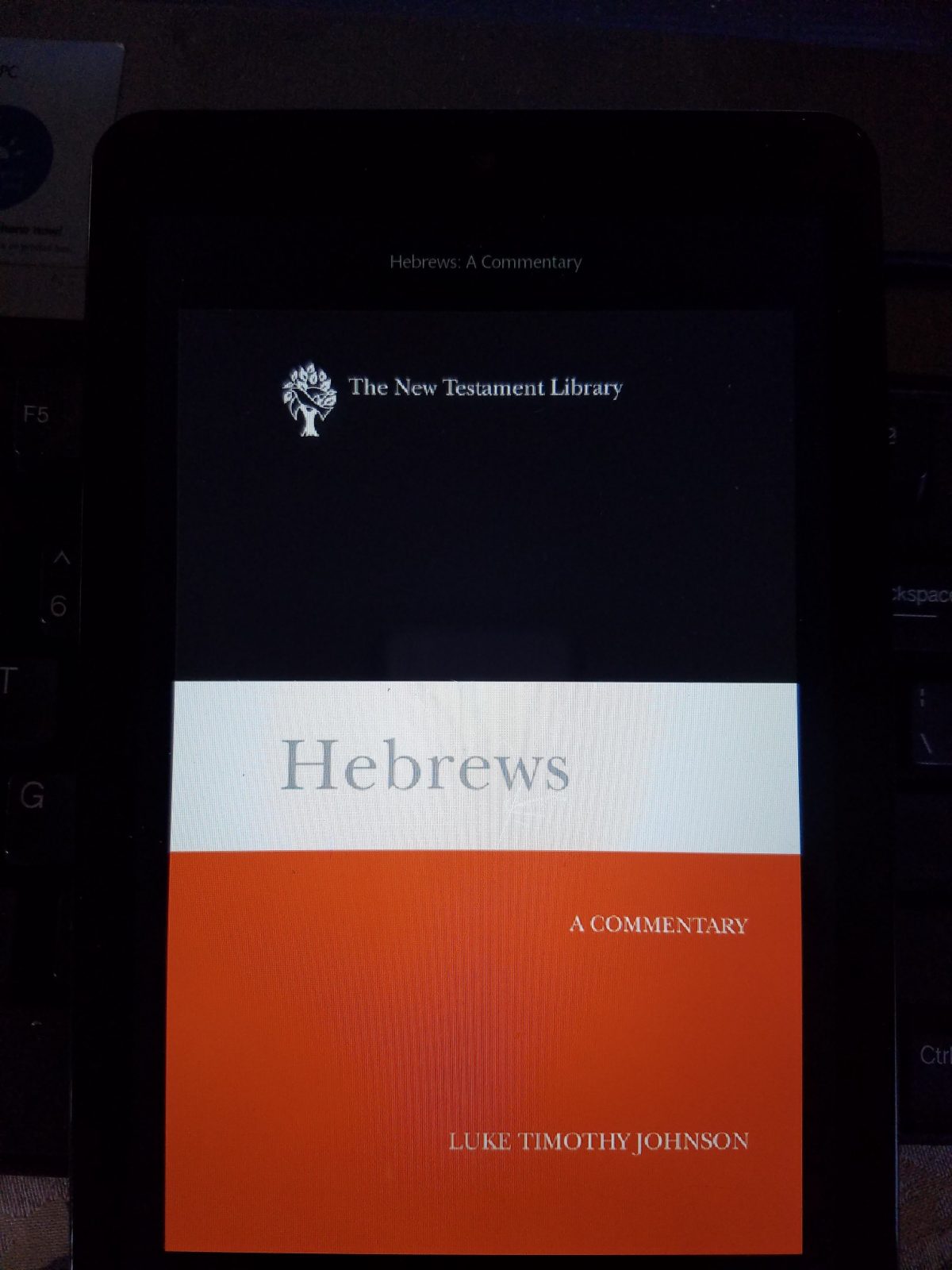
    I recently worked my way through Luke Timothy Johnson’s Hebrews: A Commentary (New Testament Library) along  with the Greek text, and I’m going to write a few notes on the book, which may, or may not, constitute a real review. Time will tell!

    The problem with many blogger book reviews is that they often amount to no more than various length notifications as to whether the author liked the book or not. There are some really wonderful exceptions to this, and you really can find a great deal of information about a title in the blogosphere, but you can also read many words (such as these) which don’t tell you a thing! As an alternative, you get an argument against everything the author wrote in the book, usually without sufficient quotations or references to let you get a feel for what the reviewer is arguing against.

    In my view the ideal review identifies the goal(s) of the book, comments on how successful the book was in accomplishing these goals, has some interaction with the ideas, and finally has a summary evaluation which is based on the stated goals. I recall reading a book about Christian apologetics. I thought it was well written, carefully argued, and thorough. There was one problem, however. The author claimed in the introduction that he would close all the holes in arguments from Christianity and the Bible. He compared the work of others to putting one leaky bucket in another: You slow the leak but you don’t stop it. He was going to stop it. In the end, if I was asked whether I liked the book, I would have to say “yes,” despite (or even because of) the fact that I disagreed in many places. Yet in a review I would have to say that the stated objective was not achieved, and making a claim that one would accomplish such an objective was, shall we say, suboptimal.

    In the case of a commentary, the difficulty is greater than with an ordinary book. There are two key problems: 1) Many people have very fixed ideas of what a commentary ought to do, and little forgiveness for a commentary that doesn’t accomplish their list of goals, and 2) People (particularly scholars) have quite a variety of very fixed ideas. No matter how you choose to write a commentary, no matter how large or small you make it, and no matter how carefully you draw compromises between never completing the task and short-changing the reader, someone will complain.

    I would like you to note here my own inconsistency. I’m writing in prescriptive language about what ought to be in a review, while arguing against prescriptive ideas about writing a book. I will live with this inconsistency.

    Besides, this isn’t a review. Here are my general thoughts.

    I found Hebrews: A Commentary by Luke Timothy Johnson to be the most helpful commentary I have read thus far in terms of stimulating theological reflection. By that I mean that the author doesn’t merely provide a view, but he argues it in such a way that it stimulates new thinking. My personal response to some of his views is that they are perhaps a little too tied to orthodox theology and a little less daring than the book of Hebrews deserves, but that is at the nit-picking level. Johnson knows how to present quite orthodox theology in a way that is challenging and helpful.

    As I studied using this commentary, reading the Greek text and taking second looks at the textual notes, I often found myself reflecting for some time after I’d read my chosen portion for the day. I rarely find that level of stimulation for thought in a commentary.

    This is not David Allen’s volume in the NAC series. Dr. Allen covers everything and references everything. The only negative thing I would say about his commentary is that I have to have some energy built up before I go to consult it. If you want a detailed and complete survey of the topic along with arguments in favor of a particular solution, but all means use David Allen’s work. On the other hand, if you want to get more quickly to the topic for teaching and preaching, use Luke Timothy Johnson.

    I know we don’t like to think that we might shirk some portion of the possible study of a passage we’re going to teach or preach. We’d like to think that we covered everything before we tried to present an exposition to others. But we all face the clock. Brevity is not a sin.

    So when I want to get right to meditating on the text, but with some solid meat to set it up, I turn to Johnson’s commentary.

    Now I haven’t called this a review, yet I’d like to present some interaction. I’d suggest, however, that I’ve already done this in blog posts on Hebrews written after reading material from Johnson’s commentary. You can start with Hebrews and the Problem of Writing Introductions. I could provide a number of links, but the simplest thing to do is to type “Hebrews” in the search box after you get to that article. Nearly everything I wrote on Hebrews after that point references Johnson.

    Note: I read

  • A Good Book Review – Running My Race

    A Good Book Review – Running My Race

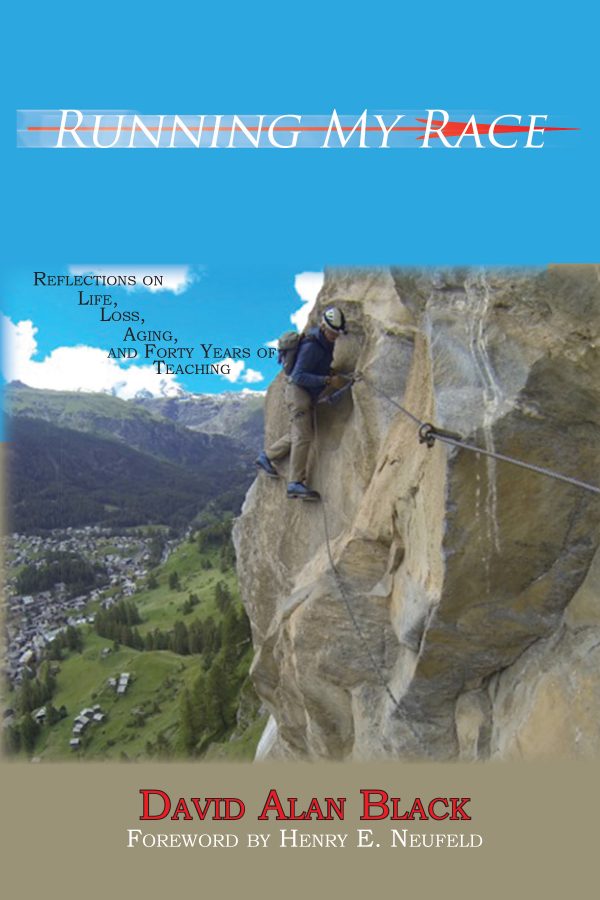
    A good book review is not one that says nice things about the book, although nice is nice, so to speak. I occasionally read a positive review that makes me wonder whether the reviewer read the book. There are likewise negative reviews that make one wonder. As a publisher, I must take all these in stride.

    A really good review, however, is one that shows the reader read the book and also got from it something the author and publisher had hoped to get across.

    Thus a review of Running My Race (David Alan Black) on The Tired Blog. I was feeling fairly tired today, and then I read this review. It really cheered me up. If I can publish a few books each year that make readers uncomfortable, then I’m doing my job.

    Of course, as publisher I’d also like to note that Running My Race is a good book! 🙂


  • Review: A Bat in the Belfry

    This was the first book I’ve read by Sarah Graves. I must confess that initially I came close to abandoning the book. The first couple of chapters plodded along, and there were too many people introduced for my taste. But I persevered, and it was worth it.

    As the book moves forward the many personal stories start to make sense and to combine into an excellent mystery. I’ve seen this before, but I’ve also seen books where the personal stories failed even after the reader was obviously supposed to see the connections.

    The story line combines small town values, society, and politics with an excellent mystery. I did suspect the correct person fairly early in the book, but I only suspected him. The details that would make me certain didn’t come until later.

    I still rate this a 3 of 5 stars. I will look at more books by this author, but I’m not running out to get another one today.

    Buy A Bat in the Belfry via my Amazon.com aStore.

  • Book Note: The Well Tempered Clavicle

    I am only a moderately intense follower of the Xanth novels, but this one looked like fun (I usually get around to them eventually), so I checked it out.

    The humor is still there. There are too many puns for me, though I do enjoy many of them, and this one was on the topic of destroying puns even! My impression is that over time the humor has been toned down a bit and the social commentary has gotten just a bit stronger, a feeling I also got about another book I read recently.

    If you’re a Xanth fan, you’ll want to read this one, of course. If you’re not, I’d generally recommend starting earlier in the series, though no matter where you start, Xanth takes a little bit of getting used to!

    I rate it 4 stars.

  • Book Note: Turning to God

    I asked my pastor for a good book on the basics of Christian conversion and he handed me William Barclay’s little book Turning to God.

    It’s a small book, with just 103 pages of reasonable size text. It’s not complex. The vocabulary is straightforward. I wouldn’t recommend it for speed reading, but you don’t need any strong theological background to follow the discussion.

    Barclay works from the conversion stories and evangelistic methods presented in the book of Acts to develop both an understanding of what conversion means and the approaches to evangelization that will produce conversion.

    This is an exceptionally good book. It appears to be out of print, but there are quite a number of used copies available online.

    I give this a definite five bright stars!

  • Book: Snuff (Terry Pratchett)

    How can I say enough good things about Terry Pratchett’s Discworld books? The fact is, I can’t. If you have any liking for fantasy and humor, you need to get involved in this series.

    The most recent one (at least that I’ve gotten my hands on) is Snuff, and the only new thing I’d have to say is that it tends to add a bit more thrill, mystery, and social commentary, while being slightly less humorous than previous volumes. I don’t find that annoying. It’s still funny. It’s still great writing.

    So what more can be said? Read this book. If you haven’t read anything by Pratchett,. start with an earlier volume, such as Hogfather. But get to Snuff as soon as you can.

    I rate this 5 of 5.

  • Book: Fatal Error

    J. A. Jance is one of my favorites in the mystery/thriller category, and Fatal Error is up to her best standard. I enjoyed every minute of the book. I didn’t feel like speed reading through anything, and I never felt that she’d left out part of the story, which is a rare thing for me.

    I always hate summarizing the story, but this book features Alli, who has the money to live a life of leisure but wants to be a cop. Unfortunately, she gets furloughed right after graduating from the police academy. But at the same time she’s drawn into a mystery–the disappearance of a friend.

    The story loosely brings to mind those well-off detectives, such as titled characters in British mystery, who have outside resources and aren’t afraid to use them in the cause of justice. As one character in the book eventually decides, Alli is rich and pushy, but also very smart.

    I read the hardcover edition, 353 pages, and rate it 5 of 5 stars.